A full-house off-grid solar system is not simply a collection of panels and batteries. It is a carefully matched power system that must produce electricity, store enough of it for later use, and safely supply household loads when the sun is not available. The same load-first discipline used when planning custom underground bunkers is useful here: identify what must keep working before choosing equipment. That approach prevents a common problem: buying a large-looking solar kit before determining whether it can support the home’s actual appliances, seasonal needs, and electrical service requirements.
Successful off-grid living starts with realistic expectations. A household that uses electricity for space heating, water heating, drying clothes, cooking, and air conditioning will need far more generating and storage capacity than a home designed around efficient appliances and alternative fuels. Design for the way people actually live, not for a panel kit’s advertised wattage. It is also wise to distinguish between necessities and conveniences early in the process, because a system can be designed to keep critical loads operating reliably without necessarily powering every energy-intensive appliance simultaneously.
Table of Contents
- Why Planning Matters
- Measure Household Energy Use
- Choose System Size
- Plan the Solar Array
- Plan Battery Storage
- Choose an Inverter
- Prepare for Weather
- Account for Supporting Equipment
- Installation and Safety
- Maintenance and Energy Management
- Common Mistakes
- Frequently Asked Questions
Why Planning Matters Before Buying Equipment
Off-grid solar differs from ordinary backup power in that it serves as the household’s primary electrical supply. Panels generate energy only when sunlight is available, while batteries cover nighttime use and periods of low output. A refrigerator may run all day at modest power, while a well pump may draw high power briefly. Both matter, but in different ways. Planning also helps determine which loads should be placed on dedicated essential-load circuits and which can be scheduled only when the batteries are well charged or solar production is strong.
How to Measure Household Energy Use
Start with 12 months of utility bills if the home already has grid service. Then make a list of items to be loaded, covering refrigerators, freezers, pumps, heating and cooling equipment, water heaters, dryers, kitchen appliances, lighting, electronics, and workshop tools. Plug-in meters can help measure smaller devices. For hardwired equipment, appliance labels, manuals, electrician measurements, and utility interval data can provide useful starting points, although actual operating habits should still be considered.
Separate energy from power. Energy is measured in kilowatt-hours and shows how much electricity a device uses over time. Power is measured in kilowatts and indicates how much the system must deliver at a given moment. Record seasonal changes, especially winter heating loads and summer cooling demand. A load list should also note when each device normally operates, because a microwave, pump, air conditioner, and kitchen appliance used together may create a much greater momentary demand than their individual daily energy totals suggest.
How to Choose the Right System Size
Solar array and battery capacity should be based on daily energy needs, while inverter capacity should cover the highest likely simultaneous load. Pumps, compressors, and some tools can require a brief startup surge above their normal running demand. Consider future changes as well, such as adding a freezer, workshop equipment, electric vehicle charging, a larger pump, or additional occupants. Leaving practical room for expansion can be less disruptive than replacing major components later.
- Essential-load systems support selected circuits, such as refrigeration, lights, communications, and a water pump.
- Whole-home backup systems support most household circuits for limited periods.
- Full-time off-grid systems must handle everyday use through poor-weather periods as well as sunny days.
Planning the Solar Array
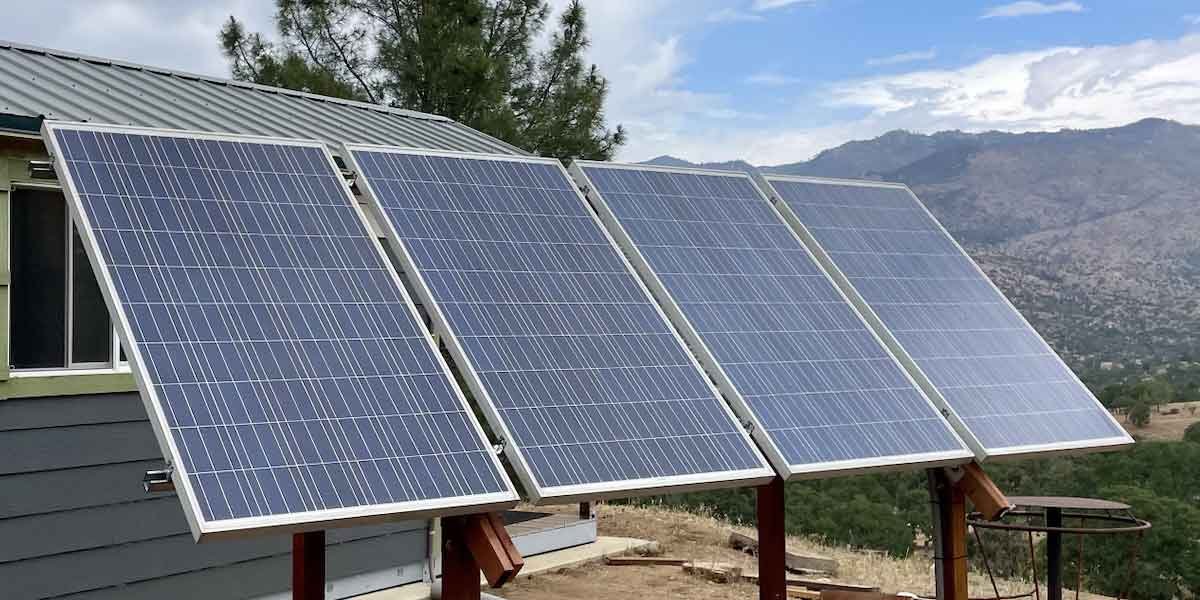
Choose between roof, ground, or pole mounting based on sun access, roof condition, maintenance access, land availability, and local requirements. Trees, nearby structures, hills, and low winter sun angles can all reduce output. Use the weakest solar month, not the best summer month, as a core design reference. A location that appears clear at midday may still be affected by morning or late-afternoon shade, so observe the site throughout the likely solar window rather than evaluating it at a single time of day.
Nameplate panel wattage is not the same as daily production. Dirt, snow, heat, shading, wiring, and equipment losses reduce real-world output. The PVWatts calculator can help estimate solar production for a specific location, though a site assessment is still important for identifying nearby shade and installation constraints. Panel orientation and tilt should be selected with year-round production in mind, while allowing safe access for inspection, cleaning when necessary, and snow removal where appropriate.
Planning Battery Storage
Battery planning begins with usable capacity, not just the total capacity printed on a specification sheet. Usable energy depends on the battery chemistry, manufacturer limits, operating temperature, and system settings. Lithium-based and lead-acid batteries have different charging, maintenance, and discharge characteristics; follow the equipment manufacturer’s requirements. Battery capacity should also be evaluated alongside charging capability: storage that cannot be adequately recharged during available solar hours may not deliver the expected day-to-day resilience.
Decide how many low-production days the system should cover. In cloudy climates, several weak solar days can be more important than average daily sunshine. Place batteries where they are protected from weather, kept within their approved temperature range, and accessible for inspection. The installation area should also allow required clearances, appropriate ventilation where specified, secure cable routing, and a practical way to isolate equipment for service.
Choosing an Inverter
The inverter converts battery-stored direct current into the alternating current used by household equipment. Confirm whether the home needs split-phase service for standard North American 120/240-volt loads, and compare continuous output, surge capacity, idle consumption, generator compatibility, charging capability, and monitoring features. Idle consumption warrants attention in smaller systems because the inverter itself draws power even when household loads are light.
Choose equipment designed to work together. The inverter, battery management system, charge controllers, solar array, generator input, and electrical panel should be configured as a complete system rather than assembled from incompatible parts. Clear documentation, supported firmware, available replacement parts, and local technical support can also matter when the system is the home’s main source of electricity.
Preparing for Weather and Seasonal Changes
Winter brings shorter days and lower sun angles, while snow, smoke, dust, rain, and extended cloud cover can reduce production. High temperatures can also affect panel output. A backup generator remains useful during long overcast periods, periods of unusually high demand, equipment faults, or emergency charging. Fuel storage, safe generator placement, and a planned method for connecting generator power should be considered before an emergency occurs.
For example, during several cloudy days, a household may limit laundry and power tools while preserving refrigeration, water pumping, communications, lighting, and necessary heating equipment. Managing discretionary loads can protect battery reserves until solar production improves. Establishing simple household rules—such as running high-demand appliances during sunny periods and checking battery state before starting a major task—can make the system easier to live with.
Accounting for the Balance of System
Budget for more than panels, batteries, and an inverter. A complete installation can require mounting hardware, combiner boxes, disconnects, fuses, breakers, grounding equipment, cable, conduit, battery enclosures, monitoring hardware, and weatherproofing. Long wire runs may require larger conductors to limit voltage drop. Equipment locations should be planned together so cable routes are protected, serviceable, and compliant with applicable requirements rather than treated as an afterthought.
Installation, Permits, and Safety
High-voltage DC circuits and large battery banks require careful design and installation. Use qualified electrical professionals for final connections, protective devices, grounding and bonding, labeling, and inspection. Local requirements can address structural support, battery placement, emergency disconnects, equipment clearances, and fire access. The U.S. Department of Energy notes that local governments commonly require permits and inspections for solar installations to verify compliance with safety codes. Never assume that a component is de-energized simply because a main breaker is off; solar arrays and batteries can continue to present electrical hazards under certain conditions.
Maintenance and Daily Energy Management
Perform a monthly visual check of panel surfaces, mounting points, visible wiring, battery temperature readings, and fault alerts. Review production and consumption data to identify unexpected changes early. Run flexible high-demand tasks during strong solar hours, and use reserve settings to protect stored energy before storms or during winter. Keep maintenance records, including alert messages, generator run time, battery behavior, and any recurring shading or soiling issues, because trends are often easier to identify over several months than on a single day.
Common Planning Mistakes
- Sizing from summer averages instead of poor-weather production.
- Ignoring motor startup surges.
- Choosing an inverter before listing household loads.
- Underestimating storage needed for cloudy days.
- Forgetting wiring, mounting, protection, permits, and labor.
- Installing panels where seasonal shade will affect them.
- Failing to plan a backup charging method.
- Assuming future appliances and lifestyle changes will not affect system demand.
- Neglecting monitoring until a battery, inverter, or charging problem becomes urgent.
Frequently Asked Questions
Can an off-grid solar system power an entire house?
Yes, if the system is sized for the home’s actual energy use, peak demand, local solar conditions, and desired reserve during poor weather. Homes with large electric heating, cooling, cooking, or water-heating loads may need substantial capacity or may benefit from reducing those loads through efficiency upgrades or alternative energy sources.
How many batteries does an off-grid home need?
The answer depends on daily electricity use, battery usable capacity, critical loads, and the number of low-production days the system must handle. The number of battery units alone is less important than their usable energy storage, compatible voltage, charging limits, and ability to operate safely with the selected inverter.
Is a generator still useful with solar panels?
Yes. A generator can provide backup power and charging during extended periods of poor weather, maintenance, or exceptional demand. It can also reduce pressure to oversize a solar-and-battery system solely for rare periods of unusually low production.
Should panels go on the roof or ground?
Choose the location with the best combination of sun exposure, structural suitability, service access, snow management, and available space. Ground-mounted arrays may be easier to access, while roof-mounted arrays can preserve yard space; the best choice depends on the individual property.
Final Planning Checklist
- Measure real household energy use and identify essential loads.
- Calculate simultaneous demand and motor surges.
- Design for seasonal solar production and poor weather.
- Choose practical battery reserves and compatible equipment.
- Budget for all wiring, protection, mounting, labor, and permits.
- Leave room for future changes in energy use.
- Plan operating habits and backup power before the system is needed in poor weather.
A dependable off-grid solar system begins with accurate load measurement and realistic weather planning. The best design is not necessarily the largest. It is the one that matches the household, site conditions, equipment limits, and daily energy habits throughout the year.