Do you ever end a conversation with your husband feeling confused, exhausted, and questioning your own sanity? If so, you’re not alone, and you’re not crazy. You may be experiencing gaslighting, a subtle but deeply damaging form of emotional abuse that can erode your sense of self and leave you feeling lost within your own marriage. This article will provide the clarity and validation you need, along with a concrete path forward to reclaim your reality.
It’s Not Just in Your Head: Your Feelings Are Valid
The first and most important thing to understand is that the confusion, self-doubt, and feeling of “going crazy” are not signs of your own weakness; they are the intended effects of gaslighting. Your feelings are a natural, healthy response to a manipulative and disorienting environment. Trusting that inner alarm bell is the first step toward healing.
When a woman is gaslit by her husband, she often spends enormous energy trying to figure out what she did wrong or why she keeps “misremembering” things. The answer is that she didn’t do anything wrong. The disorientation is by design.
What Is Gaslighting in a Marriage?
Gaslighting in a marriage is a pattern of psychological manipulation where one partner systematically undermines the other’s perception of reality to maintain power and control. It’s not a simple disagreement or a misunderstanding. It is a deliberate, often covert, campaign to make you doubt your own thoughts, memories, and feelings, ultimately making you more dependent on your abuser.
This form of coercive control is a serious threat to a person’s mental well-being. Research published in the Journal of Family Violence found that gaslighting in intimate partner violence involves a dynamic combination of affectionate and abusive behaviors extended over the course of a relationship, making it especially difficult for victims to recognize and name what is happening to them.
Am I Being Gaslit? A 10-Point Checklist
If you’re unsure whether you’re being gaslit, review the following checklist. Answering “yes” to several of these questions may indicate that gaslighting is present in your marriage.
- Do you frequently second-guess your memory of events, even when you were sure of them at the time?
- Does your husband often deny saying or doing things that you distinctly remember?
- Do you find yourself apologizing for your feelings or for bringing up your concerns?
- Are you often told that you are “too sensitive,” “overreacting,” or “making things up”?
- Do you feel more anxious, less confident, and more isolated than you used to?
- Have you started to doubt your own judgment, perception, or even your sanity?
- Does your husband twist your words and use them against you in arguments?
- Do you feel a growing distance from friends and family, either by his design or your own withdrawal?
- Do you constantly make excuses for your husband’s behavior to yourself or others?
- Do you have a persistent feeling that you can’t do anything right in the relationship?
Common Gaslighting Phrases Your Husband Might Use
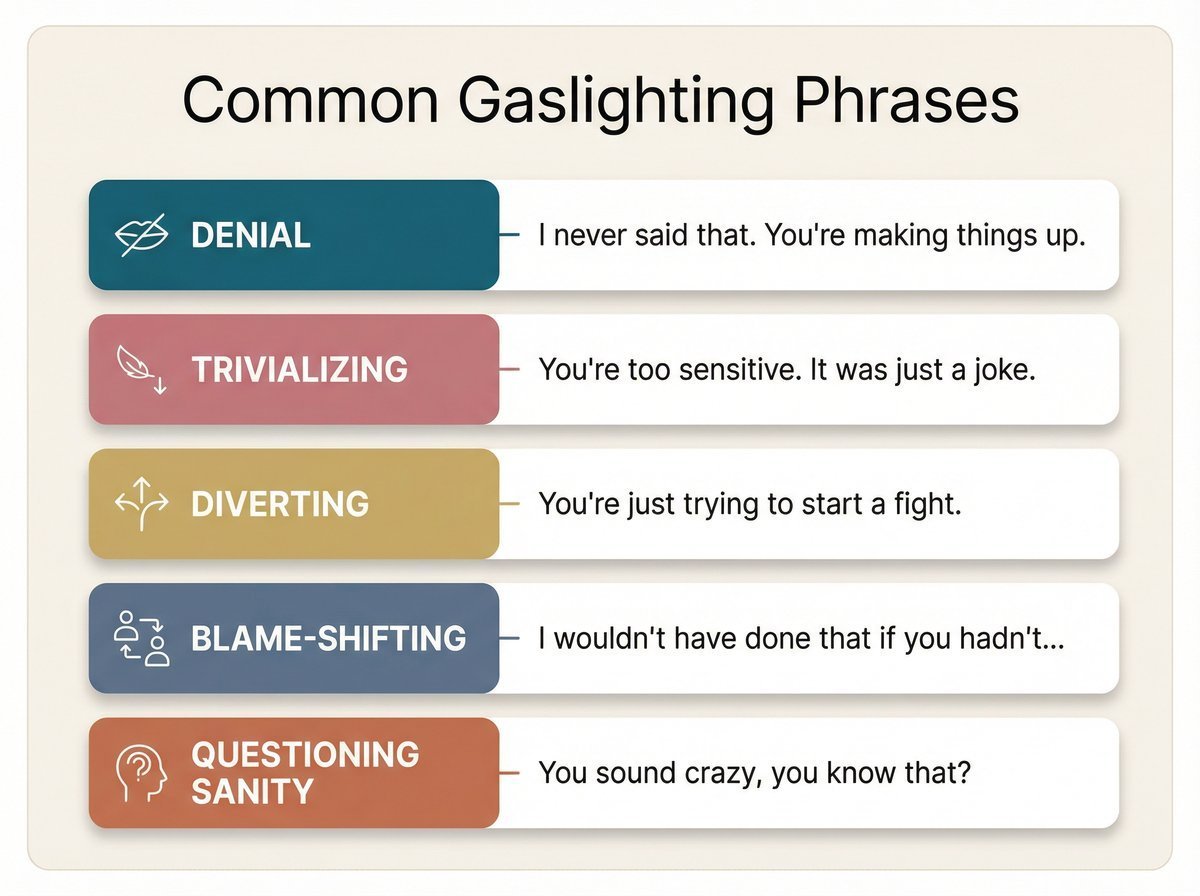
Gaslighters often rely on a predictable script. Recognizing these phrases can be a powerful tool for identifying the manipulation as it happens. Here are some common examples, categorized by the tactic they employ.
| Tactic | Common Phrases |
|---|---|
| Denial | “I never said that.” / “You’re making that up.” / “That never happened.” |
| Trivializing | “You’re being too sensitive.” / “It was just a joke, lighten up.” / “Why are you making such a big deal out of this?” |
| Diverting | “You’re just trying to start a fight.” / “Is that another one of your crazy theories?” / “You’re changing the subject.” |
| Blame-Shifting | “I wouldn’t have done that if you hadn’t…” / “You’re the one who’s causing all the problems.” / “You made me do it.” |
| Questioning Sanity | “You sound crazy, you know that?” / “You really need help.” / “Everyone thinks you’re unstable.” |
Why Does My Husband Gaslight Me?
Understanding the potential motivations behind your husband’s gaslighting does not excuse the behavior, but it can provide a degree of clarity. Often, gaslighting stems from a deep-seated need for control, which may be rooted in narcissistic personality traits, an inability to manage conflict or criticism, or learned behaviors from his own family of origin.
It can also be driven by a profound fear of abandonment or a desperate attempt to maintain the relationship, albeit in a toxic and controlling manner. Some gaslighters are fully aware of their manipulative behavior; others have normalized it to the point where they genuinely believe their distorted version of events. Either way, the impact on the victim is equally damaging.
What NOT to Do When You’re Being Gaslit
Your natural reactions to gaslighting may inadvertently feed the cycle. Avoiding these common mistakes is crucial for breaking free.
Don’t argue about the past. You cannot win a debate about reality with someone who is committed to distorting it. Engaging in these arguments only leads to more confusion and exhaustion, and it gives the gaslighter more opportunities to rewrite history.
Don’t seek their approval or validation. A gaslighter’s approval is often used as a tool to control you. Seeking it reinforces their power and keeps you trapped in a cycle of trying to earn something that will never be freely given.
Don’t rush to couples therapy. While well-intentioned, couples counseling can be counterproductive with a gaslighter, who may manipulate the therapist and use the sessions as another platform for abuse. Prioritize individual therapy for yourself first.
Don’t blame yourself. Self-blame is the intended outcome of gaslighting. Remind yourself that you are not the problem; the abuse is the problem.
A 3-Stage Roadmap to Reclaim Your Reality
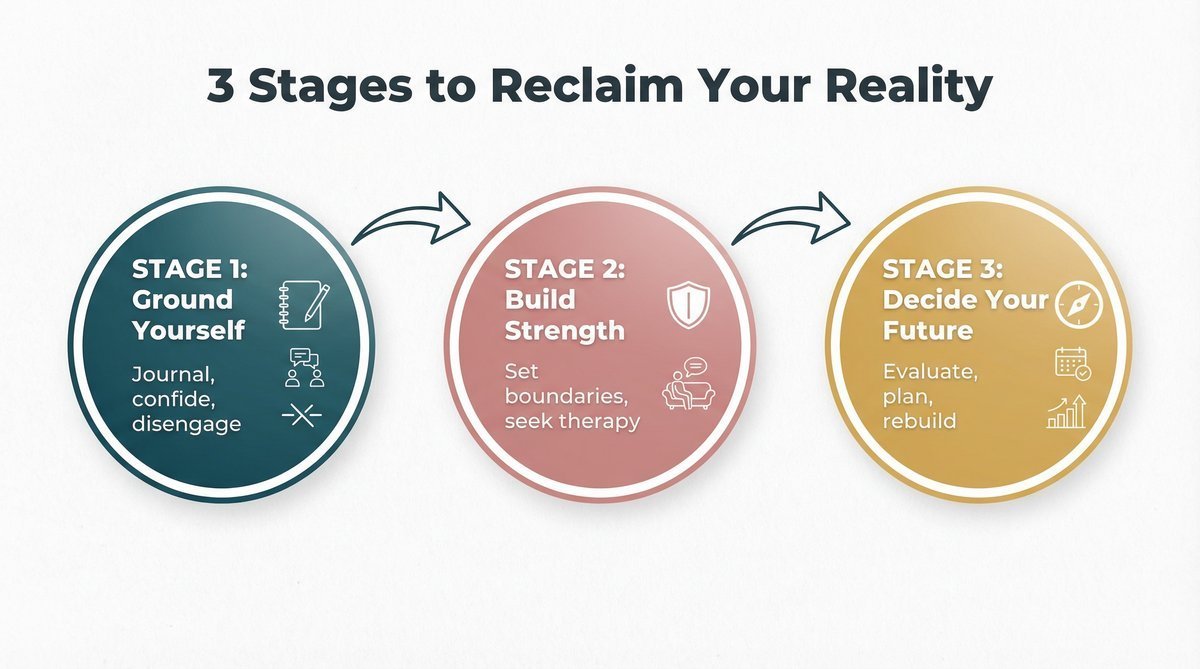
Breaking free from the grip of gaslighting is a process, not an event. This three-stage roadmap can help guide you toward reclaiming your sense of self and making informed decisions about your future.
Stage 1: Immediate Steps to Ground Yourself
Keep a private journal. Document conversations and events, noting what was said and how you felt. This creates an external record of your reality that you can return to when your husband tries to rewrite events. Keep it somewhere he cannot access.
Confide in a trusted friend or family member. Sharing your experiences with someone you trust can provide essential validation and perspective. Isolation is a key tool of the gaslighter, so actively countering it is a powerful act of resistance.
Practice disengagement. Instead of arguing, use simple, non-committal phrases like, “We remember that differently,” or “I’m not going to discuss this right now.” This removes you from the debate without conceding your reality.
Stage 2: Short-Term Actions to Build Strength
Set small, enforceable boundaries. Start with something manageable, like, “I will not continue this conversation if you raise your voice.” Enforcing even a small boundary begins to rebuild your sense of agency.
Seek individual therapy. A qualified therapist can help you understand the dynamics of psychological abuse, process your emotions, and develop coping strategies. This is one of the most important steps you can take.
Reconnect with your support system. Intentionally spend time with people who make you feel good about yourself and who support you unconditionally. Their perspective can be a powerful antidote to your husband’s distorted reality.
Stage 3: Long-Term Decisions for Your Future
Evaluate the relationship. With the clarity gained from therapy and your support system, you can begin to assess whether the relationship is salvageable or if leaving is the healthiest path forward.
Create a safety plan. If you decide to leave, or if the emotional abuse escalates, a safety plan is essential. The National Domestic Violence Hotline (1-800-799-7233) offers free, confidential support 24/7 and can help you create a plan.
Focus on rebuilding your self-esteem. Engage in activities and hobbies that you enjoy and that remind you of your strengths and capabilities. Healing your relationship with yourself is the foundation of all recovery.
Frequently Asked Questions About Being Gaslit by a Husband
Can a gaslighting husband change?
Change is possible, but it is rare and requires a significant, long-term commitment from the gaslighter to undergo intensive individual therapy and take full accountability for his abusive behavior. It is not your responsibility to change him, and his potential for change should not be the primary factor in decisions about your own safety and well-being.
Is gaslighting a form of abuse?
Yes. Gaslighting is a recognized form of psychological and emotional abuse. It can be just as damaging as physical abuse, causing long-term effects like anxiety, depression, and post-traumatic stress disorder (PTSD). In some jurisdictions, it is legally recognized as a form of coercive control.
What’s the difference between gaslighting and lying?
While all gaslighting involves lying, not all lying is gaslighting. A simple lie is a falsehood about a specific fact. Gaslighting is a broader, sustained pattern of manipulation that uses lies, denials, and distortions with the specific intent of making the victim question their own reality, memory, and sanity.
How does gaslighting affect mental health?
Gaslighting can have severe consequences for mental health, including chronic anxiety, depression, a diminished sense of self-worth, and in some cases, PTSD. It erodes your ability to trust yourself and others, and the effects can persist long after the relationship has ended. Seeking professional support is strongly recommended.
Should I go to couples therapy if my husband is gaslighting me?
Most therapists who specialize in domestic abuse advise against couples therapy in situations where one partner is actively gaslighting the other. A skilled gaslighter can manipulate the therapeutic process, and couples therapy can inadvertently create a forum for further abuse. Individual therapy for the victim should always come first.
If you are in immediate danger, please call 911. For confidential support, contact the National Domestic Violence Hotline at 1-800-799-7233 or visit thehotline.org.