In the highly competitive real estate market, prospective renters form an impression of a property within the first seven seconds of arrival. Before they ever see a renovated kitchen or a modern fitness center, the exterior environment has already communicated a powerful message about management quality and community standards. A 2023 survey by the National Multifamily Housing Council revealed that 64% of renters consider the appearance of outdoor common areas when deciding to sign a lease, notes Mike Dunfee Group Lakewood.
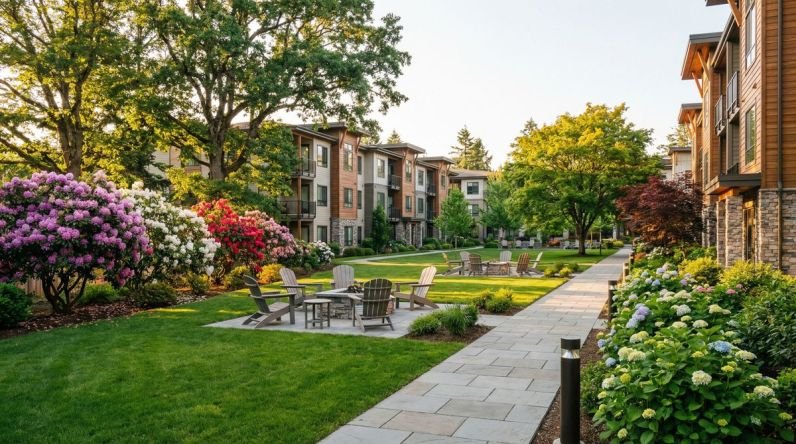
A well-maintained multi-family community exterior where professional landscaping creates a welcoming, high-value living environment.
However, the benefits of professional landscaping for multi-family communities extend far beyond simple curb appeal. When executed strategically, expert landscape management becomes a multi-dimensional asset. It drives measurable financial returns, fosters resident well-being through biophilic design, ensures environmental compliance, and significantly reduces legal liability. For property owners and managers, shifting the perspective from “maintenance expense” to “strategic investment” is the key to unlocking long-term property value.
The Financial Case: Property Value, Rental Premiums, and ROI
Professional landscaping directly increases the financial performance of multi-family communities by boosting overall property value by 15% to 20%, supporting 5% to 10% higher rental rates, and accelerating leasing speed by up to 7%. The return on investment (ROI) for comprehensive landscaping upgrades typically ranges from 100% to 200%.
The financial rationale for investing in high-quality outdoor spaces is backed by robust industry data. According to the American Society of Landscape Architects (ASLA), well-executed landscaping can enhance a property’s overall value by up to 20%.[2] This substantial increase in valuation makes the property significantly more attractive to potential investors, appraisers, and lending institutions.
Furthermore, premium landscaping allows property managers to command higher rental rates. Properties featuring mature trees, vibrant seasonal flora, and meticulously maintained hardscapes can often justify a 5% to 10% premium compared to properties with neglected exteriors. The International Society of Arboriculture notes that the presence of healthy, mature trees alone can increase residential property values by 6% to 9%.[3]
Beyond direct revenue increases, professional landscaping reduces costly vacancy periods. Data indicates that well-maintained exteriors can accelerate the leasing process by approximately 7%. When a unit sits vacant, the owner loses not only the monthly rent but also incurs ongoing utility and insurance costs. By minimizing these vacancy windows, the landscaping investment rapidly pays for itself.
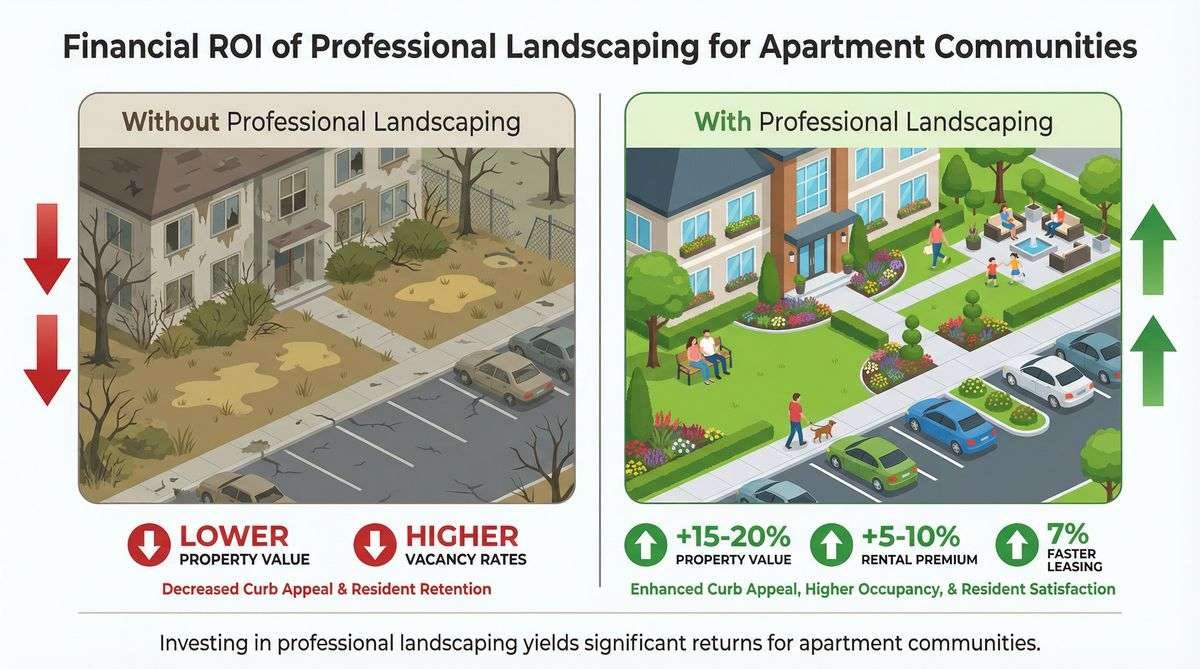
| Financial Metric | Estimated Impact of Professional Landscaping |
|---|---|
| Property Value Increase | 15% – 20% overall valuation boost |
| Rental Rate Premium | 5% – 10% higher monthly rent |
| Leasing Velocity | Up to 7% faster lease-up times |
| Overall ROI | 100% – 200% return on capital improvements |
Tenant Retention and the Psychology of First Impressions
Attractive landscaping significantly improves tenant retention by creating a sense of pride and community. Properties with well-maintained green spaces report up to 10% higher tenant satisfaction scores, and nearly half of renters cite outdoor areas as a key factor in their decision to renew a lease.
Tenant turnover is one of the largest hidden costs in multi-family real estate. Every time a resident moves out, management faces expenses related to unit preparation, marketing, and lost revenue. Professional landscaping plays a pivotal role in fostering tenant loyalty by creating an environment where residents feel proud to live. A 2022 survey by the National Apartment Association found that 48% of tenants stated access to attractive outdoor spaces played a significant role in their decision to renew their lease.[4]
When current tenants drive past their property daily, they notice the condition of the grounds. Regular, professional landscape maintenance serves as a visible reminder that management cares about the property and, by extension, the residents. This proactive approach to property care builds trust and reinforces the resident’s decision to stay long-term.
From Curb Appeal to Community Identity
Beyond basic neatness, strategic landscaping establishes a distinct brand identity for a multi-family community. Whether it is a modern, minimalist aesthetic with geometric hardscaping or a lush, resort-style environment with abundant shade trees, the landscape design tells a story. This cohesive visual identity helps differentiate the property in a crowded market, transforming a standard apartment complex into a desirable lifestyle destination. Properties that invest in a recognizable outdoor aesthetic consistently attract higher-quality applicants and command stronger lease renewal rates.
Biophilic Design and Resident Well-Being
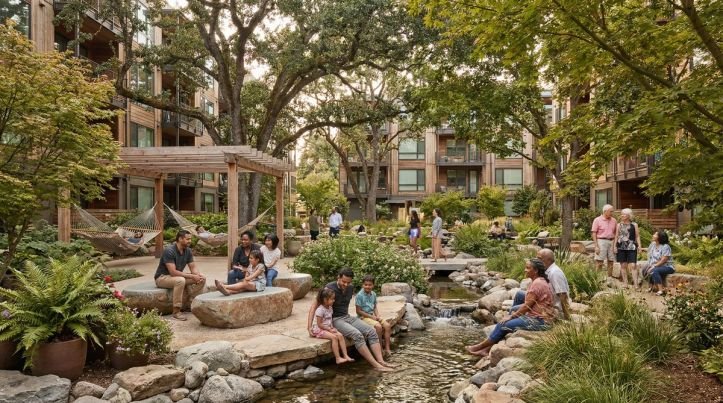
Integrating biophilic design into multi-family landscaping improves resident mental health by reducing stress and encouraging outdoor activity. Access to nature within dense housing environments fosters psychological attachment to the community and enhances overall quality of life.
While financial metrics are crucial, the human element of landscaping is equally profound. Biophilic design — the concept of integrating natural elements into the built environment — has gained significant traction in modern real estate. Research published in the National Library of Medicine demonstrates that biophilic spaces encourage mindfulness, relaxation, and healthy routines, making stress reduction a natural part of everyday life for residents.[5]
In dense multi-family housing, residents often lack private yards. Therefore, the communal green spaces must serve as their primary connection to nature. Professionally designed landscapes that incorporate diverse plant life, water features, and natural materials provide a restorative environment. When residents have access to shaded seating areas, walking paths, and vibrant gardens, they are more likely to spend time outdoors, interact with neighbors, and develop a strong psychological attachment to their community.
Sustainable Landscaping: Cutting Costs While Going Green
Sustainable landscaping practices, such as xeriscaping and smart irrigation, drastically reduce water consumption and lower utility bills. Additionally, strategic tree placement provides natural cooling, while proper grading ensures effective stormwater management and environmental compliance.
Modern professional landscaping increasingly focuses on resource efficiency and ecological responsibility. Implementing sustainable practices can significantly reduce long-term operational costs for multi-family communities. Xeriscaping — the use of drought-tolerant, native plants — drastically reduces the need for supplemental watering, leading to immediate savings on municipal water bills. Coupled with smart irrigation systems equipped with weather sensors, property managers can ensure that water is used only when absolutely necessary, eliminating wasteful runoff.
Furthermore, professional landscapers employ strategic tree placement to provide natural shade to buildings. This natural canopy can significantly lower cooling costs during the hot summer months, benefiting both the property’s bottom line and the environment. The combination of reduced water usage and lower energy consumption makes sustainable landscaping one of the most cost-effective long-term investments a property manager can make.
Stormwater Management and Environmental Compliance
A critical, yet often overlooked, benefit of professional landscaping is effective stormwater management. Multi-family properties with large areas of impervious surfaces — such as parking lots and rooftops — are highly susceptible to flooding and soil erosion. Professional landscape architects design bioswales, rain gardens, and permeable paving solutions that capture and filter rainwater on-site. This not only protects the property’s foundation and infrastructure but also ensures compliance with increasingly strict municipal environmental regulations regarding stormwater runoff.[6] Non-compliance with these regulations can result in significant fines, making professional landscape management a direct form of risk mitigation.
Safety, Liability Reduction, and Year-Round Maintenance
Professional landscaping mitigates legal liability by ensuring clear, safe pathways and eliminating hazards like dead branches or poor lighting. A comprehensive, year-round maintenance strategy prevents accidents and protects the property owner from costly slip-and-fall lawsuits.
Neglected landscaping is not just an eyesore; it is a significant legal liability. Overgrown shrubs can obscure sightlines and create security risks, while dead tree branches pose a severe threat of property damage or personal injury during storms. Furthermore, uneven walkways caused by invasive root systems or poor drainage can lead to slip-and-fall accidents, which are among the most common and costly premises liability claims in multi-family housing.
Professional landscaping crews understand safety requirements and risk management protocols. They ensure that all pedestrian areas are clear, well-lit, and free of debris. In regions that experience harsh winters, this extends to prompt snow and ice removal. By maintaining a rigorous, year-round schedule, property managers demonstrate a standard of care that protects both the residents and the ownership entity from legal exposure.
| Season | Key Professional Landscaping Tasks for Multi-Family Properties |
|---|---|
| Spring | Soil testing, mulching, irrigation system activation, planting seasonal color |
| Summer | Weekly mowing, weed control, pest management, drought monitoring |
| Autumn | Leaf removal, aeration, dormant seeding, perennial pruning |
| Winter | Snow and ice management, dormant tree pruning, hardscape inspection |
Frequently Asked Questions
How does professional landscaping affect property value in multi-family communities?
High-quality, professional landscaping can increase the overall value of a multi-family property by 15% to 20%, according to the American Society of Landscape Architects. The improvement enhances curb appeal and makes the asset more attractive to potential buyers, appraisers, and investors, directly strengthening the property’s market position.
What is the typical ROI for landscaping investments at apartment complexes?
Comprehensive professional landscaping upgrades typically yield a return on investment (ROI) ranging from 100% to 200%. This return is driven by increased property valuation, higher rental premiums of 5% to 10%, and reduced vacancy periods resulting from faster lease-up times.
How does landscaping influence tenant retention rates?
Attractive outdoor spaces foster a sense of community and pride among residents. Research indicates that properties with well-maintained landscaping experience up to 10% higher tenant satisfaction scores. A 2022 National Apartment Association survey found that 48% of tenants consider outdoor amenities when deciding to renew their lease.
What landscaping features do renters value most?
Modern renters highly value functional, biophilic spaces. The most sought-after features include shaded communal seating areas, well-lit walking paths, designated pet areas, and sustainable native plant gardens that provide a meaningful connection to nature. Outdoor gathering spaces such as fire pits and community gardens also rank highly among prospective tenants.
Can sustainable landscaping actually lower operating costs?
Yes. Implementing xeriscaping with native, drought-tolerant plants and installing smart irrigation systems significantly reduces water consumption. Strategically planted shade trees can lower building cooling costs during warm months, and proper stormwater grading reduces the risk of expensive infrastructure damage from flooding.
How does professional landscaping reduce liability for property owners?
Professional landscapers proactively identify and eliminate hazards across the property. By keeping walkways clear of debris, removing dead or structurally compromised tree branches, ensuring proper outdoor lighting, and managing snow and ice removal, they drastically reduce the risk of slip-and-fall accidents and the subsequent legal claims that represent a significant financial exposure for multi-family property owners.
Conclusion
The benefits of professional landscaping for multi-family communities extend far beyond the surface level of green grass and colorful flowers. It is a strategic business decision that directly impacts the bottom line through increased property value, higher rental yields, and improved tenant retention. By embracing biophilic design and sustainable practices, property managers can simultaneously enhance resident well-being while reducing operational costs and legal liabilities.
In today’s competitive real estate market, the outdoor environment is no longer a secondary consideration — it is a primary driver of community performance. Properties that invest in expert landscape management do not simply look better; they lease faster, retain residents longer, and generate stronger returns. The question is no longer whether professional landscaping is worth the investment. The data makes clear that the real cost is in neglecting it.
- National Multifamily Housing Council. (2023). Resident Preferences Survey. nmhc.org
- American Society of Landscape Architects (ASLA). (2024). Landscape Architecture Industry Report. asla.org
- Morales, D.J. et al. The Influence of Trees and Landscaping on Rental Rates at Office Buildings. International Society of Arboriculture. isa-arbor.com
- National Apartment Association. (2022). Tenant Amenity and Retention Survey. naahq.org
- National Library of Medicine (PMC). (2025). Biophilic design, neuroarchitecture and therapeutic home environments. pmc.ncbi.nlm.nih.gov
- U.S. Environmental Protection Agency (EPA). Green Infrastructure and Stormwater Management. epa.gov