The majority of rooms out there don’t need all-new everything. They just need a couple of smarter choices. Turns out, a room can look and feel seriously high-end with a carefully-selected group of tiny upgrades – and once you realize what the pros are really up to, the distance between “okay” and “whoa” isn’t as far as you might imagine.
Start With What Your Eye Hits First
Each room contains preferred display space – the faces, walls, and fittings that are sifted through before anything becomes aware of registering. This is where it makes the most sense to make small investments.
Light switches and outlet covers represent one of the biggest missed opportunities in any home. The default plastic plate is almost free, is read as almost free because it is almost free. Swap them for screwless metal ones, a twenty-minute job where literally nothing else in the room changes and suddenly the room feels like it was attended to.
The ceiling is another blank face. Pick a color that contrasts subtly – not a ton darker, just a single shade or two away from the wall, and it’ll draw the eyes up and make standard ceiling heights feel more generous. Add a medallion around a basic light fixture and suddenly it looks like more than a builder install.
Hardware is applying the same logic to cabinetry. Heavy brass or matte black pulls, swap them for the builder knobs in minutes and the perceived quality of the entire room shifts immediately.
The “Invisible” Upgrades Nobody Talks About
Small changes can have a big impact without a lot of effort. For instance, throw pillow inserts may not be the first thing you think of when considering a decorative change, but they do make a big difference. While you might spend additional money on a down or feather insert, that will allow you to create that sharp, clean “karate chop” appearance that is used in a lot of style photos. This is an easy way to upgrade the look of your pillows that doesn’t require you to replace the covers.
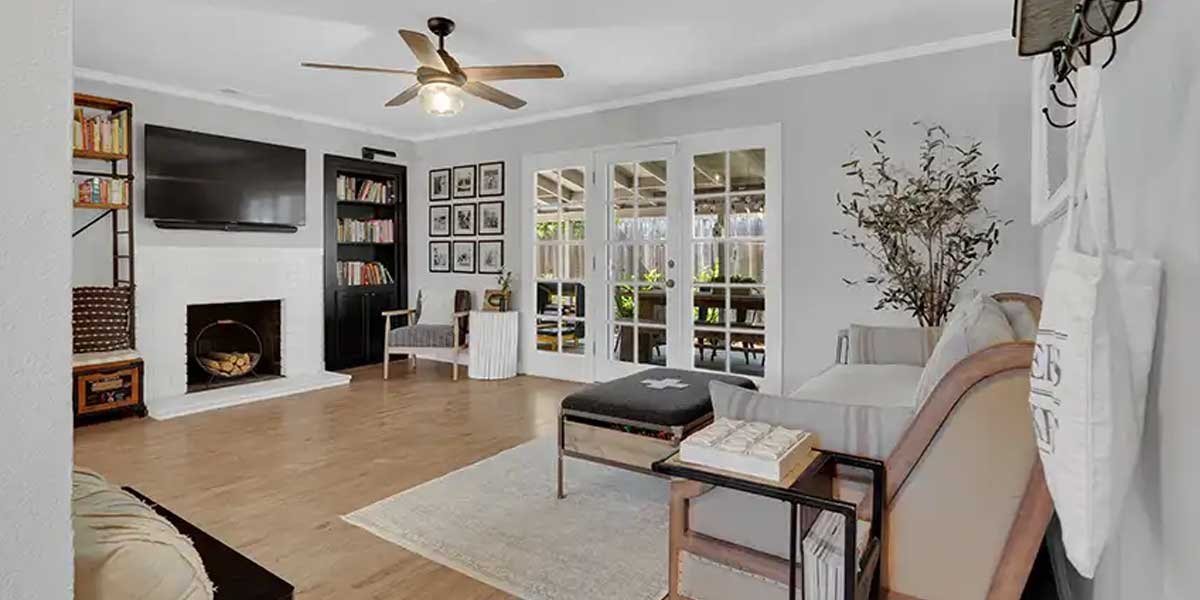
The same goes for window treatments. Simply hanging your curtains from the ceiling down above the window frame and extending your rod beyond the window frame will make it look as though your window is larger and ceiling is higher, without changing either of those things. Large oversized rugs have been listed in this category because if you only use a rug that fits under a coffee table, your room will appear smaller. If you use a rug that allows all your furniture legs to rest on top of it (or at a minimum the front legs on that side if it is a chair or couch), it will look as though a professional has designed the room.
Styling Surfaces Without The Retail-Store Feeling
There is a distinction between a highly decorated surface and a beautifully styled one. Decorating usually overfills space. Styling keeps it simple with variation, and intentional organization.
The easiest organization is to group items by height, texture solid/translucent, matte/shiny, one tall element, one mid height, one low. Leave “blank space” around each little group so they can stand out give your eyes a place to rest.
This lets pieces have context and look intentional rather than collected by someone who isn’t allowed to throw anything away.
To tease out the good stuff that seems to work as a focal point rather than filling space, it’s worth considering the hardware and cabinetry choices that anchor a room. Sourcing quality MDF doors, drawer fronts, and cabinet components from a specialist manufacturer — something like https://lovech.ca/ or similar trade suppliers in your area — can make a significant difference to the overall finish of a kitchen or bathroom. These are the kinds of details that read as considered and deliberate rather than off-the-shelf.
Lighting Isn’t One Thing, It’s Several
Ceiling lights can make an area seem uninviting. All those expensive hotel lobbies and gorgeous living rooms in magazines that have caught your eye? None of them are designed with one big light on the ceiling. Lighting room involves lots of small light sources at different levels. No rewiring is required for this.
Cordless LED lamps on shelves, battery LED picture lamps above art, a table lamp or two in dark corners – useful secondary lights that don’t require wiring. They also solve a practical problem: a room that looks good at 7pm is harder to achieve than one that looks good at noon.
Nice, usable light that not from straight overhead: There are two or three ways of accomplishing that. The simplest is adding a few new light sources at different points of the room’s height. After dark, you will have mastered this.
The Case For Doing Less, Better
People always perceive homes with high-end aesthetic details, even small ones, to be of higher value. According to Zillow, homes with certain high-quality finishes like tuxedo kitchen cabinets or black front doors, can sell for up to $6,000 more than expected. We know it’s not just about the bells and whistles. It’s about perception. Perception drives value. And perception is driven by the details.
When refreshing our homes, the inclination is to add more… more furniture, more art, more accessories. But, the more predictable track is to subtract first. Clear the surfaces. Find the two or three pieces that are truly worthy in each room. Give them space.
A room that feels reigned in, where every item has been placed instead of just deposited, looks expensive. Expensive rooms are almost always edited rooms. That’s not a budget that’s a decision.