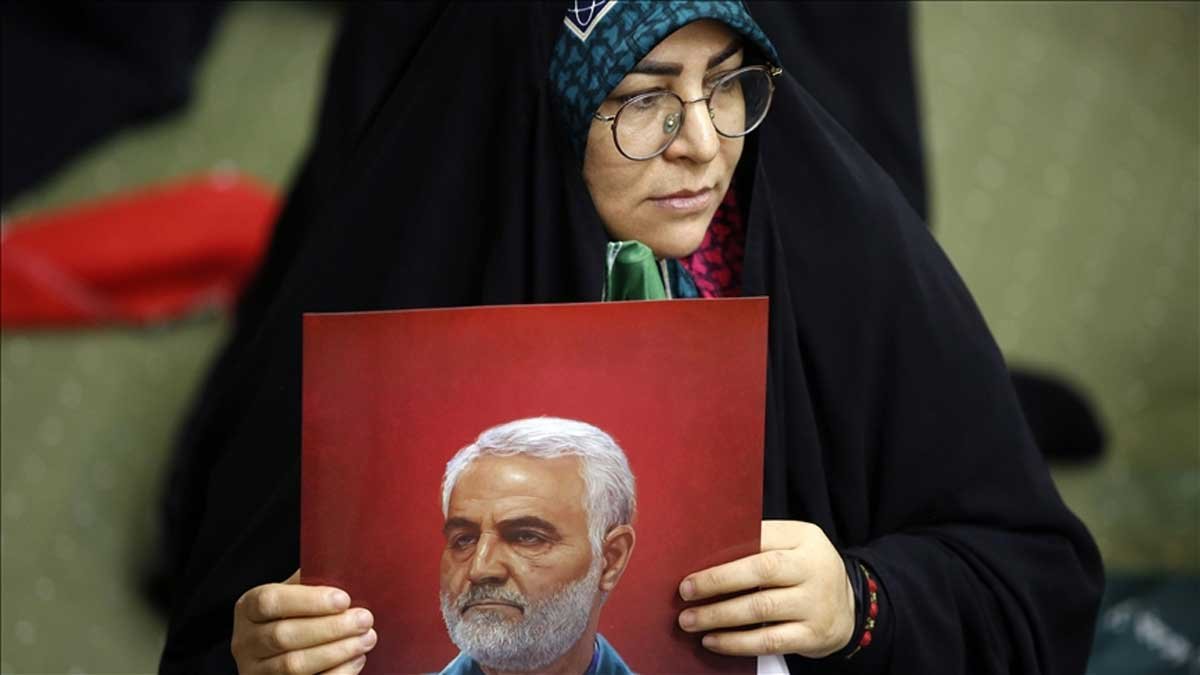
Hamideh Soleimani Afshar is the niece of slain Iranian Revolutionary Guard Major General Qasem Soleimani. On April 3, 2026, U.S. Immigration and Customs Enforcement agents arrested her and her daughter in Los Angeles after Secretary of State Marco Rubio revoked their green cards, citing her public support for the Iranian regime and what the U.S. government described as a fraudulent asylum claim.
Who Is Hamideh Soleimani Afshar?
Hamideh Soleimani Afshar is an Iranian national who had been living as a lawful permanent resident in Los Angeles, California. She is the niece of Qasem Soleimani, the commander of Iran’s Quds Force who was killed in a U.S. drone strike in Baghdad in January 2020. Her daughter, Sarinasadat Hosseiny, is Qasem Soleimani’s grandniece.
According to the U.S. State Department, Soleimani Afshar had been living what it described as a “lavish lifestyle” in Los Angeles while publicly promoting the Iranian government’s positions online. She first arrived in the United States under an asylum claim filed in 2019, which the Department of Homeland Security later called fraudulent, pointing to at least four documented trips she made back to Iran after receiving a green card.
Her husband has also been barred from entering the United States as part of the same enforcement action.
Why Was Hamideh Soleimani Afshar Arrested?
The U.S. State Department cited her public social media activity as the primary basis for revoking her legal residency status. In an official statement, the department accused her of promoting Iranian regime propaganda, celebrating attacks against American soldiers and military facilities in the Middle East, praising Iran’s leadership, and denouncing the United States as the “Great Satan.”
“As identified by both press reporting and her own social media commentary, Soleimani Afshar is an outspoken supporter of the totalitarian, terrorist regime in Iran,” the State Department said in its April 4, 2026 statement.
DHS added that her 2019 asylum claim had been filed fraudulently, noting that she returned to Iran at least four times after obtaining a green card. Asylum protections are typically reserved for those who face genuine persecution in their home country, making repeated voluntary returns to that country a significant legal contradiction.
DHS spokesperson: “It is a privilege to be granted a green card to live in the United States of America. If we have reason to believe a green card holder poses a threat to the U.S., the green card will be revoked.”
“The US government celebrated kidnapping the family of an Iran Commander they killed. Now there are claims it isn’t his family and instead they just rounded up people with the same last name.”
— r/WhitePeopleTwitter, April 4, 2026 (161 upvotes)
The U.S. government’s description of the arrest has been challenged by some observers who questioned whether the individuals detained are genuinely related to Qasem Soleimani or simply share the same surname. Multiple major news outlets — CBS News, Al Jazeera, and the New York Post — reported the family connection based on the State Department’s own claims.
Marco Rubio’s Revocation Powers and Legal Questions
Secretary of State Marco Rubio invoked rarely used legal authority to terminate the green card status of Soleimani Afshar and her daughter. The same mechanism was used by Rubio in 2025 to detain and seek deportation of several pro-Palestinian activists with legal status, including Columbia University student Mahmoud Khalil. Those cases remain entangled in federal court lawsuits arguing that Rubio’s determinations penalized constitutionally protected speech.
The Soleimani Afshar case raises similar questions. Her statements were made publicly on social media — activity that, for U.S. citizens, would carry First Amendment protections. Green card holders occupy a different legal position, but civil liberties advocates have argued that penalizing lawful residents for political speech, even pro-Iranian speech, risks setting a precedent that extends government power well beyond its traditional immigration enforcement role.
Rubio confirmed the action on X (formerly Twitter): “She is also an outspoken supporter of the Iranian regime who celebrated attacks on Americans and referred to our country as the ‘Great Satan.'”
| Person | Relation | Status | Action Taken |
|---|---|---|---|
| Hamideh Soleimani Afshar | Niece of Qasem Soleimani | ICE Custody (Los Angeles) | Green card revoked, pending deportation |
| Sarinasadat Hosseiny | Grandniece (Afshar’s daughter) | ICE Custody (Los Angeles) | Green card revoked, pending deportation |
| Afshar’s husband | Not named publicly | Outside U.S. | Barred from entering the U.S. |
| Fatemeh Ardeshir-Larijani | Daughter of Ali Larijani | Outside U.S. | Legal status revoked |
How Laura Loomer’s Report Triggered the Arrest
Shortly after the State Department’s announcement, far-right influencer and Trump ally Laura Loomer publicly stated that she had personally reported Soleimani Afshar to the State Department and thanked Rubio for acting on her tip. “This is a big scalp,” Loomer wrote on social media.
The sequence of events, a viral social media post by a political influencer, followed swiftly by a government enforcement action, prompted sharp criticism from civil liberties observers. A post on Reddit’s r/voteinorout_news described the pattern: “A viral post about one woman → government action → ICE detention with no charges. Critics say Lara Loomer flagging Afshar Soleimani online was followed by Marco Rubio terminating her status, raising alarms about due process.”
“Not only Larijani’s daughter but also Hamideh Soleimani (Qasem’s niece) have been arrested and soon to be deported from the US!”
— r/PERSIAN, April 4, 2026 (388 upvotes)
The case sits at a volatile intersection: an ongoing U.S.-Iran war that began February 28, 2026, an administration aggressively using immigration law as a foreign policy instrument, and a political environment in which social media pressure can move directly into government action within days.
Who Was Qasem Soleimani?
Qasem Soleimani commanded Iran’s Quds Force, the foreign operations branch of the Islamic Revolutionary Guard Corps, from 1998 until his death. He was killed on January 3, 2020, in a U.S. drone strike at Baghdad International Airport ordered by President Trump. Before the 2003 U.S. invasion of Iraq, he was relatively unknown outside Iran. Over the following decade, he became the most recognizable face of Iran’s regional military strategy, arming militants, directing proxy forces, and overseeing operations across Iraq, Syria, Lebanon, and Yemen.
Iranian authorities designated him a national martyr. Within the Trump administration, Soleimani was considered the chief architect of attacks that killed and maimed hundreds of American troops through shaped explosive devices. His assassination was one of the most consequential U.S. military actions in the Middle East in years and directly accelerated the tensions that culminated in the current U.S.-Iran war.
Broader Enforcement Context: Iranian Nationals in the U.S.
The Soleimani Afshar arrest is part of a wider policy the Trump administration announced in early April 2026. Secretary Rubio confirmed that the same enforcement action also terminated the legal status of Fatemeh Ardeshir-Larijani, the daughter of Ali Larijani, Iran’s former Secretary of the Supreme National Security Council. Larijani himself was killed in an airstrike the previous month. His daughter and her husband, Seyed Kalantar Motamedi, are no longer in the United States.
According to the State Department, this marks at least the second time in a month that the U.S. government has stripped immigration status from family members of top Iranian leaders. The administration framed the action as consistent with its broader stance: “The Trump Administration will not allow our country to become a home for foreign nationals who support anti-American terrorist regimes.”
Frequently Asked Questions
Is Hamideh Soleimani Afshar Qasem Soleimani’s daughter?
No. Hamideh Soleimani Afshar is Qasem Soleimani’s niece, not his daughter. Her own daughter, Sarinasadat Hosseiny, is his grandniece. Soleimani Afshar was living in Los Angeles with her daughter when ICE agents arrested them both on April 3, 2026.
What were the specific reasons given for the arrest?
The U.S. State Department cited three main grounds: social media posts promoting Iranian regime propaganda, statements celebrating attacks on American forces, and a finding by DHS that her 2019 asylum claim was fraudulent, backed by evidence of at least four trips she took back to Iran after receiving a green card.
What happens to Hamideh Soleimani Afshar now?
As of April 4, 2026, she and her daughter remain in ICE custody in Los Angeles, and the U.S. government is pursuing their deportation. The process typically involves immigration court proceedings, though the timeline varies. Legal challenges may be filed, as has occurred in similar high-profile cases including the detention of Columbia University student Mahmoud Khalil.
Under what legal authority did Rubio act?
Rubio used a rarely invoked provision of immigration law that allows the Secretary of State to terminate permanent resident status on national security and foreign policy grounds. He previously used the same authority in 2025 against pro-Palestinian activists with U.S. legal status. Federal courts have challenged those earlier uses in lawsuits that remain active.
Did Lara Loomer’s post cause the arrest?
Laura Loomer publicly claimed credit for reporting Soleimani Afshar to the State Department, and she thanked Rubio after the arrest was announced. Whether her report was the triggering event or simply coincided with an ongoing review is not publicly confirmed. The sequence has raised due process concerns among civil liberties advocates.
Why did this happen now?
The arrest occurred at the five-week mark of an active U.S.-Iran war that began February 28, 2026. The Trump administration has explicitly tied immigration enforcement actions against Iranian nationals to its wartime posture, describing green card holders with ties to the Iranian government as potential national security threats.