Creating a balanced ear stack is a process of selecting jewelry that functions as a group. A planned arrangement ensures every item is visible and the total appearance is orderly. Evaluation of the quantity and location of existing piercings is the first step. Combinations of the lobe, helix, conch or tragus provide various options for jewelry. Analysis of the ear as a complete unit helps identify locations that possess sufficient visual detail before a wearer buys new items.
Balance is not a requirement for identical ears – Asymmetrical styles are useful for creating a unique appearance that is still deliberate. One ear can feature multiple small earrings while the other ear holds fewer pieces with a prominent design. The distribution of jewelry across the skin is the primary consideration. If one section contains multiple large or complex pieces, simple jewelry in nearby areas prevents the arrangement from being crowded.
Choosing Appropriate Jewelry Sizes
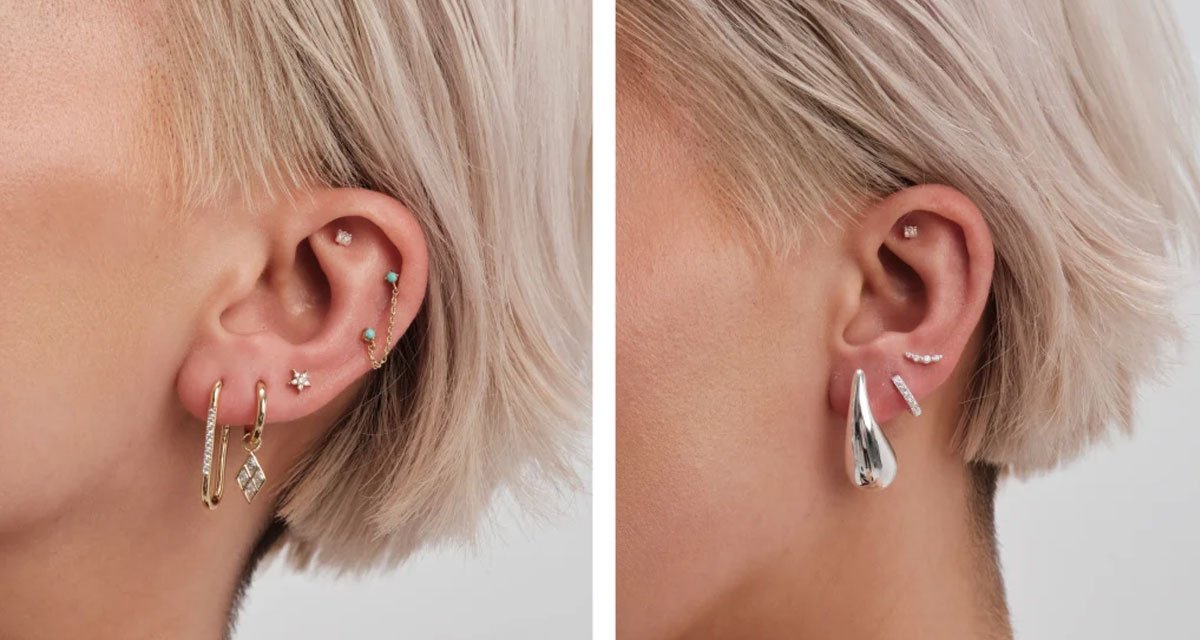
Dimensions are significant to the appearance of an ear stack. Small studs and thin hoops are effective for a subtle base, particularly on the lower lobe. Large hoops or decorative charms are useful as specific focal points. Multiple large pieces in a small area are heavy to the eye, whereas exclusively tiny pieces are difficult to see. Variation in size creates contrast and provides a sense of proportion.
Piercing location is important when you select a size – Large hoops are appropriate for lower lobe piercings where open space is available, while small studs are functional for upper cartilage areas. Jewelry is most effective when there is enough space for every item to be distinct. Evaluation of body jewelry should involve its relationship to surrounding pieces rather than an analysis of the item alone.
Selecting Complementary Metals
Metal types are helpful to connect different pieces within an ear stack. Silver and titanium create different visual effects. A primary metal is useful for a consistent appearance, while the combination of two finishes introduces contrast. Coordination is easier when pieces have similar tones, which makes a varied collection look intentional.
Mixed metals are effective when a shared element connects the jewelry. Similar shapes, stones or textures help different finishes appear related. As an example, a silver hoop and a gold stud are cohesive if their designs are simple – this method is also applicable to other accessories, allowing earrings to match rings, necklaces, bracelets or nose rings so the style is connected.
Creating A Visual Focal Point
Balanced ear stacks are often successful when one area is the center of attention – this feature is often a large hoop, a gemstone stud or a decorative charm. Other jewelry is then selected to support this piece – this strategy makes the stack easier to organize because every piece has a specific role.
Focal points are not always the largest items – Small pieces with unusual shapes or bright colors attract attention effectively. Observation of the visual weight of the entire ear is necessary to avoid placing multiple detailed designs together. Simple jewelry provides space around the main feature and allows it to be prominent.
Considering Personal Style
Ear stacks are reflections of personal fashion choices – Wearers of minimalist clothing often prefer thin hoops and small studs, while individuals with expressive styles choose charms and colorful stones. Jewelry choices are often dependent on daily outfits. Selection of pieces that match an existing wardrobe makes the combinations easier to wear.
Integration of the jewelry collection into a broader accessory style is useful. If a wearer uses bold necklaces, a simple ear stack is a good balance. If other accessories are small, earrings are a stronger feature. Consideration of the complete appearance ensures the ear stack is a natural part of a personal style.
Adjusting The Arrangement Over Time
Ear stack arrangements are flexible – Changes in preferences, clothing and piercings are opportunities to update the jewelry. Rotation of different earrings is a way to find combinations for specific events. Maintenance of a selection of interchangeable pieces allows for experimentation without the need to replace every item.
Adjustments are best when they are gradual so the effect of each new piece is visible. If one addition causes a crowded appearance, a smaller nearby item is a useful replacement to restore balance – this process makes styling adaptable and helps a wearer develop a combination that is comfortable.
Conclusion
Selection of jewelry for a balanced ear stack involves the consideration of size, location, metal and style. The objective is to create relationships between different items so the arrangement is intentional. A clear focal point, sufficient visual space and jewelry that matches a wardrobe create an ear stack that is both stylish and versatile.