Understanding complex neurobiological pathways can be challenging, especially when you need to select research materials that deliver accurate and reproducible results. Researchers are often dealing with complex cellular systems, in which minute experimental perturbations can affect the research findings. Therefore, access to reliable biological tools is the key to studying these pathways and having confidence in the results.
Similarly, the GDNF protein is a valuable research molecule that assists scientists in studying neuronal survival, growth, and cell signaling. Through the activity of GDNF, a researcher will be in a better position to understand the process through which neurons communicate, adapt, and respond to biological cues. This understanding has facilitated studies in the fields of neuroscience, cell biology, and regenerative medicine.
This article explains what the GDNF protein is and explores five key reasons why it is important in neurobiology research.
What Is GDNF Protein?
GDNF, or glial cell line-derived neurotrophic factor, is a neurotrophic factor that belongs to the transforming growth factor-beta (TGF-β) superfamily. The protein plays an important role in regulating neuronal growth, survival, and maintenance. For this reason, researchers study GDNF because it offers valuable information on the ways in which neurons are supplied with signals that determine their functioning and growth.
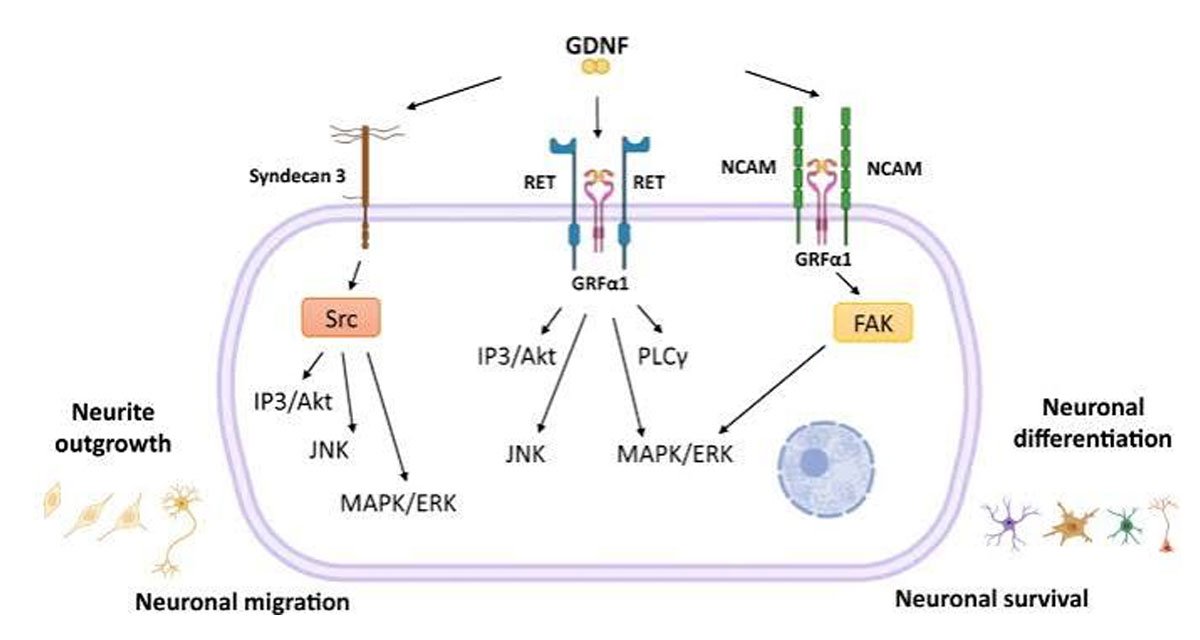
To understand this process further, GDNF is known to function via specific receptor interactions that aid transmission of biological signals within cells. The protein primarily interacts with GDNF family receptor alpha 1 (GFRα1) and the RET receptor tyrosine kinase. The interactions of these receptors trigger intracellular signal pathways that modify cellular responses such as survival, growth, and differentiation.
In laboratory research, recombinant human GDNF protein is widely used as a research tool for studying these biological processes. Recombinant GDNF is applied in research to study cellular communication, neuronal behavior, and molecular processes in controlled experimental conditions. As a result, high-quality recombinant proteins enable researchers to study pathways with more predictability.
Importance of GDNF Protein In Neurobiology
Understanding the role of GDNF protein helps researchers identify how this growth factor influences different aspects of neuronal function. In addition, GDNF can offer important clues on the biological mechanisms that keep the nervous system active, which, until now, can be seen as supporting cell survival as well as molecular communication.
Importance 1: Support Neuronal Survival
Among its key functions, neuronal survival is one of the major functions of GDNF. Neurons require certain growth signals to conserve their structure, their activity, and their interconnection to other neurons. GDNF offers valuable information that aids scientists in learning the way neurons react to factors that are related to survival.
Furthermore, GDNF has often been examined in models of dopaminergic neurons due to their significance in neuroscience research. The application of GDNF in research aids in investigating the effect of growth factors on neuronal preservation as well as cellular stability.
By studying these processes, the research on GDNF activity enables scientists to examine how neurons react to biological cues and environmental variations. This research reveals important information concerning cellular defense mechanisms and molecular determinants affecting neuronal well-being.
Importance 2: Promote Neuronal Development
GDNF plays an important role in neuronal development and differentiation. During this process, developing cells undergo modifications that enable them to turn into specialized neurons. The way growth factors mediate these cellular changes is of interest to researchers who study GDNF.
In laboratory settings, scientists apply GDNF in cell culture experiments to study cell growth, morphology, and gene expression variations. These tests enable the investigators to see how neurons are formed and how certain signals influence the properties of cells.
Therefore, the significance of GDNF to researchers who investigate neural development and the structuring of cells is that it presents a means to explore complex biological processes under established conditions. The findings are being used to further understand the development and functioning of cells in the nervous system.
Importance 3: Regulate Cellular Signaling Pathways
GDNF influences cellular activity by activating important signaling pathways, including the PI3K/Akt and MAPK/ERK pathways. These pathways play essential roles in regulating cellular processes related to survival, growth, and differentiation.
The PI3K/Akt pathway is commonly associated with cell survival signals, while the MAPK/ERK pathway is involved in regulating growth and cellular responses. Researchers study these pathways to understand how GDNF affects molecular activities within neurons.
Studying GDNF signaling helps researchers understand molecular communication within nervous system cells. By examining how cells receive and process GDNF signals, scientists can gain better insights into cellular regulation and neuronal function.
Importance 4: Advance Neurobiology Research
GDNF is widely studied in neuroscience because of its involvement in neuronal function and maintenance. Researchers use GDNF-based studies to explore how neurons develop, communicate, and respond to different biological conditions.
GDNF research supports various applications, including:
Neuronal cell models
Neurodegeneration studies
Brain signaling research
Regenerative medicine investigations
These research areas help scientists examine cellular mechanisms involved in nervous system biology and explore new approaches for understanding neuronal behavior.
Recombinant human GDNF protein provides researchers with consistent material for controlled experiments. Researchers often use GDNF Protein to examine neuronal signaling, cellular responses, and growth factor activity in laboratory studies. Using reliable recombinant proteins allows scientists to maintain better control over experimental conditions.
Importance 5: Improve Experimental Control
Research quality depends heavily on the reliability of biological materials. Variations in protein quality, activity, or consistency can affect experimental outcomes and make it difficult to compare research findings.
Recombinant GDNF proteins offer several benefits for laboratory studies, including:
Consistent quality across experiments
Defined protein characteristics
Controlled laboratory applications
Improved experimental reproducibility
These advantages help researchers create more reliable study designs and analyze cellular responses with greater confidence. Standardized research materials also reduce uncertainty during complex biological experiments. As a result, researchers can focus on evaluating biological responses rather than managing inconsistencies caused by research materials.
When selecting recombinant GDNF, researchers should evaluate important factors such as protein purity, biological activity, quality testing methods, and supplier documentation. Reviewing these details helps ensure that the selected protein meets specific research requirements.
Conclusion
GDNF protein is an important neurobiology research tool because it helps scientists understand neuronal survival, development, and signaling pathways. By studying GDNF activity, researchers can explore how neurons communicate and respond to biological signals. These insights help advance research into complex cellular mechanisms within the nervous system. Continued investigation of GDNF pathways can further improve understanding of neuronal functions and related biological processes.
Researchers can strengthen their studies by choosing well-characterized recombinant GDNF proteins that support accurate and reproducible experiments. Reliable research materials provide a stronger foundation for advancing neuroscience discoveries. Selecting proteins with verified quality and performance characteristics can also improve confidence in experimental results.