Property managers, facility managers, and security personnel have one common objective: ensure security while maintaining ease of access and use of entrances.
However, it is important to understand that not all available bollards actually offer sufficient protection against vehicle collision. Sometimes a bollard just looks like a bollard.
Buying the wrong product can mean discovering that fact the hard way. It is for that very reason that one needs to be aware of crash ratings, testing criteria, and installation procedures prior to making purchase decisions.
In this article, we discuss five simple steps to do that.
1. Understand Crash Ratings and Testing Standards
Not all bollards have been made to withstand an impact from a vehicle. There are visual deterrents out there. The point is important because once force dynamics are involved, this distinction makes all the difference.
A crash-rated bollard must be independently tested according to a known standard, and the tests make the barrier real compared to an assumption. One such standard would be ASTM C40 P1, which determines the stopping capability of the bollard.
Choose a product designed not only to meet ASTM F2656 standards for storefront use. The standard takes into account the vehicle impact scenarios typical for entrances, plazas, and pedestrian areas.
Apart from ASTM standards, there are references to K ratings – K4, K12. The rating comes from the military and government specifications. Comparing one to another will help you understand the required level of protection, rather than just choosing the higher number.
Do not forget about third-party testing documents. Manufacturer claims do not prove anything on their own, while the paperwork can be invaluable when proving compliance with standards and filing insurance claims.
2. Match Vehicle Weight and Speed Threat Levels to the Bollard
Each site has its unique threat assessment. The potential risks for a sleepy suburb shop front and an urban loading zone are not alike.
Ask yourself one question: What is the appropriate threat in terms of vehicle weight and speed for this site? The answer to that will be your guide to select a bollard, not vice versa.
For the sake of clarity, it is necessary to keep in mind that a single, properly installed C40-rated bollard stops a 5,000 lb. vehicle at a speed of 30 mph with only 24 inches of penetration.
Also, take care about the penetration distance. Measure how much clearance is available from the bollard row until the area where there are windows, sitting places, or pedestrian flow, and then ensure that the rated penetration distance is within this clearance.
Another point for consideration is bi-directional stopping capability. It means the bollard does not matter whether the impact occurs from the left or from the right; it is necessary for parking lots or two-way entrances.
The cost of undersizing the protection is paid several times in liability and damage in the future.
3. Choose Between Permanent, Removable, or Shallow-Mount Installation
The choice of installation will influence both performance and ease of use each day. The installation choice is just as important as the crash rating choice.
Fixed bollards are the ideal choice when a fixed barrier is required, and no changes to access points are necessary. These are permanent barriers that will provide a consistent level of performance without any moving parts.
Removable bollards will make sense when there is an occasional need to allow access by a vehicle. Removable bollards should not compromise the stopping capability of the bollards to allow for removal; low-quality removable bollards are weak compared to their fixed counterparts.
How the bollards are installed is as important as what they are. A Set & Pour installation process is easier than installing deep foundation bollards in the ground.
This reduced depth of installation makes it easier to install bollards retroactively in buildings without the need to dig deep foundations, which might be difficult with existing buildings.
Reduced depth of installation also minimizes disruption of underground utility lines in the retrofitted properties.
It is always good to take a walk around the property and understand how the space is used before making the final decision.
4. Factor In Spacing, Site Layout, and Grade Changes
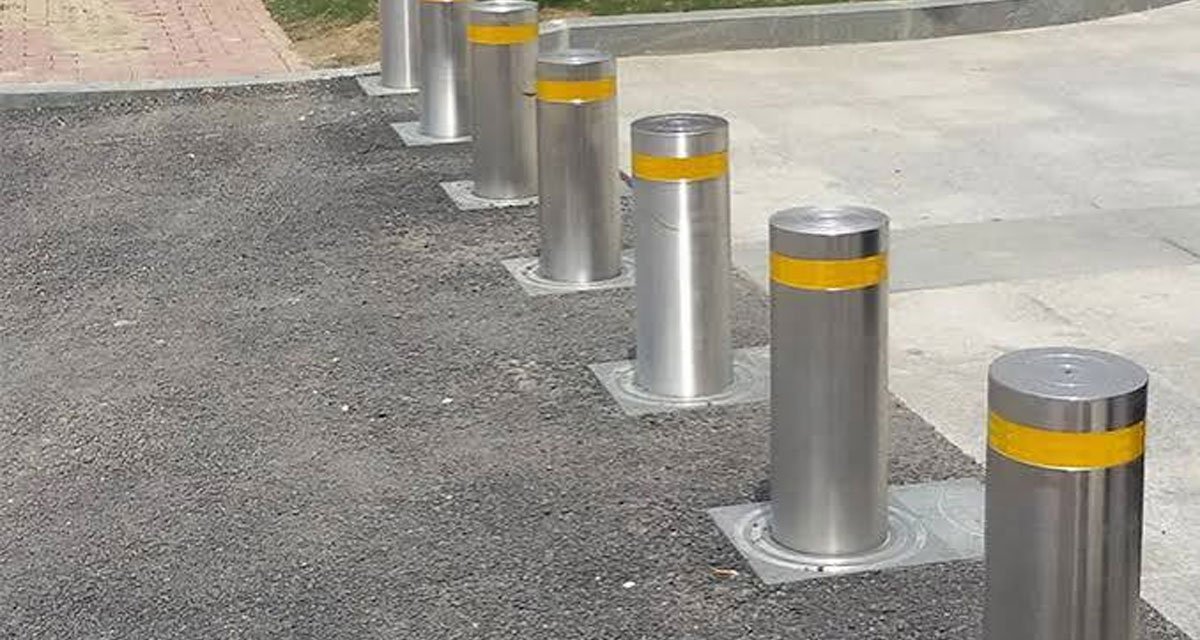
Bollards are not solitary structures; they always run in a row, and this row must align with the reality of the site and not be in opposition to it.
Flexible spacing requirements allow for more options, especially where the ground is uneven and where corners may come into play. Adjustability in the field makes it much easier to fit the row along the natural contours of a building while maintaining security.
The change in grade elevation is one of the most frequent problems. Entrances that have a slope, curb cuts, or other transitions can affect the way the bollard row will operate. Make sure that you get a row that will perform well under such conditions.
Spacing consistency also ensures visual consistency.
5. Consider the Application: Storefronts, Schools, and Pedestrian Zones
Various environments have their unique requirements, functional and aesthetic as well. A bollard protecting an entrance to a school is used differently from one protecting a loading dock.
Shop fronts should have bollards that combine security with a friendly appearance because this environment has a lot of people walking around constantly. A school should have similar discretion combined with total reliability because of the vulnerable nature of the people being protected.
Environments that allow pedestrian access, like plazas and walkways, should be protected by bollards that can stop any vehicle decisively but do not inhibit movement by pedestrians in any way.
In some cases, additional features like sign mounting or special finishes are required from the bollards. This should be clarified before buying the bollards so as not to have to add accessories later on.
Choosing the right bollards for your particular application will ensure proper function without hindering other activities in the surrounding environment.
Final Thoughts
The process of selecting an appropriate crash-rated bollard involves the integration of five critical elements. The first is the application of proper standards for the testing of products. Others include the correct level of threats, the appropriate installation process, proper site design, and application-specific design of the bollards.
This must be viewed as a process of planning rather than purchasing a product. This requires that you involve the installers in the process at an early stage and require documentation. This will make the site more secure.