The sliding glass door to your backyard has been getting harder to open for years. This spring, you noticed the seal is failing — there is fog between the glass panes, and a draft comes through even when the door is closed. The track is bent, and one of the rollers is grinding every time you slide it. You know it needs to be replaced, but you have no idea whether a standard sliding door is the right choice or whether a French door or a bi-fold door would be better.
A sliding glass door is a type of sliding door made predominantly from glass, situated in an external wall to provide egress and light (Wikipedia). Patio doors replacement involves choosing between three main door types — sliding, French, and bi-fold — and four main frame materials — vinyl, aluminum, wood, and fiberglass. The right choice depends on your budget, the size of the opening, and how you use your outdoor space.
Patio doors replacement options vary by type, material, and cost. Here is a detailed comparison of sliding, French, and bi-fold doors with prices and pros and cons.
Types of Patio Doors for Replacement
Patio doors replacement starts with choosing the door type. The three main types are sliding patio doors, French patio doors, and bi-fold patio doors. Each type operates differently and suits different opening sizes and usage patterns.
| Type | Operation | Opening width | Best for |
| Sliding | One panel slides horizontally | Up to 50% of the opening | Standard openings, tight spaces |
| French | Two panels swing inward or outward | Up to 100% of the opening | Wide access, classic style |
| Bi-fold | Multiple panels fold to one or both sides | Up to 90% of the opening | Large openings, indoor-outdoor flow |
The type you choose affects not just the appearance but also the cost, the installation complexity, and how much of the opening is usable for passing through.
Sliding Patio Doors — The Most Common Replacement
Sliding patio doors are the most common type of patio doors replacement. They consist of two to four panels, with one or more panels sliding horizontally on a track. They are simple, reliable, and the most affordable option.
A standard two-panel sliding door costs $800 to $2,500 installed. The price depends on the frame material, glass quality, and door size. A vinyl sliding door in a standard 72-by-80-inch opening costs $800 to $1,500. An aluminum sliding door runs $1,000 to $2,000. A wood or fiberglass sliding door costs $1,500 to $2,500.
The main advantage of sliding doors is that they do not swing inward or outward. The door operates within its own plane, which means no furniture or curtains need to be moved away from the door area. Sliding doors also provide a better seal than French doors because the locking mechanism compresses the door against the weatherstripping.
The main disadvantage is that only half of the opening can be open at once. In a standard two-panel sliding door, one panel is fixed and the other slides. The maximum opening width is 50 percent of the total door width. For a six-foot-wide opening, that means three feet of clear passage. If you regularly move furniture or large items through the door, a sliding door may be too narrow.
Sliding doors are the easiest patio doors replacement to install. The old door is removed, the opening is checked for square and level, and the new door is set into the opening, shimmed, and secured. A professional installation takes four to six hours for a standard two-panel door.
French Patio Doors — Style and Wider Openings
French patio doors, also called hinged patio doors, consist of two panels that swing open from the center. They provide a wider opening than sliding doors — up to 100 percent of the door width — and have a classic, traditional appearance that suits many home styles.
French patio doors cost $1,200 to $3,500 installed. The higher cost compared to sliding doors comes from the more complex hinge and frame system. French doors require a reinforced frame because the doors swing rather than slide, and the hinges must support the full weight of each door panel.
The main advantage of French doors is that both panels open fully, creating a wide passage. For a six-foot-wide French door, the clear opening is about five feet eight inches — nearly the full width. This makes French doors the better choice for moving furniture, grills, or large items in and out of the house.
The main disadvantage is that French doors swing, which means the area inside or outside the door must be clear for the doors to open. Inward-swinging doors require floor space inside the room. Outward-swinging doors require deck or patio space outside. Outward-swinging doors are more common in climates with heavy snow, where inward-swinging doors would let snow into the house when opened.
French doors also require more maintenance than sliding doors. The hinges need periodic lubrication, the weatherstripping around the door edge wears faster because of the door movement, and the locking mechanism is more complex. A multi-point locking system — which locks the door at three or more points along the frame — is recommended for security.
Bi-Fold Patio Doors — Modern Indoor-Outdoor Living
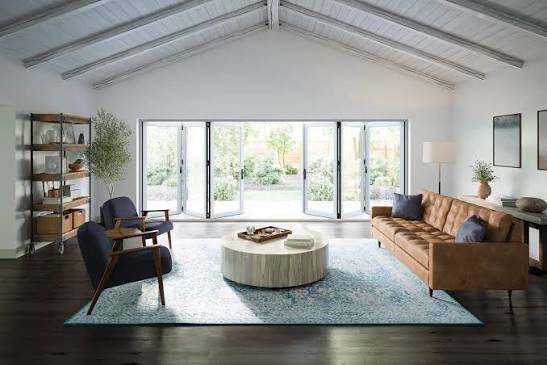
Bi-fold patio doors, also called folding patio doors, consist of multiple panels that fold against each other when opened. They create the widest opening of any patio door type — up to 90 percent of the total opening width — and are the most expensive option.
Bi-fold doors cost $2,500 to $5,000 installed for a standard three-panel configuration. Larger openings with four or five panels cost $4,000 to $8,000. The cost is driven by the complex track system, the multiple hinge points, and the heavier framing required to support the folding panels.
The main advantage of bi-fold doors is the wide, unobstructed opening they create. When fully opened, the panels stack neatly at one or both sides of the opening, leaving almost the entire opening clear. Bi-fold doors are the best choice for connecting indoor living spaces to outdoor patios, decks, and gardens in open-plan homes.
The main disadvantages are the high cost, the maintenance of the multiple hinge and track systems, and the installation complexity. Bi-fold doors require precise installation — the track must be perfectly level, and the opening must be square. An improperly installed bi-fold door binds, leaks air, and is difficult to operate.
A door installer with 22 years of experience explained: “Bi-fold doors look amazing when they are done right. But I have fixed more bi-fold installations than I have installed. The track has to be dead level, and the header has to carry the weight.”
Patio Door Frame Materials — Comparison
The frame material affects the cost, energy efficiency, maintenance, and lifespan of the patio doors replacement. The four most common frame materials are vinyl, aluminum, wood, and fiberglass.
Vinyl frames are the most popular choice for sliding patio doors. They cost the least, do not require painting, and provide good insulation with multi-chambered hollow cores. Vinyl frames last 20 to 30 years and are the best value for most homeowners. The drawbacks are limited color options — most vinyl doors are white or beige — and lower structural rigidity compared to aluminum or fiberglass.
Aluminum frames are strong, lightweight, and commonly used in contemporary homes. They cost more than vinyl but less than wood or fiberglass. Aluminum frames require thermal breaks — plastic inserts between the interior and exterior metal — to prevent heat transfer. Without thermal breaks, aluminum frames are the least energy-efficient option. Aluminum frames last 25 to 40 years.
Wood frames offer the best appearance and the highest cost. They are typically used in French doors and custom bi-fold installations. Wood frames require regular maintenance — painting or staining every two to four years — and are vulnerable to rot in humid climates. Wood frames last 30 to 50 years with proper care.
Fiberglass frames combine the strength of aluminum with the insulation of vinyl and the paintability of wood. They are the most durable frame material, resisting dents, rust, rot, and warping. Fiberglass frames cost the most — 20 to 40 percent more than vinyl — but last 40 to 60 years with minimal maintenance.
Patio Doors Replacement Cost Summary
The total cost of patio doors replacement depends on the door type, frame material, glass quality, and installation labor. The ranges below include materials and professional installation for a standard 72-by-80-inch opening.
| Door type | Vinyl frame | Aluminum frame | Wood or fiberglass
|
| Sliding (2-panel) | $800u2013$1,500 | $1,000u2013$2,000 | $1,500u2013$2,500 |
| French (2-panel) | $1,200u2013$2,000 | $1,500u2013$2,500 | $2,000u2013$3,500 |
| Bi-fold (3-panel) | $2,500u2013$4,000 | $3,000u2013$4,500 | $3,500u2013$5,000 |
Adding Low-E coated double-pane glass adds $100 to $300 to the total. Triple-pane glass adds $200 to $500. Installation labor is typically included in the quoted price for patio doors, unlike windows where labor is often separate. Confirm this before signing.
Frequently Asked Questions
How much does it cost to replace patio doors?
Patio door replacement costs $800 to $5,000 installed. Sliding doors are the cheapest at $800 to $2,500. Bi-fold doors are the most expensive at $2,500 to $5,000.
Which is better, a sliding or French patio door?
Sliding doors are better for tight spaces and budgets. French doors are better for wide access and classic style. Both are reliable when quality products are chosen.
Which patio door frame material lasts longest?
Fiberglass frames last the longest at 40 to 60 years. Aluminum lasts 25 to 40 years. Vinyl lasts 20 to 30 years. Wood lasts 30 to 50 years but requires regular maintenance.
Can I replace just the glass in a patio door?
Yes, if the frame is in good condition. Glass replacement costs $300 to $600. If the frame or track is damaged, full door replacement is the better choice.
How long does patio door installation take?
Professional installation takes four to six hours. Bi-fold doors take six to eight hours.
What is the most energy-efficient patio door type?
Sliding doors with Low-E glass are most efficient. They seal tighter than French doors.
Do new patio doors add value to a home?
New doors recover 70 to 90 percent of cost at resale. They also improve natural light.
When is the best time to replace patio doors?
Spring and fall offer the best weather for installation. Avoid extreme heat or cold, which affect the sealant and frame expansion during installation.