


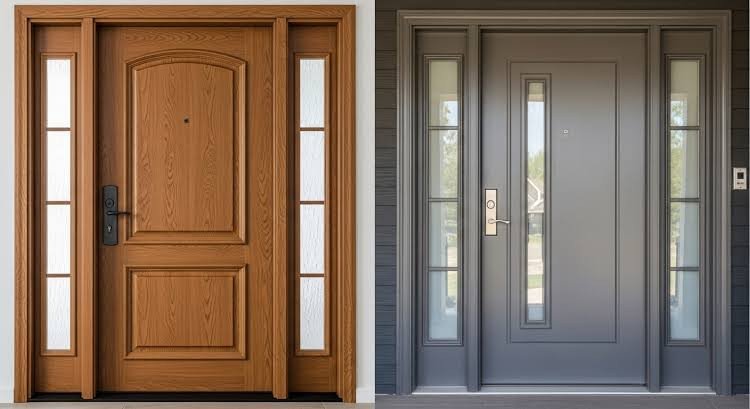
The front door is the first thing people see when they visit your house, notes New Bedford team. Yours is original from 1985, drafty in the winter, and the paint is peeling at the bottom edge. You know it needs to be replaced, but when you start looking at options, the choices are overwhelming — steel, wood, fiberglass, glass inserts, pre-hung, slab. Each type of entry door has different costs, maintenance needs, and energy performance.
A door is a movable barrier that allows access to a building (Wikipedia), and the material you choose affects everything from your energy bills to your home’s curb appeal. The four main entry door materials are steel, wood, fiberglass, and glass. Each one serves a different set of priorities.
The pros and cons of each type of entry door material vary by cost, climate, and security needs. Here is how to match the door to your priorities.
Steel Entry Doors — Security and Affordability
Steel entry doors are the most popular choice for residential front doors in North America. They offer the best security for the price, with a cost range of $400 to $1,200 installed, and provide excellent insulation when properly constructed.
A steel door consists of a steel skin bonded to a polyurethane or polystyrene foam core. The foam core provides the insulation. The steel skin provides the strength. A standard 20-gauge steel door resists forced entry better than wood or fiberglass doors of the same thickness. Higher-security doors use 18-gauge or 16-gauge steel, which is thicker and heavier.
Steel doors are the most energy-efficient option when the door has a polyurethane foam core. The R-value — a measure of insulation — for a steel door with polyurethane foam is R-5 to R-7, compared to R-2 to R-3 for a solid wood door. This difference matters in climates with extreme temperatures.
The main drawback of steel doors is dents. A steel door that gets hit by a car door, a bicycle, or a heavy object will dent permanently. The dent can be filled with auto body filler and repainted, but the repair is visible. Steel doors are also prone to rust if the paint is scratched and the metal is exposed to moisture.
A door contractor with 20 years of experience put it simply: “Steel is the best value for the money. You get security, insulation, and a reasonable price. But if you have kids throwing baseballs near the front door, you might want fiberglass.”
Wood Entry Doors — Classic Beauty with Maintenance
Wood entry doors are the traditional choice for homes where appearance is the top priority. They cost $800 to $2,500 installed and offer a warmth and character that no other material matches. Wood doors are available in mahogany, oak, cherry, walnut, fir, and pine.
Solid wood doors are made from thick planks joined with mortise and tenon joints. The best wood doors are made from vertical-grain heartwood, which resists warping better than flat-grain wood. The door is finished with multiple coats of varnish, paint, or stain to protect it from the elements.
Wood doors require the most maintenance of any entry door type. The finish must be inspected annually and reapplied every two to three years. In direct sunlight, the finish degrades faster — a south-facing wood door may need refinishing every 18 months. Water pooling at the bottom edge causes rot if not sealed properly.
The R-value of a solid wood door is R-2 to R-3, which is lower than steel or fiberglass. In cold climates, a wood door is a significant source of heat loss unless paired with a storm door. Wood doors also expand and contract with humidity changes, which can cause sticking in summer and gaps in winter.
The aesthetic advantage of wood is that it can be refinished, not just repainted. Scratches, dings, and worn areas can be sanded out and the door re-stained or re-varnished. A quality wood door can be refinished five to ten times over its lifespan, which can exceed 50 years with proper care.
Fiberglass Entry Doors — Durability and Versatility
Fiberglass entry doors combine the appearance of wood with the durability of a synthetic material. They cost $600 to $2,000 installed and are the fastest-growing category in the entry door market because they solve most of the problems that steel and wood doors have.
A fiberglass door is made from a fiberglass-reinforced polymer skin bonded to a polyurethane foam core. The skin can be molded to mimic wood grain panels, raised moldings, and even the look of a hand-carved door. From three feet away, most people cannot tell the difference between a fiberglass door and a real wood door.
Fiberglass does not dent like steel. It does not rot, warp, or split like wood. It does not rust. It handles direct sunlight, rain, snow, and salt air without degrading. The polyurethane foam core provides an R-value of R-5 to R-7, equal to steel and better than wood.
Fiberglass doors can be painted any color. They accept paint well because the factory-applied primer is formulated for adhesion. The paint lasts four to six years before needing a new coat, compared to two to three years for a steel door. Fiberglass doors can also be ordered with a factory-applied stain that mimics the look of natural wood.
The main disadvantage of fiberglass is the higher cost compared to steel. A fiberglass door with similar insulation and design features costs 30 to 50 percent more than a comparable steel door. Fiberglass is also heavier than steel, which means the hinges and frame must be robust enough to support the weight.
Glass Entry Doors — Light and Style
Glass entry doors are not a separate material category — they are steel, wood, or fiberglass doors that incorporate glass panels. The glass content of the door affects the cost, security, and energy efficiency more than the frame material.
| Glass type | Cost premium | Best for
|
| Single decorative glass | $200u2013$500 | Entry doors with sidelights, traditional style |
| Double-pane insulated glass | $300u2013$600 | Energy efficiency, climate control |
| Tempered safety glass | Required by code | All doors with glass panels |
| Low-E coated glass | $100u2013$300 | UV protection, reducing heat gain |
| Frosted or obscured glass | $100u2013$250 | Privacy without losing natural light |
Entry doors with glass panels reduce security compared to solid doors. A determined intruder can break the glass to reach the lock. Security film — a clear polyester film applied to the glass — prevents the glass from shattering and adds $50 to $150 per door. Decorative grilles between the glass panes provide the look of divided lights without the cleaning difficulty of true divided lites.
Glass doors cost $100 to $600 more than a solid door of the same material, depending on the glass type and the size of the glass area. The energy efficiency of a glass door depends on the glass type. Double-pane Low-E glass with argon fill is required for energy-efficient entry doors in most building codes.
Comparing Entry Door Materials — Side by Side
When comparing types of entry doors, the four materials differ across five key factors: cost, security, energy efficiency, maintenance, and lifespan. The table below summarizes the differences.
| Material | Cost installed | Security | R-value | Maintenance | Lifespan
|
| Steel | $400u2013$1,200 | Excellent | R-5 to R-7 | Low; repaint every 2u20133 years | 20u201330 years |
| Wood | $800u2013$2,500 | Good | R-2 to R-3 | High; refinish every 2u20133 years | 30u201350+ years |
| Fiberglass | $600u2013$2,000 | Very good | R-5 to R-7 | Low; repaint every 4u20136 years | 30u201350+ years |
| Glass (in any frame) | Varies | Lower | Varies | Low; clean glass | Depends on frame |
Steel offers the best security for the lowest price. Wood offers the best appearance but requires the most upkeep. Fiberglass is the best all-around choice for most homeowners — it looks like wood, insulates like steel, and requires little maintenance.
How to Choose the Right Entry Door for Your Home
Choosing among entry door types starts with your priorities. Security, appearance, climate, and budget each point to a different door material. Steel or fiberglass suit security needs. Wood suits appearance priorities.
Climate matters. In cold climates — USDA zones 4 and below — choose a door with a polyurethane foam core and an R-value of R-5 or higher. Steel or fiberglass with a foam core performs best. In hot and humid climates, fiberglass is the best choice because it does not warp, rot, or rust. In coastal areas with salt air, fiberglass is the only choice among the three main materials — steel rusts and wood rots in salt air.
Budget is the final factor. If the budget is under $1,000 installed, steel is the only option that provides good security and insulation. If the budget is $1,000 to $1,500, fiberglass becomes an option. Above $1,500, wood and premium fiberglass are both available. The installation cost is similar for all materials — $200 to $500 for a standard pre-hung door installation.
Frequently Asked Questions
What is the best type of entry door for a home?
Fiberglass is the best all-around choice for most homes. It offers wood-like appearance, excellent insulation, low maintenance, and good security at a mid-range price.
Which entry door material is most secure?
Steel doors are the most secure. A 20-gauge steel door with a deadbolt lock resists forced entry better than wood or fiberglass doors of the same thickness.
What is the cheapest type of entry door?
Steel doors are cheapest at $400 to $700 installed. Fiberglass starts at $600 and wood at $800.
What is the most energy-efficient entry door material?
Steel and fiberglass with foam cores are most efficient. Wood doors are significantly less efficient at R-2 to R-3.
Which entry door material lasts the longest?
Fiberglass and wood last 30 to 50 years with maintenance. Steel lasts 20 to 30 years and rusts over time.
Can a fiberglass entry door be painted?
Yes, fiberglass doors accept paint well. Paint lasts four to six years on fiberglass compared to two to three years on steel. Factory-primed fiberglass doors are ready for painting.
Do I need a storm door with an entry door?
A storm door is recommended with wood doors in cold climates. Steel and fiberglass doors do not need a storm door for insulation.
Which entry door adds the most value to a home?
Steel doors recover about 100 percent of cost in added value. Wood doors have a lower return due to higher cost.
You Might Also Like...
 Spray Foam Cost Per Square Foot: Open-Cell vs Closed-Cell, Applications, and What to Expect
 Patio Doors Replacement: Sliding, French, Bi-Fold — Costs, Materials, and What to Choose
 6 Professional Garage Door Repair Companies Covering Houston
 Sliding Doors Repair: Fix Stuck Rollers, Misaligned Tracks, and Broken Locks
