You found the perfect hardwood floor on social media. Wide planks, rich walnut stain, exactly the look you wanted. Then you called a flooring company and heard a number that made you reconsider the entire project. Eighteen dollars per square foot? Twelve? The range was so wide that you had no idea whether the quote was fair or whether you were being upsold on something you did not need.
Hardwood flooring is one of the most durable and valuable home improvements available. Properly maintained hardwood floors can last 50 to 100 years (Wikipedia). But the hardwood flooring cost per square foot varies more than almost any other flooring material because of the number of variables involved — solid versus engineered construction, wood species, grade, plank width, and installation method all shift the final price.
This breakdown covers every cost factor in hardwood flooring pricing, from the material itself to the labor and hidden expenses that inflate the final price and catch unprepared homeowners by surprise.
Solid vs engineered hardwood — the construction choice affects both the cost per square foot and the floor’s lifespan
Solid vs Engineered Hardwood — The Price Gap
The biggest decision in hardwood flooring cost per square foot is choosing between solid and engineered construction, adds Lakeway TX property management. Solid hardwood costs $5 to $12 per square foot for material. Engineered hardwood costs $4 to $10 per square foot. The choice affects not just material cost but also installation method, labor requirements, and long-term value.
Solid hardwood is a single piece of wood, typically 3/4 inch thick. It can be sanded and refinished five to seven times over its long lifespan, which means it lasts 50 to 100 years. It requires a wood subfloor and must be nailed down, which limits where it can be installed. Solid hardwood cannot go below grade — no basements — because moisture from the concrete slab causes cupping and warping.
Engineered hardwood has a thin veneer of real wood — typically 1/12 to 1/6 inch thick — bonded to a plywood or HDF core. The veneer thickness determines how many times it can be refinished. A 1/12-inch veneer can be sanded once, maybe twice. A 1/6-inch veneer can be sanded two to three times. Engineered wood can be installed over concrete slabs, in basements, and over radiant heating because the cross-layer construction resists expansion and contraction.
A flooring contractor with 20 years of experience explained the trade-off: “People ask me which is better. Solid is better if you want a floor that outlasts you. Engineered is better if you are installing over concrete or want to save a few dollars per foot. Neither is wrong.”
Wood Species and Cost — What Each Type Costs
The wood species you choose affects the total hardwood flooring cost per square foot more than any other single factor you will encounter. Domestic species are cheaper. Exotic species cost significantly more. The table below breaks down the price ranges.
| Species | Cost per sq ft | Janka hardness | Best for
|
| Red oak | $4u2013$8 | 1,290 | Most rooms, budget-friendly |
| White oak | $5u2013$9 | 1,360 | Modern style, water-resistant |
| Hickory | $5u2013$10 | 1,820 | High-traffic areas, durability |
| Maple | $5u2013$9 | 1,450 | Smooth uniform look |
| Brazilian walnut | $8u2013$14 | 3,680 | Extreme durability, exotic look |
| Brazilian cherry | $7u2013$12 | 2,350 | Rich red tones, formal spaces |
Red oak is the most popular and widely used species for hardwood flooring in North America. It costs the least, takes stain evenly, and is widely available. White oak has become more popular in the last five years because of its tighter grain and better moisture resistance — it is the same wood used in whiskey barrels.
Hickory is the hardest domestic wood species available, scoring 1,820 on the Janka hardness scale. It handles dogs, kids, and heavy furniture better than oak. The trade-off is that hickory has dramatic color variation — boards range from nearly white to dark brown in the same bundle. Some homeowners love the character. Others find it too busy.
Exotic wood species cost significantly more because of import duties, transportation costs, and slower growth cycles. Brazilian walnut is three times harder than red oak and has a dark, rich color that does not require staining. But it is difficult to work with — it dulls saw blades faster and requires predrilling for nails.
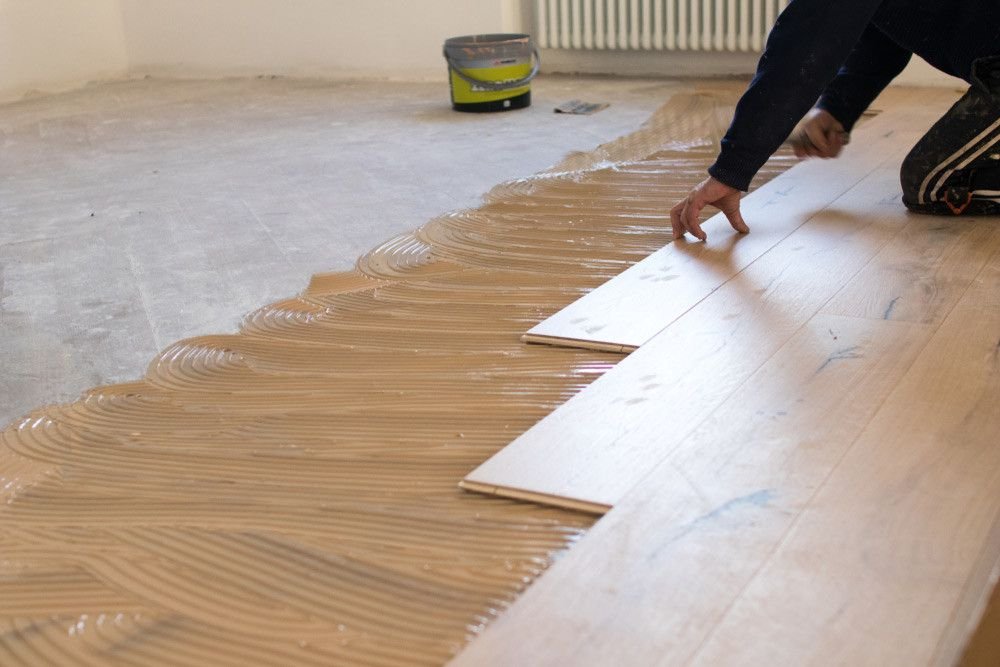
Nail-down hardwood installation — the most common method, adding $3–$5 per square foot in labor cost
Installation Labor — The Hidden Half of the Budget
Installation labor adds $3 to $8 per square foot to the hardwood flooring cost per square foot, making it 40 to 60 percent of the total project cost. The method determines the price.
Nail-down installation costs $3 to $5 per square foot and is the most common method for solid hardwood over plywood subfloors. The installer uses a pneumatic floor nailer to drive nails through the tongue of each plank at a 45-degree angle. Nail-down is the most secure method but requires a wood subfloor.
Glue-down installation costs $4 to $6 per square foot and is used for engineered hardwood over concrete slabs. Adhesive is troweled onto the concrete, and the planks are pressed into the wet glue. Glue-down requires the concrete to be clean, dry, and level. Moisture testing is mandatory — a failed test means the slab needs a moisture barrier, which adds $0.50 to $1 per square foot.
Floating installation costs $3 to $5 per square foot and is typically used for click-lock engineered planks. The planks are not attached to the subfloor. They interlock with each other and float over an underlayment. Floating floors are the easiest to install and the easiest to replace, but they do not feel as solid underfoot as nail-down or glue-down.
The step that gets skipped most often: acclimation. Hardwood needs 72 hours to adjust to the room’s temperature and humidity before installation. Skipping acclimation causes the planks to expand or contract after installation, creating gaps or buckling. One experienced installer in Atlanta told me he replaces at least one floor per year where the homeowner refused to wait for the full acclimation period.
Plank Size and Pattern — How They Change the Price
Plank width and installation pattern affect the hardwood flooring cost per square foot more than most homeowners expect. Wider planks and complex patterns add 20 to 50 percent to the total.
Standard strip flooring — 2.25 to 3 inches wide — is the most affordable and traditional option. Narrow planks are cut from smaller, younger trees that are abundant and inexpensive. Strip flooring creates a traditional, busy look with more seams and more visual lines.
Wide plank flooring — 5 to 8 inches wide — costs 20 to 40 percent more than strip flooring in the same species. Wide planks require older, larger trees that are less abundant. They also require more careful installation — wide planks are more prone to cupping and gapping if the subfloor is not perfectly level or if the wood was not properly acclimated.
Herringbone and chevron patterns add $2 to $5 per square foot in labor costs because each plank must be cut at a precise angle. These patterns also produce 15 to 20 percent more material waste than straight lay. The result is beautiful but expensive — a herringbone floor in white oak can easily cost $18 to $25 per square foot installed.
Additional Costs That Catch Homeowners Off Guard
Several costs beyond material and labor inflate the total hardwood flooring cost per square foot. These hidden expenses add $2 to $5 per square foot and are the most common source of budget overruns.
Subfloor preparation costs $1 to $3 per square foot. Old carpet, tile, or vinyl must be removed and disposed of. Damaged plywood must be replaced. Low spots must be filled with leveling compound. These costs are sometimes included in the installation quote and sometimes added after the contractor sees the subfloor condition.
Baseboard removal and reinstallation costs $1 to $2 per linear foot. New baseboards, if the old ones are damaged during removal, cost $2 to $4 per linear foot installed. Quarter-round or shoe molding adds $0.50 to $1.50 per linear foot.
Transition strips at doorways cost $15 to $50 each. A home with five doorways connecting to the new hardwood area needs five transitions, which adds $75 to $250 to the total.
Furniture moving costs $100 to $500 depending on the amount of furniture and whether the contractor handles it. Some contractors include moving furniture within the room. Others require the room to be empty before they arrive. Confirm this before signing.
Cost Comparison — Room by Room
The total hardwood flooring cost per square foot varies by room size and layout. Smaller rooms cost more per square foot because the setup and waste are similar regardless of room size.
| Room | Size | Material grade | Total installed cost
|
| Bedroom | 12×12 ft | Mid-grade oak | $900u2013$1,800 |
| Living room | 16×20 ft | Mid-grade oak | $2,000u2013$3,500 |
| Great room | 500 sq ft | Premium white oak | $5,000u2013$8,000 |
| Whole home | 1,500 sq ft | Mid-grade oak | $12,000u2013$22,000 |
| Whole home | 2,000 sq ft | Premium exotic | $25,000u2013$40,000 |
Frequently Asked Questions
What is the average hardwood flooring cost per square foot installed?
Mid-grade hardwood costs $10 to $15 per foot installed.
Is solid or engineered hardwood more expensive?
Solid hardwood costs more upfront but lasts longer. Engineered costs less initially but has a shorter lifespan and fewer refinishing opportunities.
What is the cheapest hardwood flooring option?
Engineered red oak is cheapest at $7 to $9 per square foot.
How much does hardwood installation labor cost per square foot?
Installation labor costs $3 to $8 per square foot. Nail-down is cheapest; glue-down costs the most.
How much more do wide plank floors cost?
Wide plank costs 20 to 40 percent more than strip flooring. Installation is also more labor-intensive.
What hidden costs should I expect with hardwood flooring?
Subfloor prep and trim add $2 to $5 per square foot.
Can I install hardwood flooring myself to save money?
DIY works for floating engineered floors. Nail-down solid hardwood needs professional experience to avoid costly mistakes.
Is hardwood flooring worth the cost compared to laminate or vinyl?
Hardwood flooring adds resale value to your home and can last 50 to 100 years with proper care. Laminate and vinyl cost less but must be replaced every 15 to 25 years with no resale value increase.