You cannot buy ferrock for a driveway this year. That is the honest starting point, and almost nobody writing about this material says it out loud.
Ferrock is real, the chemistry is genuinely interesting, and the carbon story beats concrete by a wide margin. But if you searched for a ferrock gravel driveway alternative because your gravel keeps ending up in the lawn, you need something you can actually order, and this article treats that as the job.
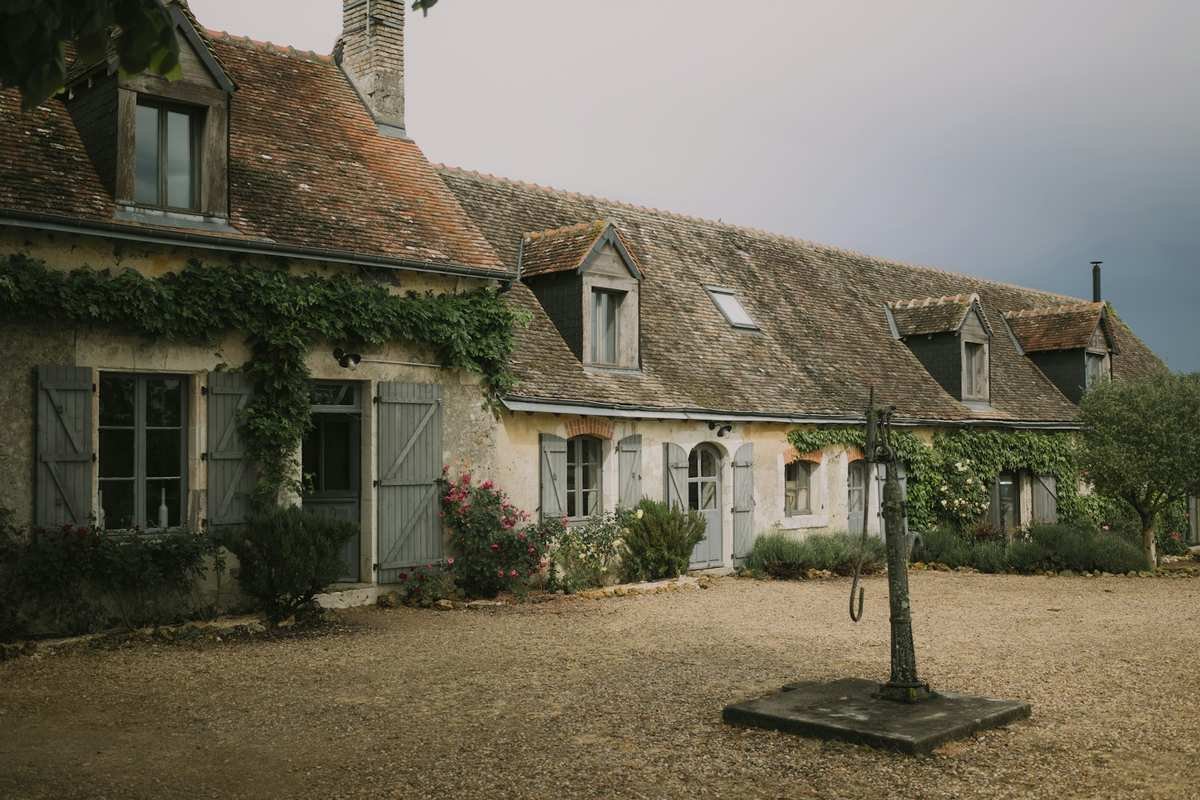
ferrock gravel driveway alternative — stone farmhouse with a compacted gravel courtyard driveway that ferrock aims to replace
Why gravel pushes people toward alternatives
Gravel fails slowly, not suddenly. The stones migrate under tires, ruts form where the wheels always track, and every storm carries a little more of your driveway toward the street, which is why so many owners start shopping for a replacement.
Homeowners who have lived with it tend to be blunt about the experience:
“I’d really recommend avoiding gravel if you can afford it. Whatever you use it will slowly migrate to everywhere around the driveway, including the pavement, next door, your house and your garden.”
– r/DIYUK, January 2026 (7 upvotes)
Concrete solves the migration problem but creates two new ones: runoff and carbon. Producing one ton of ordinary cement releases roughly a ton of CO2, and a sealed slab sends every drop of rain to the storm drain instead of the ground.
That squeeze is exactly the gap ferrock promises to fill: a hard surface without the carbon bill. Whether it can fill it for your driveway is a different question.
What ferrock actually is
Ferrock is a cement substitute made mostly from waste steel dust and ground glass, invented by David Stone during his doctoral work at the University of Arizona. Instead of releasing CO2 while curing, it absorbs the gas and locks it into iron carbonate.
The recycled content sits around 95 percent, and small-scale tests have measured compressive strength up to about five times that of ordinary Portland cement mixes. It also holds up well in salt water, which is why early pilots leaned toward marine work; the Wikipedia entry on ferrock collects the published numbers.
On paper, that reads like the perfect driveway material: harder than concrete, carbon-negative, made from things we throw away. Paper is where most of it still lives.
Where the ferrock gravel driveway alternative falls apart
The problem is supply, not science. There is no retail bag of ferrock at any building supplier, no certified residential installer network, and no published price list you could take to a contractor for a quote.
I spent an afternoon trying to find a single U.S. supplier who would quote a residential pour, and the trail dies at research pages and pilot projects every time. The material has appeared in test pours, walkway sections, and university demonstrations, not in anyone’s driveway down the street.
That creates three practical walls for a homeowner:
- No supply chain. Steel dust is an industrial byproduct, and nobody has built the collection and distribution network to sell it in driveway quantities.
- No code history. Your building department has decades of data on concrete and asphalt. A permit reviewer has nothing to check ferrock against, and some will simply say no.
- No local repair path. If a ferrock slab cracks in year five, no contractor in your area has ever patched one.
There is one more catch that the eco-marketing skips: cured ferrock is a solid surface, like concrete. If part of gravel’s appeal for you was drainage, a ferrock slab gives that up unless you design in permeable joints or borders.
None of this means the material is a scam. It means the timeline is wrong for a 2026 driveway project, and pretending otherwise wastes your season.
What to use instead while ferrock grows up
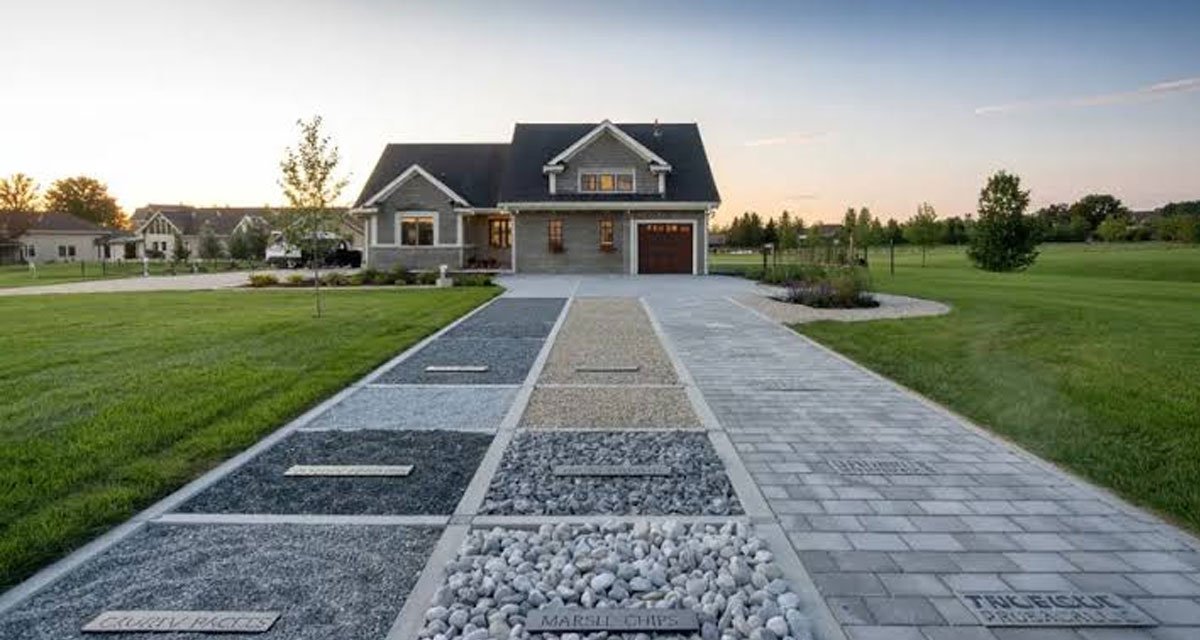
Four materials deliver most of what people want from ferrock, and every one of them can be ordered this week: grid-stabilized gravel, decomposed granite, recycled concrete aggregate, and porous asphalt. Each keeps water soaking into your ground instead of the storm drain.
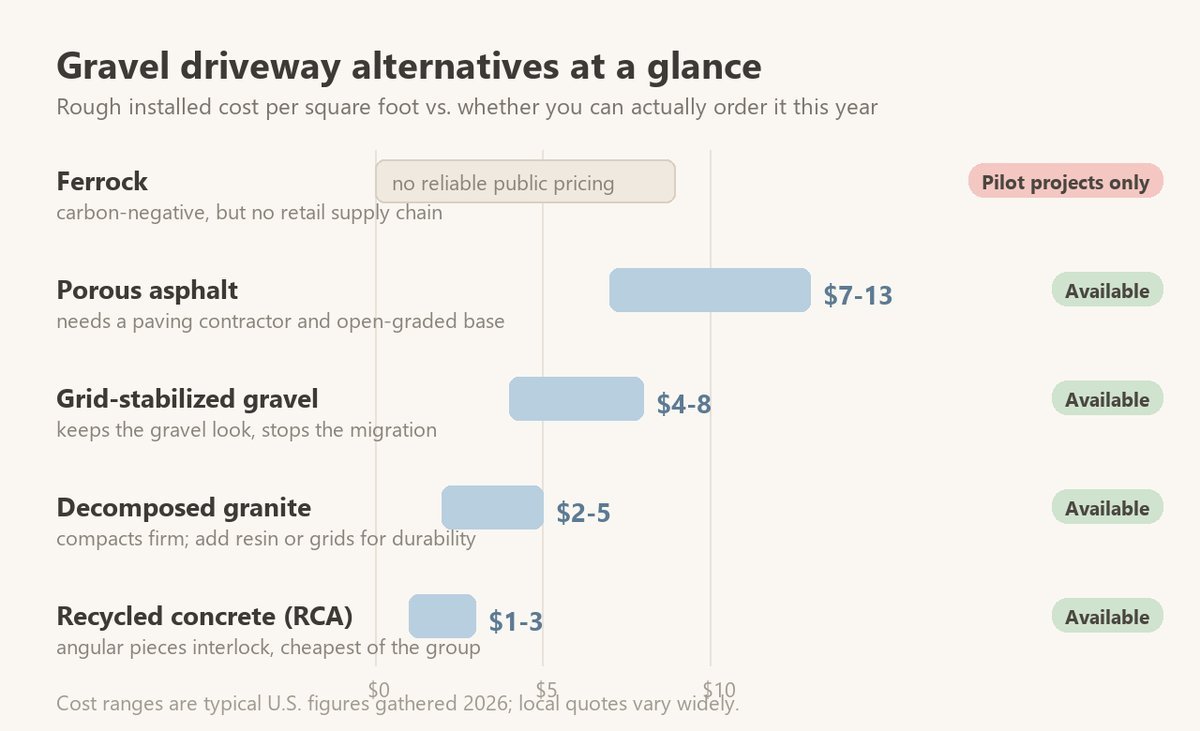
| Option | Rough installed cost/sq ft | Drains? | DIY-friendly? | Biggest drawback |
|---|---|---|---|---|
| Grid-stabilized gravel | About $4–8 | Yes | Yes, with a plate compactor | Grids add upfront cost |
| Decomposed granite | About $2–5 | Yes | Yes | Surface loosens under heavy traffic unless bound |
| Recycled concrete (RCA) | About $1–3 | Mostly | Yes | Utilitarian look, occasional dust |
| Porous asphalt | About $7–13 | Yes | No, contractor only | Needs vacuum sweeping to stay porous |
| Ferrock | No public pricing | No, solid surface | No | You cannot buy it |
Grid-stabilized gravel deserves the longest look because it fixes the exact complaint that sends people searching in the first place. Plastic cells hold each stone in place, so the surface stops migrating while keeping the look and the drainage.
Decomposed granite is the budget sleeper here. It compacts into a firm, sandy-toned surface that reads far more finished than loose gravel, and a resin binder or grid base pushes its durability close to paving.
Whichever loose material you pick, the stone shape matters more than the brand name. The landscaping crowd has settled this one:
“You want a small crushed rock. There’s lots of different colours/types of crushed rock. But the key thing is that it’s crushed. You want a flat, angular rock so it doesn’t roll around every time you look at it.”
– r/landscaping, November 2025 (10 upvotes)
Angular crushed stone locks together under compaction; rounded pea gravel never stops rolling. That single spec change costs nothing and removes half the maintenance people blame on “gravel” as a category.
How to choose for your site
Match the material to your soil, slope, and patience rather than to the greenest brochure. Clay soil, a sloped run, or a plow-in-winter climate each knock certain options off the list before price even enters the conversation.
A few decision rules cover most driveways:
- Clay or soggy soil: grid-stabilized gravel or porous asphalt over an open-graded base; loose DG will pump and rut.
- Sloped driveway: grids or porous asphalt; anything loose washes downhill in the first big storm.
- Snow plowing: porous asphalt wins because a plow blade skims it clean; loose surfaces lose stone to the snowbank every pass.
- Tight budget, flat lot: RCA base with a crushed-stone top layer is hard to beat for the money.
Permeable surfaces also do real environmental work today, not someday. The EPA’s permeable pavement guidance credits them with cutting runoff and filtering pollutants before they reach waterways.
That matters for the eco math. A driveway that recharges groundwater in 2026 arguably does more good than a carbon-negative slab you might pour in 2032.
FAQ
Is a ferrock gravel driveway alternative worth waiting for?
No, waiting is not practical because ferrock has no residential supply chain, installer network, or building-code track record, and no announced date for any of them. Pick a permeable surface you can install now and revisit ferrock when it reaches suppliers.
Is ferrock really stronger than concrete?
Small-scale tests have measured compressive strength up to about five times that of ordinary Portland cement mixes. Those results come from lab samples and pilot pours, not from decades of driveways carrying cars through freeze-thaw winters.
How much does ferrock cost?
There is no reliable public price, because ferrock is not commercially sold for residential projects. Any figure you see quoted online is an estimate built on research-batch economics, not a number a contractor will honor.
Does ferrock drain like gravel?
No. Cured ferrock forms a solid surface similar to concrete, so rain runs off rather than soaking through. A ferrock driveway would need permeable joints, borders, or drainage channels to match what gravel does naturally.
The honest verdict
Ferrock is worth rooting for and not worth planning around. If your gravel is driving you out of your mind this year, the driveway you can actually build with stabilized crushed stone or porous paving will outperform the one you can only read about.