
Both efficiency and cost reduction are the primary goals for the organization, which results in better customer experiences. Many companies use systematic improvement methods to remove waste and streamline processes to accomplish these objectives. Lean six sigma black belt training empowers professionals with advanced techniques to spearhead such efforts and achieve tangible results across the business functions.
Lean Six Sigma isn’t exclusive to manufacturing. It is now adopted across various sectors such as healthcare, finance, IT, and logistics, among others, for continuous improvement and operational excellence.
What Is Lean Six Sigma?
Lean Six Sigma is an implementation of two existing and successful methodologies:
- Lean, that is a focus on the waste and the process flow.
- Six Sigma, a method that seeks to reduce process variation and defects through the application of data-driven decision-making.
They offer a structured approach to discovering inefficiencies, tackling issues, and enhancing performance within an organization.
The methodology focuses on measurable results and constant improvement, not just one-off improvements.
Supporting Improvements Across Business Functions
Lean Six Sigma’s greatest asset is that it is flexible. The principles can be used in almost any department in an organization.
Operations
Lean Six Sigma is applied to operational teams to optimize processes, prevent delays, maximize resource utilization, and boost production efficiency.
Manufacturing
The methodology is used by manufacturers to reduce defects, enhance quality control, cut waste, and optimise manufacturing.
Healthcare
Lean Six Sigma is applied in hospitals and healthcare institutions to reduce waiting times, optimize clinical workflows and quality of services, while ensuring regulatory compliance.
Finance
Finance departments benefit from minimizing processing errors, from accurate reporting, and from streamlined approval processes.
Human Resources
Process optimization can help HR teams optimize recruitment processes, employee onboarding, training workflows, and performance management.
Information Technology
Lean Six Sigma is used by IT departments for the following purposes: to enhance service delivery, to shorten incident resolution time, and to optimize project management processes.
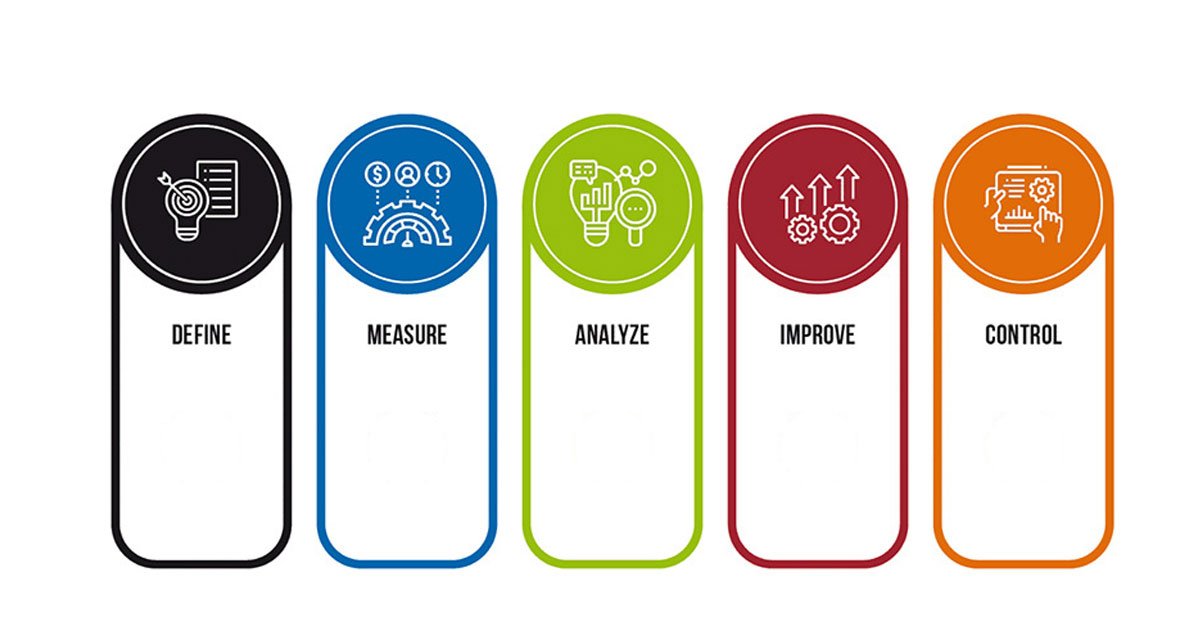
The DMAIC Framework
The DMAIC methodology is typically used in Lean Six Sigma projects:
- Define: Identify the problem, project goals, customer requirements, and expected outcomes.
- Measure: Gather pertinent information to learn about the existing process performance and set a baseline.
- Analyze: Use data analysis to identify root causes of inefficiencies, delays, or quality issues.
- Enhance: Create and execute specific solutions to problems identified.
- Control: Keep an eye on the improved process to verify that the process improvement is sustained over time.
Through this systematic process, organizations can take informed decisions based on facts and not on assumptions.
Developing Internal Improvement Leaders
Sustaining continuous improvement requires skilled professionals who can lead change across multiple departments.
Individuals who complete Lean Six Sigma black belt training are equipped to:
- Lead complex improvement projects
- Analyze business data
- Mentor Green Belt professionals
- Manage cross-functional teams
- Drive strategic process improvements
- Support organizational transformation initiatives
These leadership capabilities make Black Belt professionals valuable contributors across industries.
Why Six Sigma Certification Matters
Professional certification is evidence of understanding the Lean Six Sigma concepts and hands-on problem-solving processes.
With growing demand for process improvement skills, getting a 6 Sigma certification in India will enhance job prospects and career opportunities in manufacturing, healthcare, IT, consulting, banking, and other industries.
Certification also gives organizations assurance that improvement programs are managed by following recognized methodologies throughout the world.
Creating a Culture of Continuous Improvement
It is best that Lean Six Sigma is used as a way of life in an organization, not as a project.
Successful businesses actively promote staff members at all levels to:
- Identify improvement opportunities
- Share ideas for process optimization
- Use data to support decisions
- Collaborate across departments
- Monitor performance regularly
This culture is a way to keep businesses agile and reacting to the changing needs of the market.
Final Thoughts
Professionals aspiring to gain expertise in process improvement can gain useful insight and skills for handling operational problems through 6 Sigma certification in India. CtrlX offers an extensive Lean Six Sigma black belt training program that enables professionals to develop advanced skills in solving problems, implementing data-driven improvements, and leading transformation efforts in different areas of the organization.
CtrlX’s learning framework stresses practical aspects, DMAIC methods, and real-life improvement projects so that participants acquire the knowledge base necessary for ensuring continuous improvement and excellence in operations.
You Might Also Like...
 Sinkom Explained: The Complete Guide to Smart Integration, Coordination, and Innovation
 Autoamina: Transforming Modern Automation with Intelligent Systems
 Pappedeckel: The Sustainable Cardboard Lid Revolutionizing Global Packaging
 Konversky: The Complete Guide to AI-Powered Conversational Marketing Success
