Duolingo, Babbel, Anki, and italki top the field in 2026. The catch with any list of best apps for language learning is that the winner changes completely depending on the job you need the app to do.
best apps for language learning — learn languages desk scene with phone, laptop, and earbuds
No app makes you fluent on its own, and the sooner a list admits that, the more useful it gets. Even Wirecutter, after studying languages in 15 apps over six weeks, framed its winners by learning style rather than crowning one champion.
The picks below come from cross-referencing the major editorial tests with what learners in communities like r/languagelearning report actually using a year into their studies. Those two sources disagree more often than you would expect, and the disagreements are where the useful advice lives.
Match the App to the Job, Not the Download Charts
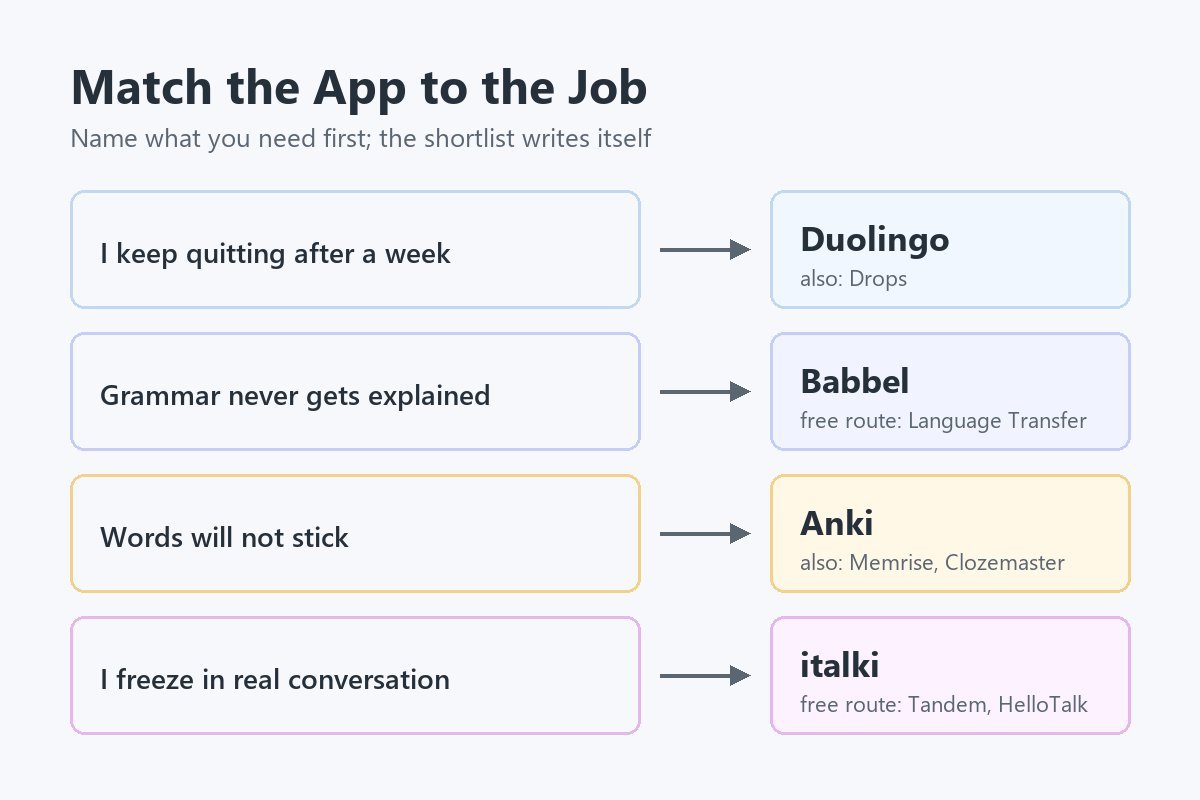
Language apps cluster into four jobs: building a daily habit, teaching grammar properly, drilling vocabulary into long-term memory, and getting you talking to humans. Name your job first, and an overwhelming market shrinks to two or three candidates.
A habit app like Duolingo can be genuinely good at keeping you showing up while being mediocre at explaining why a sentence works. A grammar course like Babbel can explain everything and still bore you into quitting by week three.
Learners who have been through several apps describe the same trap:
“The problem is that you’re kinda asking for four different things: * **Easy and fun** → apps like Duolingo and Drops try to make language learning accessible to anyone; in order to be more accessible, they also need to be more surface level or progress slower * **Immerse in the language** → apps like Migaku or tools like Yomitan help you consume media in another language; how easy or fun they are to use depends on the media you are trying to consume (and whether you know media to consume in the…”
– r/languagelearning, December 2025 (18 upvotes)
That framing explains most of the disappointment people feel with these tools. They bought a vocabulary drill and expected a speaking coach, or bought a speaking coach and expected it to build the habit for them.
The Big Names: Duolingo, Babbel, Pimsleur, and Speak
The four apps that dominate editorial rankings each earn their spot for one specific strength: Duolingo for free daily practice, Babbel for grammar instruction, Pimsleur for audio lessons, and Speak for judgment-free speaking drills.
Duolingo: the habit machine
Duolingo is a free, gamified course platform covering around 40 languages, and it remains the easiest on-ramp in the business. The streaks, leagues, and push notifications are engineered with the same techniques mobile games use, which is exactly why it works for people who have quit everything else.
Its weakness shows up around the intermediate mark. Lessons stay heavy on tap-the-word-bank exercises and light on explanation, so learners routinely report a 300-day streak alongside an inability to hold a two-minute conversation.
Use it as the habit anchor it is, on the free tier, and let something else do the teaching. The paid tier mostly removes ads and adds convenience rather than changing what the app teaches.
Babbel: grammar that gets explained
Babbel is a paid subscription course, priced around the level of a streaming service, that actually explains grammar and syntax alongside vocabulary. Wirecutter made it a top pick precisely for learners who want the theory, not just the phrases.
Dialogues are built around situations adults care about, like ordering, apologizing, and making small talk with coworkers. The trade-off is a catalog of only around a dozen languages, so learners of less common languages will need to look elsewhere.
Pimsleur: lessons for your commute
Pimsleur is an audio-first program built on roughly 30-minute spoken lessons, available for about 50 languages on a monthly subscription. You listen, you get prompted, and you answer out loud before the native speaker does.
It is the one major app you can use entirely hands-free, which makes it the default recommendation for drivers and dish-washers. Expect strong pronunciation and listening skills, and expect to need a separate tool for reading and writing.
Speak: conversation without the embarrassment
Speak is an AI conversation app that uses speech recognition to drill you on saying full sentences out loud, and Wirecutter rated it best for visual learners. The appeal is blunt: it never gets tired, never judges, and costs less than a human tutor.
AI conversation is still a rehearsal room rather than a stage. It prepares you for real exchanges without fully replacing them, so treat Speak as the bridge between silent study and an actual conversation partner.
The Apps Serious Learners Graduate Into
Past the beginner stage, the apps that keep showing up in learner communities are not courses at all: spaced-repetition tools like Anki, tutor marketplaces like italki, and immersion readers like LingQ take over the heavy lifting.
Vocabulary engines: Anki, Memrise, and Drops
Anki is a free flashcard program built on spaced repetition, the memory technique of reviewing material right before you would forget it. It is free on desktop and Android, with a one-time iOS app priced around $25 that funds development.
The interface looks like it was designed in a spreadsheet, and the first hour of setup is genuine friction. Learners tolerate both because nothing else moves vocabulary into long-term memory as efficiently, and shared decks exist for nearly every language and textbook.
Memrise softens the same idea with short video clips of native speakers saying each phrase, which does wonders for listening comprehension. Drops turns vocabulary into five-minute visual sessions, better treated as a warm-up than a curriculum.
Speaking practice: italki, Tandem, and HelloTalk
italki is a marketplace for one-on-one lessons with tutors over video call, with community tutors starting around the price of a coffee per session. Thirty minutes of stumbling through real conversation teaches you more about your actual level than a month of app exercises.
Tandem and HelloTalk are free exchange apps that pair you with native speakers who are learning your language. You correct their English, they correct your Spanish, and the built-in correction tools keep the chat honest.
The exchange apps cost nothing but pay you in proportion to your patience, since half of every session belongs to your partner’s learning. Budget learners should start there; anyone who values time over money should book the tutor.

Immersion tools: LingQ, Clozemaster, and Language Transfer
LingQ is a reading-first immersion tool that turns real articles, books, and podcasts into lessons, tracking every word you have looked up. It suits learners who are done with courses and want to live in native content with training wheels.
Clozemaster drills vocabulary inside full sentences pulled from real usage, styled like a retro game. It fills the awkward gap after a beginner course, when you know 500 words but have never met them in the wild.
Language Transfer is a completely free, donation-funded audio course that teaches through reasoning instead of memorization, and its Spanish course has a near-cult following. For a zero-budget start it embarrasses several paid competitors.
Best Apps for Language Learning, Compared
The comparison most lists skip: what each app is actually for, what the free tier really gives you, and roughly what the paid version costs. Prices shift often, so treat the figures as ballpark.
| App | Best for | Free tier | Approx. paid cost | Standout trait |
|---|---|---|---|---|
| Duolingo | Daily habit, vocabulary | Full course with ads | ~$13/month for Super | Streaks that actually stick |
| Babbel | Grammar and structure | First lesson per course | ~$8-15/month | Explains the why, not just the what |
| Pimsleur | Audio and pronunciation | 7-day trial | ~$20/month | Fully hands-free lessons |
| Speak | AI speaking drills | Limited trial | ~$15-20/month | Speech recognition feedback |
| Anki | Long-term vocabulary | Free on desktop/Android | ~$25 once on iOS | Spaced repetition, shared decks |
| Memrise | Listening + vocabulary | Core lessons | ~$8-15/month | Native-speaker video clips |
| Drops | Casual visual vocab | 5 minutes/day | ~$10/month | Zero-effort sessions |
| italki | Real conversation | Free community features | ~$5-15 per lesson | Human tutors on demand |
| Tandem / HelloTalk | Language exchange | Fully usable free | Optional premium | Native partners, mutual correction |
| LingQ | Reading immersion | Limited word lookups | ~$13/month | Turns any content into a lesson |
| Clozemaster | Vocab in context | Generous free tier | ~$8/month | Sentence-level practice |
| Language Transfer | Free structured course | Everything | Donation only | Teaches through reasoning |
| Mango Languages | Free via libraries | Free with a library card | ~$12/month without one | Practical dialogue focus |
Read the table by job and the pattern is hard to miss: the famous apps own the habit-and-course jobs, while the best speaking and vocabulary tools are cheaper, uglier, and less advertised.
Learning a Language Without Spending Anything
A complete free setup exists in 2026: Language Transfer for the course, Anki for vocabulary, Duolingo for the daily habit, and Tandem or HelloTalk for conversation. The only real cost is tolerating some rough interfaces.
The most overlooked freebie sits in your wallet. Many public libraries include Mango Languages with a library card, a fact that surfaces in nearly every Reddit thread about free learning and still surprises people every time.
Dreaming Spanish deserves a mention for Spanish learners specifically, offering hundreds of hours of free comprehensible-input video sorted by level. Its learners tend to become evangelists, which says something about the method.
What the free route cannot buy is correction. Nothing free will sit with you for thirty minutes and untangle why you keep botching the past tense, which is the single strongest argument for eventually spending money on a human.
Build a Stack, Not Just a Streak
Experienced learners almost never use one app; they run a small stack that covers course, vocabulary, input, and speaking. Two or three tools used daily beat any single subscription, including every app named above.
The pattern repeats across every community thread on the topic:
“Depends on your language, and honestly, if you try to find “the one app to learn a language”, you are missing out. Multiple specialized resources will always beat one “allrounder-app”. For me, the following things are important: \- a good online dictionary \- a discord server that focusses on the language, to connect both with natives and with fellow learners so i can use the language in a natural setting and ask questions \- anki for vocab \- some kind of grammar resources (can be youtube vide…”
– r/languagelearning, July 2025 (9 upvotes)
Three stacks that map to common situations:
- Zero-budget beginner (Spanish): Language Transfer for the course, Anki with a frequency deck, Dreaming Spanish for input, and a weekly Tandem exchange.
- Commuter with 40 minutes of driving: Pimsleur in the car, Drops in the elevator, and one italki lesson on Saturday morning.
- Intermediate learner escaping the plateau: LingQ for daily reading, Clozemaster for context vocab, and two italki sessions a week to convert input into speech.
One honest warning about habit apps: the streak can quietly become the goal. If you have ever done a 2-minute lesson at 11:58 pm purely to keep the owl happy, you already know the difference between maintaining a streak and learning a language.
Language choice changes the stack more than any ranking admits, and “depends on the language” is reliably the most upvoted answer in these threads. Spanish and French learners are spoiled everywhere, while Japanese or Korean learners should prioritize script-specific tools and expect general-purpose apps to lag behind.
FAQ About Language Learning Apps
Is Duolingo enough to actually learn a language?
No. Duolingo builds vocabulary and a durable daily habit, but by itself it will not get you to comfortable conversation. Pair it with a grammar source and real speaking practice, and it becomes a useful piece instead of a false promise.
What are the best free apps for language learning?
Language Transfer, Anki, and Tandem together form the strongest free stack: a real course, a vocabulary engine, and live conversation. Check your public library too, since many include full Mango Languages access with a card.
How long does it take to learn a language with apps?
Plan in hundreds of hours, not weeks. The US Foreign Service Institute estimates roughly 600-750 class hours for an English speaker to reach professional working proficiency in Spanish or French, and apps do not shorten that arithmetic so much as make the hours easier to show up for.
Are paid language apps worth it?
Paid apps are worth it when they buy something the free stack lacks: Babbel’s explanations, Pimsleur’s hands-free audio, or italki’s human correction. Paying for a second vocabulary drill you already have for free is where the money gets wasted.
Which app is best for speaking practice?
italki is the strongest option because a human tutor adapts, interrupts, and corrects in ways software still cannot. Speak is the best rehearsal tool before those lessons, and Tandem covers the same ground free if you trade your time.
Pick by job, spend late, and put speaking on the calendar before you feel ready. The learners who reach fluency are rarely the ones who found a perfect app; they are the ones who stopped shopping and stacked three imperfect tools that cover each other’s blind spots.