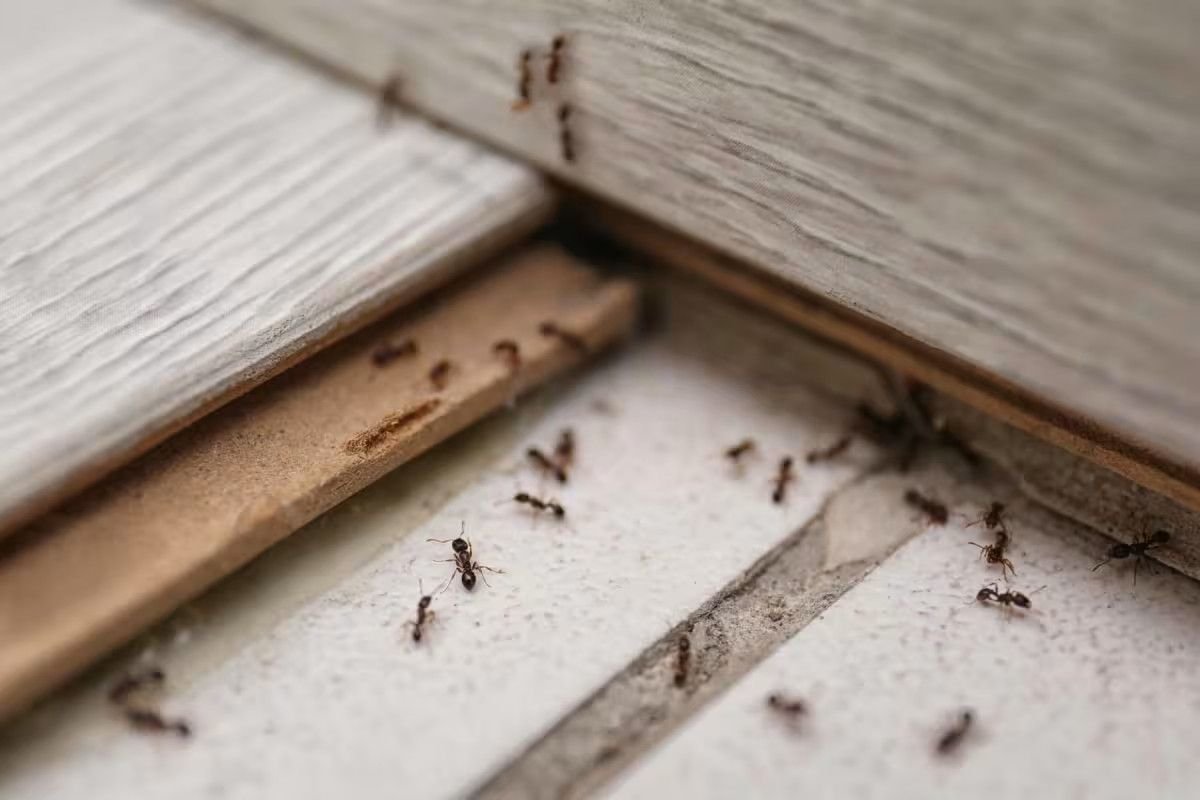
You found a trail of tiny black ants in the kitchen. Or maybe you found sawdust under a baseboard and a single large black ant. Or a mound of fire ants just appeared in the front yard overnight. The cost to get rid of ants depends almost entirely on which kind of ant you have.
Ant extermination in the U.S. costs between $150 and $500 for a one-time treatment of common household ants like odorous house ants and pavement ants. Carpenter ant treatment runs $250 to $1,000 because it requires finding and treating the nest inside the structure. Fire ant yard treatment runs $100 to $300 per application. Ongoing ant prevention through a general pest control plan runs $40 to $70 per month. Here is the breakdown by ant type and treatment method.
Cost by Ant Species: The Single Biggest Price Driver
Sugar Ants and Odorous House Ants: $150 to $300
These are the small dark ants that form trails to the kitchen counter, the bathroom sink, and anywhere food or water is available. They are the most common and least expensive ant to treat. Treatment involves gel bait placement along trails, indoor perimeter treatment, and sealing visible entry points. A single visit at $150 to $250 is usually sufficient for light to moderate infestations. A two-visit plan with a follow-up at two weeks adds $75 to $125.
If the ants keep returning to the same room after multiple treatments, the colony is outdoors and the entry point has not been found. The price increases to $250 to $350 when outdoor nest location and treatment are added to the indoor service.
Carpenter Ants: $250 to $1,000
Carpenter ants are the most expensive ant to treat because they nest inside wood structures. Unlike termites, they do not eat wood. They excavate it to create nesting galleries. The treatment requires finding the nest, which may be in a wall void, a roof soffit, a window frame, or a deck post. This takes time and experience.
Treatment involves drilling small holes into the wall or structural wood where the nest is located and injecting insecticidal dust directly into the nest cavity. This is followed by gel bait placement for satellite colonies and perimeter treatment to prevent reentry. The cost is $250 to $500 for a localized infestation in an accessible location. A widespread infestation with multiple nests, or a nest in a difficult-to-access location like a roof peak or a finished wall requiring drywall repair, runs $500 to $1,000.
Carpenter ant treatment is expensive because it is structural pest control, not general pest control. The technician is locating and treating a nest inside your walls, not just spraying a perimeter. The higher price reflects the skill, time, and liability involved.
Fire Ants: $100 to $300 per Treatment
Fire ants live outdoors in mounds and are treated entirely in the yard. Indoor fire ant infestations are rare. Treatment involves broadcast granular bait applied across the lawn to kill foraging workers and the queen, plus individual mound treatments with liquid insecticide or dust for visible mounds. A single application costs $100 to $200 for an average yard. Two to three applications per season, spaced four to six weeks apart, are standard for persistent fire ant problems.
Fire ant treatment is often sold as a seasonal program. Four to five treatments from spring through fall cost $300 to $600 for the full season. This is the most common purchase rather than a single treatment, because fire ant queens can repopulate a treated yard within weeks if neighboring properties are not treated.
Pharaoh Ants: $250 to $500
Pharaoh ants are the tiny pale yellow ants that are the hardest to eliminate because colonies split when stressed. Treatment requires professional-grade non-repellent baits applied across multiple rooms over multiple visits. Spraying any insecticide makes the problem worse by triggering budding.
Treatment typically requires three to four visits over six to eight weeks. Total cost runs $250 to $500. In multi-unit buildings, all affected units must be treated simultaneously, which makes this a building management expense rather than an individual tenant expense. Consumer treatment of pharaoh ants in an apartment almost always fails because untreated adjacent units repopulate the treated unit.
One-Time vs. Recurring Ant Control
A one-time treatment at $150 to $300 solves most common ant problems permanently if the entry points are sealed afterward. Ants are outdoor insects that enter homes in search of food and water. Block the entry and the problem does not return. A one-time treatment combined with sealing is the right choice for sugar ants, pavement ants, and most seasonal ant invasions.
While sealing cracks and using DIY baits can help manage minor issues, some regions experience higher levels of pest activity due to local environmental factors. In these areas, consistent monitoring and seasonal treatments are often necessary to keep colonies from establishing themselves inside the structure. Professional Pest control in Topeka can provide a thorough assessment of a property’s specific vulnerabilities and implement more robust barriers. This proactive approach helps reduce the risk of recurring invasions and supports long-term indoor comfort without the need for constant homeowner intervention or repeated chemical applications throughout the year.
Recurring ant control at $40 to $70 per month makes sense when the ant pressure is continuous. This includes homes in warm climates where ants are active year-round, homes with persistent carpenter ant activity from surrounding wooded areas, and homes where fire ants reinvade from untreated neighboring properties. The monthly fee covers quarterly perimeter treatments, bait station monitoring, and free service calls between scheduled visits if ants reappear.
Local environmental shifts can also heavily influence how quickly colonies rebound in certain regions. For example, homeowners dealing with stubborn desert infestations often require specialized intervention to establish an enduring barrier around their property line. Seeking professional pest control in Las Cruces can help identify structural entry points early, reducing the likelihood of recurring ant invasions and maintaining long-term household comfort.
For most single-family homes in seasonal climates, a one-time treatment in spring when ants first appear, combined with sealing entry points, is more cost-effective than a monthly plan. Paying $40 per month for a year is $480. A one-time spring treatment at $200 plus $15 in caulk and door sweeps is $215. The outcome is the same for standard sugar ants. Recurring plans become the better value only when ants return multiple times per year despite sealing.
DIY vs. Professional: The Ant Treatment Cost Comparison
DIY ant treatment costs $20 to $50. This buys a tube of gel bait like Advion or Terro at $10 to $20, a bag of diatomaceous earth at $10 to $15, and silicone caulk for sealing at $5 to $10. This is the same gel bait professionals use and the same sealing technique. Applied correctly, DIY solves sugar ant and pavement ant problems for a fraction of the professional cost.
DIY is not appropriate for carpenter ants. Carpenter ant nests inside walls require drilling and dust injection that needs professional equipment and experience. Guessing wrong about the nest location means drilling multiple holes in your walls with no result and paying for drywall repair on top of a professional visit. If you have carpenter ants, start with a professional inspection at $75 to $150. This is cheaper than the drywall repair from a failed DIY attempt.
DIY is also not appropriate for pharaoh ants. Consumer ant baits often contain fast-acting insecticides that cause colony budding. What was a single trail in the kitchen becomes multiple trails in the kitchen, bathroom, and laundry room. The $20 you saved on DIY bait costs you a $400 professional treatment that now has to treat three times the area.
Factors That Change the Ant Treatment Price
Home size. Ant treatment is less sensitive to square footage than flea or roach treatment because ants form distinct trails rather than infesting every square foot of carpet. A 3,000-square-foot home costs only slightly more than a 1,500-square-foot home for sugar ant treatment because both homes have the same number of kitchens, bathrooms, and entry points. Carpenter ant treatment scales more with square footage because larger homes have more potential nest locations.
Number of nests. For carpenter ants, this is the primary price driver. A single nest in a deck post is a $300 job. Three satellite colonies in the roof soffits, the garage wall, and the kitchen window frame is a $900 job. The inspection determines how many nests are present.
Access difficulty. Carpenter ant nests in finished walls that require cutting and repairing drywall add $200 to $400 for the repair work. Nests in roof peaks or second-story soffits that require ladder work add $50 to $100. Nests in accessible crawl spaces or unfinished basements cost less.
Location. High-cost cities add 20 to 40 percent to the national averages. A $200 sugar ant treatment in Atlanta is a $280 treatment in San Francisco. Fire ant treatment is most common and competitively priced in the southeastern United States where the ants are endemic.
Frequently Asked Questions
Why is carpenter ant treatment so much more expensive?
Carpenter ant treatment is structural pest control. The technician must locate the nest inside your walls, which requires experience interpreting ant behavior, using moisture meters and infrared cameras, and sometimes drilling exploratory holes. Treatment involves injecting insecticidal dust directly into the nest cavity. This is fundamentally different from perimeter spraying for sugar ants. The labor is more skilled, the liability is higher, and the time required is longer. A sugar ant treatment takes 30 minutes. A carpenter ant treatment takes one to three hours.
Does regular pest control include ants?
Yes. General pest control plans at $40 to $70 per month cover the most common ants including odorous house ants, pavement ants, and Argentine ants. Carpenter ants, fire ants, and pharaoh ants are typically excluded from general plans and billed as specialty services. Read the pest list in your contract. If carpenter ants are not listed, they are not covered, and treating them will cost extra.
Is ongoing ant prevention worth the monthly cost?
For most homes in seasonal climates, no. A spring treatment plus sealing entry points prevents ants for the entire season. Paying monthly for ant prevention when ants are only active for four to five months out of the year is paying for coverage you do not need. Ongoing plans are worth it in warm climates where ants are active year-round, in homes with a history of multiple ant invasions per year, and for properties surrounded by wooded areas or untreated neighboring yards that provide continuous ant pressure.