With the partial government shutdown of the Department of Homeland Security (DHS) now stretching past the 30-day mark, the pressing question for many Americans is simple: when will it end? The Senate has tried and failed four times to pass a funding bill, leaving the public to grapple with growing airport delays and uncertainty.
The next opportunity for a vote could come as early as today, Monday, March 16, as the Senate returns to session. This article breaks down the timeline of the shutdown, the political stalemate at its heart, the real-world consequences for Americans, and what to expect next in the ongoing effort to reopen the government.
A Timeline of Failed Votes: How We Got Here
The path to the current stalemate is marked by a series of failed attempts in the Senate to pass HR 7147, the House-passed bill to fund the Department of Homeland Security. Each vote failed to achieve the 60 votes necessary to overcome the Senate’s procedural hurdles.
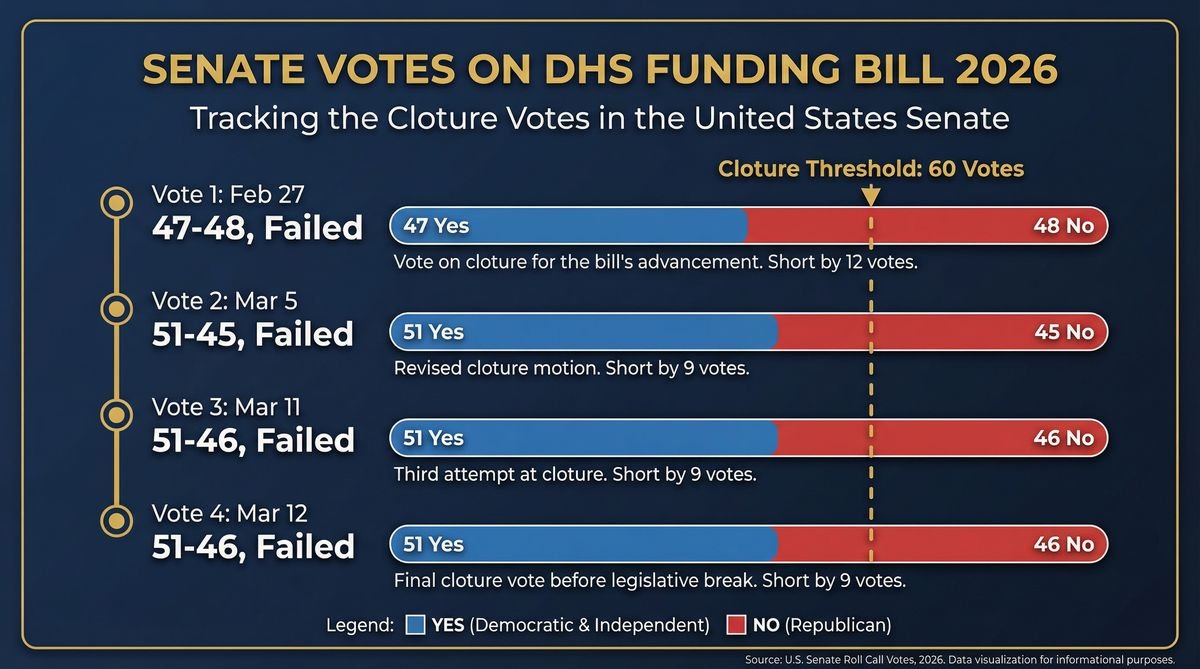
Here is a summary of the key votes that have taken place:
| Vote # | Date | Vote Count | Outcome |
|---|---|---|---|
| 1 | Feb. 27, 2026 | 47-48 | Failed to reach 60-vote threshold |
| 2 | Mar. 5, 2026 | 51-45 | Failed to reach 60-vote threshold |
| 3 | Mar. 11, 2026 | 51-46 | Failed to reach 60-vote threshold |
| 4 | Mar. 12, 2026 | 51-46 | Failed to reach 60-vote threshold, Sen. Fetterman (D-PA) was the only Democrat to vote yes. |
This consistent failure to break the deadlock highlights the deep divisions in the Senate and the fundamental disagreement over the attached policy reforms to the funding bill.
The 60-Vote Hurdle: Why Can’t a Simple Majority End the Shutdown?
Many observers wonder why the Senate can’t pass the funding bill with a simple majority. The answer lies in a Senate procedure known as the filibuster, which allows a minority of senators to delay or block a vote on a measure. To end this delay, the Senate must invoke “cloture,” a process that requires a supermajority of 60 votes.
In the current highly polarized environment, neither party controls a 60-seat majority, making bipartisan cooperation essential to pass most major legislation. Because the DHS funding bill is a contentious piece of legislation with significant policy disagreements, it has been unable to garner the 60 votes needed to overcome the filibuster and proceed to a final up-or-down vote. This procedural requirement is the central legislative obstacle prolonging the shutdown.
The Sticking Point: What Are Republicans and Democrats Arguing About?
The deadlock over the DHS funding bill stems from a fundamental disagreement on immigration enforcement reforms. The current crisis was ignited by the killing of Alex Pretti by Customs and Border Protection (CBP) agents in January 2026, which led Democrats to demand significant changes to the agency’s operations.
The Democratic Position: A Push for Accountability
Senate Democrats, led by Minority Leader Chuck Schumer and top appropriator Senator Patty Murray, are insisting on a series of reforms to rein in what they describe as reckless and dangerous behavior by Immigration and Customs Enforcement (ICE) and CBP. Their proposals include requiring judicial warrants for property entry, mandating body cameras and standardized uniforms, and prohibiting agents from wearing masks.
“We will not vote to help Republicans spend one more dime letting Stephen Miller terrorize American cities,” Senator Murray stated, emphasizing the Democratic stance against what they see as an overreach of federal power. Democrats have offered to pass funding for other DHS agencies like TSA and FEMA separately, but Republicans have blocked these efforts, insisting on a comprehensive funding package.
The Republican Position: A Focus on Security
Republicans, under the leadership of Senate Majority Leader John Thune, argue that the Democratic proposals would hamstring law enforcement and compromise national security. They contend that the focus should be on providing full, uninterrupted funding for the entire Department of Homeland Security, especially amid heightened global threats.
Republicans have accused Democrats of using the shutdown as a “political pawn” and have rejected attempts to pass piecemeal funding bills. They maintain that the security of the nation should not be held hostage to policy debates and that the existing laws provide sufficient oversight for federal law enforcement agencies.
Real-World Impact: How the DHS Shutdown Affects You
The political standoff in Washington has tangible consequences that are being felt across the country. The partial shutdown of the Department of Homeland Security is not an abstract political debate; it has real-world impacts on travel, disaster preparedness, and the federal workforce.
TSA and Airport Delays
The most visible effect for many Americans has been at the nation’s airports. With Transportation Security Administration (TSA) agents working without pay, there has been a significant increase in unscheduled absences. This staffing shortage, combined with the start of the busy spring break travel season, has led to extraordinarily long security lines at major airports, with some travelers reporting waits of up to three hours.
FEMA and Disaster Relief
The shutdown is also straining the Federal Emergency Management Agency (FEMA). The agency’s Disaster Relief Fund is at a critically low level, with only about $5 billion remaining. This has forced FEMA to scale back on long-term rebuilding projects to conserve funds for immediate emergency response, a concerning development as the nation faces the potential for natural disasters.
Other DHS Agencies
Other critical DHS functions are also impacted. The U.S. Coast Guard continues its essential operations, but its members are not receiving pay. The Secret Service is also affected, and the popular Global Entry program for expedited customs screening has been suspended, further inconveniencing international travelers.
How Long Will the Shutdown Last? What the Prediction Markets Say
With no clear end in sight from Washington, some are turning to prediction markets for clues on how long the government shutdown might last. These markets, such as Kalshi and Polymarket, allow users to bet on the outcomes of future events, and their odds can provide a data-driven, if not definitive, forecast.
As of mid-March, traders on these platforms are not optimistic about a swift resolution. The consensus forecast suggests the shutdown will last between 57 and 59 days. The odds indicate a 94% probability that the shutdown will continue past March 21 and a 57% chance it will last until at least April 15. These predictions reflect the deep-seated political stalemate and the lack of any apparent progress in negotiations.
External pressures could eventually force a compromise. The upcoming FIFA World Cup in June, which will bring a massive influx of international visitors, is seen as a potential deadline that could compel lawmakers to act to avoid major disruptions to travel and security.
Frequently Asked Questions (FAQ)
What is the current status of the government shutdown?
As of March 16, 2026, the Department of Homeland Security has been in a partial shutdown for over 30 days. Essential services continue, but many federal employees are working without pay.
When is the next vote to end the shutdown?
The Senate reconvened on Monday, March 16, and a vote could occur at any time. However, no specific time for the next vote has been officially scheduled.
Why is the government shut down?
The shutdown is the result of a political impasse over Democratic demands for reforms to Immigration and Customs Enforcement (ICE) and Customs and Border Protection (CBP) following a fatal shooting by CBP agents.
What is the 60-vote rule?
It is a Senate procedure that requires a supermajority of 60 votes to end a filibuster and move forward with a vote on a bill. It is the primary legislative obstacle to ending the current shutdown.
How does this shutdown compare to the longest in US history?
The longest government shutdown in US history was 43 days in 2025. The current shutdown is on track to approach or exceed that record if a resolution is not reached soon.
Conclusion
The partial government shutdown of 2026 continues with no immediate end in sight. The political stalemate, rooted in a deep disagreement over immigration enforcement reforms, has proven to be a formidable obstacle. The requirement for a 60-vote supermajority in the Senate to break the deadlock means that a bipartisan compromise is the only path forward.
While the Senate could vote again at any time, the success of any future vote remains uncertain. Until a deal is reached, Americans can expect continued disruptions to travel and a strain on essential government services. The coming days will be critical in determining whether lawmakers can find common ground or if the shutdown will set a new and unwelcome record in American political gridlock.