Refinancing a mortgage involves replacing an existing home loan with a new one, often to secure more favorable terms such as a lower interest rate, reduced monthly payments, or a different loan structure. This financial decision can significantly impact a homeowner’s long-term financial health, making it essential to understand the various factors that indicate whether it is an opportune time to pursue a refinance.

Understanding Mortgage Refinancing
Mortgage refinancing is the process of paying off your current home loan by taking out a new one, typically with different terms. This can be a strategic financial move for homeowners looking to adjust their loan conditions to better suit their current financial situation or market environment.
When you refinance, you are essentially applying for a new mortgage. The new loan then pays off your old one. The terms of the new loan, such as the interest rate, repayment period, and monthly payments, may differ from your original mortgage. The decision to refinance is often driven by a desire to achieve specific financial goals, such as reducing overall interest costs, lowering monthly payments, or accessing home equity.
Key Indicators: When Refinancing Makes Sense
Several key financial and personal circumstances can signal an opportune moment to consider refinancing a mortgage, including significant drops in interest rates, improvements in personal credit scores, or a desire to alter the loan’s duration or type.
Homeowners often evaluate refinancing when they observe changes in the economic landscape or their personal financial standing. These indicators can help determine if a refinance will yield substantial benefits.
Lower Interest Rates
One of the most common reasons to refinance is a notable drop in prevailing interest rates. If current mortgage rates are significantly lower than the rate on your existing loan, refinancing could lead to substantial savings over the life of the loan and reduce your monthly payments. Financial experts often suggest that a rate reduction of at least 0.5% to 0.75% can make refinancing worthwhile, though some may consider a 1% or 2% drop as a more definitive trigger [1] [2]. For example, reducing a $250,000 loan at 6% to 5% could save approximately $157 per month, totaling over $56,000 in interest over a 30-year term [1].
Improved Credit Score
A higher credit score can significantly impact the interest rate you qualify for. If your credit score has improved since you originally took out your mortgage, you may be eligible for better loan terms and a lower interest rate. Lenders view borrowers with higher credit scores (often 780 or above) as less risky, which can translate into more favorable offers [2].
Desire to Shorten or Lengthen Loan Term
Refinancing can allow you to adjust the length of your mortgage. Switching from a 30-year to a 15-year mortgage, for instance, can drastically reduce the total interest paid over the loan’s lifetime, even if it increases your monthly payment. Conversely, extending the loan term can lower monthly payments, providing more financial flexibility, though it may increase the total interest paid over time [1] [2].
Switching Loan Types
For homeowners with an adjustable-rate mortgage (ARM), refinancing into a fixed-rate mortgage can provide stability and predictability, especially if interest rates are expected to rise. A fixed-rate loan ensures that your principal and interest payments remain constant for the life of the loan, protecting you from potential rate increases [1].
Accessing Home Equity
A cash-out refinance allows you to convert a portion of your home equity into liquid cash. This can be a valuable option for funding major expenses such as home renovations, college tuition, or consolidating high-interest debt. With a cash-out refinance, you take out a new mortgage for a larger amount than your current outstanding balance, receiving the difference in cash [1] [2]. For example, if you have a $300,000 mortgage and your home is worth $400,000, you might refinance for $320,000 and receive $20,000 in cash, assuming an 80% loan-to-value ratio [3].
Eliminating Private Mortgage Insurance (PMI)
If you have a conventional loan and your home equity reaches 20% (either through principal payments or increased home value), refinancing can help you eliminate Private Mortgage Insurance (PMI). PMI is typically required when you make a down payment of less than 20% and adds to your monthly housing costs. Refinancing to remove PMI can reduce your overall monthly payment [1] [2].
Financial Benefits of Refinancing
The primary financial advantages of refinancing a mortgage include securing a lower interest rate, reducing monthly payments, shortening the loan term to save on total interest, and leveraging home equity for other financial needs.
Refinancing offers several potential financial benefits that can improve a homeowner’s financial standing. These benefits are often the driving force behind the decision to refinance.
| Benefit | Description | Potential Impact |
|---|---|---|
| Lower Interest Rate | Reduces the percentage charged on the loan principal. | Decreased monthly payments and significant savings over the loan term. |
| Reduced Monthly Payments | Lowering the principal and interest portion of your payment. | Improved cash flow and greater financial flexibility. |
| Shorter Loan Term | Paying off the mortgage in a shorter timeframe. | Substantial savings on total interest paid and faster debt freedom. |
| Cash-Out Equity | Borrowing against the accumulated equity in your home. | Funds for home improvements, debt consolidation, or other large expenses. |
| Eliminate PMI | Removing Private Mortgage Insurance from your monthly payment. | Lower overall housing costs. |
When Refinancing May Not Be the Right Choice
Despite its potential advantages, refinancing is not always the optimal financial decision and may be ill-advised if current interest rates are higher, if the homeowner plans to move soon, or if they are already far into their existing loan term.
It is crucial to assess your individual circumstances and market conditions before committing to a refinance. There are several scenarios where refinancing might not be beneficial:
Higher Interest Rates
If current mortgage rates are higher than your existing rate, refinancing would likely increase your monthly payments and the total interest paid over time. In such cases, it generally does not make financial sense to refinance [2].
Planning to Move Soon
Refinancing involves closing costs, which can range from 2% to 6% of the loan amount [3]. If you plan to sell your home within a few years, you may not stay in the property long enough to recoup these upfront costs through monthly savings. The
break-even point calculation is essential here to determine if the savings will outweigh the costs before you move [2].
Using Savings for Non-Essential Spending
While a cash-out refinance can provide funds, using these funds for non-essential spending, such as vacations or luxury items, can put your home at financial risk. It is generally advisable to use cash-out funds for investments that can increase your net worth or provide a return, such as home improvements or debt consolidation [2].
Far into Your Loan Term
If you are already well into your mortgage term, say past the midpoint, refinancing to a new 30-year loan can reset the amortization schedule. This means you could end up paying more interest over the life of the new loan, even if you secure a lower interest rate, because you are extending the repayment period [2].
Applying for Other Credit Soon
A mortgage refinance involves a hard credit inquiry, which can temporarily lower your credit score by a few points. If you plan to apply for other significant credit, such as a car loan or another mortgage, in the near future, refinancing might negatively impact your ability to secure favorable terms on those new loans [2] [3].
The Costs Involved in Refinancing
Refinancing a mortgage is not without costs, as it involves various fees similar to those incurred when originating the initial mortgage, typically ranging from 2% to 6% of the new loan amount.
Just like your original mortgage, refinancing comes with closing costs. These fees cover the administrative and legal expenses associated with processing a new loan. Understanding these costs is vital for accurately assessing the financial viability of a refinance.
| Cost Category | Description | Typical Range (as % of loan) |
|---|---|---|
| Origination Fee | Fee charged by the lender for processing the loan application. | 0.5% – 1.5% |
| Appraisal Fee | Cost for a professional appraisal to determine the home’s current market value. | $300 – $600 |
| Title Insurance | Protects the lender and borrower against future claims to the property’s title. | 0.5% – 1.0% |
| Credit Report Fee | Cost to pull your credit report and scores. | $20 – $50 |
| Recording Fee | Fee paid to the local government to officially record the new mortgage. | Varies by location |
| Attorney/Closing Fee | Fees for legal services and handling the closing process. | $500 – $1,500 |
These closing costs can typically range from 2% to 6% of the total loan amount [3]. For a $300,000 loan, this could mean paying between $6,000 and $18,000 in upfront fees. It is crucial to factor these costs into your decision-making process.
Calculating Your Break-Even Point
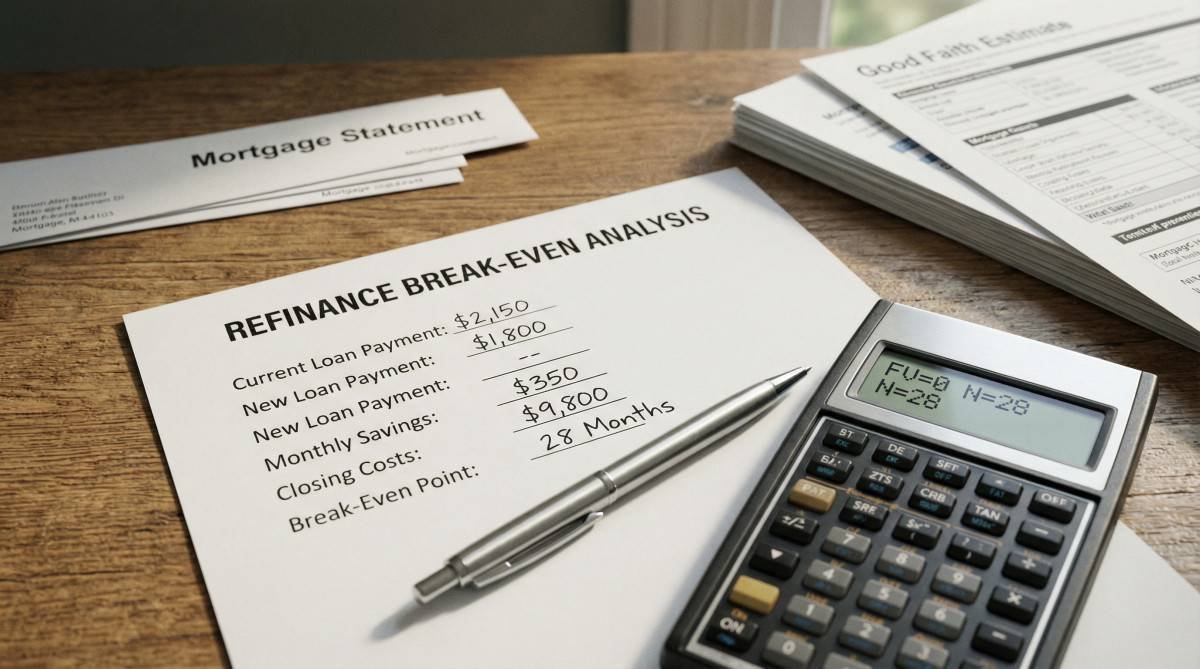
The break-even point in refinancing refers to the duration it takes for the savings generated by the new mortgage to offset the initial closing costs, serving as a critical metric for determining the financial benefit of the refinance.
To determine if refinancing is financially advantageous, you need to calculate your break-even point. This is the point in time when the money you save each month from your new, lower mortgage payment equals the total amount you paid in closing costs. If you plan to stay in your home longer than your break-even point, refinancing is likely a good financial move.
The formula for calculating the break-even point is:
Total Closing Costs ÷ Monthly Savings = Months to Break Even
For example, if your closing costs are $6,000 and your new mortgage saves you $263 per month, your break-even point would be approximately 22.8 months ($6,000 ÷ $263 ≈ 22.8). This means you would need to stay in your home for at least 23 months to recoup your refinancing costs [2].
The Mortgage Refinancing Process
The mortgage refinancing process generally mirrors the original mortgage application, involving steps such as choosing a lender, submitting an application with financial documentation, obtaining a home appraisal, and finally, closing on the new loan.
Understanding the steps involved in refinancing can help you navigate the process smoothly and avoid surprises:
- Choose a Lender: You can work with your current mortgage provider or shop around for new lenders to compare rates and terms.
- Submit Application and Documentation: Similar to your initial mortgage, you will need to provide financial documents such as pay stubs, W-2s, bank statements, and tax returns.
- Home Appraisal: A new appraisal will be conducted to determine your home’s current market value, which impacts the loan-to-value ratio for your new mortgage.
- Underwriting: The lender will review your application, credit history, and financial documents to assess your eligibility and risk.
- Closing: If approved, you will sign new loan documents, and the new mortgage will pay off your old one.
It is important to note that while you might skip a mortgage payment or two during the transition, interest continues to accrue on your loan [1].
Frequently Asked Questions
How does refinancing a mortgage work?
Refinancing a mortgage involves replacing your existing home loan with a new one, typically to obtain better terms like a lower interest rate or different repayment schedule.
How soon can you refinance a mortgage?
The waiting period to refinance varies by loan type and lender, with some conventional loans allowing immediate refinancing, while FHA and VA loans often require a waiting period of 210-212 days [1].
Is now a good time to refinance?
The optimal time to refinance depends on current interest rates, your credit score, financial goals, and how long you plan to stay in your home, making it a highly individualized decision.
Does refinancing hurt your credit score?
Refinancing typically involves a hard credit inquiry, which can cause a small, temporary dip in your credit score, but consistent on-time payments on the new loan can help it recover [3].
What documents do I need to refinance my mortgage?
Common documents required for refinancing include pay stubs, W-2s, bank statements, tax returns, and details about your current mortgage and property [3].
Conclusion
Deciding when to refinance your mortgage is a significant financial decision that requires careful consideration of various factors. By understanding the current interest rate environment, evaluating your personal financial situation, and calculating the break-even point, homeowners can make an informed choice that aligns with their long-term financial goals. Whether it’s to secure a lower interest rate, reduce monthly payments, shorten the loan term, or access home equity, a well-timed refinance can provide substantial benefits. Conversely, being aware of situations where refinancing may not be advantageous is equally important to avoid unnecessary costs or financial risks. Consulting with a mortgage professional can provide personalized guidance to help determine the most favorable course of action for your unique circumstances.
References
[1] Rocket Mortgage. “When should I refinance my mortgage? Key signs.” https://www.rocketmortgage.com/learn/should-i-refinance
[2] Bankrate. “When Should You Refinance Your Mortgage?” https://www.bankrate.com/mortgages/when-to-refinance/
[3] TransUnion. “When To Refinance Your Mortgage.” https://www.transunion.com/blog/credit-advice/is-now-a-good-time-to-refinance-my-home