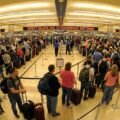
The line hasn’t moved in twenty minutes. Your boarding time is in forty. Somewhere ahead, a single TSA lane is processing what looks like three flights’ worth of passengers, and the officer who was working the second lane just disappeared into a back corridor. This scene — frustratingly familiar to anyone who flies regularly — is no longer a bad-luck anomaly. It’s a symptom of a deepening TSA staffing crisis at airports across the country.
The Transportation Security Administration workforce has been stretched thin by a compounding mix of chronic underpay, relentless burnout, post-pandemic attrition, and the long shadow of federal budget instability. Airport security checkpoint delays that once spiked only during holidays have become routine at major hubs and regional airports alike.
What’s driving the shortage, which airports are bearing the worst of it, how federal employee retention and attrition became a structural emergency, and what — if anything — Congress and the Department of Homeland Security are doing about it are all questions worth examining carefully. Practical strategies for navigating air travel disruptions caused by understaffing round out the picture.
What Is the TSA Staffing Crisis and Why Is It Happening Now?
The Transportation Security Administration workforce shortage is the product of years of compounding failures — low pay, brutal working conditions, budget instability, and a pandemic that accelerated departures faster than hiring could keep pace. The result is a federal agency responsible for screening roughly 2.5 million passengers daily that has chronically struggled to keep enough officers on the floor to do it safely and efficiently.
Low Pay and Competition From Private Sector Security
For most of TSA’s existence, Transportation Security Officers were explicitly excluded from the General Schedule pay system that covers virtually every other federal employee. That exclusion wasn’t a technicality — it meant TSA officers earned less than comparably graded federal workers, with fewer protections and weaker collective bargaining rights.
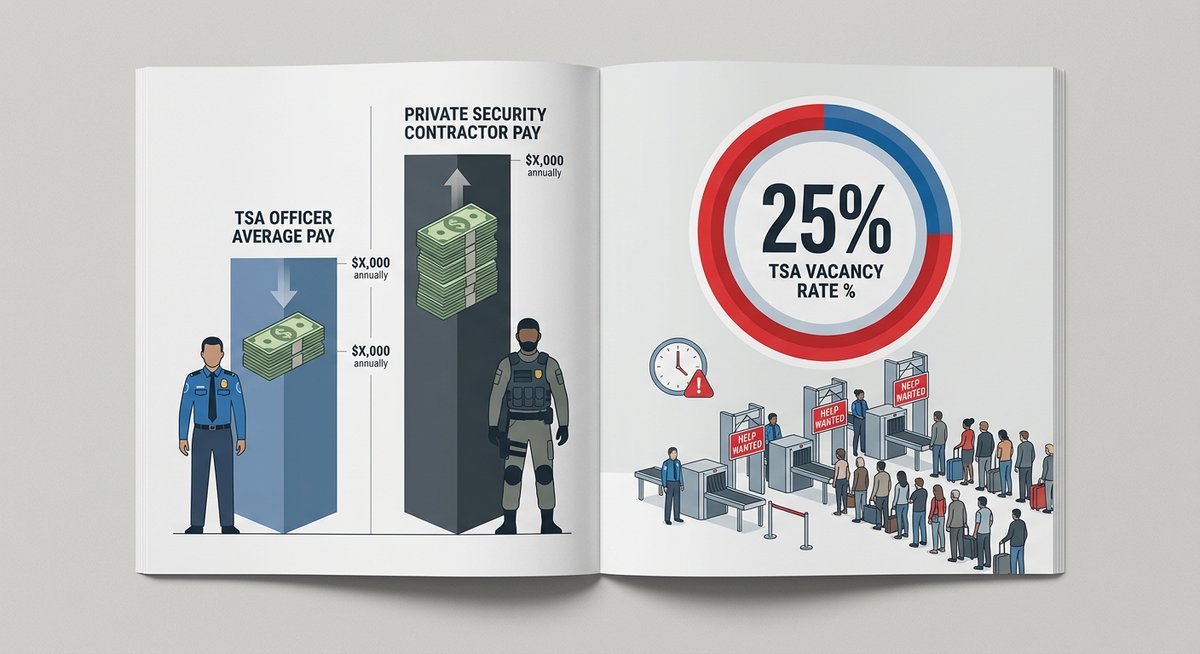
Starting salaries for TSA officers have historically hovered around $36,000 to $46,000 annually, depending on location and pay band. Private airport security contractors, by contrast, often offer comparable or higher base wages without the federal bureaucracy, making recruitment a genuine contest TSA frequently loses. According to the American Federation of Government Employees, TSA’s annual turnover rate has reached as high as 20% in recent years — roughly double the federal workforce average.
The pay gap doesn’t just hurt recruitment. It poisons retention. Officers who gain experience and training have every incentive to take that expertise to a private employer willing to pay more for it.
| Employment Type | Estimated Starting Pay (Annual) | Federal Benefits Eligible | Collective Bargaining Rights |
|---|---|---|---|
| TSA Transportation Security Officer | ~$36,000–$46,000 | Yes (limited) | Restricted (pre-2023) |
| GS-equivalent Federal Employee | ~$46,000–$56,000 | Yes (full) | Yes |
| Private Airport Security Contractor | ~$38,000–$52,000 | Varies by employer | Varies by employer |
Burnout, Attrition, and the Post-Pandemic Exodus
Checkpoint work is physically demanding and psychologically grinding. Officers stand for hours, absorb passenger frustration daily, and operate in loud, high-pressure environments with little autonomy. Burnout isn’t a fringe experience in this workforce — it’s a structural feature.
When COVID-19 collapsed air travel in 2020, TSA offered voluntary separation incentives to reduce payroll. Many experienced officers took them. When passenger volumes rebounded sharply in 2021 and surged through 2022 and 2023, TSA was left trying to rebuild a depleted workforce against a labor market that had tightened considerably. Federal employee retention and attrition data from the Office of Personnel Management confirmed that TSA consistently ranked among the lower-scoring agencies in employee satisfaction surveys during this period.
The hiring pipeline simply couldn’t absorb the demand. Background checks, training requirements, and onboarding timelines mean a new TSA officer isn’t checkpoint-ready for roughly four to six months after their application date. That lag turns every resignation into a staffing hole that takes half a year to fill — and meanwhile, passenger volumes keep climbing.
Which Airports Are Most Affected by TSA Understaffing?
The Transportation Security Administration workforce shortage hits hardest at the nation’s busiest hubs, where checkpoint lanes close during peak hours and standard 30-minute wait times balloon past 90 minutes. Chicago O’Hare, Atlanta Hartsfield-Jackson, Los Angeles International, Miami International, and Dallas/Fort Worth consistently rank among the airports with the most severe airport security checkpoint delays — but the problem extends well beyond those marquee names.
Major Hubs Reporting the Longest Security Wait Times
Atlanta Hartsfield-Jackson International Airport processes more passengers annually than any other airport in the world, making every staffing gap exponentially more disruptive. When a single checkpoint lane goes dark due to call-outs, the ripple effect reaches gates across two concourse terminals within minutes.
Chicago O’Hare International Airport has reported recurring peak-hour closures at its Terminal 1 and Terminal 3 checkpoints, particularly on Friday afternoon departure surges. According to TSA’s own wait time data published on its What to Expect at the Airport portal, O’Hare regularly posts standard lane wait times exceeding 45 minutes during morning banks — roughly double the TSA’s own 30-minute benchmark.
Los Angeles International Airport and Miami International Airport face a compounding problem: both operate in high cost-of-living metros where federal employee retention and attrition rates are especially punishing. Officers who complete TSA training frequently leave for private security contractor roles or local law enforcement positions that offer higher base pay and better benefits — a pattern TSA’s own workforce data has flagged repeatedly.
| Airport | Peak Standard Lane Wait (Reported) | Primary Staffing Pressure |
|---|---|---|
| Atlanta Hartsfield-Jackson (ATL) | 60–90 minutes | Volume throughput, high turnover |
| Chicago O’Hare (ORD) | 45–75 minutes | Peak-hour lane closures |
| Los Angeles International (LAX) | 45–60 minutes | Cost-of-living attrition |
| Miami International (MIA) | 40–70 minutes | Federal employee retention failures |
| Dallas/Fort Worth (DFW) | 35–60 minutes | Rapid passenger volume rebound post-pandemic |
Regional and Mid-Size Airports Feeling the Squeeze
Smaller airports absorb the staffing crisis differently — and in some ways, more severely. A major hub can redistribute officers across multiple checkpoints when someone calls out sick. A regional airport running two or three officers per shift has no such cushion.
Airports like Raleigh-Durham International, Salt Lake City International, and Memphis International have each reported instances where a single unplanned absence forced a full checkpoint shutdown during morning departure windows, triggering air travel disruptions that cascaded into missed connections at downstream hubs. One missing officer at a small airport can mean a 30- to 50-percent reduction in checkpoint throughput, and there’s no backup team waiting in the wings.
Historical Context — TSA Staffing Levels Since 9/11
The Transportation Security Administration workforce has never operated at a steady state. Since the agency’s founding, it has cycled through rapid expansion, politically driven contraction, and crisis-level attrition — a pattern that explains why the current shortage feels both sudden and entirely predictable.
From Post-9/11 Surge to Sequestration Cuts
Congress passed the Aviation and Transportation Security Act in November 2001, and TSA stood up a federal screening workforce of roughly 60,000 officers within a single year — one of the fastest civilian hiring surges in U.S. government history. That speed came with tradeoffs: compensation structures were set outside the standard General Schedule pay scale, a decision that would haunt federal employee retention and attrition efforts for two decades.
The Budget Control Act of 2011 set the stage for what came next. When sequestration cuts took effect in 2013, TSA absorbed hundreds of millions in budget reductions, forcing checkpoint hour reductions and officer furloughs at airports nationwide. Air travel disruptions spiked that spring, with wait times stretching past 90 minutes at major hubs before Congress partially restored funding under public pressure.
| Period | Approximate TSA Workforce | Key Driver |
|---|---|---|
| 2002 (post-9/11 buildup) | ~60,000 officers | Aviation and Transportation Security Act |
| 2013 (sequestration) | Reduced via furloughs and attrition | Budget Control Act cuts |
| 2020 (pandemic low) | Significant voluntary separation losses | COVID-19 travel collapse |
| 2022–2023 (recovery gap) | Hiring lagged behind demand rebound | Post-pandemic travel surge |
Pandemic Disruption and the Recovery Gap
When COVID-19 collapsed air travel demand in 2020, TSA offered voluntary separation incentives and early retirement packages to reduce payroll costs. Thousands of experienced officers took those deals. That institutional knowledge walked out the door permanently.
Travel demand rebounded sharply through 2021 and into 2022 — faster than nearly every industry forecast anticipated. TSA’s airport security checkpoint delays worsened almost immediately, because the agency couldn’t backfill departures fast enough against a labor market now offering far more competitive wages elsewhere. According to the TSA, the agency screened over 850 million passengers in fiscal year 2023, approaching pre-pandemic volumes, while still operating with a workforce depleted by pandemic-era attrition.
The boom-and-bust cycle is the real story here. Every contraction — sequestration, shutdown, pandemic — strips away officers who don’t return. Each recovery starts from a lower baseline than the last.
Government and Legislative Response to the TSA Workforce Crisis
Congress took its most significant step toward resolving the Transportation Security Administration workforce crisis in 2022, when lawmakers passed legislation granting TSA officers full Title 5 federal employee pay parity — a change long demanded by labor advocates. The fix was overdue by roughly two decades. Whether it arrives in time to reverse chronic federal employee retention and attrition trends remains an open question.
The TSA Workforce Reform Act and Pay Parity Legislation
The TSA Workforce Reform Act, signed into law as part of the fiscal year 2023 omnibus spending package, formally moved TSA officers onto the General Schedule pay system — ending the agency’s use of a separate, lower-wage compensation structure that had been in place since 2001. According to the Transportation Security Administration, the change was projected to raise officer pay by an average of roughly 30 percent, directly targeting one of the root drivers of airport security checkpoint delays caused by understaffing.
The Department of Homeland Security also increased TSA’s hiring and retention budget in subsequent appropriations cycles, funding signing bonuses and expanded recruitment pipelines. Still, implementation has been uneven across facilities.
| Legislative Action | Year | Key Impact on TSA Workforce |
|---|---|---|
| Aviation and Transportation Security Act | 2001 | Created TSA; placed officers under separate pay authority below GS scale |
| Budget Control Act (Sequestration) | 2013 | Triggered staffing reductions and furloughs across TSA checkpoints |
| TSA Workforce Reform Act (FY2023 Omnibus) | 2022 | Granted full Title 5 GS pay parity; average ~30% pay increase for officers |
Pay parity addresses the recruitment side of the equation. It does less, at least immediately, for the burnout and air travel disruptions driven by years of accumulated understaffing. The TSA still faces a pipeline problem — training new officers takes months, and high-volume hubs like Chicago O’Hare and Los Angeles International cannot absorb demand surges overnight simply because salaries improved on paper.
The most quotable fact here is also the most damning: TSA operated for over twenty years as a federal law enforcement-adjacent agency while paying its frontline workforce below the standard federal civilian pay scale. Fixing that structural inequity is necessary. It is not, by itself, sufficient.
How to Navigate Airports During TSA Staffing Shortages
Travelers can’t fix the TSA staffing crisis at airports, but they can adapt to it. A few adjustments to timing, preparation, and program enrollment can shave significant frustration off the security experience — even when checkpoint lines are at their worst.
Arrive Earlier and Check Real-Time Wait Data
The TSA publishes estimated wait times through its MyTSA app and website, broken down by airport and time of day. Checking these numbers before leaving for the airport gives a much clearer picture than guessing. During active staffing shortages, adding at least 30 extra minutes beyond your usual buffer is a reasonable baseline — and an hour isn’t excessive at high-volume hubs like ATL or ORD during morning departure banks.
Off-peak windows still exist even during staffing crunches. Midday departures (11 a.m. to 2 p.m.) and late evening flights tend to face shorter security queues because passenger volume drops between the morning and afternoon surges.
Enroll in TSA PreCheck or CLEAR
TSA PreCheck lanes are typically shorter than standard lanes and move faster because enrolled passengers skip shoe removal, laptop unpacking, and liquid bag checks. Enrollment costs $78 for five years and is available at over 200 airports. CLEAR, a private biometric screening service, offers expedited identity verification at participating airports and pairs effectively with PreCheck for the fastest throughput possible.
Neither program eliminates wait times entirely during severe understaffing, but both meaningfully reduce exposure to the worst of the airport security checkpoint delays.
Pack Smart and Stay Flexible
- Consolidate liquids in a single quart-sized bag before arriving — fumbling at the conveyor belt slows the entire line.
- Wear easy-to-remove shoes if you don’t have PreCheck. Lace-up boots in a staffing shortage line are a recipe for stress.
- Check airline rebooking policies before travel. If a missed flight due to security delays is a possibility, knowing your airline’s same-day standby or rebooking options in advance prevents a second scramble at the gate.
- Monitor government shutdown news. Federal funding lapses are the single fastest trigger for TSA staffing drops, and they typically make headlines days before the deadline.
Frequently Asked Questions
Why is TSA short-staffed at airports right now?
Multiple factors are converging: decades of below-market pay that only recently received a legislative fix, high burnout and attrition rates among frontline officers, lingering workforce losses from the COVID-19 pandemic, and recurring federal budget instability including government shutdowns. The TSA hiring pipeline also takes four to six months per new officer, making rapid recovery difficult even when funding is available.
Which airports are most affected by the TSA staffing shortage?
Major hubs like Atlanta Hartsfield-Jackson, Chicago O’Hare, Los Angeles International, Miami International, and Dallas/Fort Worth consistently report the longest airport security checkpoint delays during staffing shortages. Regional airports such as Raleigh-Durham, Salt Lake City, and Memphis are also heavily impacted because they operate with minimal staffing margins and cannot absorb even a single call-out without disruption.
How long are TSA security wait times during a staffing crisis?
Standard lane wait times at major airports can stretch from 45 minutes to over 90 minutes during acute staffing shortages, compared to the TSA’s 30-minute benchmark. At smaller airports, full checkpoint shutdowns can occur, potentially causing delays of an hour or more until replacement officers arrive.
What is the TSA doing to fix the staffing shortage?
The most significant reform was the 2022 TSA Workforce Reform Act, which granted officers full General Schedule pay parity — raising salaries by an estimated 30 percent on average. The Department of Homeland Security has also funded signing bonuses, expanded recruitment campaigns, and increased the TSA hiring budget. Implementation remains uneven across facilities, and the training pipeline lag means results take months to materialize at checkpoints.
How does the TSA staffing crisis affect airport safety?
The TSA has maintained that security standards have not been lowered despite staffing shortages. However, longer lines and officer fatigue raise legitimate concerns about screening thoroughness. The American Federation of Government Employees has publicly warned that chronic understaffing increases the risk of errors at checkpoints. The agency relies on technology upgrades and overtime shifts to bridge gaps, but neither substitutes fully for adequate staffing levels.
What Comes Next for TSA Staffing
The TSA staffing crisis at airports is not a sudden emergency — it’s the predictable result of twenty years of structural underpayment, boom-and-bust workforce planning, and federal budget brinkmanship. Pay parity legislation was a necessary correction, but reversing two decades of attrition patterns takes more than a single law. The hiring pipeline is slow, institutional experience cannot be rebuilt overnight, and passenger volumes show no sign of retreating.
For travelers, the practical reality is straightforward: arrive earlier, use available tools like MyTSA and PreCheck, and stay alert to government funding timelines that directly affect checkpoint staffing. For policymakers and DHS budget planners, the question is whether sustained funding and improved working conditions can finally stabilize a workforce that has never been given the resources to match its mission. The answer will be measured in checkpoint wait times for years to come.