In an era of increasing environmental concerns and aging municipal infrastructure, the quality of the water flowing from your tap is no longer something that can be taken for granted. From the “forever chemicals” known as PFAS to lead leaching from old pipes and the emerging threat of microplastics, the list of potential contaminants in our drinking water is growing. While municipal water treatment plants do their best to meet safety standards, they are often not equipped to remove these modern pollutants. This has made home water filtration systems an essential investment for any health-conscious family. In this comprehensive guide, we will explore the latest innovations in water filtration, from the gold standard of reverse osmosis to whole-house systems that protect every tap in your home.
The State of Tap Water: Why Home Filtration is No Longer Optional
Answer Capsule: Aging infrastructure and emerging contaminants like PFAS and microplastics have made home water filtration essential for ensuring safe, high-quality drinking water, explains the Service Star Realty Mesa team. By installing a dedicated filtration system, you can remove up to 99% of harmful pollutants, protect your family’s health, and significantly reduce your reliance on environmentally damaging bottled water.
The reality of modern tap water is more complex than most people realize. While the Safe Drinking Water Act sets standards for many contaminants, it does not cover everything. Emerging pollutants like PFAS (Per- and Polyfluoroalkyl Substances), which are used in everything from non-stick cookware to firefighting foam, have been found in the water supplies of millions of Americans. These “forever chemicals” do not break down in the environment and have been linked to a range of health issues, including cancer and immune system disruption. Additionally, aging lead pipes in many cities continue to pose a risk of heavy metal contamination, especially in older homes.
According to the Environmental Working Group (EWG), their Tap Water Database has identified more than 300 contaminants in U.S. tap water, many of which are present at levels that exceed health-based guidelines. Beyond the health risks, the environmental impact of bottled water is staggering, with billions of plastic bottles ending up in landfills and oceans every year. By choosing a high-quality home filtration system, you are not only protecting your family’s health but also taking a stand for the environment. It is a one-time investment that provides peace of mind and crystal-clear water for years to come.
| Contaminant Type | Common Sources | Health Risks | Best Filtration Tech |
|---|---|---|---|
| PFAS (Forever Chemicals) | Industrial runoff, consumer products | Cancer, immune disruption | Reverse Osmosis, Activated Carbon |
| Lead & Heavy Metals | Aging pipes, industrial waste | Neurological damage, developmental issues | Reverse Osmosis, Ion Exchange |
| Microplastics | Degraded plastic waste | Unknown long-term effects | Ultrafiltration, Reverse Osmosis |
| Chlorine & VOCs | Municipal treatment, pesticides | Taste/odor issues, respiratory irritation | Activated Carbon Block |
1. Reverse Osmosis (RO): The Gold Standard for Pure Water
Answer Capsule: Reverse osmosis (RO) systems use a semi-permeable membrane to remove up to 99% of all contaminants, including fluoride, lead, and arsenic. By incorporating a multi-stage process that includes sediment and carbon filtration, RO systems provide the highest level of water purity for your home.
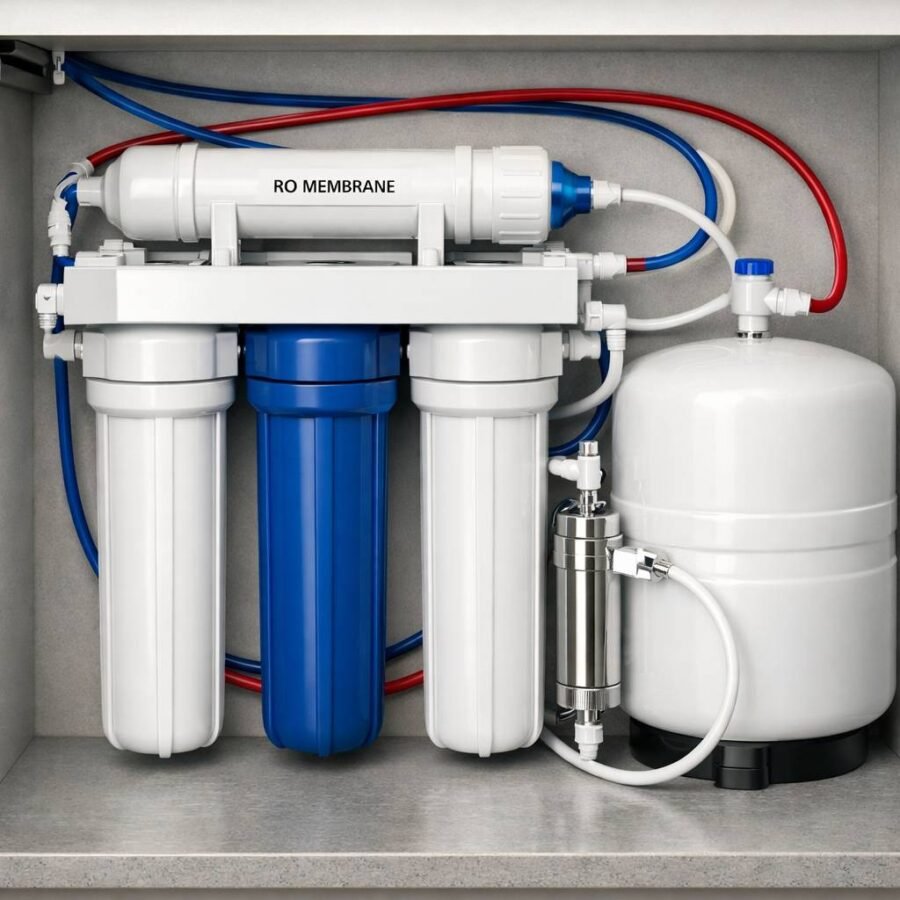
Reverse osmosis is widely considered the gold standard for home water filtration. The process works by forcing water through a semi-permeable membrane with microscopic pores that are small enough to block almost all contaminants while allowing pure water molecules to pass through. A typical multi-stage RO system includes a sediment pre-filter to remove large particles, an activated carbon filter to remove chlorine and VOCs, and the RO membrane itself. Some systems also include a post-carbon filter to polish the water’s taste and a remineralization stage to add back essential minerals like calcium and magnesium.
The remineralization stage is a critical but often overlooked component of a high-quality RO system. Because RO is so effective at removing contaminants, it also removes the natural minerals that give water its taste and provide health benefits. Adding these minerals back into the water not only improves its flavor but also helps to balance its pH, making it more alkaline and less acidic. Whether you choose a countertop RO system for a rental or an under-sink RO system for a permanent home, you can be confident that you are providing your family with the cleanest, safest water possible. According to NSF International, RO systems are certified to remove a wide range of health-related contaminants, including lead, arsenic, and fluoride.
2. Whole-House Water Filtration: Protecting Every Tap
Answer Capsule: Whole-house water filtration systems treat water at the point of entry (POE) to protect your plumbing, appliances, and skin. By removing chlorine, heavy metals, and sediment from every tap in your home, these systems provide a comprehensive solution for clean water throughout your entire living space.
While point-of-use filters are excellent for drinking water, a whole-house water filtration system provides a more comprehensive solution. These systems are installed at the main water line where it enters your home, ensuring that every drop of water—from the shower to the washing machine—is filtered. This is especially important for removing chlorine and chloramines, which are commonly used by municipal treatment plants but can be harsh on your skin and hair. Chlorine can also dry out your skin and cause respiratory irritation when inhaled in the shower.
Beyond the health benefits, whole-house filtration also protects your home’s plumbing and appliances. Sediment pre-filters remove sand, silt, and rust that can clog pipes and damage water heaters, dishwashers, and washing machines. Some systems also use KDF media to remove heavy metals and prevent the growth of bacteria and algae within the filter. When compared to the cost of replacing individual pitcher filters every few months, a whole-house system is often a more cost-effective long-term solution. By investing in a whole-house system, you are not only protecting your family’s health but also extending the life of your home’s most expensive appliances.
3. Targeted Solutions: Under-Sink and Countertop Filters
Answer Capsule: Point-of-use (POU) filters provide high-quality drinking water without the need for extensive plumbing modifications. By incorporating activated carbon block technology and ultrafiltration (UF), these targeted solutions can remove taste and odor, as well as many health-related contaminants.
For many homeowners, a point-of-use filter is the most practical and cost-effective solution for clean drinking water. Under-sink water filters are installed directly on the cold water line under the kitchen sink and provide filtered water through a dedicated faucet. These systems often use activated carbon block technology to remove chlorine, VOCs, and many health-related contaminants. Some systems also incorporate ultrafiltration (UF), which uses a hollow fiber membrane to remove bacteria and viruses without the need for a storage tank or wastewater.
Countertop water filters are another popular option, especially for renters or those who don’t want to perform any plumbing modifications. These systems sit on the kitchen counter and connect to the faucet with a simple diverter valve. While they may not be as powerful as an RO system, they are excellent for removing taste and odor and providing high-quality drinking water for a fraction of the cost. Many countertop filters also incorporate ion exchange technology to remove heavy metals like lead and mercury. By choosing a targeted solution, you can enjoy clean, safe drinking water without the need for a major home renovation.
4. Understanding Certifications: NSF/ANSI Standards
Answer Capsule: A guide to the most important water filter certifications, including NSF 42, 53, 58, and 401, is essential for choosing a high-quality system. These certifications ensure that the filter has been independently tested and verified to remove the contaminants it claims to remove.
When choosing a water filtration system, it’s important to look for NSF/ANSI certifications. These standards are developed by NSF International and the American National Standards Institute (ANSI) to ensure that water filters are safe and effective. NSF 42 is the standard for aesthetic effects, such as taste and odor, while NSF 53 is the standard for health-related contaminants like lead, PFAS, and arsenic. NSF 58 is the standard for reverse osmosis systems, and NSF 401 is the standard for emerging contaminants like pharmaceuticals and microplastics.
It’s important to note that “tested to NSF standards” is not the same as “NSF certified.” A certified product has been independently tested and verified by a third-party organization like NSF or IAPMO, while a product that has only been “tested” may not have undergone the same rigorous evaluation. By choosing a certified product, you can be confident that the filter will perform as advertised and provide your family with the highest level of protection. Always check the manufacturer’s website or the NSF database to verify a product’s certification status before making a purchase.
5. Smart Water Filtration: The Future of Home Hydration
Answer Capsule: Exploring IoT-connected systems that monitor water quality and filter life in real-time is the next step in home water filtration. By incorporating real-time TDS monitoring and leak detection, these smart systems can alert you to hidden problems and integrate with home automation systems for maximum efficiency.
The future of home water filtration is not just about cleaning water; it’s about monitoring it. Smart water filtration systems use sensors to track water quality and filter life in real-time, providing you with up-to-the-minute information through a smartphone app. This includes Total Dissolved Solids (TDS) monitoring, which measures the concentration of dissolved minerals and contaminants in your water. Some systems also incorporate leak detection, which can alert you to even the smallest leaks and automatically shut off the water supply if a major leak is detected.
Beyond simple water conservation, smart filtration systems can also help you reduce plastic waste. By providing you with accurate information about when to change your filters, these systems ensure that you are always using a fresh filter and not wasting money on unnecessary replacements. Additionally, many smart systems can be integrated with home automation systems like Amazon Alexa or Google Home, allowing you to monitor your water usage and filter life with simple voice commands. By choosing a smart filtration system, you are not just upgrading your home; you are contributing to a more resilient and sustainable future for your community.
Frequently Asked Questions (FAQ)
- Q1: What is the best water filtration system for a home?
- A: The best water filtration system for a home depends on your specific water quality and budget. For the highest level of purity, a reverse osmosis (RO) system is the gold standard, as it can remove up to 99% of all contaminants. For a more comprehensive solution, a whole-house water filtration system treats water at the point of entry to protect every tap in your home. For a more practical and cost-effective solution, a point-of-use (POU) filter like an under-sink or countertop system provides high-quality drinking water without the need for extensive plumbing modifications.
- Q2: Does reverse osmosis remove all minerals?
- A: Yes, reverse osmosis is so effective at removing contaminants that it also removes the natural minerals that give water its taste and provide health benefits. This is why many high-quality RO systems include a remineralization stage to add back essential minerals like calcium and magnesium. Adding these minerals back into the water not only improves its flavor but also helps to balance its pH, making it more alkaline and less acidic.
- Q3: How much does a whole house water filter cost?
- A: The cost of a whole-house water filtration system can vary widely depending on the type of system and the complexity of the installation. A basic sediment and carbon filter can cost between $500 and $1,500, while a more advanced system with KDF media and UV sterilization can cost $2,000 to $5,000 or more. Additionally, professional installation can add $500 to $1,500 to the total cost. However, when compared to the cost of replacing individual pitcher filters every few months, a whole-house system is often a more cost-effective long-term solution.
- Q4: Are water filter pitchers actually effective?
- A: Water filter pitchers are excellent for removing taste and odor, such as chlorine, but they are not as effective as RO or whole-house systems at removing health-related contaminants like lead, PFAS, and arsenic. Most pitchers use a simple activated carbon filter that can become clogged over time, reducing its effectiveness. If you are concerned about health-related contaminants, it’s best to choose a more advanced filtration system that is certified to remove the specific pollutants in your water.
- Q5: How often should I change my water filters?
- A: The frequency with which you should change your water filters depends on the type of filter and the volume of water you use. Most pitcher filters should be changed every 2 to 3 months, while under-sink and countertop filters should be changed every 6 to 12 months. RO membranes typically last 2 to 3 years, while whole-house filters can last 1 to 5 years or more depending on the media. Always check the manufacturer’s recommendations and monitor your water’s taste and flow rate to determine when it’s time for a replacement.
Conclusion: Investing in Your Family’s Health
Investing in a home water filtration system is one of the most important steps you can take to protect your family’s health and the environment. By adopting a clean water mindset, you shift from reacting to expensive problems to proactively preserving your home’s most critical resources. The strategies outlined in this guide—understanding the state of tap water, choosing the right filtration technology, understanding certifications, and exploring smart filtration—are not isolated tasks but interconnected components of a holistic home water care system. A few hours of maintenance each year can prevent thousands of dollars in future repairs and add a decade or more to the life of your plumbing system. Protect your investment, and it will continue to protect you.