What would you sacrifice to save your own life? A simple necklace? A precious ring? What about your firstborn child? This isn’t a modern thriller. It’s the central, chilling bargain of a centuries-old fairy tale.
The story of Rumpelstiltskin spins a dark narrative from a simple lie. A boastful father, a greedy king, and a desperate girl converge in a tower of straw. An impossible task leads to an unholy pact. This tale, collected by the Brothers Grimm, continues to haunt us. It forces us to question the nature of good and evil.
This article peels back the layers of this iconic story. We will explore the complex characters and the murky moral landscape. We will delve into the power of names and the weight of promises. Prepare to see Rumpelstiltskin in a new, unsettling light.
The Story of Rumpelstiltskin: A Quick Retelling
It all begins with a lie. A poor miller, desperate to seem important, boasts to the king. He claims his daughter can spin straw into gold. The king, a man consumed by avarice, immediately seizes the opportunity. He locks the girl in a tower room filled with nothing but straw and a spinning wheel. The ultimatum is brutal: transform this worthless straw into gleaming gold by dawn, or face execution. The girl, who possesses no such magical ability, is left alone to face an impossible task.
For three nights, the impossible is demanded. On the first night, a strange little man appears. He spins the straw into gold for the price of her necklace. The second night, he returns, taking her ring for his service. The king’s greed only grows. He promises marriage for one last, even larger room of gold.
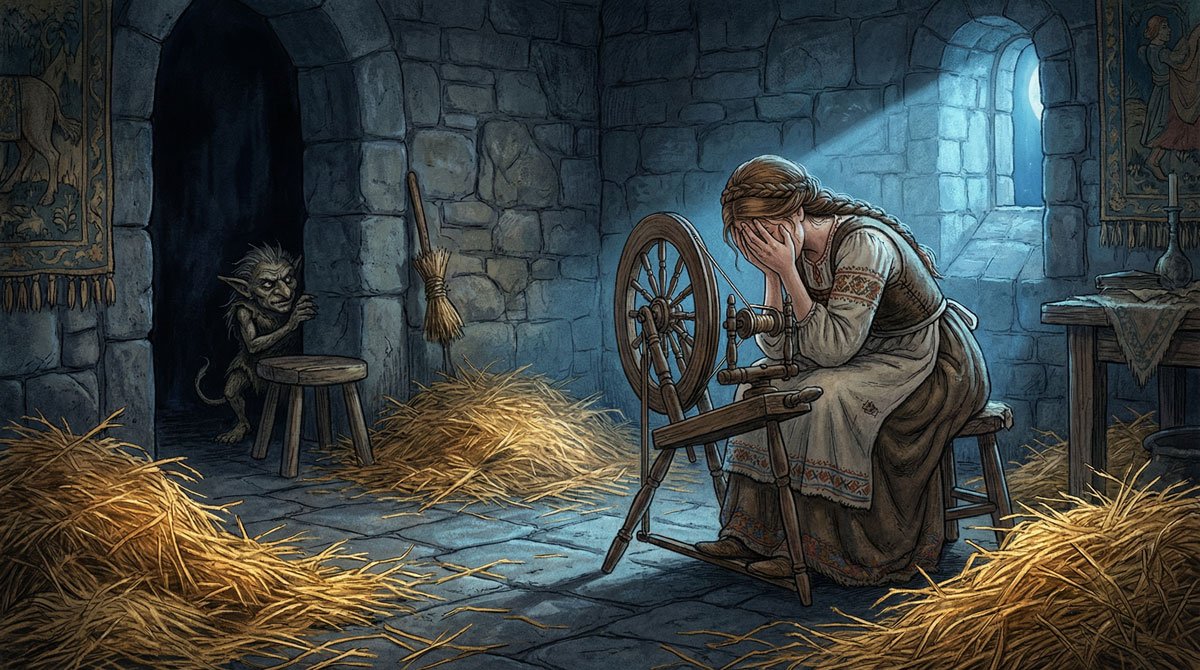
On the third night, the girl has nothing left to give. The little man, Rumpelstiltskin, extracts a terrible promise: her firstborn child. She agrees, seeing no other way out. The straw turns to gold, and the miller’s daughter becomes queen. A year later, her child is born, and Rumpelstiltskin returns to collect his due.
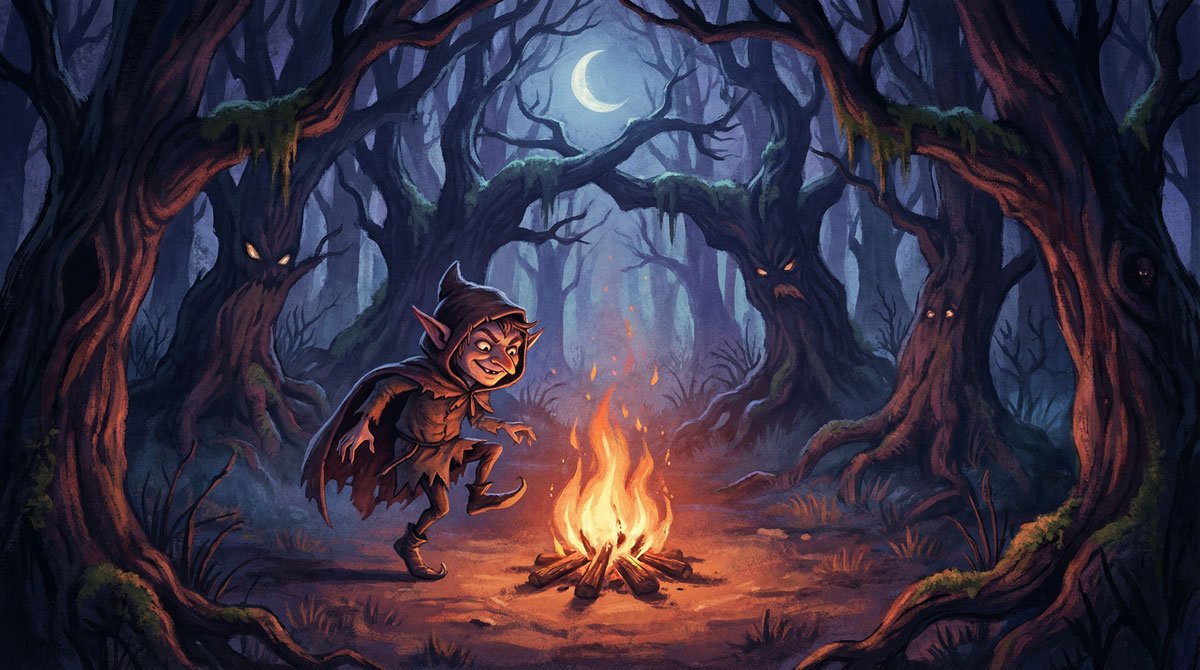
Horrified, the queen offers him all her wealth. He refuses, stating a living being is dearer than all treasures. Yet, he shows a sliver of pity. He gives her a final chance: guess his name in three days. After two days of frantic, fruitless guessing, a messenger returns with a strange tale. He saw a little man dancing around a fire, singing his own name.
When the imp returns, the queen reveals his name: Rumpelstiltskin. The story’s ending shifts depending on the version. In the 1812 edition, he simply runs away in anger. The later 1857 version offers a more gruesome finale. He stomps his foot so deep into the ground that he tears himself in two trying to get free.
The Characters: More Complex Than They Appear
The enduring power of Rumpelstiltskin lies in its cast of morally ambiguous characters. None are purely good or evil. They are driven by recognizable human flaws: vanity, greed, and desperation. This complexity invites us to look beyond the fairy tale archetypes and see the unsettling reflections of ourselves.
The Miller: Vanity’s First Victim
The story’s entire conflict ignites from the miller’s casual boast. He is not a malicious man, but his desire for social status is disastrous. His lie places his daughter in mortal danger. Yet, he faces no consequences. He simply disappears from the narrative, a ghost of unchecked ambition. The miller represents the destructive power of a small lie, spun from insecurity.
What makes the miller particularly troubling is his ordinariness. He is not a villain in the traditional sense. He is simply a man who wants to be noticed, to be valued. This makes his actions all the more relatable and disturbing. How many of us have exaggerated our abilities or those of our loved ones to gain approval? The miller’s fate—or rather, his lack of one—serves as a stark reminder that those who set disasters in motion often walk away unscathed, leaving others to face the consequences.
The King: Greed in a Crown
The king embodies the corruption of power. His greed is insatiable. He escalates his demands each night, unmoved by the girl’s terror. His proposal of marriage is not an act of love, but a transaction. He sees the miller’s daughter not as a person, but as a source of infinite wealth. He is a chilling portrait of leadership devoid of morality.
The king’s character reveals a darker truth about power structures. He uses the threat of death as a tool of coercion, exploiting the girl’s vulnerability for his own gain. His willingness to marry her is not a reward, but another form of possession. She becomes a queen, yes, but she is still trapped in a gilded cage, forever bound to a man who valued her only for what she could produce. The king’s prosperity at the story’s end is perhaps the tale’s most bitter pill to swallow.
The Miller’s Daughter/Queen: Trapped Between Impossible Choices
Is she a passive victim or a pragmatic survivor? The miller’s daughter is a study in powerlessness. She is passed from her father’s control to the king’s. Her choices are made under duress. However, her journey from terrified girl to resourceful queen is significant. She uses her wits, not magic, to save her child. She becomes an active agent in her own story.
Rumpelstiltskin: Villain, Victim, or Something Else?
Here lies the story’s dark heart. Rumpelstiltskin is the most complex figure. He is a savior who demands a terrible price. He is a magical being, yet he displays very human emotions: pity, pride, and explosive rage. Why does he want a child? Theories range from a desire for family to a need for a living soul. His lonely dance in the woods hints at a profound isolation. He is both the monster and the tragic figure of the tale.
| Character | Primary Motivation | Key Action | Moral Consequence |
|---|---|---|---|
| The Miller | Vanity / Social Climbing | Lies about his daughter’s ability | None (escapes punishment) |
| The King | Greed / Avarice | Threatens death for gold | None (gains a wife and gold) |
| The Queen | Survival / Maternal Love | Makes and breaks a desperate promise | Keeps her child through cleverness |
| Rumpelstiltskin | Loneliness / Desire for life | Bargains magic for a living being | Self-destructs from rage |
The Moral Maze: What Does This Story Really Teach?
Unlike simpler fairy tales, Rumpelstiltskin offers no easy moral. It presents a tangled web of questionable actions and unsettling outcomes. The story forces us to confront a world where the wicked prosper and a desperate bargain feels almost justified. This moral ambiguity is precisely why the tale remains so powerful and endlessly debatable.
The Traditional Interpretation
On the surface, the story warns against common vices. It cautions against the miller’s boastful lies and the king’s consuming greed. It underscores the danger of making promises you cannot keep. The queen’s predicament serves as a lesson in taking responsibility for one’s choices, no matter how dire the circumstances. These are the straightforward takeaways often taught to children.
The Problem With the Moral
Many modern readers find the story’s resolution deeply unsatisfying. The true villains—the vain miller and the greedy king—face no repercussions. They are rewarded for their cruelty and dishonesty. Meanwhile, Rumpelstiltskin, who repeatedly saves the girl’s life, is the only one to suffer a gruesome end. This raises uncomfortable questions. Is it right for the queen to break her promise, a promise that saved her life?
Alternative Interpretations
Perhaps the story isn’t about simple morality. Some see it as a cautionary tale about making pacts with unknown, supernatural forces. Others view it through a psychological lens, as a young woman’s journey from dependence to empowerment. It can also be read as a critique of a patriarchal society, where a woman is a commodity to be traded by her father and husband.
What Modern Readers Can Learn
Rumpelstiltskin teaches us that life is rarely a clear-cut battle between good and evil. It highlights the complexities of power dynamics and the impossible choices people make under pressure. The story encourages us to look for the humanity in monstrous figures and the flaws in seemingly innocent ones. It is a timeless lesson in critical thinking and empathy.
The Power of Names: Why “Rumpelstiltskin” Matters

The climax of the story hinges not on a battle, but on an utterance: a name. The name “Rumpelstiltskin” itself is peculiar, believed to mean “little rattle stilt.” It connects to German folklore about noisy, mischievous spirits like poltergeists. But its true power in the tale goes far deeper than its literal translation.
In many ancient cultures and folk traditions, names held immense power. To know a creature’s true name was to have control over it. This belief is a common thread in folklore worldwide, from Celtic tales to ancient magical practices. A name was not just a label; it was the essence of a being’s identity and the source of its power. By discovering his name, the queen strips Rumpelstiltskin of his mystique and his leverage.
But why does Rumpelstiltskin, a creature of secrets, sing his own name aloud? This act of hubris is his downfall. In his moment of anticipated victory, his pride overwhelms his caution. He believes himself to be completely safe, unseen in his remote woodland home. This moment of carelessness makes him vulnerable and ultimately leads to his defeat.
This ancient theme of names and power still resonates today. In our digital age, our names are linked to vast amounts of personal data. The concepts of identity, privacy, and control are more relevant than ever. The story of Rumpelstiltskin serves as a timeless allegory for the power that a name—and the identity it represents—can hold.
Cultural Echoes: Rumpelstiltskin Around the World
While the Brothers Grimm popularized the tale, the story of a supernatural helper with a secret name is ancient and widespread. Folklorists classify it as Aarne-Thompson-Uther (ATU) type 500, “The Name of the Helper.” Research suggests its origins may trace back as far as 4,000 years. This powerful narrative has echoed across continents, adapting to local cultures while retaining its core themes. For a comprehensive look at its history and variants, the Rumpelstiltskin Wikipedia page offers extensive detail.
These variations show how different cultures interpret the central conflict. The helper’s nature changes, from a devil in Cornwall to a simple imp in England. The stakes and resolutions shift, but the core elements—an impossible task, a magical bargain, and the power of a name—remain remarkably consistent. This demonstrates the story’s universal appeal and its ability to tap into fundamental human anxieties and hopes.
| Variant Name | Origin | Key Difference |
|---|---|---|
| Tom Tit Tot | England | The helper is an imp who spins flax, not straw. |
| Whuppity Stoorie | Scotland | A gentlewoman makes a deal with a fairy to save her sick child. |
| Duffy and the Devil | Cornwall, UK | The helper is explicitly a devil named “Terry-top.” |
| Joaidane | Arabic | The helper is a jinn who helps a girl weave silk. |
| Daiku to Oniroku | Japan | An ogre helps a carpenter build a bridge in exchange for his eyes. |
From Page to Screen: Rumpelstiltskin in Popular Culture
The strange tale of Rumpelstiltskin has proven to be a fertile ground for modern storytellers. Its themes of debt, desperation, and dark magic continue to captivate audiences. The character of the cunning, magical deal-maker has been endlessly reinterpreted in literature, film, and television, demonstrating the story’s remarkable staying power.
Numerous authors have penned literary retellings, often exploring the story from different perspectives. These adaptations frequently give Rumpelstiltskin a more sympathetic backstory or delve deeper into the queen’s psychological state. They expand the simple fairy tale into complex novels that examine the original’s moral gray areas.
On screen, the character has taken many forms. Perhaps the most famous modern incarnation is in the TV series “Once Upon a Time,” where Rumpelstiltskin (also known as Mr. Gold) is a central, tragic anti-hero whose story spans centuries. This version fully embraces the character’s complexity, portraying him as both a villain and a victim of circumstance. The show explores his motivations, his capacity for love, and his struggle with power, transforming him from a simple fairy tale creature into a fully realized character.
The story’s influence can also be seen in various fantasy films and shows that feature similar deal-making imps and the motif of a name holding power. The archetype of the cunning magical bargainer appears in countless modern fantasy works. From the demon crossroads deals in “Supernatural” to the contract magic in anime and manga, the shadow of Rumpelstiltskin looms large. The tale’s themes of desperate bargains and hidden costs resonate deeply with contemporary audiences navigating a world of complex transactions and unforeseen consequences.
Even in children’s media, the story continues to be retold and reimagined. Animated films and picture books offer softer versions, while young adult novels explore darker, more mature interpretations. This constant reinvention speaks to the story’s fundamental power. It taps into primal fears about debt, identity, and the price of survival, making it endlessly adaptable to new contexts and new generations.
Psychological Interpretations: What Lies Beneath the Surface
Beyond its surface narrative, Rumpelstiltskin can be read as a psychological allegory. The story’s strange elements—spinning straw into gold, a magical imp, a name that holds power—can be understood as symbols of deeper human experiences. This psychological lens offers a fresh perspective on why the tale continues to resonate centuries after it was first told.
From a Jungian perspective, Rumpelstiltskin represents the shadow self, the dark, repressed aspects of our personality that we refuse to acknowledge. He emerges in moments of crisis, offering solutions that come at a terrible cost. The miller’s daughter’s journey can be seen as a process of individuation, where she must confront and ultimately name this shadow figure to reclaim her power. The act of naming Rumpelstiltskin is not just about guessing a word; it is about recognizing and confronting the hidden parts of ourselves.
The spinning of straw into gold can be interpreted as the transformation of base experiences into valuable wisdom. The straw represents the raw, difficult circumstances of life—poverty, fear, and powerlessness. The gold symbolizes the precious insights and strength that can emerge from hardship. However, the story warns us that this transformation cannot be achieved through shortcuts or magical thinking. The price of avoiding genuine struggle is a debt that will eventually come due.
The theme of the promised child is particularly rich in psychological symbolism. The firstborn child can represent the future, potential, or even the authentic self that one might sacrifice in a moment of desperation. The queen’s fierce determination to keep her child reflects the human instinct to protect what is most precious, even if it means breaking a vow. This internal conflict between honoring commitments and protecting what we love is a universal human dilemma.
Some psychologists also view the tale as a commentary on the dangers of external validation. The miller’s lie stems from a need to impress the king, to be seen as important. This sets off a chain of events where the daughter must constantly prove her worth through impossible feats. The story suggests that seeking approval through false pretenses leads only to entrapment and desperation. True freedom comes not from meeting others’ impossible expectations, but from discovering and claiming one’s own identity—symbolized by the queen’s ultimate act of naming Rumpelstiltskin.
Frequently Asked Questions
- 1. What is the true moral lesson of Rumpelstiltskin?
- There is no single moral. The story explores the dangers of greed and lies, the weight of promises, and the complexities of power. It challenges readers to think critically rather than offering a simple lesson, as the characters who act poorly (the king and miller) are not punished.
- 2. Is Rumpelstiltskin a villain or a victim?
- He is a complex mix of both. He saves the queen’s life three times but demands a cruel price. His loneliness and rage suggest a tragic backstory, making him one of literature’s most debated anti-heroes. He is a magical helper who becomes a monstrous creditor.
- 3. Why does Rumpelstiltskin want the queen’s baby?
- The story never explicitly states why. Theories suggest he is lonely and wants a child of his own, that he needs a human child for magical reasons, or that he represents a supernatural force claiming a soul. This ambiguity is a key part of the tale’s mystery.
- 4. What does the name “Rumpelstiltskin” mean?
- The name is German and translates to “little rattle stilt.” It is associated with a type of noisy goblin or poltergeist from folklore that makes rattling sounds. The name itself is meant to sound strange and otherworldly, adding to the character’s mystique.
- 5. Why is knowing Rumpelstiltskin’s name so powerful?
- In ancient folklore, knowing a supernatural being’s true name was believed to grant power over it. The name was tied to the being’s essence and identity. By guessing his name, the queen strips Rumpelstiltskin of his power and breaks the contract, turning his own magic against him.
- 6. What happens to Rumpelstiltskin at the end of the story?
- It varies. In the first Grimm edition (1812), he just runs away. In the more famous 1857 edition, he stomps his foot into the ground in a rage and then tears himself in two. This more violent ending emphasizes the self-destructive nature of his fury.
- 7. Are there different versions of the Rumpelstiltskin tale?
- Yes, many. The story is found worldwide under different names, such as “Tom Tit Tot” in England and “Whuppity Stoorie” in Scotland. While details change, the core elements of a magical helper, an impossible task, and a secret name are remarkably consistent across cultures.
- 8. What is the significance of spinning straw into gold?
- It represents the ultimate act of creating immense value from something worthless. This magical transformation is what drives the king’s greed and sets the entire plot in motion. It is a powerful symbol of impossible alchemy and the desire for unearned wealth.
- 9. Why didn’t the king and the miller face consequences?
- This is a central moral problem of the story. Their lack of punishment is unsettling and forces readers to question the tale’s fairness. It suggests that in some narratives, power and status can shield individuals from the consequences of their destructive actions.
- 10. What can modern readers learn from Rumpelstiltskin?
- The story teaches us about the complexities of desperation and power. It serves as a reminder to be wary of deals that seem too good to be true and to consider the long-term consequences of our promises. It also encourages empathy for characters who don’t fit simple labels of “good” or “evil.”
Conclusion: The Enduring Riddle of Rumpelstiltskin
Rumpelstiltskin is more than just a fairy tale; it is a dark mirror reflecting our own world’s complexities. The story endures not because it offers easy answers, but because it asks difficult questions. It leaves us to grapple with the unsettling reality that justice is not always served, that saviors can be monstrous, and that even the most desperate bargains have a final, terrible price.
The tale forces us to look beyond simple labels of good and evil. It challenges our understanding of promises, power, and identity. In a world that often demands we spin our own straw into gold—to transform our struggles into success, our pain into productivity—the story serves as a cautionary reminder. There are no shortcuts without consequences. Every deal has a hidden cost. And sometimes, the only way to break free is to name the forces that bind us.
Long after the spinning wheel has stopped and the gold has been counted, the riddle of the little man in the woods remains. Who was the true villain in this twisted tale of greed and gold? Was it the vain father, the greedy king, the desperate queen, or the lonely imp? The answer, perhaps, is as elusive and unsettling as Rumpelstiltskin’s name itself. And that is precisely why, centuries later, we are still trying to guess it.