Pshaw is an old exclamation of disbelief or impatience. You say it when someone hands you a claim, a compliment, or an excuse you refuse to take seriously.
That one line covers the pshaw meaning most people search for, but it misses the interesting part. The word is not dead so much as retired, and it only works now if you say it with a wink.
Most people meet it in one of three places: an old novel, a cartoon, or a five-letter puzzle grid that ruined their morning.
Pshaw meaning in plain English
Pshaw is an interjection that brushes something aside: impatience with nonsense, disbelief at a tall claim, or mock modesty after a compliment. Dictionaries file it beside oh and bah, the small noises that carry whole opinions.
Dictionary.com goes further and lists it as a noun and a verb too. You can give a pshaw, and you can pshaw at somebody’s idea, though almost nobody has done either out loud since radios had tubes.
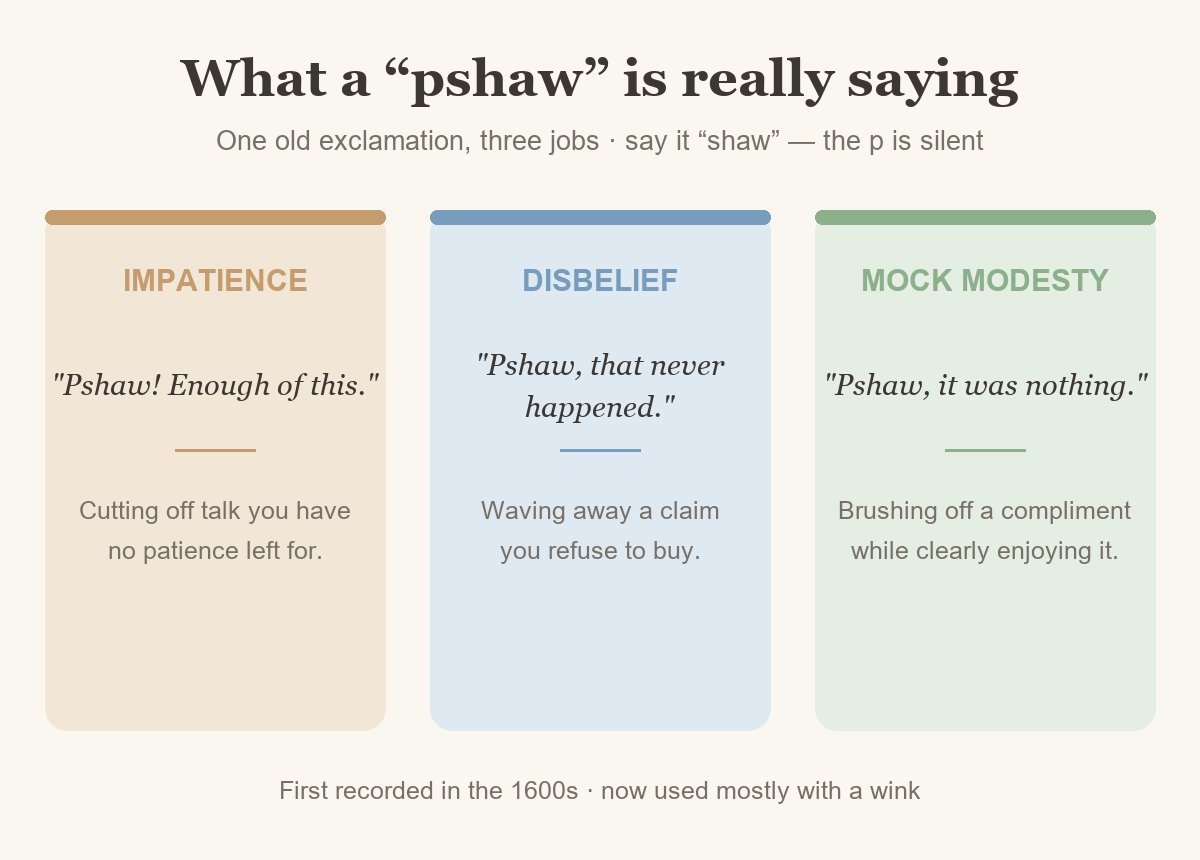
Tone does all the work. The same syllable can shut down an argument or deflect praise, and the listener sorts out which from your eyebrows.
How to pronounce pshaw
Say shaw, rhyming with saw. The p is silent, so the word many readers have been sounding out as puh-shaw in their heads for years is really one syllable.
I said puh-shaw in my head for an embarrassing number of years before checking. Collins records it as a plain shaw sound, though some speakers keep a little spit of air up front, like the start of a scoff.
Where the word came from
English picked up pshaw somewhere in the 1600s, and nobody invented it so much as transcribed it. It started as a written-down version of the sputtering noise people already made at nonsense.
Merriam-Webster dates its earliest citation to 1607, while other dictionaries put the first print appearance closer to the 1660s. Spelling a snort was never an exact science.
Its golden age came later, in Victorian and early twentieth-century fiction. Heroines pshawed at suitors, colonels pshawed at newfangled ideas, and Etymonline files it with the era’s other stage-direction noises, halfway between a word and a sound effect.
How people actually use pshaw now
Nobody says pshaw straight anymore. It survives as a deliberate antique, pulled out when you want a dismissal to sound theatrical instead of harsh, and everyone in the room knows the costume is part of the joke.
The most common live use is mock modesty. Someone praises your cooking, you flap a hand and say pshaw, it was nothing, and the old-timey sound lets you enjoy the compliment while pretending to refuse it.
Cartoons and games keep the word on life support. Sam & Max built a whole gag around it, and their subreddit treats the exchange with the solemnity of literary criticism:
““Pshaw?” You see this is a very deep and high quality post We’re looking into the deep intrinsic meaning we can find in the brief exchange between Sam and Max When Sam says “Pshaw!” Max promptly responds, but not as a question as it may suggest to the average listener Max is reaffirming Sam’s statement, he’s making him feel heard If no one else in the world cared enough to respond, Max makes sure Sam knows he would Truly a beautiful moment between two quality partners who, although they may nev…”
– r/SamandMax, September 2025 (13 upvotes)
A decent rule: use pshaw on friends, never in an argument you actually want to win. In a meeting it reads as contempt in a top hat.
Pshaw in a sentence
Seeing the word do its job is faster than any definition. Each example leans on the tone that makes pshaw work: theatrical, knowing, and slightly antique.
- “Pshaw,” said the colonel, “no motorcar will ever replace a decent horse.”
- Pshaw, that award was pure luck – I barely rehearsed.
- She pshawed at the rumor and went back to her book without looking up.
- “You, nervous? Pshaw. You have given a hundred of these talks.”
- He gave a little pshaw when I suggested the shortcut, and we got lost anyway.
Notice the last two: pshaw still works as a verb (to pshaw at something) and even a noun (to give a pshaw), exactly as the dictionaries promise.
The Wordle morning that revived it
PSHAW recently turned up as a Wordle answer, and the reaction showed how far the word has drifted out of circulation. The r/wordle subreddit spent a whole morning insisting it was not a real word.
The puzzle was genuinely cruel: a silent p, one vowel, and a consonant cluster nobody guesses. Players with three yellow tiles sat there brute-forcing letter salad.
“This is my first time on this subreddit. I came here specifically because I was so unbelievably upset with today’s word lol I had three yellows by the second guess, and it took me over twenty minutes of brute forcing random combinations of letters to find it Glad I’m not the only one that didn’t appreciate it lol”
– r/wordle, July 2026 (25 upvotes)
The angry crowd was wrong on the facts, though. Pshaw sits in every major dictionary and word-game list, which is exactly why puzzle editors reach for it.
Pshaw vs. other dismissive noises
English keeps a whole drawer of dismissive noises, and they are not interchangeable. Pshaw is the mustiest and most theatrical of the set; its younger cousins do the same work with far less costume.
| Noise | Rough translation | Tone | Where you’ll meet it |
|---|---|---|---|
| Pshaw | Oh, nonsense | Theatrical, knowingly old-fashioned | Old novels, cartoons, ironic speech |
| Pfft / pssh | Yeah, right | Casual, a little smug | Everyday talk, texting |
| Bah | I want no part of this | Grumpy, Scrooge-flavored | Grumbling, “bah humbug” jokes |
| Pooh-pooh | I dismiss your idea | Mild, slightly fussy | Mostly as a verb: to pooh-pooh a plan |
| Tsk / tut | You should know better | Disapproving, schoolteacherly | Clicked more than spoken |
Notice the pattern: the older the noise, the more self-aware you have to be to use it. Pssh costs nothing; pshaw requires a performance. And if internet-age shorthand is more your speed, we have pulled apart what cuz actually means in the same spirit, along with the frontier escape verb hightail.
FAQ about pshaw
Is pshaw a real word?
Yes, pshaw is a real English word, recorded since the 1600s and listed as an interjection by Merriam-Webster, Dictionary.com, and Collins. Scrabble dictionaries and the Wordle answer list both accept it.
Is saying pshaw rude?
Pshaw is dismissive but rarely offensive, because its antique sound softens the blow; today it usually lands as playful skepticism rather than insult. Tone still matters, since any dismissal can sting mid-argument.
What is the difference between pshaw and pssh?
Pssh is the modern, casual descendant: the same dismissive job with no literary baggage. Pshaw is the antique you choose on purpose, usually for comic or mock-dramatic effect.
Does the pshaw meaning change in old books?
No. In Victorian and early twentieth-century fiction pshaw meant what it means now: impatience, disbelief, or contempt at something just said. The real difference is that those characters said it with a straight face.
So should you actually say it?
Yes, as long as you commit to the bit. Pshaw works when both sides hear the wink, which makes it safe for friends, family, and group chats, and risky anywhere sincerity is expected.
A word is only truly dead when nobody bothers to complain about it. Pshaw just earned a full morning of outrage from about a hundred thousand puzzle players, which is more life than most 400-year-old words can claim.