How does a professional football team end up paying nearly $100 million to a player who is no longer on their roster? That is the staggering reality facing the Miami Dolphins in 2026. The team is set to absorb a record-shattering $99.2 million dead cap hit for quarterback Tua Tagovailoa, a move that has forced a dramatic and painful roster overhaul under a brand-new front office. This article will break down the series of decisions that led the Dolphins into salary cap hell, explain what it means for the upcoming season, and map out the long, arduous path back to contention.
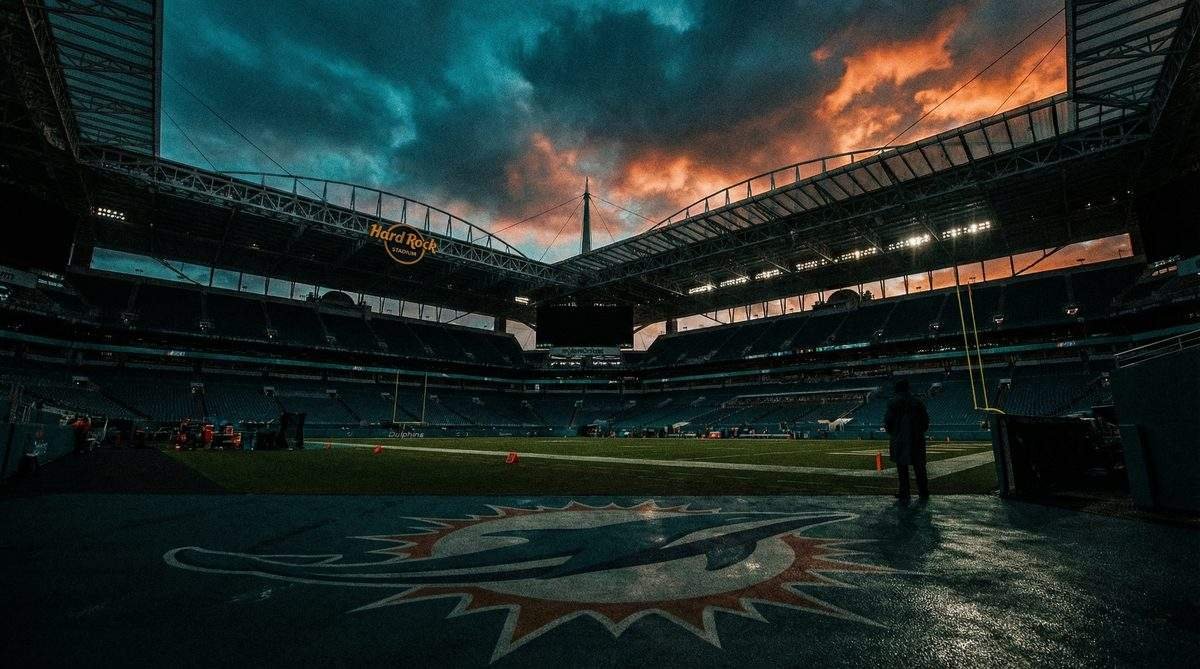
Hard Rock Stadium at dusk, home of the Miami Dolphins, under a dramatic stormy sky
How Did the Dolphins Get Here? A Timeline of Key Decisions
The Dolphins’ current salary cap crisis is not the result of a single bad decision, but rather a series of high-stakes gambles that ultimately did not pay off. The foundation of this financial predicament was laid in the summer of 2024, when the team signed quarterback Tua Tagovailoa to a massive four-year, $212.4 million contract extension. The deal, which included $167 million in guaranteed money, was intended to secure the franchise’s long-term future at the most important position. However, after a disappointing 2025 season that saw Tagovailoa benched, the Dolphins were left with an untenable contract and a difficult choice.
Compounding the issue were several other blockbuster moves made by the previous regime. The trade for and subsequent release of star wide receiver Tyreek Hill, the large contract given to edge rusher Bradley Chubb, and the lingering dead money from the contracts of Jalen Ramsey and Terron Armstead all contributed to the perfect storm of salary cap disaster. By the time new General Manager Jon-Eric Sullivan took the helm in early 2026, the team was already deep in a financial hole with limited options.
Understanding the NFL Salary Cap: A Quick Explainer
To fully grasp the severity of the Dolphins’ situation, it’s helpful to understand a few key NFL salary cap terms. These mechanisms, while complex, are essential to how teams are constructed and managed. For a complete overview, you can visit the official NFL Operations salary cap page.
Dead Cap: In simple terms, dead cap (or dead money) is a salary cap charge for a player who is no longer on a team’s roster. This happens when a player with guaranteed money or a prorated signing bonus is traded or released. Think of it like a bill coming due — the money was already promised, and it still counts against the team’s spending limit, even if the player is gone.
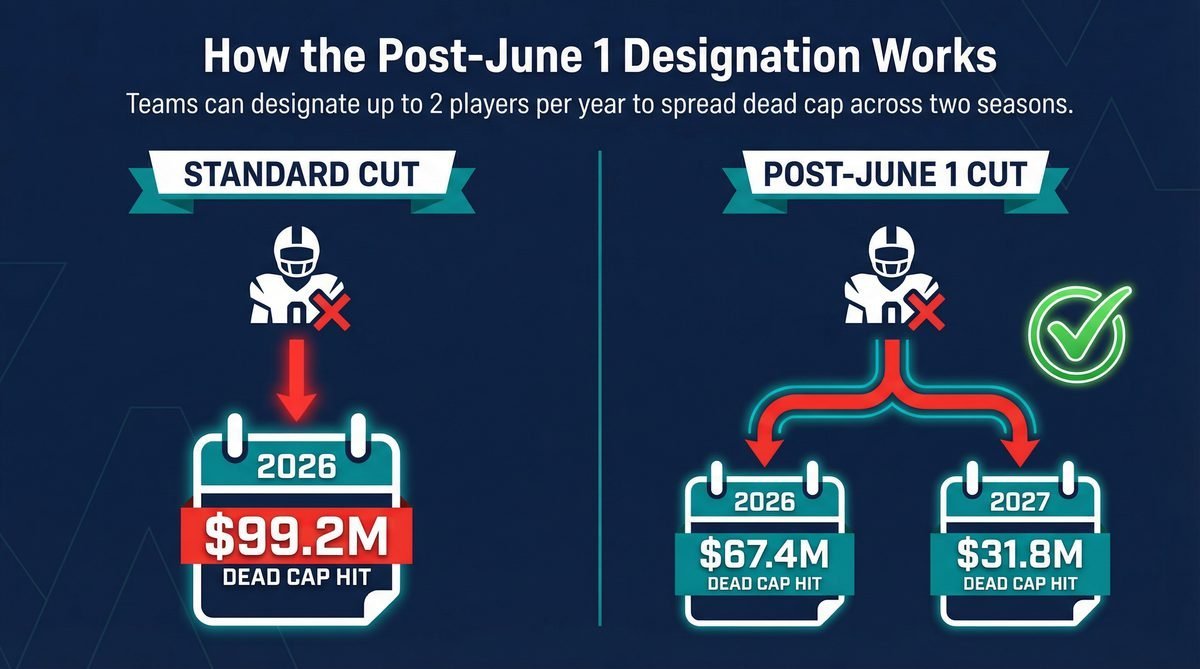
Post-June 1 Designation: This is a procedural move that allows teams to spread a large dead cap hit over two seasons instead of one. When a player is designated as a post-June 1 cut, the dead money from future years of their contract does not accelerate into the current year’s cap. Instead, it’s pushed to the following year’s cap. Teams are allowed to use this designation on up to two players per year.
Top 51 Rule: During the NFL offseason, only the 51 largest salary cap hits on a team’s roster, plus all prorated signing bonuses for all players, count against the salary cap. This rule allows teams to carry up to 90 players on their offseason roster without having every contract count against the cap.
The Aftermath: A Look at the Dolphins’ 2026 Roster and Cap Casualties
The culmination of these past decisions has resulted in a brutal 2026 offseason for the Dolphins. The team is projected to carry approximately $144 million in dead cap charges, a figure that represents nearly 48% of the league’s $301.2 million salary cap for the year. This has forced the new front office to make a series of difficult cuts, parting ways with several high-profile players.
Here is a breakdown of the most significant cap casualties and their impact on the 2026 salary cap:
| Player | Position | 2026 Dead Cap Hit | Cap Savings |
|---|---|---|---|
| Tua Tagovailoa | QB | $67.4 million (Post-June 1) | -$11.1 million |
| Tyreek Hill | WR | $28.2 million | $22.9 million |
| Jalen Ramsey | CB | $20.9 million | $0 |
| Minkah Fitzpatrick | S | $13.0 million | $5.8 million |
| Terron Armstead | LT | $10.7 million | $4.3 million |
| Bradley Chubb | EDGE | $7.3 million | $20.2 million (Post-June 1) |
With these players gone, the 2026 Dolphins will look drastically different. The offense will rely on the development of young playmakers like running back De’Von Achane and wide receiver Jaylen Waddle, while the newly signed Malik Willis takes over at quarterback. The defense, stripped of its veteran leaders, will be a collection of young players and low-cost free agents.
The NFL’s Worst Dead Cap Hits: How Do the Dolphins Compare?
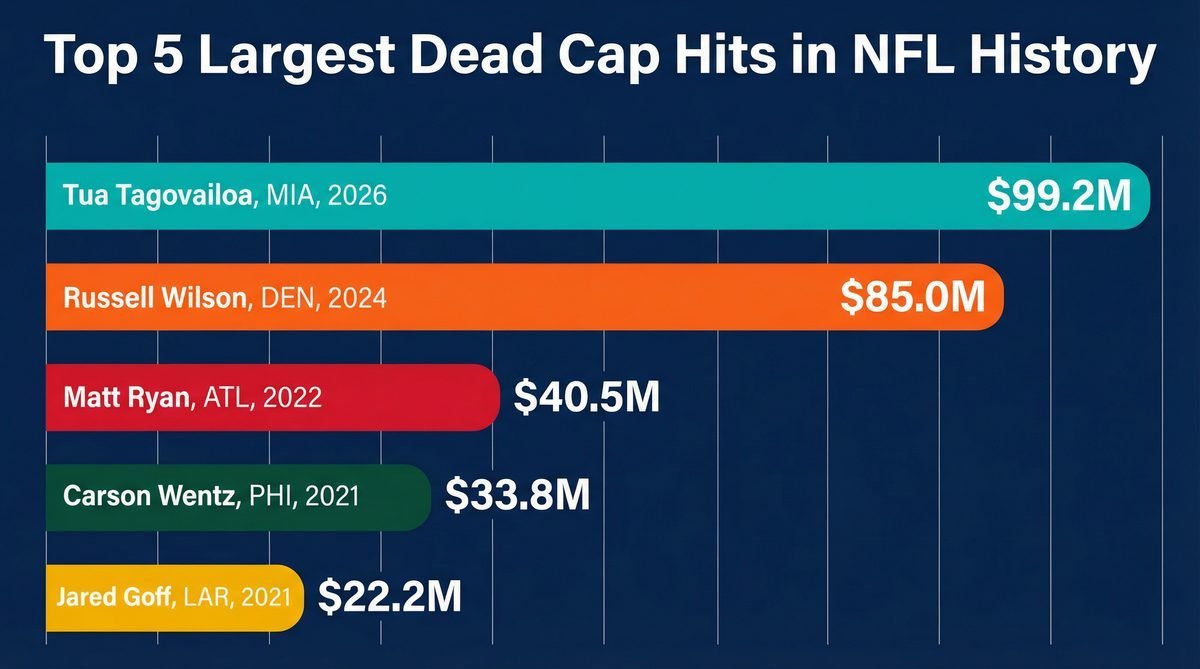
While the Dolphins’ $99.2 million dead cap charge for Tua Tagovailoa is unprecedented, they are not the first team to find themselves in a difficult financial situation due to a large quarterback contract. However, the sheer magnitude of Miami’s dead money problem sets a new standard for salary cap mismanagement.
| Player | Team | Year | Dead Cap Hit |
|---|---|---|---|
| Tua Tagovailoa | Miami Dolphins | 2026 | $99.2 million |
| Russell Wilson | Denver Broncos | 2024 | $85 million |
| Matt Ryan | Atlanta Falcons | 2022 | $40.5 million |
| Carson Wentz | Philadelphia Eagles | 2021 | $33.8 million |
| Jared Goff | Los Angeles Rams | 2021 | $22.2 million |
As the table illustrates, the Dolphins’ dead cap hit for Tagovailoa is more than the next two largest dead cap hits in NFL history combined. This underscores the severity of the team’s financial predicament and the challenges they face in the coming seasons.
The Path Forward: What to Expect in 2026 and Beyond
The 2026 season is shaping up to be a full-blown rebuilding year for the Miami Dolphins. With nearly half of their salary cap allocated to players no longer on the roster, the team will have limited resources to improve through free agency. Instead, the focus will be on the NFL Draft, where the Dolphins currently hold eight picks. New General Manager Jon-Eric Sullivan has been clear about his intentions to build a sustainable foundation, rather than seeking quick fixes.
“We have a bit of an uphill climb. We’ll do it the right way. What I want to do is build a foundation that’s my responsibility, something that’s sustainable over time. We’re not looking for quick fixes here. We’re looking to build something that will last over time, and I think you got to go. You do that with discipline, long-term vision and focus at the forefront of everything you do.”
— Jon-Eric Sullivan, Miami Dolphins General Manager
The silver lining for the Dolphins is the potential for a quick turnaround in 2027. The team is projected to have over $91 million in effective cap space, which would give them the flexibility to be aggressive in free agency and add significant talent to the roster. The pain of the 2026 season is a necessary evil to reset the salary cap and create a brighter future.
Frequently Asked Questions (FAQ)
How much salary cap space do the Miami Dolphins have in 2026?
After all the recent roster moves, the Dolphins have very limited cap space for the 2026 season, estimated to be around $5 million. This number will fluctuate as the team continues to make moves in free agency and the draft.
What is the Miami Dolphins’ total dead cap in 2026?
The Dolphins are projected to have approximately $144 million in dead cap charges for the 2026 season. This figure includes the $67.4 million post-June 1 portion of Tua Tagovailoa’s dead cap, plus dead money from Tyreek Hill, Jalen Ramsey, and other released players.
Why did the Dolphins release Tua Tagovailoa?
The Dolphins released Tua Tagovailoa after a disappointing 2025 season that ended with him being benched, combined with a complete change in the front office and coaching staff. New GM Jon-Eric Sullivan and head coach Jeff Hafley opted to start fresh with a younger, cheaper roster, making Tagovailoa’s massive contract an untenable situation.
What is the biggest dead cap hit in NFL history?
Tua Tagovailoa’s $99.2 million dead cap hit is the largest in NFL history, surpassing the previous record of $85 million set by Russell Wilson with the Denver Broncos in 2024.
Can the Miami Dolphins be competitive in 2026?
It will be extremely difficult for the Dolphins to be competitive in 2026. With a significant portion of their salary cap dedicated to dead money, the team will have a less talented roster than most of their opponents. The team faces the NFL’s second-hardest schedule, making a winning record a tall order.
How much cap space will the Dolphins have in 2027?
The Dolphins are projected to have over $91 million in effective cap space in 2027, which will allow them to be major players in free agency. This is the light at the end of the tunnel for Miami fans enduring a difficult 2026 season.