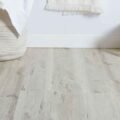
You are standing in the flooring aisle. On your left, “Laminate — looks like real hardwood.” On your right, “Vinyl — 100% waterproof.” Both have wood-look planks. Both cost about the same. And you have no idea which one belongs in your living room.
Choosing between laminate vs vinyl is not a trivial choice. The floor you pick today will sit under your feet for the next 10 to 20 years. It will see coffee spills, dog claws, rolling desk chairs, notes Alta Property Management experts. The wrong decision in the laminate vs vinyl debate means warped boards, peeling surfaces, or a reinstallation project you did not budget for.
Laminate mimics wood but fears water. Vinyl survives floods but feels hollow. The differences span cost, feel, and room suitability.
Laminate flooring cross-section: wear layer, print layer, HDF core, and backing
What Is Laminate Flooring?
Laminate flooring is a multilayer synthetic product with a photographic image layer that simulates wood or stone, fused under high pressure. Its core is dense fiberboard — not solid wood, not waterproof.
The structure tells you most of what you need to know. From top to bottom: a transparent aluminum-oxide wear layer that resists scratches and fading, a high-resolution printed décor layer that creates the wood or stone look, a thick high-density fiberboard (HDF) core that gives the plank its rigidity and stability, and a balancing backing layer that prevents moisture from seeping in from below.
The structure tells you most of what you need to know: a transparent aluminum-oxide wear layer, a high-resolution photographic print layer, a thick HDF core for rigidity, and a balancing backing layer for moisture protection.
Understanding the laminate vs vinyl origins helps: laminate was invented in 1977 by the Swedish company Perstorp and sold under the brand Pergo. (Wikipedia) The original idea was simple: give homeowners the look of hardwood at a fraction of the cost, without requiring a professional installer’s skill set. That bet paid off. By the mid-1990s, laminate had become one of the fastest-growing flooring categories in North America and Europe.
But here is the catch that catches most first-time buyers: laminate’s HDF core is essentially hardened cardboard. Leave standing water on it long enough — a leaking dishwasher overnight, a plant pot that drains onto the floor for a week — and the edges swell into visible ridges that no amount of sanding will fix.
What Is Vinyl Flooring
Vinyl flooring is a fully synthetic floor covering made primarily from polyvinyl chloride (PVC) with plasticizers, stabilizers, and a printed design layer, resulting in a flexible, completely waterproof material. It comes in three main formats: sheet vinyl, luxury vinyl tile (LVT), and luxury vinyl plank (LVP).
In the laminate vs vinyl story, sheet vinyl arrived in American homes in the 1950s as a kitchen-and-bathroom staple — one continuous roll, no seams, wipe it clean and move on. Luxury vinyl plank, the format most people compare against laminate today, emerged in the 2000s as a direct competitor. It offered the same click-lock installation as laminate but with a core that did not care about water.
A typical LVP plank has four layers: a UV-cured top coat that resists scratches and stains, a clear vinyl wear layer that takes the daily abuse, a printed film layer with the wood or stone pattern, and a waterproof core — either solid PVC, WPC (wood-plastic composite), or SPC (stone-plastic composite).
That core changes everything. SPC vinyl contains about 60% limestone and 40% PVC. It will not swell, warp, or bubble no matter how much water sits on top.
Another difference in the laminate vs vinyl comparison: vinyl also has a thinner profile — typically 4 to 8 millimeters versus laminate’s 8 to 12 millimeters. That thinness makes it easier to transition between rooms, but it also means you feel the subfloor more. You hear your own footsteps differently.
Vinyl plank flooring is completely waterproof — the key advantage over laminate in kitchens and bathrooms
Laminate vs Vinyl Flooring: Key Differences at a Glance
When comparing laminate vs vinyl flooring, laminate wins on looks and feel underfoot while vinyl wins on water resistance and practical durability. The table below maps the head-to-head comparison across every decision-relevant category.
| Category | Laminate Flooring | Vinyl Flooring (LVP/LVT)
|
| Water resistance | Low to moderate; standing water causes warping | 100% waterproof; unaffected by moisture |
| Core material | High-density fiberboard (HDF) | PVC, SPC, or WPC |
| Thickness | 8–12 mm | 4–8 mm |
| Wear layer | Aluminum oxide coating | Clear PVC wear layer (4–20 mil) |
| Scratch resistance | Excellent (hard surface) | Moderate (softer, can gouge) |
| Underfoot feel | Warm, solid, closer to real wood | Cooler, thinner, can feel hollow |
| Noise | Quieter, less hollow sound | More echo on concrete subfloor |
| Installation | Floating click-lock (DIY-friendly) | Floating, glue-down, or loose lay |
| Material cost | $2–$5 per sq ft | $3–$7 per sq ft |
| Lifespan | 15–25 years | 10–20 years (sheet); 15–25 (LVP) |
| Best rooms | Living rooms, bedrooms, hallways | Kitchens, bathrooms, basements |
Water Resistance — The Deciding Factor for Most Homeowners
Water resistance is the single biggest differentiator in the laminate vs vinyl flooring comparison, and it determines where each one can be installed with confidence. Vinyl does not absorb water at any layer; laminate will swell and delaminate if moisture penetrates the surface.
This is not a subtle difference. It is the difference between a floor that can handle a washing machine overflow and one that needs to be torn out after the same event.
Test it yourself: water on laminate overnight causes edge swelling. On vinyl, nothing happens.
Manufacturers have tried to bridge the laminate vs vinyl water-resistance gap. Several laminate brands now offer “water-resistant” lines with wax-infused cores or sealed edge coatings. Shaw’s Repel technology and Mohawk’s HydroSeal are two examples. These handle spills wiped up within an hour. But they still carry stipulations against installing laminate in bathrooms, mudrooms, or any space with a floor drain.
One homeowner described it this way: “A water line burst in my laundry room. The vinyl planks were submerged for four hours. I pulled them up, dried the concrete, and snapped them back in place — exactly the same.” That is not a scenario laminate could survive.
Durability and Longevity — Which Floor Holds Up Better
The laminate vs vinyl durability debate breaks into two questions: resistance to surface damage and structural lifespan over years of use. The two floors answer them differently because their surfaces work in opposite ways.
Laminate’s aluminum-oxide surface scores 5H to 9H on the pencil-hardness scale, while vinyl sits at 2H to 4H. Push a metal chair leg across both, and laminate stays unmarked while vinyl may show a gouge.
But in the laminate vs vinyl comparison, hardness is not toughness. Vinyl’s softer surface absorbs impact without cracking. Drop a heavy pot on laminate, and the HDF core can crack under point impact. Drop the same pot on vinyl, and the plank may dent temporarily but rarely cracks through.
A laminate floor in a busy hallway typically shows surface wear near the entry door around year five — tiny scratches that catch the light. A vinyl floor in the same spot may look fine at year five but develop indentations where people walk, especially if the subfloor is not level.
In the laminate vs vinyl longevity debate, both floors will last 15 to 25 years. The difference is how they fail. Laminate fails by edge swelling and surface scratching. Vinyl fails by denting, peaking at the seams, and — in cheap products — the photographic layer wearing through.
One contractor put it bluntly: “I have pulled up ten-year-old laminate that looked terrible and fifteen-year-old vinyl that was still functional.”
Appearance and Realism — Can You Tell the Difference?
Laminate looks more like real wood than vinyl does. That is the consensus among flooring professionals and the main reason people choose laminate when water is not a concern.
The photographic layer in a premium laminate plank uses 1200-dpi printing with embossed-in-register texture — the surface grain matches the printed pattern exactly. Several manufacturers replicate hand-scraped hardwood so convincingly that wood dealers have complained.
Vinyl’s appearance has improved but still trails laminate. Most LVP prints at 600 to 900 dpi, and the embossing rarely aligns with the printed pattern — a visible difference next to good laminate.
Here is where vinyl catches up: vinyl plank comes in wider, longer formats — up to 72 by 9 inches — mimicking actual hardwood dimensions with fewer seams and a more natural look.
Installation — DIY-Friendly or Professional Job
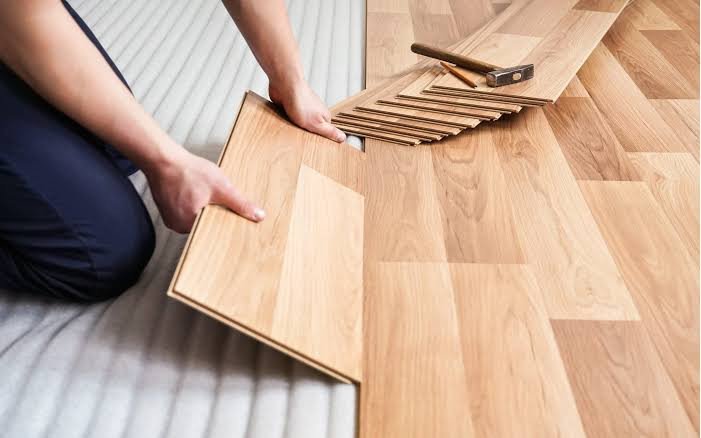
Both laminate and click-lock vinyl planks use similar floating-floor methods, but the details differ enough that your choice may depend on your subfloor condition and your tolerance for frustration.
Laminate is more forgiving of imperfect subfloors. Its thicker core bridges small dips that vinyl plank would telegraph as visible unevenness.
Vinyl plank cuts cleanly with a utility knife. Laminate needs a power saw with a special blade. For a DIY installer, this difference adds about two hours of labor and much less frustration.
Underlayment requirements also differ. Laminate needs a separate foam underlayment. Many vinyl planks come with an attached pad and go directly on the subfloor, saving $0.30 to $0.60 per square foot.
The step that most often gets skipped: acclimation. Laminate needs 48 to 72 hours in the room. Vinyl needs about 24. Skip laminate’s acclimation and you get gapped seams two months later.
Cost Comparison — Upfront Price vs Long-Term Value
On material cost alone, laminate flooring vs vinyl flooring comes out cheaper for laminate. A decent laminate floor runs $2 to $4 per square foot. A comparable vinyl plank floor runs $3 to $6 per square foot. For a 500-square-foot space, that difference is about $500 to $1,000 before installation.
Vinyl’s waterproof nature means no replacement after a water event. A dishwasher leak in a kitchen with laminate can mean a $2,000 full-floor replacement. With vinyl, it means wiping up the water.
Resale value nudges the laminate vs vinyl calculation the other way. Real estate agents report that laminate — resembling hardwood more convincingly — can add slight perceived value. Vinyl is seen as a budget choice, even when it cost more than the laminate. That is not rational, but neither is the housing market.
A realtor in Nashville described it this way: “Buyers walk into a house with laminate and say, ‘Oh, wood floors!’ They walk into a house with vinyl and ask, ‘Is this plastic?’ Perception matters when you are trying to get an offer.”
Comfort and Noise Underfoot
Laminate feels warmer and quieter than vinyl underfoot. The thicker HDF core absorbs footfall sound better, and the material does not conduct temperature the way vinyl’s dense limestone core does. On a cold winter morning, barefoot on laminate is uncomfortable but tolerable. Barefoot on SPC vinyl is genuinely cold — like standing on a slightly soft tile.
Sound is the bigger complaint with vinyl in the laminate vs vinyl noise comparison. A vinyl floor on a concrete subfloor produces a hollow, clicking echo with each footstep. The effect is most noticeable in hallways and open-plan areas. Thicker underlayment helps but raises floor height and can create transition issues.
Laminate produces a duller, more solid footfall — closer to real hardwood. In a second-story bedroom, it transmits less impact noise to the floor below.
The noise gap is narrowing. Newer SPC vinyl with attached foam backing is within 10 to 15 percent of laminate’s sound profile.
Which Room Gets Which Floor?
The right choice depends on the room’s moisture level and daily use. Each room in your home has different flooring needs’s relationship with water and the daily abuse the floor will take.
Kitchen — Laminate vs Vinyl Verdict
Vinyl, without debate. A kitchen sees standing water from dishwashers, sink splashes, and the occasional overturned pot of pasta water. Laminate in a kitchen is a gamble that most homeowners lose within five years.
Bathroom — Laminate vs Vinyl Verdict
Vinyl. No laminate product — even water-resistant grades — carries a bathroom warranty. Bathrooms have floor drains, toilet seals that fail, and humidity cycles around 60 percent. Vinyl sheet flooring is ideal here because it has zero seams.
Living Room and Bedroom — Laminate vs Vinyl Verdict
For the laminate vs vinyl choice in low-moisture rooms, laminate is the better option if water is not a concern. The warmer, wood-like feel and quieter sound make these rooms more comfortable. Spills here are rare and usually cleaned up immediately.
Basement
Vinyl. Concrete slabs release moisture vapor that gets trapped under laminate flooring and causes mold. Even with a vapor barrier, the risk is higher than with vinyl.
Hallway and Entryway — Laminate vs Vinyl Verdict
This is the hardest call. Laminate handles high foot traffic beautifully but struggles with wet shoes. Vinyl handles moisture perfectly but shows wear patterns faster. The compromise: vinyl in the entryway, laminate in the hallway beyond.
Frequently Asked Questions
Which is more durable, laminate or vinyl flooring?
Laminate is harder; vinyl is tougher. There is no universal winner. For pet owners, laminate’s scratch resistance is superior. For households with frequent spills, vinyl’s waterproof core wins.
Can laminate flooring be installed in a bathroom?
No, laminate should not go in bathrooms. Even water-resistant laminate products exclude bathrooms from their warranties. Vinyl flooring is the correct choice for bathrooms.
Which is cheaper, laminate or vinyl flooring?
Laminate costs less upfront. Vinyl costs less over time in damp rooms.
Does vinyl flooring look cheap compared to laminate?
Premium vinyl looks good, but laminate looks more realistic. The difference shows most in sunlight. In dimmer rooms or with rugs, most visitors will not notice the difference.
Can you install laminate over a concrete subfloor?
Yes, with a vapor barrier. Concrete releases moisture that damages laminate without it. Vinyl plank can be installed directly over concrete with no vapor barrier.
Which floor works better with radiant heating?
Vinyl works better with radiant heat. Its thin core conducts heat efficiently. Both require the radiant system to stay below 85°F.
How long does laminate flooring last compared to vinyl?
Both floors last 15 to 25 years under normal conditions. Laminate wears down with gradual surface scratches and fading. Vinyl stays visually consistent longer but may develop dents and seam peaking in high-traffic areas. Proper maintenance extends both.
Which flooring is better for pets — laminate or vinyl?
Laminate resists scratches better. Vinyl handles water accidents better. The ideal combination for pet owners is laminate in living areas and vinyl in the mudroom or feeding area.