When Israel Kamakawiwoʻole—known affectionately as Bruddah Iz—died on June 26, 1997, the world mourned the loss of one of Hawaii’s greatest musical treasures. Yet few truly understood the woman who stood beside him through his meteoric rise to fame, his personal struggles, and his final days. That woman was Marlene Kamakawiwoʻole, a former hula dancer whose quiet strength and unwavering devotion became the foundation of his extraordinary life.
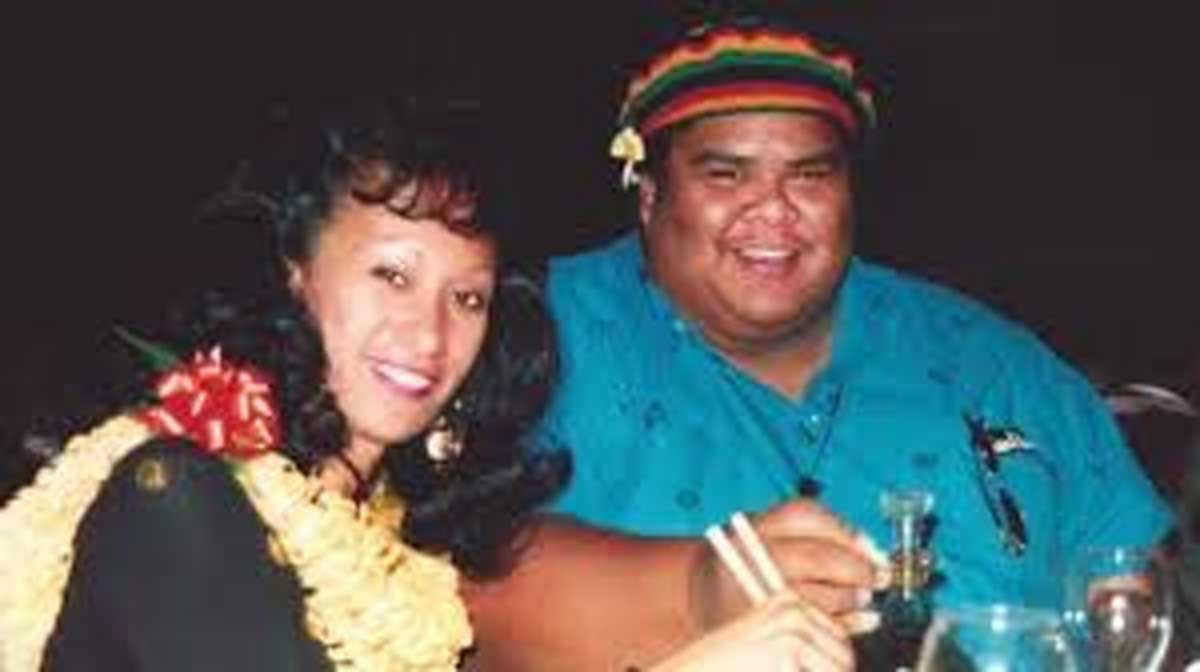
Their love story began not in concert halls or recording studios, but in the neighborhoods of Honolulu, where a young boy made an audacious promise to a girl he barely knew. “I am going to marry you one day,” Israel declared to 14-year-old Marlene. She laughed at his boldness. Yet years later, when he asked her to be his wife, she said yes—beginning a 15-year journey that would test their commitment, challenge their patience, and ultimately define what it means to love unconditionally.
This is the story that rarely makes headlines. Not the story of Israel’s platinum albums or his iconic rendition of “Somewhere Over the Rainbow/What a Wonderful World.” Rather, it’s the intimate portrait of a marriage between two people from Hawaii who chose each other despite the obstacles, who grew together through hardship, and whose love continues to resonate through their children and grandchildren. Understanding Marlene’s role in Israel’s life reveals something profound about the man behind the music—and the price of greatness.
From Childhood Friends to Soulmates: How Israel Met Marlene
The story of Israel and Marlene begins long before either of them understood the significance of their meeting. Marlene Ah Lo was born in 1962 in Honolulu, growing up in a family that valued Hawaiian traditions and cultural expression. By her early teens, she had already discovered her passion for hula—the ancient Hawaiian dance form that tells stories through movement. She performed across Hawaii and beyond, traveling to Tokyo, Omaha, and Idaho to share her art.
Israel Kamakawiwoʻole, born in 1959, was three years her senior. He grew up in the Kaimuki community, surrounded by music from an early age. His uncle, the renowned musician Moe Keale, was a major influence. By the time he was a teenager, Israel was already performing with his older brother Skippy and cousin Allen Thornton, forming what would become the Makaha Sons of Niʻihau. The band was gaining traction, blending traditional Hawaiian music with contemporary sounds.
When Marlene was 14 and Israel was 17, their paths crossed. The exact circumstances remain somewhat private, but what matters is what happened next. Israel, with the confidence and directness that would characterize his personality throughout his life, approached Marlene and made his declaration. He told her mother too, sharing his vision of their future together. Marlene found it charming, if a bit presumptuous. She was young, focused on her dancing career, and had no reason to believe this boy’s bold prediction would come true.
Yet Israel was serious. Over the next several years, as both pursued their respective careers in entertainment, their connection deepened. They saw each other at community events, at performances, in the tight-knit world of Hawaiian music and culture. Marlene watched Israel’s talent flourish. She saw how audiences responded to him, how his voice could move people to tears. And slowly, imperceptibly, the childhood promise began to feel less like a joke and more like destiny.
By the time Israel proposed, Marlene was ready. She was 20 years old, and he was 23. She said yes without hesitation.
A Love Celebrated: Their 1982 Wedding and First Years Together

On September 18, 1982, Israel and Marlene were married at Ka Makua Mau Loa church in Kalihi. They had invited 500 guests to celebrate their union. What they didn’t anticipate was that over 1,000 people would show up. The celebration was so large, so overwhelming in its joy, that Marlene’s parents had to take out a second mortgage on their house to pay for the reception.
This detail—seemingly small—reveals something essential about Israel. He was a man of genuine warmth and generosity. He didn’t invite 500 people because he was arrogant or seeking attention. He invited them because he loved his community, and his community loved him. When he told everyone to come, they came. They wanted to celebrate him, to be part of his joy.
For Marlene, the wedding was a threshold moment. Israel had made it clear that their marriage would require sacrifice. “There is only room for one entertainer,” he told her. She understood what this meant. Her career as a hula dancer—the thing she had worked toward, the thing that defined her—would have to take a back seat. She would become a wife, a mother, a support system.
She accepted this role. But there was one moment that suggested she hadn’t entirely abandoned her identity. During one of Israel’s performances, he brought her onstage. As he sang, she danced. It was a brief moment, a glimpse of what she had been, but it was hers. It showed that even as she stepped into the role of supporting her husband, she remained an artist in her own right.
The early years of their marriage coincided with Israel’s growing success. The Makaha Sons of Niʻihau were becoming Hawaii’s most popular contemporary traditional group. Albums like “Puana Hou Me Ke Aloha” (1984) and “Hoʻola” (1986) were commercial successes. Israel was being recognized as a major talent, not just in Hawaii but increasingly beyond the islands.
For Marlene, these were years of adjustment. She was building a home, raising their daughter Ceslie-Ann “Wehi” (born around 1983), and managing the practical realities of being married to a man whose career was taking off. It was during this period that the first real strains in their marriage began to show.
Behind Closed Doors: The Truth About Their Marriage
Every marriage has a public face and a private reality. Israel and Marlene’s marriage was no exception. To the outside world, they were a success story—a talented musician and his devoted wife, building a life together in Hawaii. But behind closed doors, their relationship was far more complicated.
Marlene would later describe a pattern that defined the first half of their marriage. She would go to work during the day, managing the household and caring for their young daughter. When she returned home, Israel would leave—and he wouldn’t return until the following morning. He spent entire nights out, partying, socializing, living the life of a successful musician who had admirers and opportunities waiting for him everywhere.
“Years of that used to drive me nuts,” Marlene would eventually say, reflecting on this period with a candor that is both heartbreaking and honest. She wasn’t complaining about his success or his need to perform. She was describing the loneliness of being left behind, night after night, while her husband pursued his pleasures. She was describing the exhaustion of being the one who stayed home, who kept things together, who made sure their daughter had what she needed.
The weight of this responsibility became unbearable at times. Marlene found herself in a position she hadn’t anticipated when she said yes to Israel’s proposal. She had given up her career. She had become the caregiver, the manager of their household, the one responsible for their daughter’s wellbeing. And her husband, the man she loved, was not present in the way she needed him to be.
There were moments when Marlene seriously considered leaving. She would pack up their daughter and go stay at her mother’s house for months at a time. These weren’t casual visits. They were acts of desperation, attempts to create space between herself and a marriage that felt increasingly one-sided. “Believe me, I wanted out so many times,” she would later confess.
What kept her from leaving? Marlene has spoken about this in interviews, and her answer is revealing. She loved Israel. Despite his absences, despite his selfishness, despite the ways he took her for granted, she loved him. She also learned something important during these difficult years. Her father had spoiled her as a child, giving her everything she wanted. But marriage to Israel forced her to see things differently. It taught her about sacrifice, about commitment, about the difference between loving someone and being in love with someone.
There was also a practical matter. At some point, Israel moved out. They lived separately for a time, their marriage effectively on pause. This separation might have become permanent. But then something happened that changed everything. Israel suffered a heart attack. The man who had seemed invincible, who had taken his wife for granted, who had pursued his own pleasures without regard for her feelings—he suddenly became vulnerable.
Marlene’s response was immediate and instinctive. She went to him. She began helping to care for him, managing his health, being present in the way she had desperately wanted to be present all along. They continued living apart, but something had shifted. The crisis had created an opening for genuine connection. Israel, facing his mortality, began to understand what he had almost lost. Marlene, given the opportunity to help rather than simply endure, found a new way to express her love.
Their reconciliation wasn’t dramatic. There were no grand gestures or public declarations. Instead, it was quiet and practical—the work of two people learning to be together in a healthier way. It was the foundation they would stand on for the remainder of their time together.
In Her Own Words: Marlene Reflects on Love and Loss
Understanding Israel and Marlene’s relationship requires listening to Marlene herself. In interviews and public appearances, she has shared insights that reveal the depth of her love and the complexity of their marriage.
On loving unconditionally, Marlene has been clear and unambiguous. She has said that she loved Israel not for his money, not for his fame, not for what he could provide. She loved him as a person. “I would still choose him even if he did not have a penny,” she has stated. This wasn’t romantic idealization. It was the hard-won wisdom of someone who had stayed through difficult times and emerged with her love intact.
When asked about being taken for granted, Marlene didn’t shy away from the truth. “He took me for granted for a long time. He knew that I would be there,” she reflected. There’s no bitterness in this statement, only honesty. She understood that Israel’s behavior came from a place of assumption—he assumed she would always be there, always be waiting, always be willing to support him. And he was right. She was always there. But it cost her something.
Yet Marlene has also spoken about what she learned from Israel. Despite his flaws, despite the pain he caused her, he taught her valuable lessons about life, about love, about what it means to commit to another person. She has described how his presence in her life changed her perspective, how it made her grow in ways she couldn’t have anticipated.
On the tenth anniversary of Israel’s death, Marlene gave an interview that touched on their most intimate moments. She remembered how Israel would buy her roses when he could afford them. These small gestures—flowers, moments of tenderness—were woven throughout their relationship. They were the counterweight to the nights he spent away, the balance that kept their love from tipping into bitterness.
In a video titled “How to Love Unconditionally,” Marlene spoke directly about the nature of their bond. She talked about choosing love even when it was difficult, about staying committed even when leaving seemed easier. Her words have resonated with many people who have watched the video, who have heard in her voice the echo of their own struggles with love and commitment.
What emerges from Marlene’s reflections is a portrait of a woman who understood that love is not a feeling that comes and goes. It is a choice. It is a commitment. It is the decision to stay, to work through difficulties, to believe in the possibility of growth and change. She made that choice with Israel, and it shaped both of their lives.
June 26, 1997: The Day Everything Changed
By the mid-1990s, Israel Kamakawiwoʻole had achieved what few musicians ever do. His solo career had taken off spectacularly. The 1993 album “Facing Future” had become a commercial phenomenon. His medley of “Somewhere Over the Rainbow/What a Wonderful World” was being used in films and television shows, reaching audiences far beyond Hawaii. In 1997, he won multiple awards at the Na Hoku Hanohano Awards, Hawaii’s most prestigious music honors. He watched the awards ceremony from a hospital room.
But Israel’s body was failing. Throughout his life, he had struggled with obesity. At one point, he weighed 757 pounds while standing 6 feet 2 inches tall. This wasn’t simply a matter of appearance or health statistics. It was a medical crisis. His weight had created chronic respiratory and cardiac problems. He had been hospitalized multiple times. His doctors warned him that his lifestyle was unsustainable.
In June 1997, Israel’s condition deteriorated rapidly. He was admitted to Queen’s Medical Center in Honolulu. Marlene was there. Their daughter Wehe was there. His family surrounded him as his body, exhausted from years of struggle, began to shut down.
On June 26, 1997, at 12:18 a.m., Israel Kamakawiwoʻole died of respiratory failure. He was 38 years old. He had been married to Marlene for 15 years. Their daughter was 14. The man who had promised a young girl that he would marry her one day had kept that promise, but the time they had together was cut tragically short.
The impact on Hawaii was immediate and profound. On July 10, 1997, the Hawaiian flag flew at half-mast for Israel’s funeral—a rare honor. His koa wood casket lay in state at the Hawaii state capitol building in Honolulu. He was only the third person, and the only non-government official, to receive this distinction. Approximately 10,000 people attended his funeral service. The grief was palpable, genuine, overwhelming.
Two days after the funeral, his ashes were scattered into the Pacific Ocean at Mākua Beach. Thousands of people gathered to witness this final farewell. Marlene was there. According to witnesses, many people commemorated him by honking their car and truck horns on all Hawaiian highways that day. It was as if the entire state was saying goodbye to a son, a brother, a voice that had become part of Hawaii’s identity.
For Marlene, this was the moment she had feared but perhaps always known was coming. The man she had chosen to love, despite his flaws, despite the difficulties, was gone. She was 35 years old, a widow with a teenage daughter and a lifetime of memories that would have to sustain her.
Rebuilding Life: How Marlene Honored Israel’s Memory
The years immediately following Israel’s death were perhaps the most challenging of Marlene’s life. She had to grieve while also being strong for their daughter. She had to process her loss while managing the practical realities of being a widow. She had to figure out who she was in a world where her primary identity had been “Israel’s wife.”
Marlene made a deliberate choice during this time. She retreated from public life. She was not interested in becoming a celebrity by association, in cashing in on her husband’s fame, in seeking the spotlight that had never been her natural habitat anyway. Instead, she focused on what mattered most: raising their daughter and preserving Israel’s legacy in a way that felt authentic to her.
This meant living quietly. She settled in Pearl City, Hawaii, away from the tourist areas and the music industry hustle. She devoted herself to raising Wehe, who was navigating her own grief while also dealing with the normal challenges of adolescence. Marlene became the stable presence in her daughter’s life, the one who could answer questions about her father, who could share stories, who could help her understand the man behind the legend.
Financially, Marlene was secure. Israel’s estate was valued at approximately $3 million. More importantly, his music continued to generate royalties. As his songs were used in films and television shows, as his albums continued to sell, as new generations discovered “Somewhere Over the Rainbow/What a Wonderful World,” the money kept coming. In 2010, Marlene said that the royalties from Israel’s music would be enough to live on if she retired. She didn’t need to work. She could focus entirely on her family.
But Marlene didn’t simply sit back and enjoy the financial security. She became a custodian of Israel’s legacy. She participated in memorial events. She gave interviews about their life together. She made herself available to documentaries and tributes. She attended the dedication of a bronze bust of Israel at the Waianae Neighborhood Community Center in 2003, standing beside sculptor Jan-Michelle Sawyer as the community honored her late husband.
In 2010, when NPR named Israel “The Voice of Hawaii” as part of its 50 Great Voices series, Marlene was there to represent him. In 2025, when Israel was inducted into the Ukulele Hall of Fame, Marlene attended the ceremony, a living connection to the man being honored.
What’s remarkable about Marlene’s approach to widowhood is that she never tried to become something she wasn’t. She didn’t attempt to capitalize on Israel’s fame by launching her own career. She didn’t write a tell-all book or seek out media attention. She simply lived, quietly and with dignity, keeping Israel’s memory alive through her presence and her participation in events that mattered.
Her daughter Wehe grew up and had her own family. Marlene became a grandmother, watching her grandchildren grow up in a world where their grandfather’s music was everywhere, where his voice was a constant presence. Two of her grandchildren, Elijah and Kiara Parker, developed a love for music and the ukulele—carrying forward the family’s musical legacy in their own way.
When asked about seeing her children’s love of music, Wehe reflected: “Instruments are not my thing, but seeing this reflected in my kids is bittersweet. It is untouchable in terms of how to describe it and how it causes me to feel. But it is very comforting to see a reflection of him in front of me every day through my children.”
This is Marlene’s greatest legacy—not the money, not the fame by association, but the family she helped raise and the values she passed down. Her grandchildren know their grandfather’s songs even though they never met him. They know his story because Marlene told it to them. They understand his importance because she made sure they did.
A Love That Transcends Time: Their Lasting Impact
Nearly three decades after Israel’s death, his music continues to reach new audiences. The medley “Somewhere Over the Rainbow/What a Wonderful World” has spent over 371 weeks at the top of the World Digital Songs chart—the longest-leading number-one hit on any Billboard song chart. It has been featured in countless films and television shows. It has become a song that people play at funerals, at weddings, at moments when they need to feel connected to something larger than themselves.
But the song is not just a commercial success. It is a testament to the love between Israel and Marlene. When Israel recorded that song in 1988, he was a man in his late twenties, already struggling with his weight, already aware that his time on earth might be limited. The song carries a quality of longing, of yearning, of hope mixed with melancholy. It is the sound of someone reaching for something beautiful even in the face of darkness.
Marlene heard that song countless times. She watched it become a phenomenon. She saw it touch people’s hearts around the world. And she understood that in some way, she was part of that song’s legacy. She had been there when Israel recorded it. She had supported him through the struggles that gave the song its emotional depth. She had stood by him as he became “The Voice of Hawaii.”
The impact of their love story extends beyond music. It is a story about commitment, about sacrifice, about the possibility of growth and change within a marriage. It is a story that resonates with people who have their own struggles with love, their own doubts about whether they can make it work, their own questions about what it means to love unconditionally.
In 2014, Pixar released a short film called “Lava” that featured two volcanoes as main characters. The film was inspired in part by Israel’s music and his style. James Ford Murphy, the director, cited Israel’s cover of “Somewhere Over the Rainbow” as a partial inspiration for the film’s emotional core. This is the kind of legacy that transcends the music industry—the ability to inspire artists in completely different mediums, to influence the way people think about love and beauty and connection.
For Marlene, watching her husband’s influence grow even after his death must be bittersweet. She lost him when he was still young, when there was so much more life to live together. But she also got to see the world embrace what he created, to understand his importance, to recognize his genius. And she got to play a role in that legacy, not as a performer or a public figure, but as the woman who loved him, who stood by him, who made his life possible.
Their story is not a fairy tale. It is not a simple narrative of two people who met, fell in love, and lived happily ever after. It is a story about real people navigating real difficulties. It is a story about a woman who gave up her career to support her husband. It is a story about a man who took his wife for granted and then learned, too late, what he had almost lost. It is a story about love as a choice, as a commitment, as something that requires work and sacrifice and faith.
And it is a story that continues. Every time someone listens to “Somewhere Over the Rainbow/What a Wonderful World,” they are hearing the voice of a man who loved his wife, who was loved by his wife, who created something beautiful that will outlive them both. Every time someone watches “Lava” or hears Israel’s music in a film, they are participating in the legacy that Marlene helped to build and that she continues to protect.
This is the love story that rarely makes headlines. This is the woman who stood in the shadows so that her husband could shine. And this is the legacy that they created together—not just in music, but in the lives they touched, the love they demonstrated, and the hope they continue to inspire.
Frequently Asked Questions About Israel and Marlene
A Love Story for the Ages
The love story of Israel Kamakawiwoʻole and Marlene Kamakawiwoʻole is not the kind that typically makes headlines. There are no dramatic declarations, no public scandals, no fairy tale ending. Instead, it is a story about two people from Hawaii who chose each other despite the obstacles, who grew together through hardship, and whose commitment to one another created something that continues to inspire people around the world.
Israel was a man of extraordinary talent but also extraordinary struggle. His voice could move people to tears. His music could capture the essence of Hawaiian culture and make it accessible to millions. But he was also a man who struggled with his weight, who sometimes took his wife for granted, who pursued his own pleasures without always considering the impact on those who loved him. He was, in other words, human.
Marlene was a woman of quiet strength. She gave up her own career to support her husband. She stayed through difficult times when leaving would have been easier. She loved him not for what he could provide, but for who he was. And when he died, she didn’t disappear. She didn’t try to capitalize on his fame or become a celebrity in her own right. Instead, she devoted herself to preserving his legacy and raising their daughter with the values that had sustained her through their marriage.
What their story teaches us is that love is not a feeling. It is a choice. It is the decision to stay, to work through difficulties, to believe in the possibility of growth and change. It is the commitment to another person even when that commitment costs you something. It is the willingness to sacrifice your own dreams so that someone else can pursue theirs, and the faith that in doing so, you are building something meaningful.
Israel’s music continues to touch millions of people. Every time someone listens to “Somewhere Over the Rainbow/What a Wonderful World,” they are hearing the voice of a man who was loved deeply and who loved deeply in return. Every time that song is used in a film or television show, every time it appears in a commercial or a documentary, Marlene’s sacrifice is honored. Her choice to stand by Israel, to support him, to love him unconditionally, made his greatest achievements possible.
And their legacy continues through their children and grandchildren. Wehe raised her own family with the values that Marlene instilled in her. The grandchildren who never met Israel know his music, know his story, understand his importance. They carry forward the family’s commitment to Hawaiian culture and music. They are living proof that love transcends death, that the impact of a life well-lived extends far beyond the years we spend on earth.
This is the love story that rarely makes headlines. This is the woman who stood in the shadows so that her husband could shine. This is the legacy that they created together—not just in music, but in the lives they touched, the love they demonstrated, and the hope they continue to inspire. And it is a story that deserves to be told, remembered, and celebrated for generations to come.