Determining the precise amount of an FHA-insured home loan one can afford involves evaluating several financial metrics, including credit score, existing debt obligations, and the size of the down payment. The Federal Housing Administration sets specific guidelines, but individual lender criteria and regional loan limits also play a significant role in the final affordability assessment.

Understanding FHA Loan Affordability: Key Factors
FHA loan affordability is influenced by a combination of personal financial health and federal regulations. Key factors include your credit score, which dictates minimum down payment requirements, your debt-to-income ratio, and the FHA’s established loan limits for your specific area. Understanding these elements is fundamental to accurately estimating your purchasing power.
Prospective homebuyers seeking an FHA-insured mortgage must consider several critical financial components that collectively determine their borrowing capacity. These factors are not isolated but rather interact to provide a comprehensive picture of what a borrower can realistically afford. A strong understanding of these elements is essential for navigating the FHA loan process effectively.
The Federal Housing Administration (FHA) does not directly lend money; instead, it insures loans made by FHA-approved lenders. This insurance protects lenders against losses if a borrower defaults, which in turn allows lenders to offer more favorable terms, such as lower down payments and more flexible credit requirements, compared to conventional loans [1].
FHA Loan Limits by Location
FHA loan limits are not uniform across the United States; they vary significantly based on the median home prices in specific counties and metropolitan areas. These limits are updated annually by the U.S. Department of Housing and Urban Development (HUD) to reflect current market conditions, ensuring that FHA loans remain accessible in diverse housing markets.
The maximum amount an FHA loan will insure is subject to annual adjustments by the U.S. Department of Housing and Urban Development (HUD). These FHA loan limits are determined at the county level, meaning that the maximum loan amount available to a borrower can differ significantly based on their intended property location. For instance, in 2026, the FHA loan limit for a single-family home in a low-cost area is generally up to $541,287, while in high-cost areas, it can extend up to $1,249,125 [4].
This localized approach ensures that individuals in more expensive housing markets still have access to FHA financing. It is crucial for potential buyers to verify the specific FHA loan limits for the county where they plan to purchase a home. This information is publicly available on the HUD website and can significantly impact the maximum home price a borrower can consider.
| Area Type | FHA Loan Limit (Single-Family Home, 2026) |
|---|---|
| Low-Cost Areas | Up to $541,287 |
| High-Cost Areas | Up to $1,249,125 |
The Role of Your Credit Score
A borrower’s credit score is a pivotal factor in FHA loan qualification and directly influences the required down payment and potential interest rate. While FHA guidelines are more flexible than conventional loans, a higher credit score generally leads to more favorable loan terms, including a lower minimum down payment and a more competitive interest rate.
The FHA has established minimum credit score requirements for its insured loans, making homeownership accessible to a broader range of individuals. Generally, a credit score of 580 or higher allows for a minimum down payment of 3.5% of the home’s purchase price. For those with credit scores between 500 and 579, the FHA requires a higher minimum down payment of 10% [1] [3].
It is important to note that while the FHA sets these minimums, individual lenders may impose their own, stricter credit score requirements. For example, some lenders may require a minimum credit score of 580, regardless of the FHA guidelines. A higher credit score not only helps meet lender-specific criteria but can also result in a lower interest rate, which translates to lower monthly mortgage payments over the life of the loan.
Debt-to-Income Ratio (DTI) and FHA Loans
The debt-to-income (DTI) ratio is a crucial metric lenders use to assess a borrower’s ability to manage monthly mortgage payments alongside existing debts. The FHA typically requires a DTI of 43% or less, though exceptions can be made for borrowers with strong compensating factors, allowing for a DTI up to 50% in some cases.
Your debt-to-income (DTI) ratio is a percentage that compares your total monthly debt payments to your gross monthly income. Lenders use this ratio to determine if you have sufficient income to cover your new mortgage payment in addition to your existing financial obligations. The FHA generally prefers a DTI ratio of 43% or lower [3].
To calculate your DTI, sum all your recurring monthly debt payments, such as credit card minimums, student loan payments, and car loan payments, and divide that total by your gross monthly income. A lower DTI indicates a healthier financial position and a greater capacity to take on a mortgage. While 43% is a common guideline, some lenders, with FHA approval, may accept a DTI as high as 50% if the borrower has strong compensating factors, such as significant cash reserves or a very high credit score [3].
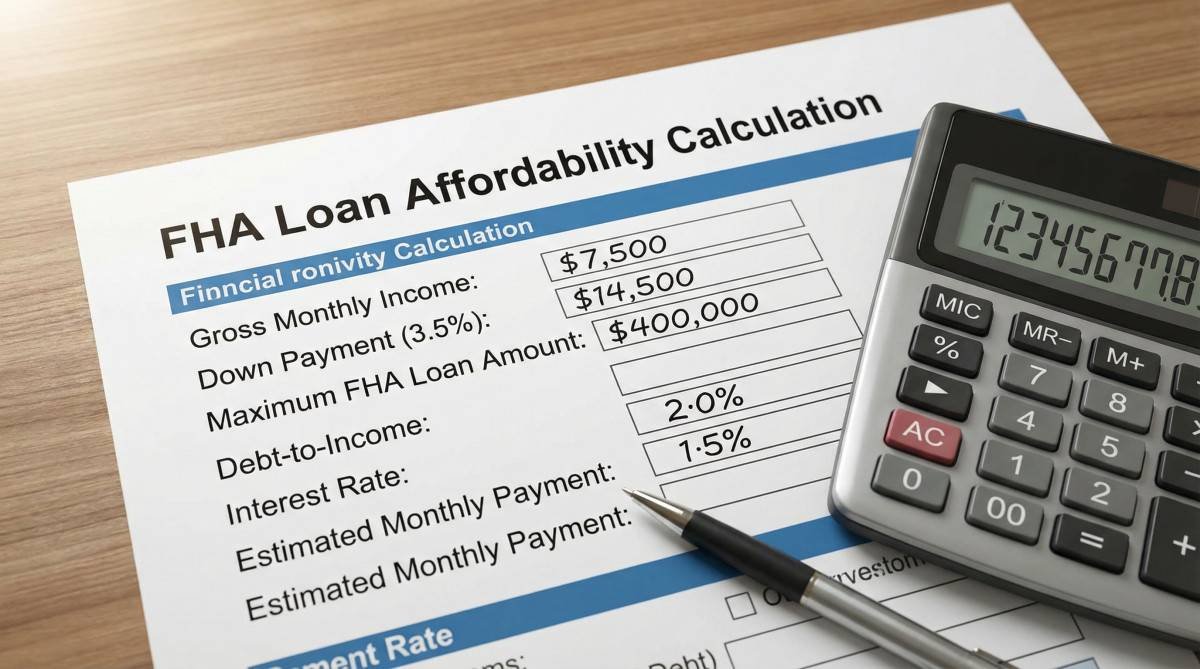
| DTI Ratio | Lender Interpretation |
|---|---|
| 25% or less | Strong borrowing capacity |
| 26% – 35% | Moderate borrowing capacity, generally acceptable |
| 36% – 43% | Higher end of acceptable, may require review of other factors |
| Over 43% | May require compensating factors or specific lender programs |
Down Payment Requirements and Mortgage Insurance
FHA loans are known for their low down payment options, requiring as little as 3.5% for borrowers with a credit score of 580 or higher. However, these loans also mandate mortgage insurance premiums (MIP), which include an upfront payment and annual premiums, impacting the overall cost of the loan.
One of the most attractive features of FHA loans is the relatively low down payment requirement. For borrowers with a credit score of 580 or higher, a down payment of just 3.5% of the home’s purchase price is typically sufficient. If your credit score falls between 500 and 579, a 10% down payment is required [1] [3]. This flexibility makes homeownership more attainable for many individuals who may not have substantial savings for a larger down payment.
However, FHA loans come with mandatory Mortgage Insurance Premiums (MIP). This includes an upfront MIP (UFMIP) equal to 1.75% of the loan amount, which is typically financed into the loan. Additionally, an annual MIP is charged, paid monthly, and its duration depends on the loan-to-value (LTV) ratio at the time of origination. If the initial down payment is less than 10%, the annual MIP is paid for the life of the loan. If the down payment is 10% or more, the annual MIP can be canceled after 11 years [3]. These insurance costs add to the overall monthly housing expense and should be factored into affordability calculations.
Additional Costs to Consider
Beyond the principal and interest, FHA loan affordability must account for various additional costs, including property taxes, homeowners insurance, and closing costs. These expenses can significantly impact the total monthly housing payment and should be thoroughly researched and budgeted for to avoid unexpected financial strain.
When calculating how much FHA house you can afford, it is crucial to look beyond just the loan principal and interest. Several other costs contribute to your total monthly housing expense and the overall financial commitment of homeownership. These include property taxes, homeowners insurance, and closing costs.
- Property Taxes: These are levied by local government entities and vary significantly based on the property’s location and assessed value. Property taxes are typically included in your monthly mortgage payment and held in an escrow account by your lender.
- Homeowners Insurance: This protects your home and belongings from damage and liability. Like property taxes, homeowners insurance premiums are often included in your monthly mortgage payment and managed through an escrow account. The cost can vary based on location, home value, and chosen coverage.
- Closing Costs: These are fees paid at the closing of a real estate transaction. For FHA loans, closing costs typically range from 2% to 5% of the loan amount and can include origination fees, appraisal fees, title insurance, and other administrative expenses [3]. While some closing costs can be negotiated or covered by the seller, borrowers should budget for these upfront expenses.
Strategies to Increase Your FHA Loan Affordability
To enhance FHA loan affordability, prospective buyers can implement several strategies, such as improving their credit score to qualify for better terms, reducing existing debt to lower their debt-to-income ratio, and saving for a larger down payment to decrease the loan amount and potentially reduce mortgage insurance duration.
If your initial assessment suggests that your desired home price is beyond your current FHA loan affordability, there are proactive steps you can take to improve your financial standing and increase your purchasing power:
- Improve Your Credit Score: A higher credit score can unlock more favorable loan terms, including a lower interest rate and the minimum 3.5% down payment. Focus on paying bills on time, reducing credit card balances, and avoiding new credit inquiries to boost your score [3].
- Reduce Your Debt-to-Income Ratio (DTI): Paying down existing debts, especially those with high monthly payments, can significantly lower your DTI. A lower DTI makes you a more attractive borrower and can increase the loan amount for which you qualify [3].
- Save for a Larger Down Payment: While FHA loans offer low down payment options, contributing a larger down payment reduces the loan amount, thereby lowering your monthly payments. A down payment of 10% or more can also lead to the cancellation of annual MIP after 11 years, saving you money in the long run [3].
- Explore Down Payment Assistance Programs: Many state and local programs offer down payment and closing cost assistance, particularly for first-time homebuyers or those with moderate incomes. These programs can significantly reduce your upfront out-of-pocket expenses [3].
- Shop Around for Lenders: Different FHA-approved lenders may offer varying interest rates and terms. Comparing offers from multiple lenders can help you find the most competitive rates and save money over the life of the loan.
Frequently Asked Questions About FHA Loan Affordability
What is the minimum credit score for an FHA loan?
The FHA generally requires a minimum credit score of 500, but a score of 580 or higher is needed for the lowest 3.5% down payment option [3].
How much down payment is required for an FHA loan?
A 3.5% down payment is required for credit scores of 580 or above, while a 10% down payment is needed for scores between 500 and 579 [3].
What is the maximum debt-to-income ratio for an FHA loan?
The FHA typically prefers a debt-to-income ratio of 43% or less, though some exceptions allow for up to 50% with compensating factors [3].
How long do I have to pay FHA mortgage insurance?
If your down payment is less than 10%, annual MIP is paid for the life of the loan; with 10% or more down, it can be canceled after 11 years [3].
Can I get an FHA loan with a low income?
Yes, FHA loans are designed to be accessible, and there are no specific income minimums, but your income must support your debt-to-income ratio [3].
Conclusion
Understanding how much FHA house you can afford is a multi-faceted process that involves a careful review of your financial situation and FHA guidelines. By considering factors such as credit score, debt-to-income ratio, down payment, and FHA loan limits, prospective homeowners can accurately assess their purchasing power. Proactive steps to improve these financial metrics can significantly enhance affordability and pave the way to successful homeownership. Consulting with FHA-approved lenders and utilizing available resources can further clarify the path to securing an FHA loan that aligns with your financial goals.
References
- [1] A guide to FHA loan affordability | Rocket Mortgage
- [2] How Much House Can I Afford With FHA? | HomeLight
- [3] FHA Loan Requirements for 2026 – NerdWallet
- [4] FHA Mortgage Limits – HUD