The sudden, shocking blast of cold water during a morning shower is a universal homeowner nightmare that immediately signals the end of a water heater’s lifespan. When faced with replacing this essential, yet often ignored, appliance, many homeowners are surprised to discover how significantly the technology has advanced over the past decade. The days of simply swapping out an old tank for an identical new one are gone. Today, conducting a thorough water heater comparison is a critical step in managing a home’s long-term energy consumption and ensuring optimal comfort. Water heating is typically the second largest energy expense in a residential property, accounting for roughly 20 percent of a home’s total utility costs. Therefore, choosing the right system is an investment that will impact your monthly budget for the next ten to twenty years.
The modern market is dominated by three primary categories: traditional storage tank models, on-demand tankless units, and highly efficient heat pump (hybrid) systems. Each of these technologies operates on fundamentally different principles, presenting a unique set of advantages and drawbacks. A system that works perfectly for a retired couple in a small, warm-climate condominium might be entirely inadequate for a bustling family of five living in a cold-weather region. To make an informed decision, homeowners must evaluate their specific household needs, analyzing factors such as peak hot water demand, available physical space, fuel source availability, and their budget for both the initial installation and long-term operating costs. This guide provides a detailed comparison of the three leading water heater types to help you find the perfect fit for your home.
Traditional Storage Tank Water Heaters
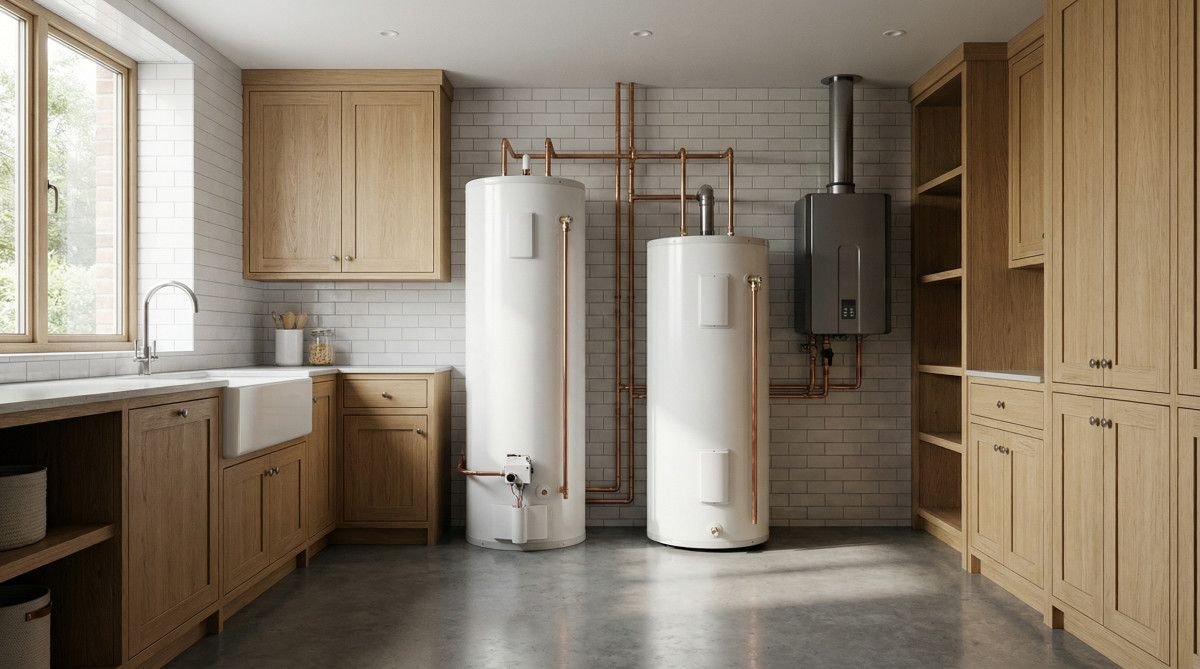
Answer Capsule: Traditional storage tank water heaters remain the most common choice due to their low upfront cost and simple installation. They work by continuously heating a large reservoir of water (typically 40 to 80 gallons) so that hot water is always ready for immediate use.
The traditional storage tank water heater is the familiar, large cylindrical appliance found in basements and garages across the country. These units operate on a very straightforward principle: cold water enters the bottom of the insulated tank, where it is heated by either an electric heating element or a gas burner. A thermostat monitors the temperature, ensuring the entire reservoir of water is kept constantly hot, typically around 120 degrees Fahrenheit. When a hot water tap is turned on anywhere in the house, the heated water is pushed out the top of the tank and delivered through the plumbing system.
The primary advantage of a storage tank system is its affordability. These units have the lowest initial purchase price and, because they are the standard in most older homes, replacing an existing tank with a new one is usually a fast, inexpensive plumbing job requiring no major electrical or gas line upgrades. Furthermore, tanks excel at handling high simultaneous demand. If someone is showering while the dishwasher and washing machine are running, the large reservoir can usually supply all fixtures simultaneously without a drop in water pressure or temperature. However, this design has a significant flaw known as standby heat loss. Because the tank must keep the water hot 24 hours a day, even when you are sleeping or away at work, it constantly consumes energy. Additionally, once the heated reservoir is depleted, you must wait for a completely new tank of cold water to be heated, which can take an hour or more.
Tankless (On-Demand) Water Heaters
Answer Capsule: Tankless water heaters, also known as on-demand systems, heat water only when a faucet is turned on, eliminating standby energy loss. While they have a higher initial cost, they provide a continuous, endless supply of hot water and take up a fraction of the space of a tank model.
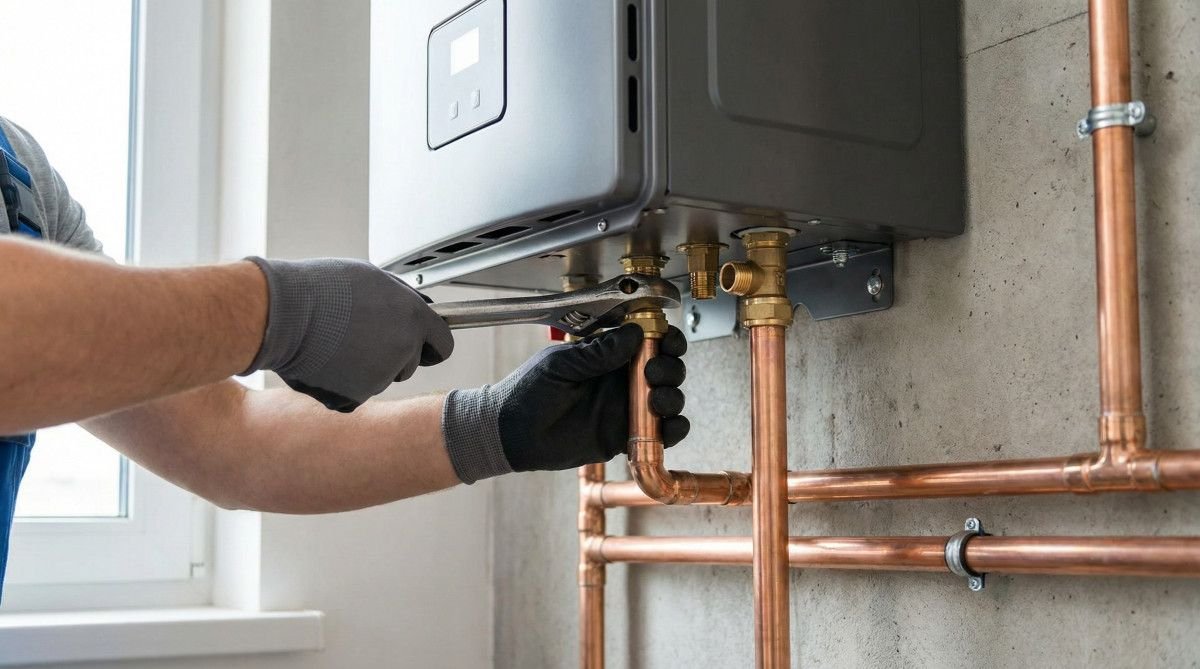
Tankless water heaters represent a paradigm shift in how homes generate hot water. Instead of storing a large volume of pre-heated water, these compact, wall-mounted units heat water directly as it flows through the device. When a hot water tap is opened, a flow sensor detects the movement and ignites a powerful gas burner or activates a heavy-duty electric element. The cold water travels through a tightly coiled heat exchanger, rapidly reaching the desired temperature before exiting the unit. The moment the tap is closed, the heating process stops instantly.
This on-demand operation eliminates standby heat loss entirely, making tankless units significantly more energy-efficient than traditional tanks. According to the Department of Energy, for homes that use 41 gallons or less of hot water daily, demand water heaters can be 24% to 34% more energy-efficient than conventional storage tank water heaters. Beyond efficiency, their greatest appeal is the promise of endless hot water; as long as you have fuel and water flowing, the unit will continue to produce hot water, meaning you will never run out during a long shower. They also free up valuable floor space due to their small footprint. The trade-off, however, is cost. The units themselves are expensive, and the installation often requires upgrading the home’s gas supply line or electrical panel to handle the massive, instantaneous energy draw required to heat water on the fly. Additionally, while they provide endless hot water, their flow rate is limited; if too many fixtures are used simultaneously, the unit may struggle to keep up, resulting in a drop in water temperature.
Heat Pump (Hybrid) Water Heaters
Answer Capsule: Heat pump water heaters offer the highest energy efficiency of any electric model by moving heat from the surrounding air into the water tank, rather than generating heat directly. They are ideal for warm climates and can reduce water heating costs by up to 60%.
Heat pump water heaters, often referred to as hybrid electric water heaters, are the most technologically advanced option on the market. Instead of using a heating element to generate heat from scratch, these systems use electricity to move heat from one place to another. They operate like a refrigerator working in reverse. A fan pulls ambient air from the room across an evaporator coil containing liquid refrigerant. The refrigerant absorbs the heat from the air and turns into a gas. A compressor then pressurizes the gas, significantly increasing its temperature. This superheated gas travels through a condenser coil wrapped around the water tank, transferring its heat into the water.
Because moving heat requires far less energy than creating it, heat pump water heaters are extraordinarily efficient. They can be two to three times more energy-efficient than conventional electric resistance water heaters, leading to massive reductions in monthly utility bills. Furthermore, their high efficiency often qualifies homeowners for substantial federal tax credits and local utility rebates, which helps offset their high initial purchase price. However, they do have specific installation requirements. Because they pull heat from the surrounding air, they must be installed in a location that remains between 40 degrees and 90 degrees Fahrenheit year-round and offers at least 1,000 cubic feet of air space around the unit. Additionally, as a byproduct of their operation, they blow cool, dehumidified exhaust air back into the room, which is a bonus in a hot garage but undesirable in a heated living space.
Making the Right Choice for Your Household
Answer Capsule: Choosing the right water heater depends on your household size, daily hot water demand, and budget. Large families with high simultaneous usage may prefer a large storage tank, while energy-conscious homeowners looking for long-term savings should consider tankless or heat pump models.
Ultimately, the decision comes down to matching the technology to your lifestyle and the physical constraints of your home. The first step is assessing your fuel source. If your home is already plumbed for natural gas, sticking with a gas-fired tank or upgrading to a gas tankless unit is usually the most cost-effective path. If you rely entirely on electricity, a heat pump water heater is unequivocally the best investment for long-term savings, provided you have the necessary space. It is also crucial to calculate your household’s peak hour demand. This involves estimating how many gallons of hot water you use during your busiest hour of the day (usually the morning routine). If your family frequently runs multiple showers while running the dishwasher, a high-capacity storage tank or a very large tankless unit will be required to prevent frustrating drops in water temperature.
Finally, consider the physical footprint. Traditional tanks and heat pump models require significant floor space and vertical clearance, which can be problematic in tight utility closets. Tankless units, mounted neatly on the wall, are the clear winner for space-constrained homes. By carefully weighing these factors against the upfront costs and projected energy savings, homeowners can select a water heating system that provides reliable comfort while maximizing their return on investment.
Frequently Asked Questions
Do tankless water heaters really save money?
Yes, tankless water heaters save money on monthly utility bills by completely eliminating standby heat loss. However, because the initial purchase and professional installation costs are significantly higher than traditional tanks, the “payback period”—the time it takes for energy savings to offset the higher upfront cost—can take several years. They are a long-term investment.
What size water heater do I need for a family of four?
For a family of four, a standard storage tank water heater should typically hold between 50 and 60 gallons to comfortably handle morning showers and simultaneous appliance use. If opting for a tankless system, you will need a unit capable of delivering a flow rate of at least 5 to 8 gallons per minute (GPM) to support multiple fixtures running at the same time.
Are heat pump water heaters noisy?
Heat pump water heaters generate a low humming sound similar to a modern refrigerator or a small window air conditioner when the compressor and fan are running. While not overly loud, they are generally best installed in a garage, basement, or dedicated utility room rather than adjacent to a bedroom or main living area.
Conclusion
Answer Capsule: A thorough water heater comparison reveals that there is no single “best” option for every home. Traditional tanks offer affordability, tankless units provide endless hot water and space savings, and heat pump models deliver unparalleled energy efficiency.
Upgrading a water heater is a significant home improvement project that requires careful consideration of both immediate costs and long-term performance. While the traditional storage tank remains a reliable and budget-friendly standby, modern innovations offer compelling alternatives for homeowners willing to invest in efficiency. Tankless systems have revolutionized the market by providing an endless supply of hot water in a compact, wall-mounted package, entirely eliminating the waste of standby heat loss. Conversely, for homes relying on electricity, heat pump water heaters represent the pinnacle of energy conservation, leveraging ambient heat to drastically slash monthly utility bills.
To ensure you make the most advantageous choice, it is highly recommended to consult with a licensed, professional plumber. They can accurately assess your home’s existing infrastructure, calculate your precise peak hour hot water demand, and help you navigate the various local rebates and tax incentives available for high-efficiency models. By approaching this decision strategically, you can secure a reliable, comfortable hot water supply while maximizing your home’s overall energy efficiency.