How does a Grammy-winning rapper, known for one of the most iconic hits of the 2000s, quietly transform into a multi-millionaire tech investor? This isn’t a hypothetical question; it’s the real-life story of Hakeem Seriki, the artist professionally known as Chamillionaire. While many remember him for the chart-topping single “Ridin’,” his most impressive work has happened offstage, in the world of venture capital and tech startups.
Chamillionaire net worth – rapper turned tech investor
Today, Chamillionaire’s net worth is estimated at a staggering $50 million. This fortune was built not on record sales, but on a series of shrewd, early-stage investments. This article breaks down his remarkable journey from a Houston hip-hop legend to a respected tech mogul, exploring his music career, his calculated pivot to the business world, a timeline of his game-changing investments, and the valuable lessons his success offers.
Who Is Chamillionaire? From Houston Roots to Global Fame
Born in Washington, D.C., to a Nigerian Muslim father and an African-American Christian mother, Hakeem Seriki’s family moved to a tough neighborhood in Houston, Texas, when he was young. It was here that he developed his passion for hip-hop, inspired by local legends like UGK and the Geto Boys. In his teens, he teamed up with childhood friend Paul Wall, and the duo became a formidable force in the city’s burgeoning mixtape scene, eventually joining the renowned Swishahouse collective.
Their independent album, Get Ya Mind Correct, sold over 150,000 copies and put them on the map. However, it was Chamillionaire’s solo career that launched him into the stratosphere. His 2005 major-label debut, The Sound of Revenge, was a commercial success, but its lead single, “Ridin’,” became a cultural phenomenon. The track, featuring Krayzie Bone of Bone Thugs-n-Harmony, soared to #1 on the Billboard Hot 100, earned a Grammy Award for Best Rap Performance, and was even parodied by “Weird Al” Yankovic with the viral hit “White & Nerdy.”
Yet, even at the peak of his fame, Chamillionaire showed signs of a different mindset. His 2007 follow-up album, Ultimate Victory, was notable for its complete lack of profanity — a conscious decision to stand apart from the conventions of the rap industry and a precursor to the unconventional path he would soon take.
The Pivot: Why Chamillionaire Left the Music Industry Behind
After the success of Ultimate Victory, fans anticipated a third album, tentatively titled Venom. However, the album never materialized. Chamillionaire grew disillusioned with the music industry’s creative limitations and parted ways with Universal Records in 2011. He saw a ceiling in the traditional artist model and sought a path with greater control and uncapped potential.
This desire for ownership wasn’t new. As early as 2004, he founded his own label, Chamillitary Entertainment, and even invested in a Houston-based car customization shop called Fly Rydes. His entrepreneurial instincts were sharp from the beginning. He famously stated:
“I got into investing by learning. The best advice is to surround yourself with people who are curious and intelligent. You can pick up from them along the way.” — Chamillionaire
This philosophy guided his transition from the recording studio to the boardroom, where he would build the majority of his wealth.
Building a Tech Empire: A Timeline of Chamillionaire’s Smartest Investments
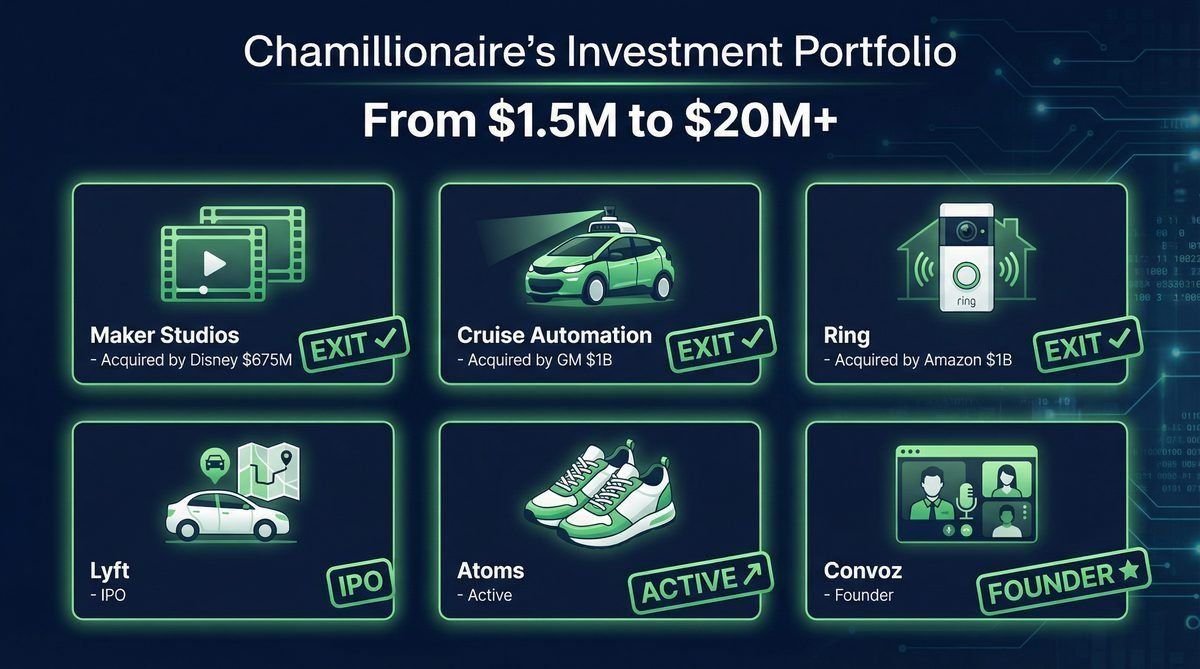
Chamillionaire’s move into tech wasn’t a random gamble; it was a calculated strategy. He began attending tech conferences to understand how companies were funded and valued. In 2015, his efforts culminated in him being named an Entrepreneur-in-Residence at Upfront Ventures, a major Los Angeles venture capital firm. This role gave him a formal platform to scout deals and mentor startups, solidifying his reputation as a serious investor.
His portfolio is a testament to his foresight, focusing on companies that solved real-world problems. Below is a timeline of his most significant and successful investments.
| Company | Year | Known For | Outcome / Status |
|---|---|---|---|
| Maker Studios | 2009 | YouTube Multi-Channel Network | Acquired by Disney for ~$675M. Chamillionaire’s reported return was over $20M from a $1.5M investment. |
| Cruise Automation | ~2015 | Self-Driving Car Technology | Acquired by General Motors in 2016 for a reported $1 billion. |
| Ring | ~2016 | Smart Doorbell & Home Security | Acquired by Amazon in 2018 for over $1 billion. |
| Lyft | Pre-IPO | Ride-Sharing Service | Successfully went public in 2019. |
| Atoms | 2019 | Minimalist Footwear | Active and growing. |
| Convoz | 2018 | Social Video App | Founder-led venture to connect creators and fans directly. |
| Access Club | 2022 | Private Investor Network | Founder-led platform connecting investors with startups, with a focus on minority founders. |
These investments showcase a clear pattern: Chamillionaire identified transformative trends in digital media, transportation, and home security long before they became mainstream, and he wasn’t afraid to place significant bets on them.
The $50 Million Question: Deconstructing Chamillionaire’s Net Worth
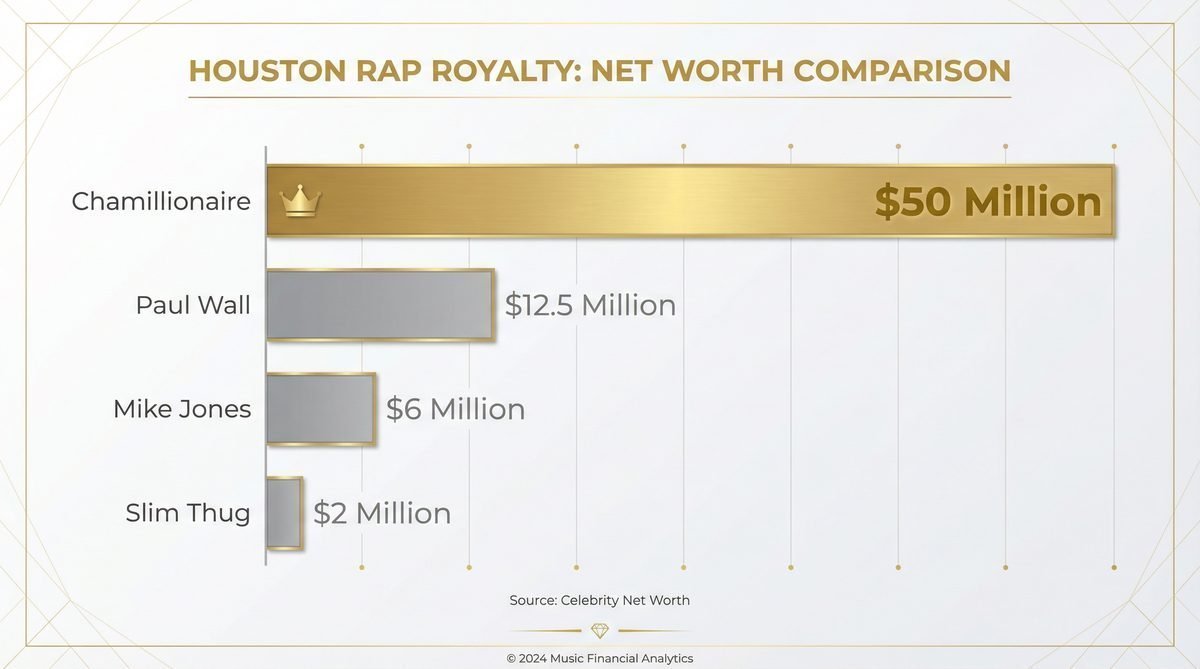
A quick search for “Chamillionaire net worth” reveals a few conflicting numbers, with some sources citing a lower figure of $30 million. However, the overwhelming consensus from authoritative financial publications like Celebrity Net Worth, Forbes, and AfroTech confirms the $50 million estimate. This figure is substantiated by his publicly known investment exits, particularly the massive return from the Disney acquisition of Maker Studios.
The discrepancy can be attributed to older, outdated reports that haven’t accounted for the full scope of his successful venture capital activities. To put his wealth into perspective, it’s helpful to compare it to some of his Houston hip-hop contemporaries, whose fortunes were primarily built through music.
| Artist | Estimated Net Worth | Primary Income Source |
|---|---|---|
| Chamillionaire | $50 Million | Tech Investments |
| Paul Wall | ~$12.5 Million | Music, Jewelry (Grills) |
| Mike Jones | ~$6 Million | Music |
| Slim Thug | ~$2 Million | Music, Real Estate |
This comparison highlights just how unique Chamillionaire’s path has been. While his peers continued to build wealth through traditional avenues, he leveraged his initial music earnings to enter a completely different league of financial success, proving that his business acumen is just as sharp as his lyrical ability.
Other artists have found different ways to monetize their music legacy. Nelly Furtado, who built a $40 million fortune, took a lump-sum approach by selling her entire catalog to Hipgnosis Song Management for an estimated $50 million in 2022.
More Than Money: Chamillionaire’s Mission to Diversify Tech
Chamillionaire’s goals extend beyond personal wealth. He has become a vocal advocate for diversity in the tech industry, actively working to create opportunities for underrepresented founders. He recognized that the venture capital world was often an insular bubble and used his unique position to build bridges.
In 2019, he partnered with fellow rapper E-40 and Shark Tank investor Daymond John to launch a pitch competition that invested $25,000 in startups founded by women or people of color. He understands that access to capital is one of the biggest barriers for minority entrepreneurs and has put his own money and influence behind solving it.
Furthermore, his own startups, Convoz and Access Club, are designed to democratize access. Convoz allows public figures to connect directly with their audience, while Access Club provides a curated network for high-profile investors to connect with early-stage startups, with a special emphasis on diversifying the funding pipeline. He isn’t just playing the game; he’s actively trying to change the rules.
Key Lessons from Chamillionaire’s Journey to Wealth
Chamillionaire’s story offers a powerful blueprint for building wealth and a meaningful career. Here are four key lessons that anyone can learn from his journey.
Think Like an Owner, Not Just a Talent. While his peers were focused on the next album, Chamillionaire was focused on building assets. He understood that true wealth comes from ownership, whether it’s a record label, a tech startup, or a real estate portfolio.
Get in the Room. He didn’t just passively invest; he actively sought knowledge by attending tech conferences and networking with industry leaders. His role at Upfront Ventures was a direct result of the relationships he built, proving that proximity to opportunity is critical.
Invest in What You Understand and Believe In. From digital media (Maker Studios) to home security (Ring), Chamillionaire invested in companies that were changing the way people live. He had a vision for the future and backed the founders who were building it.
Use Your Platform to Create Opportunities for Others. Instead of pulling the ladder up behind him, Chamillionaire has consistently worked to create pathways for other minority entrepreneurs to succeed. He understands that a rising tide lifts all boats and has used his influence to foster a more inclusive tech ecosystem.
Frequently Asked Questions (FAQ)
What is Chamillionaire’s net worth in 2024?
Chamillionaire’s net worth is estimated to be $50 million as of 2024. This wealth comes primarily from his successful tech investments rather than his music career, according to Celebrity Net Worth and multiple other financial publications.
How did Chamillionaire really make his money?
While his music career provided the initial capital, the vast majority of Chamillionaire’s wealth was generated through venture capital. His most notable success was a $1.5 million investment in Maker Studios, which yielded a return of over $20 million when the company was sold to Disney. He also had early stakes in major companies like Ring, Cruise, and Lyft before they were acquired or went public.
Is Chamillionaire a billionaire?
No, Chamillionaire is not a billionaire. His net worth is estimated to be $50 million. While his investment returns have been substantial, they have not pushed him into the billionaire category.
What is Chamillionaire doing now?
Today, Chamillionaire is an active tech investor, entrepreneur, and advisor. He runs his own social media app, Convoz, and an investor network called Access Club. He continues to invest in early-stage startups, with a focus on supporting minority and female founders. According to his official website, he has now invested in more than 60 tech companies.
Are Chamillionaire and Paul Wall still friends?
Yes, after a period of public feuding in the mid-2000s, Chamillionaire and Paul Wall reconciled in 2010. They have since collaborated on music and performed together, putting their past differences behind them.
What was Chamillionaire’s biggest investment win?
His investment in Maker Studios is widely considered his biggest win. It was a home-run deal that turned a $1.5 million investment into a reported $20 million+ payout and established him as a serious player in the tech investment world.
Conclusion
Chamillionaire’s career is a masterclass in reinvention. He leveraged his initial fame not for fleeting luxury, but for a seat at the table in some of the most important tech deals of the last decade. By trading the microphone for the pitch deck, he transformed his wealth and built a legacy that extends far beyond his musical accolades.
His journey from a Houston rapper to a $50 million tech mogul is more than just a story about money; it’s a testament to the power of curiosity, strategic thinking, and the courage to build a second act that is even more impressive than the first.