What happens when the world’s largest asset manager, a firm overseeing trillions of dollars, reports that a single client has withdrawn $52 billion? It sends a ripple through the financial world, sparking a wave of questions about market stability, investor confidence, and the hidden stories behind the numbers.
In the second quarter of 2025, this exact scenario unfolded. BlackRock, the titan of the investment industry, disclosed that a single institutional client based in Asia had initiated a massive partial redemption from its low-fee index funds. While the move was a footnote in a quarter that saw the firm’s assets under management (AUM) swell to a record $12.5 trillion, the sheer size of the withdrawal was impossible to ignore.
This article provides a comprehensive analysis of the BlackRock client withdrawal of $52 billion, exploring the potential reasons behind it, its tangible impact on BlackRock’s financials and stock performance, and what it signals for the broader investment landscape.
A Blip or a Bang? Deconstructing the $52 Billion Event

The news first broke in BlackRock’s official Q2 2025 earnings release on July 15, 2025. The report stated that the quarter’s total net inflows of $68 billion were directly impacted by a “single institutional client’s $52 billion lower-fee index partial redemption.” This single event effectively halved what would have otherwise been a much stronger inflow figure of around $120 billion.
To understand the significance, it’s crucial to decipher the terminology. A “low-fee index partial redemption” means the client pulled money from passively managed funds that track a market index, like the S&P 500. This is different from withdrawing from actively managed funds, where a manager’s specific strategy is being judged. It was a partial withdrawal, suggesting the client still maintains a relationship with BlackRock. The fact that it was from low-fee funds also meant the direct impact on BlackRock’s revenue was less severe than a similar-sized withdrawal from higher-fee active products.
The Mystery Client: Who Pulled the Plug and Why?
BlackRock has not publicly identified the Asian institutional client, leaving room for speculation. Given the immense scale of the withdrawal, the most likely candidates are a sovereign wealth fund (SWF), a central bank, or a very large national pension fund. These entities manage vast pools of capital and frequently move billions of dollars as part of their investment strategy.
Several theories have emerged to explain the motivation behind the move. The first is strategic rebalancing: the client could be shifting its asset allocation, moving capital into different asset classes such as private markets or infrastructure, or deciding to bring more of its asset management functions in-house to save on fees. The second theory involves liquidity needs, where the institution may have required a large amount of cash to fund domestic projects, manage currency fluctuations against a weakening U.S. dollar, or meet other financial obligations.
A third possibility is geopolitical hedging. In a climate of shifting trade policies and tariffs, some national entities may choose to de-risk their portfolios by reducing exposure to U.S. markets. Finally, the move could simply represent profit-taking or de-risking, where after a strong run in U.S. equities, the client decided to lock in gains or reduce its overall market exposure. While the precise reason remains confidential, the move underscores the complex, high-stakes decisions that major institutional investors navigate.
Gauging the Impact: BlackRock’s Financials Under the Microscope
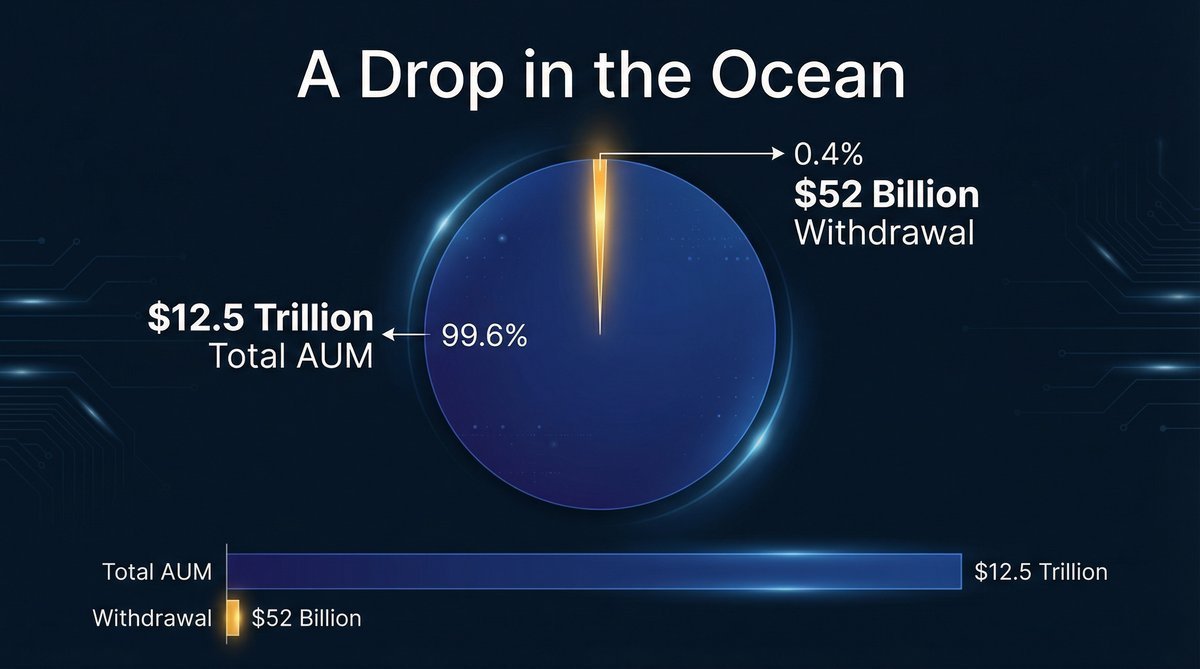
The immediate market reaction was a nearly 6% drop in BlackRock’s stock price (BLK) on the day of the announcement, as the withdrawal contributed to a slight revenue miss of about $20 million against analyst expectations. However, it is critical to place this event in the proper context.
The $52 billion withdrawal represents less than 0.5% of BlackRock’s staggering $12.5 trillion in total assets under management. The underlying fundamentals of the company’s Q2 2025 report remained exceptionally strong. The firm saw record-breaking inflows of $85 billion into its iShares ETF products, continued growth in its private markets division which reached $215 billion in AUM, and a 26% year-over-year increase in revenue from its Aladdin technology services.
To provide a clearer picture, here is a look at BlackRock’s recent quarterly net inflows:
| Quarter | Total Net Inflows (Billions USD) |
|---|---|
| Q4 2024 | $186.0 |
| Q3 2024 | $98.0 |
| Q1 2025 | $84.3 |
| Q2 2025 | $68.0 |
This historical data shows that while the Q2 2025 figure was lower, the firm continues to attract significant capital, framing the $52 billion event as an anomaly rather than a trend.
Wall Street’s Verdict: Analyst Reactions and Stock Performance
Despite the headline-grabbing number, Wall Street analysts were largely unfazed. The consensus view was that the withdrawal was a non-recurring event from a single client in a low-fee product, and not indicative of a broader problem. This sentiment was reflected in their ratings and price targets.
Following the earnings report, numerous firms reiterated their positive outlook on BlackRock. Analysts at Bank of America, Morgan Stanley, and Barclays all maintained “Overweight” or “Buy” ratings. The median analyst price target remained robust, hovering around $1,115, suggesting confidence in the stock’s long-term trajectory. Craig Siegenthaler from B of A Securities set a target of $1,224, while Mike Cyprys from Morgan Stanley matched that figure.
True to this analysis, BlackRock’s stock demonstrated resilience, recovering from the initial dip in the subsequent trading sessions. The market appeared to shrug off the one-time redemption and refocus on the firm’s powerful growth engines, including its dominance in ETFs and its expansion into private credit with the $12 billion acquisition of HPS Investment Partners, which closed on July 1, 2025, adding $165 billion of client AUM.
Beyond the Headlines: Broader Implications for Investors
This event offers several key insights for the investment community. It starkly illustrates the immense scale of passive investing and the concentrated power held by large institutional investors. A single decision from one entity can move tens of billions of dollars, highlighting the flows that shape global markets.
Furthermore, it touches on the evolving strategies of sovereign wealth funds and other large institutions, which are becoming increasingly sophisticated in their asset allocation and are actively exploring alternatives to public markets. The trend toward private credit, infrastructure, and other alternative investments is accelerating, and large redemptions from passive index funds may, in some cases, be a symptom of this broader shift.
For retail investors, the key takeaway is that such large-scale institutional moves are often driven by complex, long-term strategies that may have little bearing on the investment case for an individual. BlackRock’s diversified platform, spanning ETFs, active management, private markets, and financial technology, provides a buffer against the impact of any single client’s decision.
Frequently Asked Questions
Who withdrew the $52 billion from BlackRock?
BlackRock identified the entity only as a “single institutional client in Asia.” Due to the size of the withdrawal, it is widely believed to be a sovereign wealth fund, central bank, or a major pension fund. BlackRock has not disclosed the client’s identity.
Why was the $52 billion withdrawal significant?
Its significance lies in its size as a single transaction, which noticeably impacted BlackRock’s quarterly net inflow numbers and drew attention from the market. It is one of the largest single-client redemptions the firm has ever publicly acknowledged, effectively cutting the quarter’s net inflow figure in half.
Did the withdrawal hurt BlackRock’s overall performance?
While it caused a revenue miss of approximately $20 million and reduced net inflows, it did not fundamentally hurt BlackRock’s overall performance. The company still reported record assets under management of $12.5 trillion and saw strong growth in other key areas like ETFs and private markets.
How did BlackRock’s stock (BLK) react to the news?
BlackRock’s stock initially fell by nearly 6% on the day the news was released. However, it recovered in the following days as analysts and investors digested the context and recognized the firm’s strong underlying fundamentals. Wall Street analysts largely maintained their buy ratings and price targets.
What are BlackRock’s total assets under management (AUM)?
As of the end of the second quarter of 2025, BlackRock’s total assets under management reached a record $12.5 trillion, an 18% increase year-over-year. By the end of 2025, this figure had grown to a record $14 trillion.
Should I be worried about my BlackRock investments?
For most individual investors, this single institutional withdrawal is not a cause for alarm. The event was isolated, and BlackRock’s diversified business model, strong market position, and continued growth in key sectors remain intact. The firm’s organic base fee growth of 6% in Q2 2025 underscores the health of its core business.
Conclusion
The BlackRock client withdrawal of $52 billion is a fascinating case study in the dynamics of modern asset management. While the headline figure is certainly attention-grabbing, a deeper analysis reveals a more nuanced story. The event was a significant but ultimately manageable anomaly for a financial giant like BlackRock, whose foundational business strengths in ETFs, technology, and private markets continue to propel its growth.
The real story is not one of panic, but of perspective. It highlights the immense scale of global capital flows and the strategic, often silent, maneuvers of the world’s largest investors. For BlackRock, it was a multi-billion-dollar blip in an otherwise stellar quarter, underscoring the resilience and diversification of its massive platform.