A person rarely becomes a customer simply because they found a business in a search result.
The journey may begin with a Google search, continue through several website pages, involve reading reviews or comparing alternatives, and end days or even weeks later with a purchase, inquiry, booking, or phone call.
This is why digital marketing works best when businesses think beyond individual channels. Search engine optimization, content, website design, advertising, social media, and analytics should ultimately support the same objective: helping the right person move from awareness to action.
A well-designed digital customer journey makes that process easier.
What Is a Digital Customer Journey?
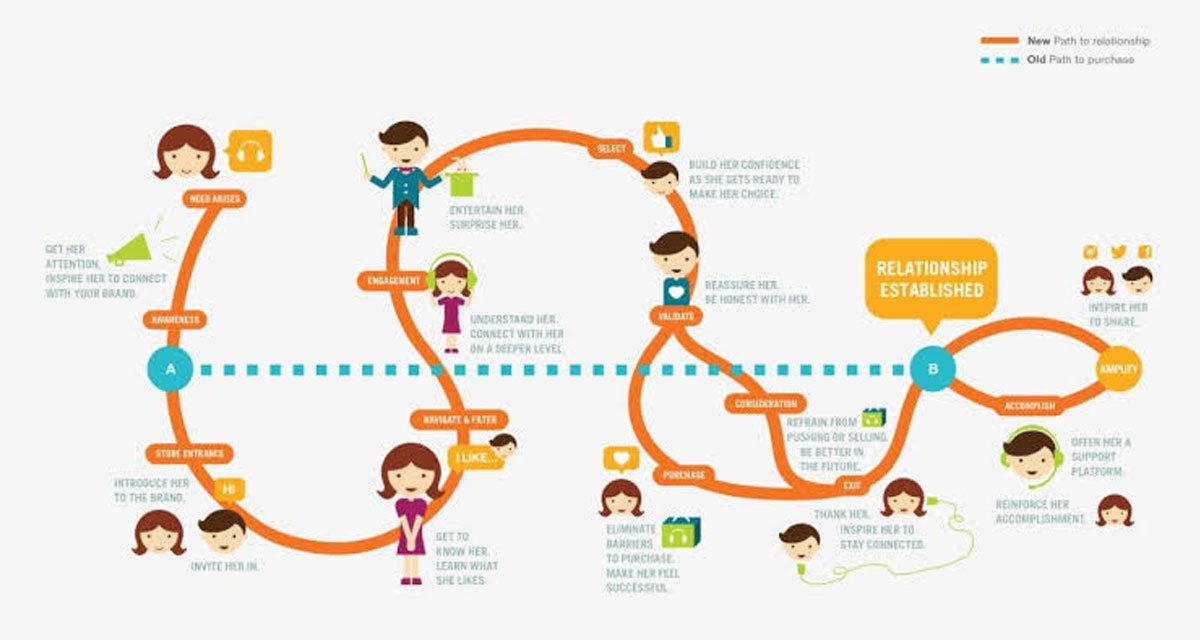
A digital customer journey is the sequence of interactions a potential customer has with a business through online channels before, during, and after a purchase.
Not every customer follows the same path. Someone who already knows a brand may go directly to a product page, while someone unfamiliar with the business may spend considerable time researching before making contact.
Understanding these different paths is essential when deciding what a website and marketing strategy should accomplish.
Start With the Customer’s Problem
A common mistake is beginning with marketing channels instead of customer needs.
Businesses often ask:
- What keywords should we target?
- Which social platform should we use?
- Should we run advertisements?
- How frequently should we publish content?
Those questions matter, but they become much easier to answer after identifying the customer’s actual problem.
Consider a company selling accounting software. A potential customer may not initially search for a particular brand. They may search for ways to reduce manual bookkeeping, manage invoices, or prepare financial reports more efficiently.
This creates an opportunity to reach the person before they have decided which product to buy.
Match Content to the Customer’s Level of Awareness
Not every visitor needs the same information.
Someone discovering a problem for the first time may need an educational explanation. Someone comparing solutions needs more specific information. Someone ready to buy needs a straightforward path to conversion.
A useful content structure can therefore include three levels.
1. Educational Content
This answers broad questions and helps people understand a problem.
Examples include:
- Beginner’s guides
- Explanations of industry terms
- How-to articles
- Common mistakes
- Problem-solving resources
The purpose is to reduce uncertainty and establish useful context.
2. Evaluation Content
At this stage, the visitor is considering possible solutions.
Useful resources may include:
- Product comparisons
- Feature explanations
- Buying guides
- Case examples
- Frequently asked questions
- Cost considerations
This type of content helps a visitor determine whether a particular solution fits their circumstances.
3. Decision Content
Someone who is close to taking action generally needs clarity rather than more generic education.
Important information may include:
- What happens after contacting the company
- Pricing or quotation information
- Service details
- Delivery or implementation information
- Guarantees or policies
- Contact options
The objective is to remove unnecessary friction.
Make Every Landing Page Answer Three Questions
When someone arrives on a website, they should quickly understand three things:
What is this?
The page should clearly communicate what product, service, or information is being offered.
Why does it matter to me?
The content should connect the offering to a meaningful customer problem or outcome.
What should I do next?
The page should provide an obvious next step.
That next step could be purchasing a product, requesting a quotation, booking an appointment, downloading a resource, or contacting the business.
A page does not necessarily need dozens of buttons. One clear next action is often easier for visitors to understand.
Connect Search Intent With Page Purpose
Search optimization becomes considerably more useful when keywords are connected to the purpose of a page.
For example, someone searching for “how to repair a leaking tap” has a different intent from someone searching for “emergency plumber near me.”
The first person may want instructions. The second may be looking for a service immediately.
Trying to send both audiences to exactly the same type of page can create a poor experience.
Before creating or optimizing a page, ask:
- What is the visitor trying to accomplish?
- What information would satisfy the search?
- Is the visitor researching or ready to act?
- What would logically come next?
This approach helps businesses create pages that serve people rather than simply targeting phrases.
Use Internal Links to Guide Visitors
Internal links are often treated primarily as an SEO technique, but they also have an important usability function.
Imagine a visitor reading an article about choosing a home security system. The article could naturally lead to a detailed guide comparing different system types, followed by a relevant product category or consultation page.
Each link should provide a logical next step.
Good internal linking can therefore create a path such as:
General question → Detailed explanation → Comparison → Product/service page
This is more useful than adding links simply because a page has space for them.
Reduce Friction Before the Conversion
A visitor can be interested in a product or service and still abandon the process because something makes taking action unnecessarily difficult.
Common sources of friction include:
- Complicated forms
- Slow-loading pages
- Unclear pricing information
- Difficult navigation
- Too many required fields
- Weak calls to action
- Missing contact information
- Poor mobile usability
Businesses should periodically experience their own website as a customer would.
Try completing a purchase, submitting an inquiry, finding a specific service, or locating an important policy using only a mobile phone.
Small obstacles can become surprisingly significant when repeated across thousands of visitors.
Bring SEO, Advertising, and Content Together
Search optimization and paid advertising are often managed as separate activities, but the information gathered from one channel can improve another.
For example, advertising campaigns can reveal which messages generate strong engagement. Those insights may help shape website headlines or content topics.
Likewise, organic search data can reveal questions that customers repeatedly ask. Those questions can become advertising messages, landing-page content, or email topics.
The channels do not need to operate independently.
A coordinated approach allows businesses to learn faster.
Companies evaluating outside expertise can compare providers based on their ability to connect these different activities. For example, businesses researching SEO & digital strategy at Ignite Digital should consider not only the individual services available but also how those services could fit into the company’s wider customer journey.
Measure Progress Beyond Traffic
Traffic is useful, but it does not tell the entire story.
A website receiving 100,000 visits is not automatically performing better than one receiving 10,000 visits.
Businesses should also examine metrics such as:
- Qualified leads
- Conversion rate
Sales
- Cost per acquisition
- Revenue generated by marketing channels
- Returning visitors
- Repeat purchases
- Lead-to-customer rate
The appropriate metrics depend on the business model.
For an online store, completed purchases may be central. For a professional service company, qualified inquiries may be more meaningful than immediate online sales.
Study Where Customers Drop Out
One of the most useful exercises is identifying where potential customers stop progressing.
Suppose a business receives substantial organic traffic but very few inquiries. The problem may not be visibility. It could be the landing page, offer, messaging, form, or trust-building information.
Similarly, if many people begin a checkout process but abandon it, improving search rankings may do little to solve the underlying problem.
The most valuable improvement is often found at the weakest stage of the journey.
Continue the Journey After the First Conversion
The customer journey does not end when someone makes a purchase or submits a form.
After conversion, businesses can use digital channels to support the customer through:
- Onboarding information
- Product education
- Follow-up communication
- Support resources
- Feedback requests
- Relevant recommendations
- Loyalty initiatives
This can turn a single transaction into an ongoing relationship.
For service businesses, post-conversion communication can be particularly useful because customers may need guidance before they fully understand the value of what they purchased.
Build the Journey Around Real Behavior
The strongest digital strategies are not built from assumptions alone.
Use analytics, customer questions, sales-team feedback, support requests, search data, and conversion information to understand how people actually interact with the business.
Then improve the journey based on what the evidence shows.
This keeps digital marketing connected to real customer behavior instead of allowing it to become a collection of disconnected activities.
Final Thoughts
A successful online presence is not simply about attracting more visitors.
It is about attracting appropriate visitors, giving them useful information, helping them evaluate their options, removing unnecessary obstacles, and making the next step clear.
SEO can help people discover a business. Content can help them understand a problem. A website can help them evaluate a solution. Conversion-focused design can make taking action easier. Follow-up communication can strengthen the relationship afterward.
When these pieces work together, digital marketing becomes a connected customer experience rather than a collection of unrelated campaigns.
That shift—from thinking about individual channels to thinking about the entire customer journey—can make digital marketing considerably more useful, measurable, and sustainable.