The best free mindfulness apps offer genuine practice tools with no subscription required. Insight Timer leads with 80,000+ free guided meditations. Smiling Mind and Medito are fully free with no premium tier whatsoever. UCLA Mindful provides research-backed sessions developed by a university mental health center. Together, these apps cover everything from quick breathing breaks to multi-week structured programs — at zero cost.
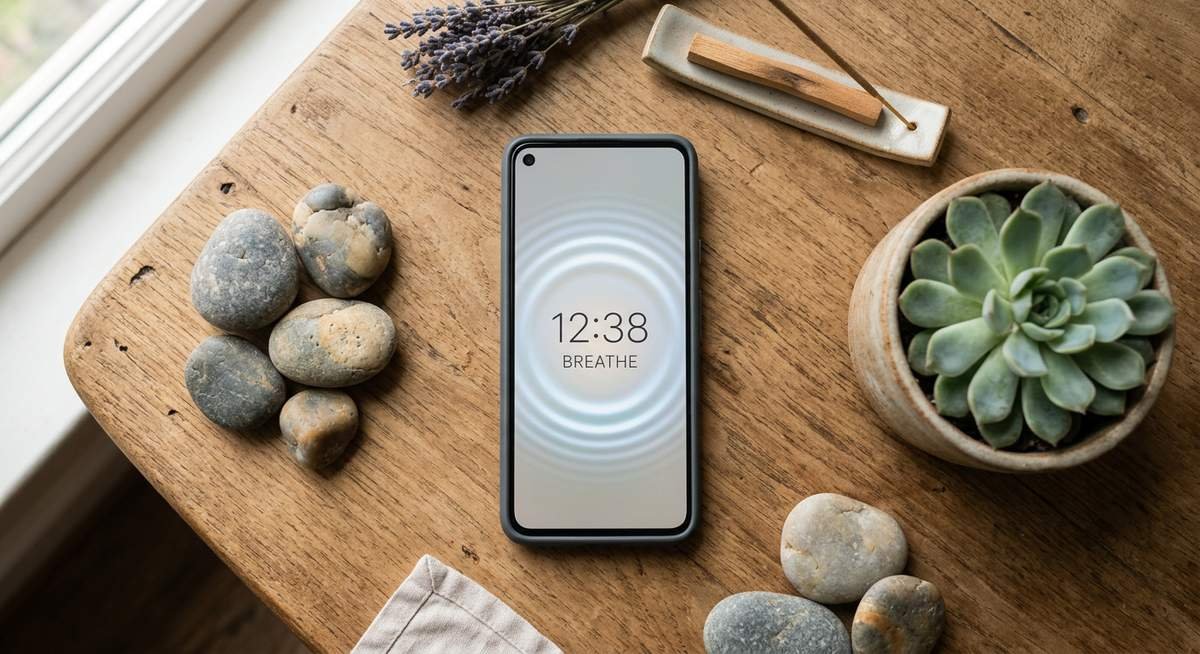
free mindfulness apps — smartphone displaying meditation timer app surrounded by smooth river stones and morning light
The mental health app market reached $9.94 billion in 2025, according to a MarketsandMarkets report, and is projected to hit $22.73 billion by 2030. Most of that growth is driven by paid platforms, which makes the genuinely free options all the more worth knowing. Subscription fatigue is real, and the apps on this list were built precisely for people who want to practice without paying monthly fees.
Seven apps made the final cut. Some are completely free forever. Others have strong free tiers that hold up even without upgrading.
At a Glance: Free Mindfulness Apps Compared
Five of the seven apps below cost nothing at all — no trial periods, no locked content, no “premium” nudges. The remaining two have strong free tiers that work well for most users without any payment. Here’s how they stack up before the full breakdowns.
| App | Cost | Platforms | Best For | Standout Feature |
|---|---|---|---|---|
| Insight Timer | Free (premium: $60/yr) | iOS, Android, Web | Variety seekers | 80,000+ free meditations |
| Smiling Mind | Completely free | iOS, Android, Web | Families, teens, educators | Non-profit, no upsells ever |
| UCLA Mindful | Completely free | iOS, Android | Beginners, academic rigor | 19 languages, university-developed |
| Healthy Minds (Humin) | Completely free | iOS, Android | Science-focused practitioners | Validated in 50+ research studies |
| Medito | Completely free, open-source | iOS, Android | Privacy-conscious users | No account required |
| Finch | Free (optional upgrades) | iOS, Android | Younger users, ADHD, anxiety | Gamified self-care pet |
| Waking Up | Free via scholarship | iOS, Android | Intellectually curious meditators | Neuroscience-backed curriculum |
The Completely Free Options (No Subscription, Ever)
Five apps on this list charge absolutely nothing, no paid tier, no locked content, no subscription prompts. Several are backed by universities and non-profits with no commercial incentive to upsell. For users who want a complete, sustainable mindfulness practice without ever reaching for a credit card, these are the ones that matter.
Insight Timer: The Largest Free Library
Insight Timer is the closest thing to a free meditation encyclopedia. The app’s free tier includes access to over 80,000 guided meditations from more than 10,000 teachers, covering stress, sleep, anxiety, relationships, creativity, and dozens of other themes. Teachers include Sharon Salzberg, Tara Brach, and Jack Kornfield, all of whom publish content there at no cost. According to the app’s own data, 3 million people use it actively each month.
What sets it apart from every other option on this list is the live element. Live events run every hour of the day, drop-in group sessions that you can join spontaneously or schedule in advance. After finishing a session, the app tells you how many people were meditating at the same time, which creates a subtle but genuine sense of community. It has been rated 4.9 stars from over 437,000 reviews on the Apple App Store and was named “Happiest App in the World” by Tristan Harris, former Google design ethicist.
The premium tier ($60/year) unlocks offline downloads, course content, and advanced playback controls. But the free tier is vast enough that many longtime users never feel the need to upgrade. Eighty thousand meditations is not a teaser, it is the full library.
Smiling Mind: The Non-Profit Built for Real People
Smiling Mind has been completely free for over 12 years. There is no premium version, no locked content, and no in-app purchase system. The Australian non-profit organization behind it is funded by philanthropists and corporate partners, and that model has stayed intact since launch.
The app offers 700+ mindfulness lessons and practices organized into structured programs: Mindful Foundations (35 sessions), Sleep (6 sessions), Digital Detox (8 sessions), and Stress Management (10 sessions), among others. Sessions range from 2 minutes to 45 minutes, and the app’s design specifically avoids the decision fatigue that plagues larger libraries. You pick a program and work through it, rather than scrolling through thousands of options.
Smiling Mind was developed with input from psychologists and educators. It covers age-specific programs for children, teens, families, and healthcare workers, making it one of the few mindfulness tools genuinely useful across generations. The fact that this level of content remains free, without a single paywall, says something about what the organization was actually built to do.
UCLA Mindful: Academic Credibility, Zero Cost
UCLA Mindful is a completely free meditation app developed by UCLA Health’s Mindful Awareness Research Center, available in 19 languages with no account required and no paid tier whatsoever. It is the strongest starting point for beginners who want clinically grounded instruction backed by a university research program rather than a subscription business model.
The sessions are built around research-based practices used in UCLA’s clinical programs. For beginners especially, there is something reassuring about knowing the content was designed by academics with a direct stake in its effectiveness, rather than by a startup trying to optimize for subscription conversion. Sessions cover the basics: body scan, breathing, loving-kindness, and open awareness practices. Nothing flashy, everything solid.
The app does not push notifications, does not track usage for advertising, and does not ask you to create an account. That quietness is itself a kind of feature.
Healthy Minds Program (Humin): The Research-Validated Pick
The Healthy Minds Program is the most scientifically validated free mindfulness app available, with outcomes measured in 50+ peer-reviewed studies showing a 24% reduction in depression and 70% reduction in reported stress. Developed by University of Wisconsin-Madison neuroscientist Dr. Richard J. Davidson, the app offers up to 600 days of free practice with no ads and no advertising revenue.
The program is organized around four wellbeing pillars: Awareness, Connection, Insight, and Purpose. Up to 600 days of practice are available for free. The app contains no ads and accepts no advertising revenue; it is sustained by donations. Under its rebranded identity as Humin (hminnovations.org), the mission is unchanged.
Most meditation apps describe themselves as science-backed. This one actually is. Dr. Davidson is one of the most cited neuroscientists working on contemplative practice, and the four-pillar framework reflects decades of lab work rather than marketing copy. Fifty peer-reviewed studies is not a marketing line, it is a body of evidence.
Medito: The Open-Source Alternative
Medito exists on a straightforward principle: “No trials, no premium tier, no unlock for $9.99. Ever.” The Medito Foundation, a registered non-profit based in Amsterdam, built the app with volunteer developers and maintains open-source code on GitHub. No account is required to use it. The app has reached more than 4.1 million people across 190 countries since launching in 2020.
The content library is smaller than Insight Timer’s but covers the fundamentals well, beginner courses, breathing exercises, sleep meditations, and single sessions for stress and anxiety. The lack of an account requirement means usage is anonymous by default, which matters to a segment of users who are uncomfortable with mental health apps collecting behavioral data.
Medito publishes its finances publicly. Less than 1% of users have donated, yet the app keeps running. For anyone skeptical of wellness apps’ motives, Medito is the rare case where the transparency matches the pitch.
Apps With Strong Free Tiers
Two apps with paid options still deserve a place in this list. Finch and Waking Up both offer free tiers substantial enough that most users never need to upgrade. Finch’s gamified self-care system and Waking Up’s scholarship program each solve the cost barrier in ways the fully free apps do not, covering use cases that the completely free options leave open.
Finch: Self-Care as a Game
Finch is a gamified self-care app where completing daily mental health exercises, mood check-ins, and breathing routines grows a virtual bird you raise. The free tier covers the full core experience, and for users managing anxiety or ADHD, the gamified structure consistently delivers what purely instructional apps cannot: a reason to actually open the app each day.
The free version covers the core experience. Paid subscriptions (Finch Plus, from $5.99/month to $69.99 lifetime) unlock advanced analytics and additional content, but most users report the free tier feels complete. For users managing anxiety, ADHD, or depression, the gamified structure lowers the barrier to actually opening the app each day, which is ultimately the hardest part of any mindfulness habit.
Waking Up: Free via Scholarship
Waking Up grants free access to anyone who requests it via its no-income-verification scholarship program, making a $129.99/year premium meditation app genuinely available at no cost. Built by neuroscientist and author Sam Harris, it combines rigorous neuroscience with contemplative philosophy for practitioners who want their meditation practice to engage with ideas rather than simply calm them down.
The content leans intellectual: Harris draws on conversations about Stoicism, psychedelics research, effective altruism, and consciousness studies alongside traditional meditation instruction. It is not the most accessible starting point for beginners, but for users who want their mindfulness practice to engage with ideas, not just calm them down, it is unique.
How to Choose the Right Free Mindfulness App
The right free mindfulness app depends on what you actually need from a practice. Insight Timer suits anyone who wants variety and community. Smiling Mind works best for families and beginners. Medito fits privacy-conscious users. UCLA Mindful is the strongest starting point for research-backed instruction. Matching the app to your specific use case matters more than picking the most popular name.
If you want variety and community, Insight Timer wins outright. No other free app comes close on sheer content volume, and the live events make it feel less like practicing alone.
If you want something you can hand to a teenager or a parent without explanation, Smiling Mind handles that better than the others. The age-specific programs and the absence of upsells make it low-friction for families.
If your priority is scientific credibility, Healthy Minds (Humin) is built on more published research than any other app on this list. If you want something with zero account requirement and open-source transparency, Medito is the one to download.
For users new to meditation, UCLA Mindful’s beginner sessions, delivered in clear, clinical language across 19 languages, offer a reliable foundation. And if habit formation is the challenge, if you’ve started and stopped a meditation practice before, Finch’s gamified structure does something clever: it makes opening the app feel like a small reward, not a chore. Building any consistent habit starts with using consistency to quiet self-doubt, and Finch is engineered precisely to lower the friction at that step.
Frequently Asked Questions
Are any mindfulness apps truly free with no strings attached?
Yes. Smiling Mind, UCLA Mindful, Medito, and Healthy Minds (Humin) are completely free with no paid tiers, no premium upsells, and no in-app purchases. Insight Timer is also free for the majority of its content, with a paid tier that remains entirely optional. None of these four require a subscription to access their core libraries.
How much of Insight Timer is actually free?
Insight Timer’s free tier includes over 80,000 guided meditations, live events running every hour, and access to content from 10,000+ teachers. The paid tier ($60/year) adds offline downloads, structured courses, and advanced playback features. Most users access everything they need without upgrading.
Which free mindfulness app is best for beginners?
UCLA Mindful is a strong starting point for beginners. It offers structured beginner sessions in 19 languages, developed by UCLA’s clinical research center, without any account requirements or subscription prompts. Smiling Mind’s Mindful Foundations program (35 sessions) is another solid option for structured progression at no cost.
Do free mindfulness apps actually help with anxiety?
Research supports the effectiveness of app-based mindfulness for anxiety reduction. According to data from the Healthy Minds Program (Humin), 70% of users reported reduced stress and the program demonstrated a 24% reduction in depression across 50+ published studies. Independent research published in academic journals has consistently shown that even brief, app-based mindfulness practice reduces self-reported anxiety symptoms when practiced regularly.
Is there a free version of Headspace or Calm?
Both Headspace and Calm offer limited free content, but their core libraries require paid subscriptions. Headspace’s free tier includes introductory sessions. Calm’s free tier covers a small selection of meditations. Users seeking a fully free experience are better served by Insight Timer, Smiling Mind, or Medito, which offer substantially more content at no cost.
Can I use free mindfulness apps offline?
Medito works fully offline without requiring an account, making it the most accessible option for users without consistent internet access. UCLA Mindful’s content can be used offline after initial load. Insight Timer requires the paid tier to download content for offline use; the free tier requires an active connection for most sessions.
Are there free mindfulness apps for children?
Smiling Mind is the strongest option for children and teens. The app includes age-specific programs developed with psychologists for children starting at age 7, teens, and families. It is entirely free and has no advertising or in-app purchases. Finch’s gentle, gamified approach also works well for younger users managing anxiety or mood challenges.
The Real Barrier Was Never the Price
What makes these apps worth highlighting is not that they are free, it is that several of them are genuinely good, built by researchers, non-profits, and open-source communities with no commercial pressure to cut corners on quality. Insight Timer’s library dwarfs what most paid apps offer. Medito’s transparency is rarer in the wellness industry than it should be. The Healthy Minds Program has a clinical evidence base that most paid apps would trade anything to replicate.
The hardest part of a mindfulness practice is not finding the right app. It is showing up consistently, especially when the novelty wears off. That is a habit problem more than a tool problem, and the small, consistent actions that build any lasting habit apply here as much as anywhere else.
Download one app. Use it for two weeks. Then decide.