The best barbell row alternatives include the single-arm dumbbell row, seated cable row, chest-supported T-bar row, inverted row, and resistance band row. Each replicates the horizontal pulling pattern that barbell rows train while adjusting for equipment availability, injury concerns, or training variety. The right choice depends on your specific goal, equipment access, and whether lower back fatigue is a limiting factor.
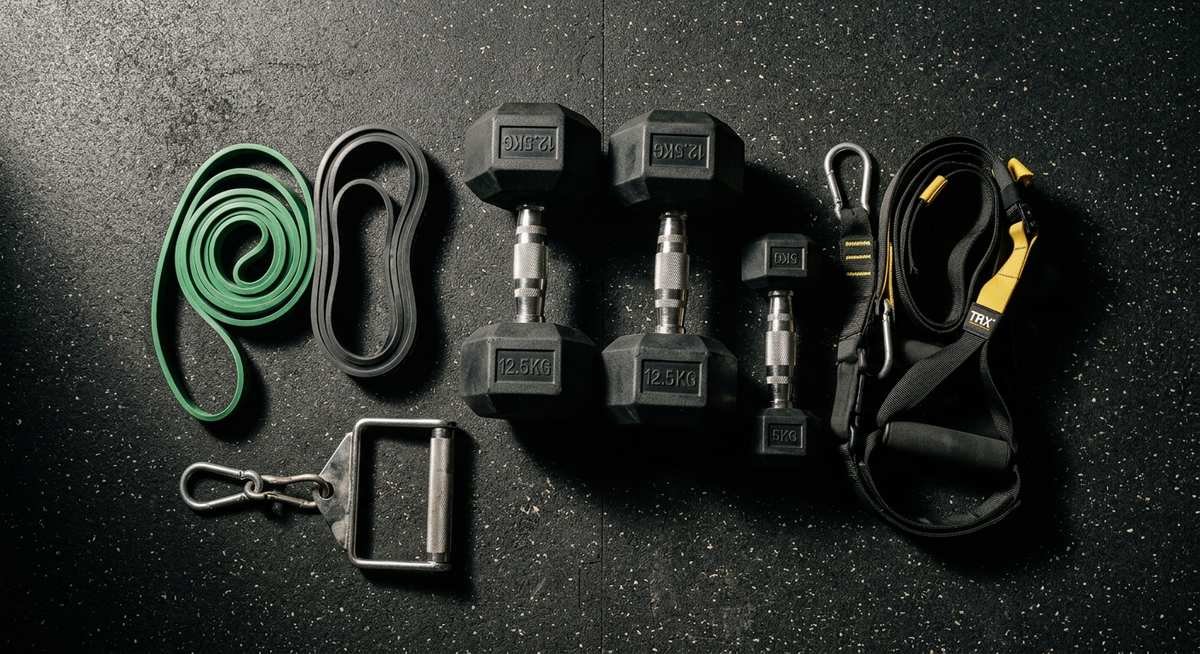
barbell rows alternative — gym equipment including dumbbells resistance bands and cable handles for back training
What Barbell Rows Actually Train
Barbell rows primarily target the latissimus dorsi, rhomboids, middle trapezius, and rear deltoids. Secondary movers include the biceps, brachialis, and erector spinae. EMG research on horizontal pulling movements consistently places the bent-over row among the highest-activation exercises for the posterior chain, requiring simultaneous effort from the upper back, lower back, and hip extensors to hold position under load.
The exercise also doubles as a bracing challenge. Holding a hip-hinged position under load forces the lower back extensors and core to work isometrically throughout every set. This is both a strength-builder and, for some lifters, the exact reason they need an alternative: that sustained spinal load accumulates over months of training and can become a liability.
Understanding what makes barbell rows effective makes it easier to choose an alternative that preserves those same training benefits. Any horizontal pull that loads the lats through a full range of motion, challenges the rhomboids at the peak of contraction, and allows progressive overload qualifies as a legitimate substitute.
When You Actually Need a Barbell Row Alternative
A barbell rows alternative becomes necessary in three common situations: lower back fatigue from heavy compound lifts, equipment limitations at home, or a need for programming variety to prevent overuse injuries. Any of these conditions makes substituting the barbell row not just acceptable but the smarter training decision.
Lower back fatigue or injury is the most common reason. After heavy deadlifts or squats, the erector spinae are already taxed. Adding bent-over rows with a fatigued lower back turns a controlled pulling exercise into a recipe for form breakdown. A chest-supported alternative eliminates that variable entirely.
Equipment limitations matter too. Home gym setups often include dumbbells or bands but not an Olympic barbell and plates. Cable machines at commercial gyms offer a mechanically similar stimulus without the balance demands of free weights.
Then there’s the programming case for variety. Sticking with a single row variation for 12 or more consecutive weeks is a common cause of elbow tendinitis and wrist strain from grip fatigue. Rotating through several alternatives keeps stimulus fresh and distributes joint stress across different pulling angles.
Most lifters treat barbell rows as non-negotiable, until the day they simply cannot perform them safely and realize they never built a reliable backup plan.
Barbell Row Alternatives: Full Comparison Chart
The table below covers the 10 most effective alternatives across key practical dimensions: equipment needed, primary muscles targeted, injury risk for the lower back, and difficulty to execute with good form.
| Exercise | Equipment Needed | Primary Muscles | Lower Back Stress | Skill Level | Closest Match To |
|---|---|---|---|---|---|
| Single-Arm Dumbbell Row | Dumbbell + bench | Lats, rhomboids, rear delt | Very low | Beginner | Standard barbell row |
| Chest-Supported Dumbbell Row | Incline bench + dumbbells | Mid-back, rhomboids | Zero | Beginner | Pendlay row |
| Seated Cable Row | Cable machine | Lats, rhomboids, biceps | Low | Beginner | Standard barbell row |
| Chest-Supported T-Bar Row | T-bar machine or landmine | Mid-back, lats | Zero | Intermediate | Barbell row (heavy) |
| Inverted Row | Barbell in rack or rings | Upper back, rear delt | Zero | Beginner | Light barbell row |
| TRX/Suspension Row | Suspension trainer | Upper back, core | Very low | Beginner | Light barbell row |
| Resistance Band Row | Resistance band | Lats, rhomboids | Very low | Beginner | Cable row |
| Pendlay Row | Barbell + plates | Full back, glutes, hamstrings | Moderate | Intermediate | Barbell row (power) |
| Meadows Row | Landmine attachment or corner | Lats, teres major | Low | Intermediate | Barbell row (unilateral) |
| Machine Row | Chest-supported row machine | Mid-back, lats | Zero | Beginner | Heavy barbell row |
Dumbbell Row Alternatives
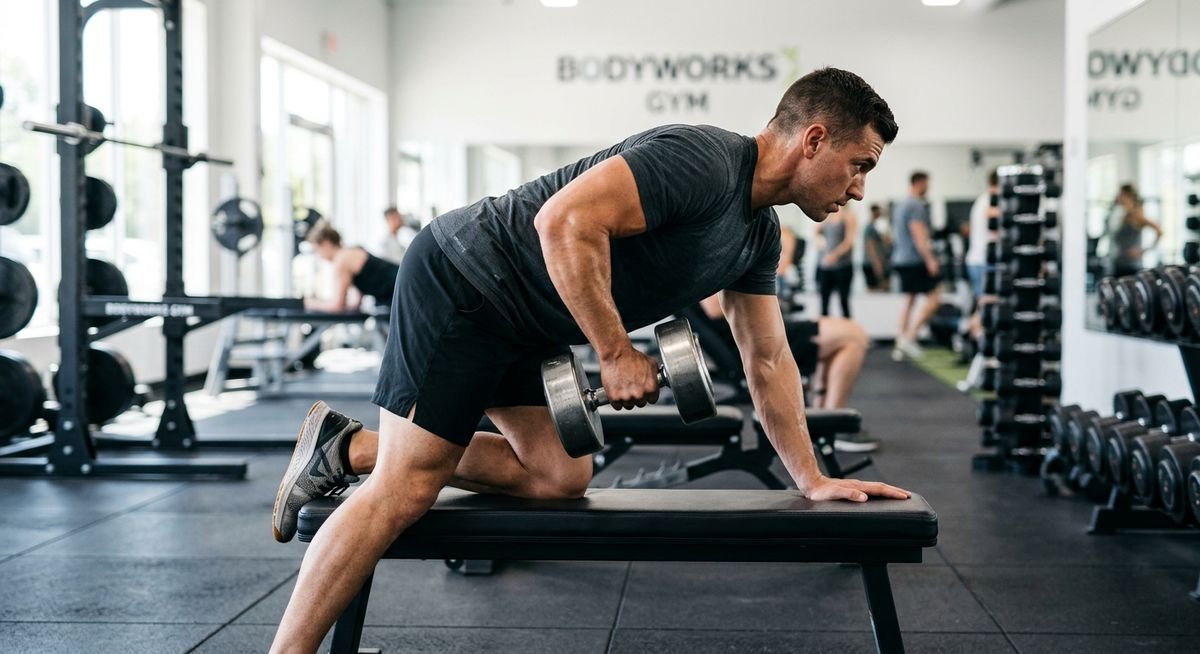
Dumbbell rows stand as the most accessible barbell rows alternative and arguably the most effective for building unilateral back strength. A single dumbbell, a flat bench, and adequate floor space is all the setup required.
Single-Arm Dumbbell Row
Place one knee and the same-side hand on a flat bench. Keep your spine neutral and pull the dumbbell toward your hip, not your shoulder. The key technical cue that separates productive reps from sloppy ones: lead with the elbow, not the hand. Rotate slightly at the torso to extend the range of motion at the top of each rep.
Load progression works exactly like a barbell exercise. Once you can complete 3 sets of 10-12 reps with controlled tempo, increase by 5 pounds. The unilateral setup also identifies strength imbalances early, since each side works independently without the stronger side compensating for the weaker.
Chest-Supported Dumbbell Row
Set an adjustable bench to 30-45 degrees. Lie face down on the pad, let the dumbbells hang below your chest, and row both arms simultaneously. The chest support eliminates lower back involvement completely, which means the mid-back muscles cannot recruit assistance from the erector spinae. Every pound of resistance goes directly into the target muscles.
Because spinal stabilization is removed, most lifters find they can actually achieve better mind-muscle connection with chest-supported variations. According to a 2021 analysis in the National Center for Biotechnology Information, chest-supported row variations demonstrate comparable latissimus dorsi EMG activation to free-weight bent-over rows while significantly reducing erector spinae activity.
Cable and Machine Row Options
Cable and machine rows offer constant tension through the full range of motion, something free-weight rows cannot replicate. At the bottom of a dumbbell row, the load is minimal. A cable maintains resistance even as the arm extends, making each rep mechanically different and, in some respects, more demanding on the lats.
Seated Cable Row
Sit at a cable station with feet braced against the platform. Pull a close-grip or wide-grip handle toward your lower sternum. The mistake most lifters make is turning this into a lower back exercise by swinging backward on each rep. Keep the torso upright within a 10-degree range and let the arms do the work.
Close-grip handles shift emphasis toward the lower lats and teres major. Wide-grip handles bring in more rhomboid and mid-trap activation. Alternating handle types across training blocks develops the full back musculature without requiring any additional exercises.
Chest-Supported T-Bar Row
The chest-supported T-bar row is the closest machine equivalent to heavy barbell rowing. The loading angle mimics a bent-over row, but the chest pad removes lower back stress entirely. This makes it particularly useful during the heavy phases of a training cycle when lower back fatigue from deadlifts or squats is already high.
Grip the handles with a neutral grip (palms facing each other) for maximum range of motion. Drive elbows back past the torso line on every rep. Machine variants like the Hammer Strength ISO Row allow each arm to move independently, adding a unilateral dimension that freestanding T-bar setups cannot offer.
Meadows Row
Load one end of a barbell into a landmine attachment or brace it in a corner. Stand perpendicular to the bar, grip the loaded sleeve with an overhand grip, and row from a staggered stance. The movement feels unusual at first because the bar path arcs slightly rather than moving straight up.
The Meadows row places the shoulder in a more externally rotated position than standard rows, which stretches the teres major at the bottom of the rep. Powerlifters and bodybuilders who have used it consistently report stronger contractions through the lat width compared to straight-bar variations, though individual anatomy affects results significantly.
Bodyweight and Suspension Row Alternatives
Bodyweight horizontal pulls get underused by lifters who assume they lack the resistance to build muscle. The inverted row and TRX row can be progressively loaded through foot elevation, added weight vests, or tempo manipulation, making them viable for intermediate and advanced trainees, not just beginners.
Inverted Row (Australian Pull-Up)
Set a barbell in a squat rack at hip height. Lie underneath it, grip the bar with hands shoulder-width apart, and pull your chest to the bar while keeping the body in a straight line from heels to shoulders. This movement trains the same muscles as a barbell row but with bodyweight as the resistance.
Difficulty scales easily. Elevating the feet on a box increases the challenge by shifting more body weight onto the upper body. Placing weight plates on the chest or wearing a loaded backpack adds external resistance without requiring any additional equipment changes.
TRX Suspension Row
Anchor a suspension trainer at shoulder height. Hold the handles, lean back, and row your chest up to hand level. Because the handles move freely, the suspension row challenges shoulder stability in a way that rigid bar variations cannot match. The rotational freedom also allows a more natural pulling path for individuals with asymmetrical shoulder mobility.
The TRX row also works well as a warm-up before heavier row variations. The light resistance and free movement pattern activates the rotator cuff and scapular retractors without pre-fatiguing the primary movers.
Resistance Band Rows
Resistance bands offer a practical barbell rows alternative for home training, travel, and injury rehabilitation. Anchor a band to a door frame, a sturdy post, or a cable stack, and perform seated or standing rows with the same cues used for cable variations.
Band resistance increases through the range of motion, meaning the peak load occurs at the fully contracted position rather than the stretched position. This loading curve is the opposite of free weights, where gravity makes the movement hardest at the weakest joint angle. Many physical therapists use this reverse accommodating resistance to rebuild pulling strength after shoulder injuries, because the lightest load coincides with the most vulnerable position.
For progressive overload, shorten the band (by folding it or anchoring closer to the body), step further from the anchor point, or stack multiple bands. A meaningful progression over 8-12 weeks is achievable without purchasing heavier bands.
Best Barbell Row Alternatives When Lower Back Pain is a Factor
For lifters managing lower back issues, the priority shifts from maximum load to pain-free horizontal pulling. Three alternatives consistently perform well in this context: chest-supported dumbbell rows, machine rows, and seated cable rows performed with a controlled torso.
Lower back injury affects a significant percentage of strength trainers. According to data from the Mayo Clinic, lower back pain is among the most common causes of activity limitation in adults under 45, and spinal loading during heavy compound lifts is a recognized contributing factor.
The tiered approach works best for managing training around back pain:
- Acute pain (within 72 hours of injury): Avoid loaded rowing entirely. Perform seated cable rows with light weight and minimal torso lean, or use TRX rows in the most upright position possible.
- Subacute phase (1-6 weeks post-injury): Chest-supported machine rows allow heavy back training without any spinal load. This is where most lifters can maintain muscle mass while healing.
- Return to full training: Reintroduce dumbbell rows before returning to barbell rows. The lighter load and unilateral setup provide a controlled environment to assess back tolerance.
A detail that rarely gets mentioned: the chest-supported position also decompresses the lumbar spine between sets, because the weight of the torso transfers to the pad rather than loading the lower back isometrically. For many lifters managing chronic tightness, this brief unloading period between sets provides genuine relief during an otherwise demanding training session.
Home Gym Solutions Without a Barbell
Home gym training without a barbell forces creative problem-solving for horizontal pulling. The most practical barbell rows alternative in this context depends on what equipment you actually have — and often the answer costs far less than expected.
| Equipment Tier | Available Exercises | Approximate Cost | Best For |
|---|---|---|---|
| Bodyweight only | Inverted rows (under table), TRX rows, towel rows | $0 | Beginners, travel training |
| Resistance bands | Band rows, face pulls, pull-aparts | $15–$40 | Rehabilitation, supplemental work |
| Adjustable dumbbells | Single-arm rows, chest-supported rows, Kroc rows | $150–$400 | Primary back training without barbell |
| Adjustable bench + dumbbells | All dumbbell variations + chest-supported work | $300–$600 | Complete home gym back training |
For home gym lifters, adjustable dumbbells provide the highest return on investment. A single pair of adjustable dumbbells (ranging from 5 to 52.5 pounds) covers enough load for effective back training through at least the first two years of consistent training, by which point most people have expanded their setup.
The towel row deserves mention for situations where even dumbbells are unavailable. Loop a sturdy towel around a door handle, grip both ends, lean back, and row. The range of motion is limited, but the movement recruits the lats and rhomboids meaningfully, making it a viable option during travel or periods of equipment scarcity.
How to Program Barbell Row Alternatives Into Your Training
Substituting a barbell row alternative is not simply a one-to-one swap in a spreadsheet. The loading, rep ranges, and exercise selection interact with the rest of the training week.
For general back development, two distinct horizontal pull variations per week outperform one high-frequency variation. The combination of a free-weight unilateral movement (single-arm dumbbell row) and a machine or cable movement (seated cable row or chest-supported T-bar) covers different loading profiles and challenges the back from slightly different angles.
A practical weekly template for lifters integrating a barbell rows alternative into their program:
- Day 1 (Pull A): Single-arm dumbbell row, 4 sets of 8-10 reps, heavy — primary mass builder
- Day 2 (Pull B): Chest-supported T-bar row, 3 sets of 10-12 reps, moderate — mid-back emphasis
- Supplemental: Seated cable row or resistance band row, 3 sets of 12-15 reps, light — pump/volume finisher
Progressive overload follows the same logic as any free-weight movement: add one rep per set before adding weight, and prioritize controlled eccentrics (the lowering phase) to maximize time under tension.
The most consistent back builders rarely commit to one movement indefinitely. Using a different barbell rows alternative every 6-8 weeks prevents accommodation, reduces overuse injury risk, and keeps training fresh. The specifics of which option to run in any given training block matter less than the consistency of executing horizontal pulls with quality volume, week after week.
Frequently Asked Questions
What is the best barbell row alternative for building back mass?
The single-arm dumbbell row is the most practical alternative for building back mass. It allows heavy loading across a full range of motion, develops unilateral strength, and requires only a dumbbell and a flat bench. For lifters with access to machines, the chest-supported T-bar row provides comparable loading with lower injury risk.
Can I replace barbell rows with dumbbell rows entirely?
Yes. Dumbbell rows train the same primary muscles (lats, rhomboids, rear deltoids, and biceps) through a similar range of motion. The unilateral version may produce better long-term back development by eliminating strength imbalances. Many competitive powerlifters and bodybuilders use dumbbell rows as their primary horizontal pull for months at a time with no negative effect on back development.
Are barbell rows bad for your lower back?
Barbell rows are not inherently harmful, but they place sustained compressive load on the lumbar spine. For lifters with healthy backs, this load is manageable and even beneficial. For those recovering from disc issues, muscle strains, or chronic stiffness, the constant spinal engagement makes barbell rows a poor choice relative to chest-supported alternatives that eliminate lumbar loading entirely.
What muscles do barbell row alternatives target?
The core muscles targeted across all horizontal pull alternatives are the latissimus dorsi, rhomboids, middle trapezius, and rear deltoids. Secondary activation includes the biceps, brachialis, and, depending on the variation, the core stabilizers. Chest-supported variations specifically reduce erector spinae involvement while increasing isolation of the upper and mid-back muscles.
What is the best barbell row alternative for a home gym?
Single-arm dumbbell rows are the best home gym option for lifters with at least one dumbbell and a stable surface for support. Without any equipment, inverted rows performed under a sturdy table or door handle replicate the movement pattern with bodyweight. Resistance bands anchored to a door provide a cable-row equivalent with virtually no equipment investment.
Is the seated cable row better than the barbell row?
Neither is objectively better. The cable row provides constant tension and lower spinal stress, making it safer to perform at higher volume. The barbell row allows greater total load and more full-body involvement. For pure upper-back hypertrophy, cable rows often outperform barbell rows because lifters can train closer to failure without lower back fatigue becoming the limiting factor.
Can you build a thick back without barbell rows?
Absolutely. Pull-ups, seated cable rows, chest-supported rows, and dumbbell rows collectively train every major back muscle group. Many accomplished bodybuilders prefer machine and cable variations over barbell rows specifically because the reduced lower back stress allows higher training volumes per session. Back thickness is driven by consistent progressive overload on horizontal pulls, regardless of whether a barbell is involved.
What is the difference between a Pendlay row and a standard barbell row?
In a Pendlay row, the bar returns to the floor between every rep, and the torso remains parallel to the ground throughout the set. Standard barbell rows allow a slight rise in the torso and continuous tension without the bar touching the floor. The Pendlay version emphasizes explosive pulling strength and is favored by Olympic lifting coaches, while the standard barbell row is more common in bodybuilding programs focused on muscle development.
Final Thoughts
Barbell rows are a productive exercise, but not an irreplaceable one. The single-arm dumbbell row, seated cable row, chest-supported T-bar row, inverted row, and resistance band row each replicate the horizontal pulling stimulus through different equipment and loading profiles. Whether the goal is managing lower back pain, training without a barbell, or simply rotating exercises to prevent accommodation, a qualified alternative exists for every situation.
Start with the option that matches your current equipment and injury status. Progress it consistently over 6-8 weeks before switching. The back responds to sustained mechanical tension, not to any specific implement delivering that tension.