
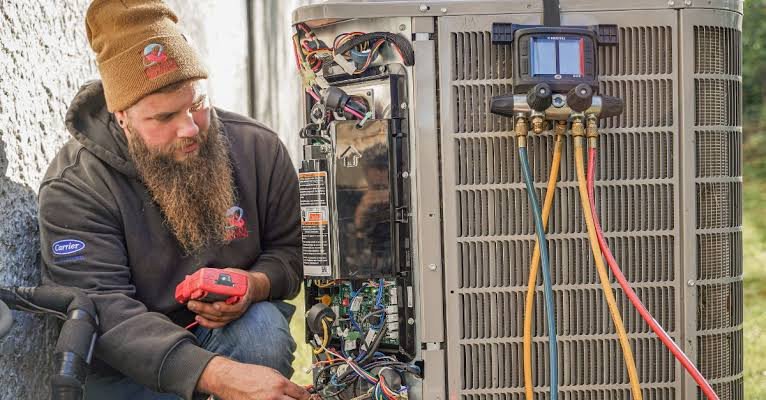
The AC stopped working on the hottest day of the summer. The thermostat says it is 90 degrees inside, and the air coming from the vents is warm. You called an HVAC company, and a technician is on the way. But you have no idea what the AC repair process involves, how long it will take, or whether the repair will be simple or expensive.
Air conditioning is the process of removing heat and moisture from indoor air (Wikipedia). When an AC system stops working, the repair process follows a sequence of diagnostic steps, component testing, and repair or replacement of failed parts. Understanding the AC repair process helps you know what to expect and recognize whether the technician is doing a thorough job.
The AC repair process involves diagnosis, component testing, and repair. Here is what you can expect during the repair from start to finish, including common problems and their costs.
Diagnosing the Problem — The First Step
The diagnostic phase is the most important part of the AC repair process. A thorough diagnosis identifies the root cause of the problem and prevents unnecessary repairs. A competent technician spends 15 to 30 minutes diagnosing the system before recommending any work.
The technician starts by checking the thermostat settings. The thermostat must be set to cool mode and the temperature set point must be below the current room temperature. A dead battery or uncalibrated thermostat is one of the most common causes of an AC system not running.
Next in the repair process, the technician inspects the outdoor unit. The condenser coil should be clean and free of debris. The fan should spin freely. The electrical connections should be tight. The technician checks the capacitor, which stores electrical charge to start the compressor and fan motors. A failed capacitor is one of the most common AC repairs.
The indoor unit of the AC system is inspected next in the process. The evaporator coil is checked for ice buildup, which indicates a refrigerant leak or airflow problem. The air filter is inspected and replaced if dirty. The condensate drain line is checked for clogs that cause water damage and system shutdown. The blower motor and fan are tested for proper operation.
Refrigerant levels are measured using pressure gauges. Low refrigerant indicates a leak that must be located and repaired before adding refrigerant. Electrical readings — voltage, amperage, and resistance — are tested on the compressor, fan motors, and control board to confirm they are within specification.
Common AC Problems and Their Repairs
Most AC repairs fall into a few categories. Understanding the most common problems gives you an idea of what the AC repair process is likely to involve.
| Problem | Repair | Cost range
|
| Failed capacitor | Replace capacitor | $150u2013$300 |
| Dirty condenser coil | Clean coil | $100u2013$250 |
| Refrigerant leak | Leak repair + recharge | $300u2013$1,500 |
| Frozen evaporator coil | Thaw + fix cause | $150u2013$500 |
| Failed contactor | Replace contactor | $150u2013$350 |
| Clogged drain line | Clear drain line | $100u2013$250 |
| Failed compressor | Replace compressor or system | $1,500u2013$4,000 |
A failed capacitor is the most common AC repair. The capacitor is a cylindrical component in the outdoor unit that stores electricity to start the compressor and fan. When it fails, the outdoor unit makes a humming sound but does not start. Replacing a capacitor is a simple repair that takes 15 to 30 minutes.
Refrigerant leaks are more complex. The technician must locate the leak using electronic leak detection or UV dye, repair the leak, and recharge the system with the correct amount of refrigerant. If the leak is in the evaporator coil or condenser coil, the coil must be replaced. Refrigerant leaks are the most common cause of an AC system that runs but does not cool.
A frozen evaporator coil is caused by restricted airflow or low refrigerant. The technician must determine the root cause before thawing the coil. If the problem is a dirty filter or blocked return duct, the fix is simple. If the problem is low refrigerant, the leak must be found and repaired before the system will work again.
The Repair Process Step by Step
Once the initial diagnosis is complete and approved and the repair is approved, the AC repair process follows these steps to restore your system to working condition.
Step 1: The technician obtains the necessary replacement parts. Most common parts — capacitors, contactors, and fan motors — are carried on the service truck. Less common parts may need to be ordered, which adds one to three days to the repair time.
Step 2: The power to the system is turned off at the breaker panel. The technician verifies that the power is off using a voltage tester before starting work.
Step 3: The failed component is removed and replaced. The technician documents the condition of the failed part and installs the new component using proper torque specifications and electrical connections.
Step 4: After the repair is complete, the system is tested. The technician restores power, starts the system, and verifies that it operates correctly. The supply air temperature is measured to confirm the system is cooling properly. Refrigerant pressures and electrical readings are checked again.
Step 5: The technician reviews the work with the homeowner, explains what was done, and provides recommendations for future maintenance. A thorough technician will show you the failed part and explain why it failed and how to prevent the same problem in the future.
An HVAC technician with 22 years of experience explained: “The most common mistake homeowners make is calling for service too late. They hear a strange noise or notice the system is not cooling as well, but they wait until it stops completely. If you notice something unusual, call early.”
AC Maintenance That Prevents Repairs
Regular AC maintenance prevents many common repairs and extends the life of the system. The AC repair process is often avoidable with simple preventive steps.
Change the air filter every one to three months. A dirty filter restricts airflow, which causes the evaporator coil to freeze and the compressor to work harder. Restricted airflow is the most common cause of AC repairs that can be prevented with regular filter changes. Filters cost $5 to $20 each.
Clean the outdoor condenser coil annually. The coil accumulates dirt, grass clippings, and debris that reduce heat transfer and cause the system to run longer and less efficiently. A clean coil can reduce energy consumption by 5 to 15 percent. The coil can be cleaned with a garden hose — do not use a pressure washer, which can damage the aluminum fins.
Schedule annual professional maintenance. A qualified HVAC technician performs a complete system inspection, cleaning, and tune-up. Annual maintenance costs $100 to $200 and includes checking refrigerant levels, testing electrical components, cleaning the coils, and inspecting the ductwork. Systems that receive annual maintenance have 30 to 50 percent fewer breakdowns.
Keep the area around the outdoor unit clear. The unit needs at least two feet of clearance on all sides for proper airflow. Trim bushes and weeds that grow around the unit. Remove leaves and debris that accumulate on the top of the unit.
When to Repair vs Replace Your AC Unit
Not every AC problem is worth repairing. The decision to repair or replace depends on the age of the system, the cost of the repair, and the efficiency of the existing unit.
For systems under 10 years old, most repairs are worth doing. The system has many years of useful life remaining, and the cost of the repair is justified by the remaining service life.
For systems 10 to 15 years old, evaluate the repair cost. If the repair is minor — less than $500 — it is usually worth doing. If the repair is major — compressor failure or refrigerant leak requiring coil replacement — replacement is often the better choice. The cost of major repairs on a system over 10 years old often exceeds the value of the repaired system.
For systems over 15 years old, replacement is almost always the right choice. Older systems operate at SEER ratings of 8 to 10, while new systems operate at SEER 14 to 22. The energy savings from a new system often cover the monthly payment for financing. A new high-efficiency system reduces cooling costs by 30 to 50 percent compared to a 15-year-old system.
Frequently Asked Questions
How long does an AC repair take?
Capacitor replacement takes 30 minutes to one hour. Refrigerant leak repair takes two to four hours. Parts that need ordering add one to three days.
What is the most common AC repair?
Capacitor failure is the most common AC repair. The capacitor starts the compressor and fan motors. A failed capacitor causes the outdoor unit to hum but not start. Replacement costs $150 to $300 and takes about 30 minutes.
Should I repair or replace my AC unit?
Repair systems under 10 years old. Consider replacement for systems over 10 years old with major repairs costing over $500. Replace systems over 15 years old — new units save 30 to 50 percent on energy costs.
How much does AC refrigerant leak repair cost?
Refrigerant leak repair costs $300 to $1,500. The cost depends on the leak location. Simple coil repairs cost less. If the evaporator or condenser coil must be replaced, the cost is higher and often leads to system replacement for older units.
Why is my AC running but not cooling?
Low refrigerant from a leak is the most common cause. A dirty condenser coil, frozen evaporator coil, or failed compressor can also cause the AC to run without cooling. A professional diagnostic is needed to determine the exact cause.
What causes an AC coil to freeze?
A dirty filter or blocked duct is the most common cause. Low refrigerant from a leak also causes freezing. The coil must be thawed and the root cause fixed.
How much does annual AC maintenance cost?
Annual maintenance costs $100 to $200. It includes inspection and cleaning and reduces breakdowns by 30 to 50 percent.
How much does an AC repair cost on average?
The average AC repair costs $200 to $600. Simple repairs like capacitor replacement cost $150 to $300. Major repairs like compressor replacement cost $1,500 to $4,000. The average across all repairs is about $400.
You Might Also Like...
 Why Air Conditioner Compressor Not Working? The Usual Causes, Safe Checks, and the Signs It Is Time to Stop Troubleshooting
 Furnace Repair Cost: Average Prices for Common Problems and Parts
 Why Is My Wall Air Conditioner Leaking Water? The Fix Starts With Drainage
 6 Professional Garage Door Repair Companies Covering Houston
