



The landscape of digital content has changed more in the last three years than in the previous three decades. By 2026, Artificial Intelligence isn’t just a “plus”—it’s the engine behind most of the text we read online. However, as AI models have become more sophisticated, so have the gatekeepers.
Whether you are a student striving for academic excellence or a non-native speaker looking to polish your prose, you’ve likely hit a wall: the dreaded “AI-generated” label. Even if you only used AI to brainstorm, a free ai detector might flag your work as robotic.
In this guide, we will explore how to use an AI Stealth Writer to bridge the gap between machine efficiency and human creativity, helping you bypass ai detection while maintaining your unique voice.
Why Is AI Detection Such a Big Deal in 2026?
A few years ago, AI detectors were easily fooled by a few swapped synonyms. Today, detection algorithms analyze “perplexity” and “burstiness”—the complex patterns of how we structure our thoughts.
For students and professionals alike, being falsely accused of “lazy” AI writing can be a reputation killer. Even if the content is 100% your own idea, if the structure is too predictable, a free ai detector will highlight it in red. This is where the art of “humanizing” text becomes essential.
The Student’s Advantage: Using AI Without Losing Integrity
For students, AI is a double-edged sword. It’s an incredible tutor, a research assistant, and a proofreader. However, academic institutions are increasingly strict. The goal for a modern student isn’t to use AI to “cheat,” but to use it to enhance their natural output.
1. Breaking Through Writer’s Block
Students often use AI to outline essays. The problem? Those outlines often lead to very “linear” writing that detectors pick up on. Using an AI Stealth Writer during the drafting phase allows students to keep their original arguments while ensuring the flow of the text feels organic and varied.
2. Refining Research Papers
When you’re dealing with dense academic data, it’s easy for your writing to become dry and mechanical. By learning how to bypass ai detection through smart editing, students can ensure their voice remains at the forefront, proving that they have synthesized the information themselves rather than just copy-pasting a prompt.
3. Learning Through Rewriting
One of the best ways to improve writing is to see your ideas expressed in different styles. Stealth writers don’t just “scramble” words; they restructure sentences. This helps students see alternative ways to present a logical argument, ultimately improving their own manual writing skills over time.
Non-Native Speakers: Ending the “Stiff English” Struggle
If English isn’t your first language, you know the struggle of writing a perfect email or article, only to have someone say, “It sounds a bit… stiff.”
Non-native speakers often rely on grammatically perfect but stylistically repetitive structures. Ironically, this “perfect” grammar is exactly what a free ai detector looks for. To a machine, “perfect and predictable” equals “AI-generated.”
Softening the Tone
An AI Stealth Writer is a game-changer for ESL (English as a Second Language) professionals. It helps by:
- Varying Sentence Length: Human writers naturally mix short, punchy sentences with longer, descriptive ones.
- Adding Idiomatic Nuance: AI often misses the subtle cultural “flavor” of English. Stealth tools help inject that missing warmth.
- Removing “Robotic” Connectors: Words like “Furthermore,” “Moreover,” and “In conclusion” are overused by standard AI. Humanizing tools find more natural transitions.
By using these tools to bypass ai detection, non-native speakers can compete on a level playing field, ensuring their ideas are judged on their merit, not on their linguistic “foreignness.”
How Does an AI Stealth Writer Actually Work?
You might be wondering: Is this just a paraphraser? The answer is no. Standard paraphrasers just swap words for synonyms, which often results in “word salad” that makes no sense.
An AI Stealth Writer uses “Human-in-the-loop” logic. It understands the context and intent of your message. It then rebuilds the text from the ground up using:
- Dynamic Vocabulary: Avoiding the “most likely next word” that standard LLMs (Large Language Models) choose.
- Structural Variance: Changing the active/passive voice balance to mimic human thought patterns.
- Contextual Awareness: Ensuring that technical terms remain accurate while the surrounding prose is softened.
Step-by-Step: How to Bypass AI Detection Safely
If you want to ensure your content passes through every free ai detector with flying colors, follow this workflow:
Step 1: Generate Your Core Ideas
Use your favorite AI to get your facts, data, and basic structure down. Don’t worry about the “tone” yet—just focus on the information.
Step 2: The “Human Touch” Edit
Read through the draft. If a sentence feels like something a textbook would say, change it. Add a personal anecdote or a specific example that an AI wouldn’t know.
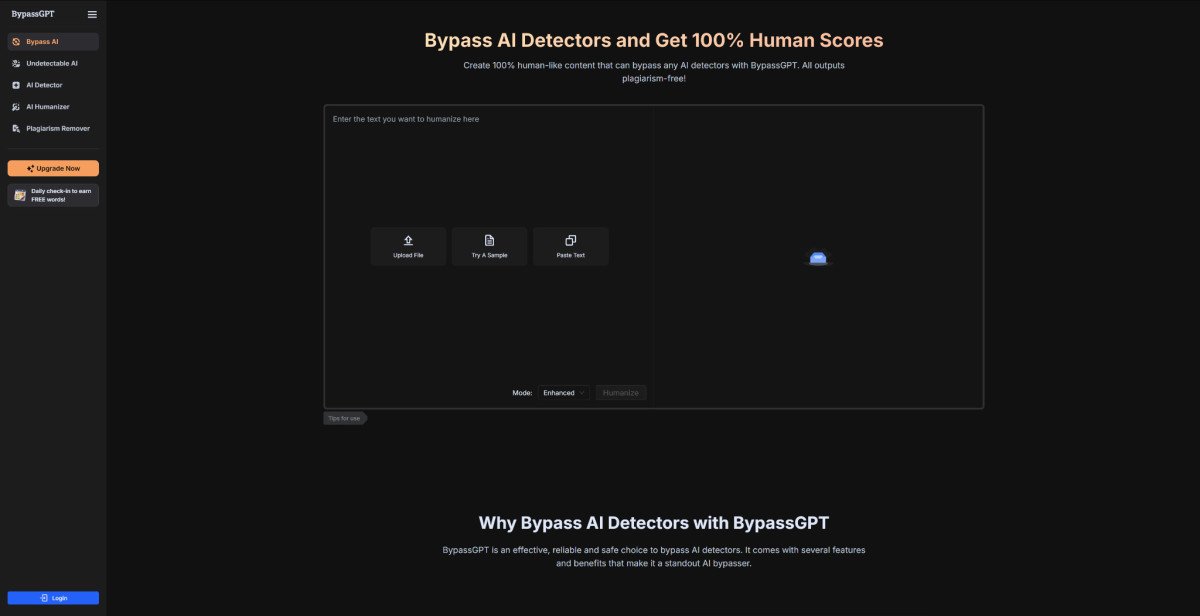
Step 3: Apply the AI Stealth Writer
Run your draft through a stealth tool. This will “randomize” the linguistic patterns that detectors look for without changing your core message.
Step 4: Final Verification
Before publishing or submitting, use a free ai detector yourself. If it still shows a high probability of AI, look at the specific sections highlighted. Usually, these are lists or overly long, complex sentences. Break them up!
The Ethics of AI Stealth Writing
As a professional SEO writer, I’m often asked: Is it ethical to bypass AI detectors?
The answer depends on intent. If you are using these tools to spread misinformation or avoid doing the work entirely, that’s a problem. But if you are using an AI Stealth Writer to:
- Ensure your original ideas aren’t unfairly flagged.
- Make your writing more readable for a human audience.
- Help bridge a language barrier.
…then you are simply using the tools of the trade. In 2026, the goal isn’t to avoid AI—it’s to collaborate with it so seamlessly that the “seams” between man and machine disappear.
Summary of Benefits
| User Group | Main Challenge | Solution |
| Students | Rigid academic tone & strict detectors | Use stealth writers to vary flow and maintain voice. |
| ESL Writers | “Stiff” or overly formal English | Humanizing tools add idiomatic flair and natural rhythm. |
| Content Creators | Search engine “AI-content” filters | Bypass ai flags to ensure better SEO ranking. |
| Job Seekers | Robotic-sounding cover letters | Create personalized, warm prose that resonates with HR. |
Final Thoughts: The Future of Writing
The battle between AI generators and AI detectors is an “arms race” that will likely never end. However, the winner will always be the writer who prioritizes the reader’s experience.
A free ai detector is just a tool, and like any tool, it can be wrong. By using an AI Stealth Writer, you aren’t just “tricking” a system; you are refining your communication to be more human, more engaging, and more effective.
Don’t let a “robotic” label hold your ideas back. Master the art of stealth writing and let your true voice be heard.
You Might Also Like...
 The Ultimate Guide to Carbon Monoxide Detector Placement: Protecting Your Home from the Silent Killer
 Yutz Definition: Meaning, Origin, and How It Differs From Putz
 Tasyyblack: The Ultimate Platform for Content Creators and Readers in 2026
 How AI Video Dubbing Breaks the Language Barrier for Creators Worldwide
