Choosing between a fixed-rate and an adjustable-rate mortgage (ARM) is a significant financial decision for homebuyers, as each option presents distinct advantages and disadvantages that can impact long-term financial stability and monthly housing costs. Understanding the fundamental differences in how interest rates are determined and adjusted is essential for selecting the mortgage type that most suitable aligns with individual financial goals and risk tolerance says Streamline Management experts.

When securing a home loan, borrowers typically encounter two primary mortgage structures: fixed-rate mortgages and adjustable-rate mortgages (ARMs). These options differ fundamentally in how their interest rates are calculated and how they behave over the loan’s duration. A fixed-rate mortgage offers stability with a consistent interest rate throughout the loan term, providing predictable monthly payments. Conversely, an adjustable-rate mortgage features an interest rate that can change periodically after an initial fixed period, leading to fluctuating monthly payments. The choice between these two depends heavily on a borrower’s financial situation, market outlook, and personal comfort with risk [1].
Understanding Fixed-Rate Mortgages
A fixed-rate mortgage is a home loan where the interest rate remains constant for the entire duration of the loan term, ensuring that the principal and interest portion of the monthly payment never changes, which provides borrowers with financial predictability and stability over many years.
Fixed-rate mortgages are characterized by an interest rate that is locked in at the time of loan origination and remains unchanged for the life of the loan. This means that the borrower’s monthly principal and interest payments will stay the same, regardless of market fluctuations. This stability is a primary appeal for many homeowners, as it simplifies budgeting and protects against potential interest rate increases [2]. Common fixed-rate mortgage terms include 15-year and 30-year options, though other durations are available. For example, a 30-year fixed-rate mortgage at a 6.5% interest rate would have the same principal and interest payment for all 360 months, assuming no changes to property taxes or homeowner’s insurance [2].
The benefits of a fixed-rate mortgage extend beyond predictable payments. Borrowers are shielded from rising interest rates, which can be particularly advantageous in an environment where rates are expected to climb. If market rates drop significantly, homeowners with fixed-rate mortgages retain the option to refinance their loan to secure a lower rate, often without penalty [2]. This flexibility allows them to take advantage of favorable market conditions while maintaining the security of a fixed payment. However, if rates remain low or decrease only slightly, the initial fixed rate might be higher than what an ARM could offer in its introductory period.
Exploring Adjustable-Rate Mortgages (ARMs)
An adjustable-rate mortgage (ARM) begins with a fixed interest rate for an initial period, after which the rate adjusts periodically based on a specified financial index, leading to potential changes in monthly payments that can either increase or decrease depending on market conditions.
Adjustable-rate mortgages (ARMs) operate differently from fixed-rate loans. They typically start with a lower interest rate than comparable fixed-rate mortgages for an initial period, which can range from six months to 10 years. After this introductory period, the interest rate adjusts at regular intervals, usually annually or semi-annually. These adjustments are tied to a financial index, such as the Secured Overnight Financing Rate (SOFR), plus a margin set by the lender. This means that monthly payments can fluctuate, potentially increasing or decreasing over the loan’s term [1].
Most ARMs include rate caps that limit how much the interest rate can change during each adjustment period and over the lifetime of the loan. For instance, a 5/1 ARM might have an initial fixed rate for five years, followed by annual adjustments. The caps might specify that the rate cannot increase by more than 2% in the first adjustment, 2% in subsequent adjustments, and 5% over the life of the loan. While the initial lower rate can make ARMs attractive, especially for borrowers who plan to sell or refinance before the fixed period ends, the uncertainty of future payments requires careful financial planning and a higher tolerance for risk [1].
Key Differences Between Fixed and Adjustable Mortgages
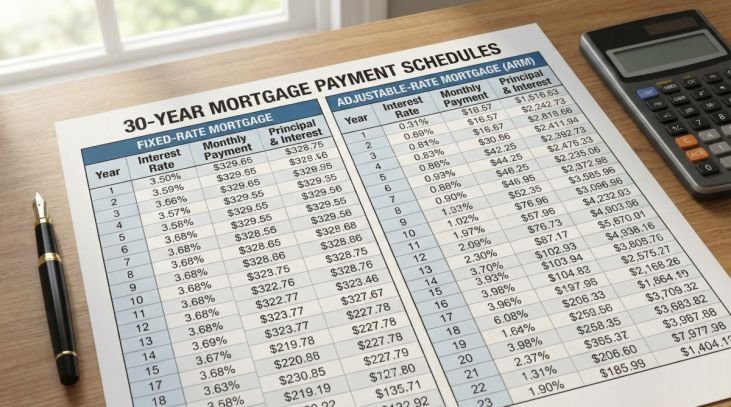
The primary distinction between fixed-rate and adjustable-rate mortgages lies in the stability of their interest rates and corresponding monthly payments, with fixed rates offering consistency and ARMs introducing variability after an initial period.
The fundamental difference between fixed-rate and adjustable-rate mortgages is how their interest rates behave over time. A fixed-rate mortgage provides a constant interest rate and predictable monthly payments for the entire loan term. This stability is a significant advantage for borrowers who prioritize consistent budgeting and protection from rising market rates. In contrast, an ARM’s interest rate is fixed for an initial period, then adjusts periodically based on market indices, leading to fluctuating monthly payments [3].
Beyond interest rate variability, other key differences include initial interest rates, down payment requirements, and interest calculation methods. ARMs typically offer a lower introductory interest rate, which can result in smaller initial monthly payments compared to fixed-rate loans. However, conventional ARMs may require a slightly higher minimum down payment, often 5%, compared to 3% for conventional fixed-rate loans [3]. The interest calculation for a fixed-rate mortgage is straightforward, set at the outset, while an ARM’s interest is recalculated with each adjustment, incorporating the index, lender’s margin, and rate caps [3].
| Feature | Fixed-Rate Mortgage | Adjustable-Rate Mortgage (ARM) |
|---|---|---|
| Interest Rate | Remains constant for the entire loan term | Fixed for an initial period, then adjusts periodically |
| Monthly Payments | Predictable and stable | Can fluctuate after the initial fixed period |
| Initial Interest Rate | Generally higher than initial ARM rates | Often lower than fixed-rate mortgages |
| Risk of Rate Increase | None (protected from market increases) | Present after the initial fixed period |
| Budgeting | Easier due to payment stability | More challenging due to payment variability |
| Down Payment (Conventional) | Minimum 3% | Minimum 5% |
Who Benefits from Each Mortgage Type?
The suitability of a fixed-rate or adjustable-rate mortgage depends on a borrower’s financial outlook, plans for the property, and comfort with potential payment fluctuations, making each type ideal for different homeowner profiles.
Fixed-rate mortgages are often the preferred choice for individuals who plan to remain in their homes for an extended period, typically 10 years or longer. The stability of consistent monthly payments provides peace of mind and simplifies long-term financial planning. First-time homebuyers often find fixed-rate mortgages less daunting due to their straightforward payment structure, and many first-time homebuyer programs exclusively offer fixed-rate options. Additionally, if current interest rates are low, locking in a fixed rate can be a strategic move to secure favorable borrowing costs for decades [3].
Conversely, adjustable-rate mortgages can be advantageous for borrowers with different circumstances. Those who anticipate selling their home or refinancing within a few years, before the ARM’s initial fixed period ends, can benefit from the lower introductory rates and reduced initial payments. ARMs may also appeal to individuals who expect a significant increase in their income in the future, making them better equipped to handle potential rate adjustments. In periods of high or volatile market rates, an ARM might offer a more attractive entry point, especially for jumbo loans where initial savings on interest can be substantial [3].
Factors to Consider When Choosing
When deciding between a fixed-rate and adjustable-rate mortgage, borrowers should carefully evaluate their financial stability, future plans for the home, current interest rate environment, and personal risk tolerance to make an informed decision.
Several critical factors should influence a borrower’s decision between a fixed-rate and an adjustable-rate mortgage. First, consider your **financial stability and income predictability**. If your income is stable and you prefer consistent expenses, a fixed-rate mortgage offers unparalleled budgeting ease. If your income is expected to grow, or you have a substantial financial cushion, an ARM’s fluctuating payments might be manageable. Second, assess your **time horizon for homeownership**. If you plan to stay in the home for a long time, the security of a fixed rate is often more appealing. If you anticipate moving or refinancing within five to seven years, an ARM’s lower initial rates could provide short-term savings [2, 3].
Third, evaluate the **current interest rate environment**. When prevailing rates are low, locking in a fixed rate can be highly beneficial. If rates are high or expected to fall, an ARM might offer a lower entry rate with the potential for future decreases. Fourth, consider your **risk tolerance**. A fixed-rate mortgage eliminates interest rate risk, while an ARM introduces the possibility of higher payments. Finally, understand the **specific terms of the ARM**, including the length of the fixed period, the adjustment frequency, the index used, and all rate caps (initial, periodic, and lifetime) [1]. Consulting with a mortgage advisor can provide personalized guidance based on your unique financial situation and goals [4].
| Consideration | Fixed-Rate Mortgage | Adjustable-Rate Mortgage (ARM) |
|---|---|---|
| Financial Stability | High preference for stable, predictable payments | Comfortable with potential payment fluctuations |
| Time in Home | Long-term (10+ years) | Short-term (less than 7 years) or plans to refinance |
| Interest Rate Environment | Ideal when rates are low or expected to rise | Attractive when rates are high or expected to fall |
| Risk Tolerance | Low tolerance for interest rate risk | Higher tolerance for interest rate risk |
| Income Growth Expectation | Less relevant | Beneficial if income is expected to increase |
Frequently Asked Questions
Is an ARM riskier than a fixed-rate mortgage?
Yes, an ARM is generally considered riskier than a fixed-rate mortgage due to the uncertainty of future interest rate adjustments and potential payment increases.
Is an ARM or a fixed-rate mortgage easier to qualify for?
Qualification for both depends on creditworthiness, but ARMs may sometimes have stricter requirements for down payments or borrower financial stability.
When is a fixed-rate mortgage generally more suitable?
A fixed-rate mortgage is more suitable for borrowers planning to stay in their home long-term or when interest rates are currently low and stable.
When might an adjustable-rate mortgage be a better choice?
An ARM might be a better choice for borrowers planning to move or refinance before the initial fixed period ends, or when current rates are high.
What are the typical adjustment caps on an ARM?
Typical ARM adjustment caps limit how much the interest rate can change per adjustment period (e.g., 2%) and over the lifetime of the loan (e.g., 5%).
Conclusion
The decision between a fixed-rate and an adjustable-rate mortgage is a personal one, requiring a thorough evaluation of current financial circumstances, future housing plans, and an understanding of market dynamics to choose the loan that most suitable supports long-term financial well-being.
Both fixed-rate and adjustable-rate mortgages offer distinct pathways to homeownership, each with its own set of benefits and risks. Fixed-rate mortgages provide the comfort of predictable payments and protection against rising interest rates, making them ideal for long-term homeowners and those who value budgeting stability. Adjustable-rate mortgages, with their lower initial rates, can be attractive for borrowers with short-term ownership plans or those who anticipate future income growth. However, the potential for fluctuating payments introduces a level of uncertainty that requires careful consideration and a higher tolerance for risk.
Ultimately, the optimal mortgage choice aligns with an individual’s financial strategy and personal preferences. Prospective homebuyers should engage in comprehensive research, assess their financial outlook, and consult with qualified mortgage professionals to navigate the complexities of these loan products. By understanding the nuances of each option, borrowers can make an informed decision that secures their housing needs while managing financial risk effectively.
References
- [1] Consumer Financial Protection Bureau. “What is the difference between a fixed-rate and adjustable-rate mortgage (ARM) loan?” https://www.consumerfinance.gov/ask-cfpb/what-is-the-difference-between-a-fixed-rate-and-adjustable-rate-mortgage-arm-loan-en-100/
- [2] Freddie Mac. “Choosing Between a Fixed-Rate and an Adjustable-Rate Mortgage.” https://myhome.freddiemac.com/blog/homebuying/choosing-between-fixed-rate-and-adjustable-rate-mortgage
- [3] Bankrate. “Fixed-Rate Mortgage Vs. ARM: What’s the Difference?” https://www.bankrate.com/mortgages/arm-vs-fixed-rate/
- [4] Kearny Bank. “Comparing Fixed-Rate vs. Adjustable-Rate Mortgages.” https://www.kearnybank.com/the-vault/comparing-fixed-rate-vs-adjustable-rate-mortgages