Beforepay charges a flat 5% transaction fee on every pay advance — a figure that annualises to roughly 79% on a fortnightly repayment cycle. Four Australian alternatives and three US apps offer different fee structures, higher limits, or bank-backed trust that Beforepay cannot match.
apps like beforepay — Australian and US pay advance alternatives comparison for 2026
Below is a side-by-side breakdown of seven pay advance apps, with verified pricing from official sources, real community warnings from Australian finance forums, and the latest regulatory updates from ASIC and the CFPB.
What Beforepay Actually Charges — And Why People Look for Alternatives
Beforepay offers pay advances up to $2,000 of earned income with a flat 5% transaction fee per advance, no subscription, and no late fees. Eligibility requires a minimum after-tax income of $300 per week, and no more than 50% of income can come from Centrelink benefits.
The fee sounds modest in isolation. But run the numbers on a fortnightly borrowing cycle and that 5% compounds to approximately 79% annualised, a figure that quietly matches many traditional payday loans.
“Only a 5% transaction fee — which translates to a 79% compounded annualised interest rate.”
— r/AusFinance, January 2022
This aligns with CHOICE’s 2025 investigation into wage advance services, which raised identical concerns about the gap between advertised fees and effective annual costs.
Readers exploring apps similar to Beforepay may also find a Beforepay review useful for gaining additional background on the service and understanding how it is presented alongside other alternatives. Reviewing additional details about Beforepay can help users compare its fees, features, and overall value before deciding which pay advance option best matches their financial needs.
Beforepay at a Glance — Fees, Limits, Eligibility
| Feature | Details |
|---|---|
| Max Advance | Up to $2,000 |
| Fee Structure | Flat 5% per advance |
| Interest | Up to 24% p.a. (risk-based, Personal Loan product) |
| Repayment | Auto direct debit on payday; up to 4 instalments |
| Late Fees | None |
| Subscription | None |
| Min Income | $300/week after tax |
| Credit Check | No traditional credit check |
| Centrelink Cap | Max 50% of income from government benefits |
Australian Alternatives to Beforepay
Four Australian apps compete directly with Beforepay: Wagetap, MyPayNow, Wagepay, and CommBank AdvancePay. Each carries the same 5% + 24% p.a. fee ceiling except CommBank, which charges flat dollar fees starting at $5 for advances up to $500.
“Biggest ones to look at: BeforePay. CommBank Advance Pay. MyPayNow. WagePay.”
— r/cashadvanceapps, 2025
Wagetap
Wagetap advances up to $2,000 of earned wages with a 5% transaction fee plus 24% p.a. interest on the outstanding balance. A $100 advance repaid within one week costs $5.46 total — $5 fee plus $0.46 interest. Repayment terms range from 2 to 62 days.
The app also handles bill payments directly, splitting costs into 3 instalments for bills under $300 or 4 instalments for larger amounts, all aligned with payday. Funding typically arrives in under 3 minutes.
MyPayNow
MyPayNow advances up to 25% of regular wages, capped at $2,000 per pay cycle. The fee structure mirrors Beforepay: 5% flat fee plus a maximum 24% p.a. interest rate. A $100 advance repaid in one week costs $105.48.
No employer integration is required; the app works directly with individual employees. Available 24/7 with no subscription fees and automatic direct debit repayment on the scheduled date.
Wagepay
Wagepay pushes the limit ceiling higher at up to $3,000, the largest among Australian pay advance apps. The maximum fee is 5% plus 24% p.a., but pricing is risk-tiered, meaning some users pay less based on their financial profile.
With over 400,000 Australian users as of early 2026, Wagepay funds via NPP (New Payments Platform) in as fast as 60 seconds. The app also offers free Equifax credit score tracking and a loyalty program with cash giveaways, features none of its direct competitors provide.
CommBank AdvancePay
CommBank AdvancePay takes a fundamentally different approach. Instead of percentage-based fees, it charges flat dollar amounts tied to the advance size:
| Advance Amount | Flat Fee |
|---|---|
| $100–$500 | $5 |
| $501–$1,000 | $10 |
| $1,001–$1,500 | $15 |
| $1,501–$2,000 | $20 |
Eligibility is restricted to existing CommBank customers with a Smart Access or Complete Access personal account and salary deposited there. Usage is capped at 4–8 times per year depending on pay frequency, and late repayments attract 14.9% p.a. interest.
CommBank charges a flat $5 on a $500 advance, from the same institution that processes your home loan. Mortgage brokers who flag fintech pay advances on bank statements rarely raise the same concerns about a product from one of Australia’s Big Four banks.
Side-by-side Australian comparison
| App | Max Advance | Fee | Interest | Funding Speed | Credit Check | Unique Feature |
|---|---|---|---|---|---|---|
| Beforepay | $2,000 | 5% flat | Up to 24% p.a. | Direct to bank | No | Up to 4 instalments |
| Wagetap | $2,000 | 5% + 24% p.a. | Included in fee | Under 3 min | No | Bill payment splitting |
| MyPayNow | $2,000 | 5% + 24% p.a. | Included in fee | 24/7 | No | No employer integration needed |
| Wagepay | $3,000 | Up to 5% + 24% p.a. | Risk-tiered | 60 sec (NPP) | No | Free Equifax score + loyalty |
| CommBank | $2,000 | $5–$20 flat | 14.9% p.a. (late only) | Minutes–1 day | No | Big Four bank backing |
US Cash Advance Alternatives Worth Knowing
Three US apps (EarnIn, Dave, and Brigit) dominate the American earned wage access market. None operate in Australia, but their fee models offer a useful benchmark for evaluating what Australian users actually pay relative to global alternatives.
EarnIn
EarnIn advances up to $150 per day and $750 per pay period, with established users potentially accessing up to $1,000. There are no mandatory fees; the app operates on an optional tip model. Instant transfers (Lightning Speed) cost $3.99–$5.99 per transaction.
With no subscription and no required charges, EarnIn’s effective cost depends entirely on whether users tip and how much. A user who never tips pays nothing beyond the optional instant transfer fee.
Dave
Dave’s ExtraCash feature advances up to $500, though the average advance sits closer to $73 for typical users and around $160 for newer accounts. The app charges a monthly membership of $1–$5 plus a per-advance fee capped at $15 (roughly 5% of the advance amount).
In practice, limits often fall short of the advertised $500 maximum. One user on r/povertyfinance noted that Dave cut their limit from $600 to $155 during the Christmas period, precisely when cash was tightest.
Brigit
Brigit advertises advances up to $500 but the effective limit for most users is $250, according to FTC findings. A mandatory monthly subscription of $8.99–$14.99 is required before accessing any advance.
In November 2023, the FTC issued a consumer alert about Brigit’s subscription model, noting that “most enrollees didn’t receive the advertised $250 maximum and membership was hard to cancel.” The FTC’s public warning is one of the few direct regulatory rebukes issued against a cash advance app in the US market.
Fee Comparison — Flat Fee vs. Subscription vs. Tip Model
Australian apps charge a percentage-based fee per use (typically 5%), while US apps rely on monthly subscriptions ($1–$15) or optional tips. The true cost depends entirely on how often you borrow and how quickly you repay.
“Each of these line of credit / cash advance apps collect a fee each month.”
— r/povertyfinance, March 2024 (204 upvotes)
True cost comparison
| App | Fee Model | Cost on $200 Advance (1 week) | Cost on $200 Advance (monthly use) | Effective APR Range |
|---|---|---|---|---|
| Beforepay | 5% per use | $10.00 | $10.00/month | ~79% (fortnightly cycle) |
| Wagetap | 5% + 24% p.a. | $10.92 | $10.92/month | ~80–85% |
| CommBank | $5–$20 flat | $5.00 | $5.00/month | ~48% (on $200) |
| EarnIn | Optional tip | $0–$5.99 | $0–$5.99/month | 0%–156% (tip dependent) |
| Dave | $1–5/mo + 5% | $11–$15 | $11–$15/month | ~115–190% |
| Brigit | $8.99–14.99/mo | $8.99–$14.99 | $8.99–$14.99/month | ~54–90% (single monthly use) |
Borrow $100 from Brigit once a month, and the $8.99–$14.99 subscription alone translates to an effective rate north of 100% annualised on that single advance. CommBank’s flat $5 fee on a $200 advance remains the cheapest option for existing CBA customers, though the 4–8 annual usage cap limits how often it can be used.
Risks Every Pay Advance User Should Understand
Pay advance apps carry three risks that rarely appear in marketing material: debt spiral from habitual use, reduced mortgage eligibility in Australia, and algorithmic limit cuts at the moment cash is needed most.
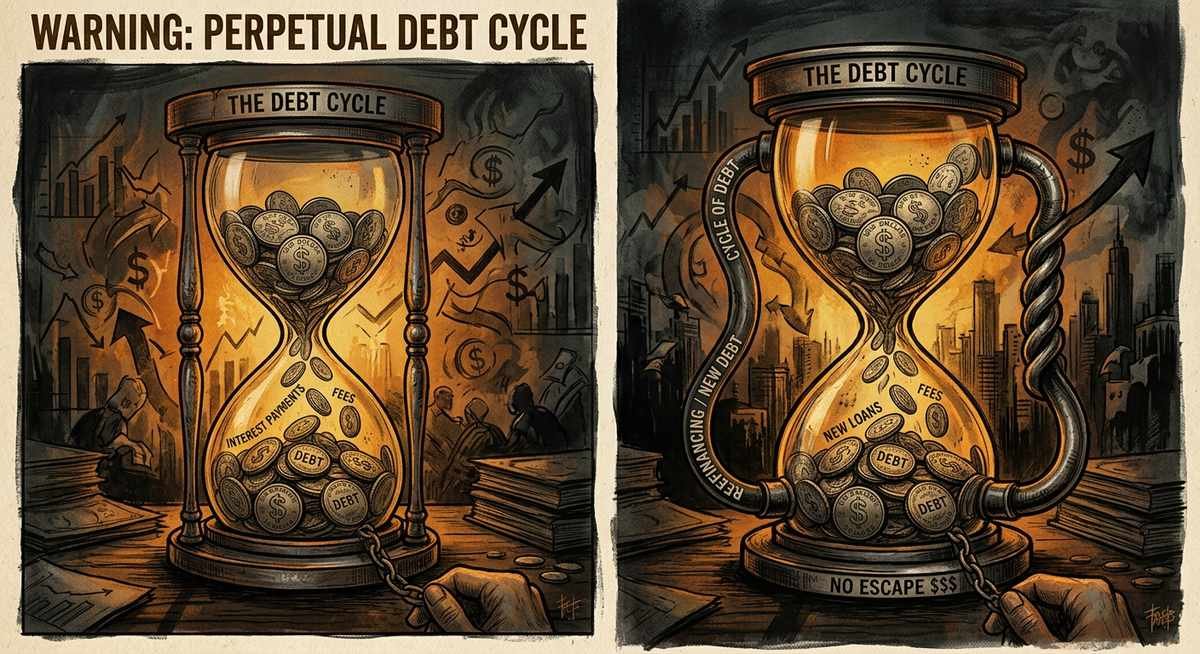
The debt spiral pattern
The shift from one emergency advance to juggling multiple apps follows a pattern documented in addiction research: tolerance builds, returns shrink, and dependence grows.
“My WHOLE paycheck goes to cash advance apps, I’m talking 2g’s every 2 weeks.”
— r/povertyfinance, March 2024 (563 upvotes)
This matches the broader pattern documented by ASIC’s MoneySmart guide to pay advance services, which warns that repeated use can create a cycle of dependency where each payday starts with repaying the previous advance.
Users in r/AusFinance threads describe the same pattern: one app for urgent expenses, then a second to cover the gap, then a third. Within months, nearly every available service is in rotation, with repayments consuming each payday before it lands.
Mortgage and loan eligibility impact
In Australia, mortgage brokers and lenders routinely scrutinise bank statements for pay advance transactions. These transactions signal cash flow stress to underwriters, regardless of the actual financial reason behind the advance.
“Lenders HATE Beforepay. I used to work in lending and seen a few loans declined because of it.”
— r/AusFinance, 2025
This is consistent with guidance from CHOICE (2025), which noted that lenders view pay advance usage as an indicator of poor cash flow management, even when the borrower’s overall financial position is healthy. The practical advice from brokers: stop using pay advance apps at least three to six months before applying for a mortgage.
Algorithmic limit reductions
Pay advance apps use real-time risk algorithms to adjust user limits. Multiple users report limits being slashed during periods of financial stress, precisely when advances are needed most. Dave users in particular have reported limits dropping from $600 to $155 around holiday periods when spending increases.
The algorithms detect exactly the financial pressure that drives users to request advances, then respond by restricting access. It is a system designed to protect the lender, not the borrower.
What the Regulators Say — ASIC and CFPB Updates
Both Australian and US regulators updated their stance on pay advance apps in late 2025 and early 2026. ASIC issued a new legislative instrument in March 2026, and the CFPB ruled that certain earned wage access products are not credit under US law.
Australia — ASIC Instrument 2026/199
ASIC’s Instrument 2026/199, effective March 31, 2026, formalises the regulatory framework for employee entitlement schemes in Australia. This instrument replaces previously expired interim relief and provides a defined pathway for pay advance providers to operate outside the National Consumer Credit Protection Act — provided they meet specific conditions around fee caps and repayment structures.
The practical effect: apps like Beforepay, Wagetap, MyPayNow, and Wagepay continue operating under this framework rather than being classified as consumer credit products, which would trigger significantly stricter lending obligations.
United States — CFPB Earned Wage Access Ruling
In December 2025, the CFPB issued an advisory opinion establishing that “Covered EWA” products meeting four specific criteria are not considered credit under the Truth in Lending Act (TILA) or Regulation Z. The four criteria require that the product: provides access only to earned wages, charges no interest, allows voluntary fees/tips (not mandatory), and is repaid automatically from the next paycheck.
Under this ruling, expedited delivery fees and optional tips are explicitly not classified as finance charges. EarnIn’s tip-based model falls squarely within these criteria. Dave and Brigit, with their mandatory subscription fees, occupy a greyer regulatory zone.
Frequently Asked Questions
What app is similar to Beforepay?
Wagetap, MyPayNow, Wagepay, and CommBank AdvancePay are the four closest Australian alternatives, all offering pay advances between $2,000 and $3,000 with similar fee structures. Wagetap and MyPayNow mirror Beforepay’s 5% + 24% p.a. model most closely. Wagepay offers higher limits up to $3,000 with risk-tiered pricing, and CommBank charges flat dollar fees instead of percentages.
Is there anything better than Beforepay?
CommBank AdvancePay charges lower flat fees ($5–$20 versus 5% of the advance) for existing CBA customers, making it cheaper on advances above $100. Wagepay offers higher limits (up to $3,000) with risk-tiered pricing that may be cheaper for low-risk borrowers. The trade-off: CommBank limits usage to 4–8 times per year, and Wagepay requires an Equifax-compatible financial profile for the best rates.
Is Beforepay a payday loan?
Legally, no. ASIC classifies pay advance services under its employee entitlement schemes framework (Instrument 2026/199), not consumer credit. Practically, the debate is fierce: the 5% fee annualises to approximately 79% on a fortnightly cycle, a figure comparable to traditional payday lending. Multiple threads on r/AusFinance have debated this exact question, with most commenters concluding that the distinction is more legal than functional.
Does using Beforepay hurt mortgage applications?
Yes. Mortgage brokers and lenders flag pay advance transactions on bank statements as indicators of poor cash flow management. At least one former lender confirmed on r/AusFinance in 2025 that they had seen loan applications declined specifically because of Beforepay usage. The recommended buffer: stop all pay advance activity at least three to six months before lodging a home loan application.
Can pay advance apps cut your limit when you need them most?
Yes. These apps use algorithms that assess risk in real time, and multiple users report limits being slashed during periods of financial stress. Dave users have described limits dropping from $600 to $155 during Christmas, the period when cash shortfalls are most acute. The algorithm interprets increased financial pressure as higher risk, reducing access precisely when demand peaks.
Are there class action lawsuits against cash advance apps?
As of early 2026, multiple class action lawsuits are active against US-based cash advance apps. Some apps have begun exiting California due to regulatory pressure from state-level enforcement. No equivalent Australian class actions have been reported, but ASIC’s Instrument 2026/199 signals increased regulatory oversight that could trigger compliance-related legal challenges if providers fail to meet the new framework conditions.
How to break the pay advance debt cycle?
Stop using all pay advance apps simultaneously; tapering off one at a time typically fails because the remaining apps absorb the gap. Contact the National Debt Helpline (1800 007 007 in Australia) for free financial counselling. Build even a small buffer of one week’s expenses before cancelling automatic debits, as apps will attempt auto-collection on payday regardless of your intent to stop using the service.
For e-commerce alternatives, see our comparison of apps like AliExpress.