Yutz means a foolish, bumbling, or socially inept person — a mild Yiddish-rooted insult that landed in American English through Jewish immigrant communities and stuck around because nothing else quite captures the same shade of exasperated contempt. The American Heritage Dictionary defines yutz as “a foolish, annoying, or socially inept person,” classifying it as informal slang of Yiddish origin.
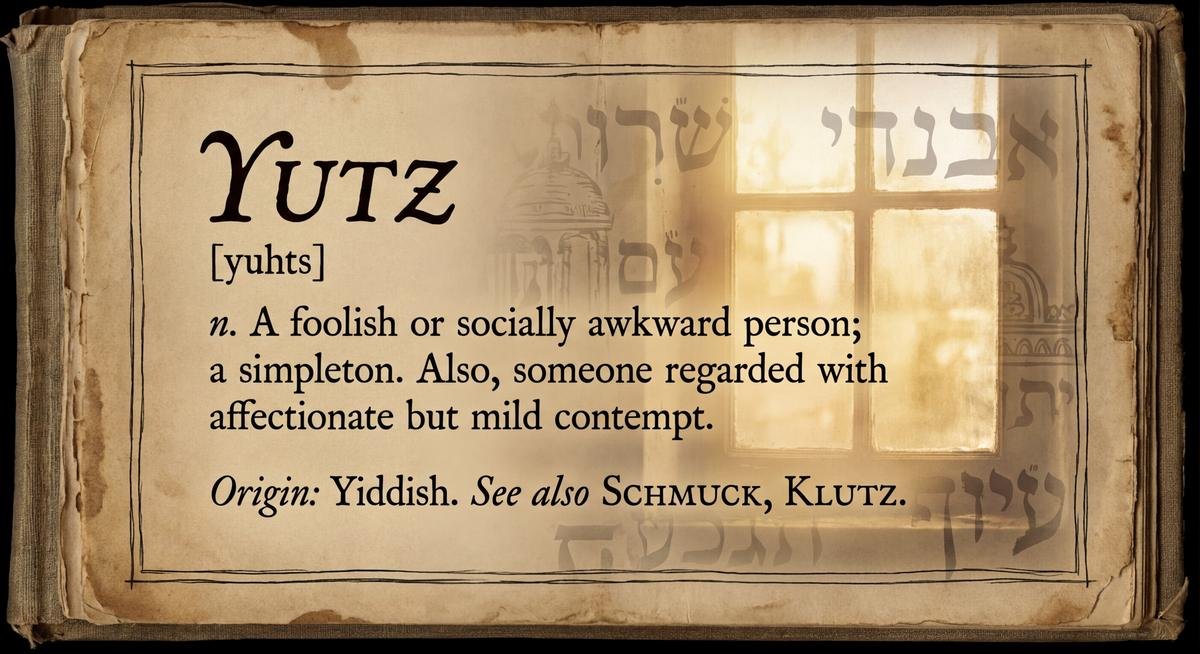
yutz definition — Yiddish-origin slang word for a foolish or bumbling person explained with etymology and usage
Picture a coworker who manages to botch the simplest task, or a driver who cannot figure out a four-way stop. Someone nearby mutters, “What a yutz.” The meaning lands immediately — even if the word itself is unfamiliar. That quiet staying power is the hallmark of Yiddish slang in American English: a linguistic inheritance carried over by Ashkenazi Jewish immigrants and polished smooth by decades of comedy writing, sitcoms, and street-corner conversation.
The yutz definition sits in interesting company alongside related terms like putz, schmuck, and schlemiel — words that share Yiddish origins but differ in tone, vulgarity, and precise shade of contempt. What follows covers the full picture: pronunciation, Yiddish etymology, real usage examples, and exactly how yutz compares to its close cousins in the American English insult family.
What Does Yutz Mean?
A yutz is an informal American English noun for a foolish, ineffectual, or contemptible person — someone bumbling, clueless, or mildly annoying, carrying a connotation closer to dismissive exasperation than genuine hostility. The word belongs firmly to informal register.
Core Definition in English
To define yutz in English: it describes a person regarded as a hapless fool or an irritating incompetent. Merriam-Webster lists yutz as an established slang term, and the American Heritage Dictionary of the English Language (Fifth Edition, 2022) formally includes it with the definition “a foolish, annoying, or socially inept person.” That dual-dictionary recognition confirms its place in the standard American English lexicon — not just street slang anymore.
The connotation is more eye-roll than outrage. Calling someone a yutz signals they have done something stupid or ineffectual, but the label rarely draws blood the way sharper insults do.
Tone and Register
Is yutz offensive? Technically, yes — it is a pejorative. Practically, it sits at the gentler end of the Yiddish-derived insult spectrum, well below schmuck or putz in terms of sting. Speakers often deploy it with affectionate mockery or weary exasperation rather than real malice.
A parent calling a child a yutz for locking keys in the car is not launching an attack — that is the word’s natural habitat. Safe for casual speech, it still reads as dismissive, so context matters. As one Yiddish language enthusiast put it on a Reddit discussion about the “scale of Yiddish idiocy words,” putz ranks among the worst while yutz sits comfortably toward the milder end of the spectrum.

How to Pronounce Yutz
Yutz is pronounced /jʌts/ — one syllable, rhyming with “cuts” and “guts.” The “y” sounds as in “yes,” the “u” is a short uh vowel as in “cup,” and the word closes with a hard “ts” cluster as in “cats.” According to the American Heritage Dictionary’s phonetic notation, the pronunciation is consistent across American English dialects.
Phonetic Breakdown
| Element | Detail |
|---|---|
| IPA Transcription | /jʌts/ |
| Syllable Count | 1 |
| Rhymes With | cuts, guts, mutts |
| Stress Pattern | Single syllable — fully stressed |
| Common Misspelling | “zutz” (not a recognized English word) |
Say it fast: YUTS. One beat. Done. American English speakers use this pronunciation consistently whether in New York, Chicago, or Los Angeles — a rare uniformity for Yiddish slang that sometimes shifts regionally.

Etymology and Yiddish Origins of Yutz
Yutz traces directly to Yiddish, the language of Ashkenazi Jewish communities in Eastern Europe — a hybrid tongue often described as roughly 70% Middle High German vocabulary with significant Hebrew, Aramaic, and Slavic layers, according to Britannica’s Yiddish language overview. The word entered American English through the massive Jewish immigration wave of the late 19th and early 20th centuries.
Yiddish Roots and Meaning Origin
The Jewish English Lexicon at the YIVO Institute traces yutz to Yiddish yonts (יאָנץ), meaning a fool or numskull. The American Heritage Dictionary offers a slightly different etymology: possibly an alteration of putz, perhaps influenced by Yiddish yold (fool) and yat (fellow, guy). Both accounts point to the same Yiddish semantic field — a rich vocabulary for human failings that English simply did not possess.
Yiddish has always excelled at gradations of contempt. Where English might reach for a single word like “idiot,” Yiddish offers a whole taxonomy of foolishness, each term calibrated for a slightly different flavor of incompetence or annoyance. Yutz occupies the milder, more exasperated end of that spectrum.
Entry Into American English
According to the YIVO Encyclopedia of Jews in Eastern Europe, approximately 2 million Ashkenazi Jews emigrated from Eastern Europe to the United States between the 1880s and 1920s, settling primarily in New York City’s Lower East Side and other urban centers. That concentration of Yiddish speakers seeded the surrounding culture with vocabulary that English simply did not have.
Yutz, alongside putz, schmuck, and schlemiel, migrated into the broader American informal lexicon through proximity and entertainment. The Borscht Belt comedy circuit — the cluster of Jewish resort hotels in New York’s Catskill Mountains that launched comedians like Mel Brooks, Henny Youngman, and Alan King — served as a transmission vector. From resort stages, Yiddish slang moved into television writing rooms and Hollywood scripts during the 1950s through 1980s, where it reached audiences with no direct connection to Yiddish-speaking communities.
First Known Use and Historical Record
Dictionary.com records the first written appearance of yutz in American English between 1980 and 1985. The actual spoken use almost certainly preceded the written record by decades — oral slang outpaces print, and Yiddish-derived terms circulated freely in speech long before anyone thought to document them formally. By the latter half of the 20th century, yutz was stable enough to appear in print without explanation — the reliable marker of a loanword that has fully arrived.
Yutz in Pop Culture: The Golden Girls and Beyond
The word yutz reached its widest audience through The Golden Girls (1985-1992), where Sophia Petrillo — played by Estelle Getty — repeatedly called Dorothy’s ex-husband Stan Zbornak a yutz. The label became so associated with the character that Golden Girls fan communities still use it as Stan’s defining adjective decades later.
“He has a likeable schmuck quality to him. He was obviously a terrible husband overall, but I can see there also having been good times.”
— r/theGoldenGirls, October 2024
That response captures something important about the word’s real-world usage. Yutz is not a knockout punch — it is an affectionate shove. Stan Zbornak was a terrible husband who left Dorothy for a younger woman, yet Golden Girls writers brought him back every season because the “lovable yutz” archetype worked. The word carries just enough contempt to be satisfying and just enough warmth to keep the door open.
Beyond The Golden Girls, yutz has appeared across decades of American sitcom writing precisely because it signals New York authenticity without crossing network censors. Seinfeld, Curb Your Enthusiasm, and The Marvelous Mrs. Maisel all lean on Yiddish vocabulary for the same reason — these words carry emotional precision that no English synonym quite matches.
Yutz Used in a Sentence — Examples
Yutz functions as a noun in American English informal speech, typically expressing mild exasperation toward someone bumbling or clueless. The examples below span casual conversation, workplace venting, and pop-culture registers.
Everyday Casual Usage
“Don’t be such a yutz — just ask someone for directions instead of driving in circles for twenty minutes.” That is the word at its most natural: affectionate frustration between people who know each other well.
“My brother forgot his own anniversary again. Absolute fool.” The same energy, compressed into two words — short, dismissive, fond.
“I can’t believe that yutz in accounting sent the wrong file to the entire company.” Here it functions as mild workplace venting, landing closer to “knucklehead” than anything genuinely cutting.
Written and Literary Usage
“The detective stared at the suspect — another small-time yutz who thought he was smarter than everyone in the room.” That is novelist register: dry, world-weary, economical.
A sportswriter might reach for it naturally: “The coach pulled his starter after the third fumble, muttering something about not losing a playoff game because of one yutz.”
The word can also function as a verb in casual speech, though this usage is less common. “Stop yutzing around and finish the project” treats it as a synonym for wasting time or behaving foolishly — a usage pattern similar to how putz doubled as both noun and verb in American English slang.
Yutz vs. Putz, Schmuck, Schlemiel — What Is the Difference?
Among Yiddish-rooted insults in American English, yutz sits at the mild end — a dismissive label for someone foolish or ineffectual, without the anatomical vulgarity carried by putz or schmuck. Knowing which word fits the moment is the difference between sounding exasperated and sounding hostile.
Comparison Table
| Word | Literal/Root Meaning | Connotation Strength | Primary Insult Type | Typical Usage Context |
|---|---|---|---|---|
| Yutz | Foolish person (from Yiddish yonts) | Mild | Bumbling fool | Casual, exasperated dismissal |
| Putz | Vulgar anatomical origin | Moderate | Contemptible idiot | Stronger dismissal, more pointed |
| Schmuck | Vulgar anatomical origin | Moderate-to-strong | Jerk, creep | Personal offense, directed contempt |
| Schlemiel | Clumsy, unlucky person | Mild | Hapless loser | Comedic or sympathetic portrayal |
| Schlimazel | Chronically unlucky person | Mild | Perpetual victim of bad luck | Often paired with schlemiel |
“Yutz, putz, schmuck, schmendrik, schlemiel, nebbish. Eskimos have a thousand words for snow, Jews have a thousand words for loser.”
— r/Yiddish, a community focused on Yiddish language and linguistics, May 2022
When to Use Yutz vs. the Alternatives
Reach for yutz when mild, exasperated dismissal is the goal — calling someone a bumbling fool without crossing into genuine vulgarity. It reads as eye-rolling rather than aggressive, which makes it the most versatile of the five for mixed or professional-adjacent audiences.
The definition of putz carries anatomical roots that push it into more pointed territory. Schmuck implies a personal character flaw — selfishness or creepiness — rather than mere incompetence. Reserve those two for contexts where sharper contempt is intentional.
Schlemiel and schlimazel belong in a different emotional register entirely. Both lean comedic and even sympathetic — the schlemiel spills the soup, the schlimazel is the one it lands on, as the classic Yiddish distinction goes. Writers crafting lovable, hapless characters will find those two far more useful than yutz, which carries a cooler, more dismissive edge. If you enjoy exploring the deeper origins of unusual English words, the Yiddish insult family rewards the same kind of curiosity.
Yutz Meaning in Hebrew vs. Yiddish
Yutz is a Yiddish word, not a Hebrew word — and the distinction matters. Yiddish and Hebrew are separate languages with different structures, vocabularies, and historical trajectories, despite both being used within Jewish communities.
Hebrew is a Semitic language revived as a modern spoken tongue in the late 19th century and now the official language of Israel. Yiddish is a Germanic language that developed among Ashkenazi Jews in Central and Eastern Europe, absorbing Hebrew and Aramaic vocabulary along the way. Yutz belongs squarely to the Yiddish side of this divide.
The confusion arises because many Yiddish words contain Hebrew-origin components, and because American English speakers often use “Hebrew” and “Yiddish” interchangeably when describing Jewish-origin vocabulary. When someone asks about the yutz meaning in Hebrew, they almost always mean Yiddish. The word has no standard usage in modern Hebrew.
Frequently Asked Questions
Is yutz a word?
Yes. It appears in the American Heritage Dictionary (Fifth Edition), Merriam-Webster, and Dictionary.com as informal American English slang meaning a foolish, annoying, or socially inept person. The term entered English from Yiddish and has been in documented use since the early 1980s.
What does yutz mean in Yiddish?
In Yiddish, the word refers to a foolish or ineffectual person — a simpleton or bumbling fool. It traveled into American English through Jewish immigrant communities, particularly in New York, during the late 19th and early 20th centuries and is now recognized as established slang by both Merriam-Webster and the American Heritage Dictionary.
What is the difference between yutz and putz?
Putz carries a vulgar anatomical root meaning and lands with noticeably more contempt. Using the milder term signals almost affectionate exasperation — the kind directed at a bumbling coworker. Calling someone a putz signals sharper, more pointed contempt. For writers choosing the right register, the gentler option is the safer pick in mixed company.
What does zutz mean? Is it the same as yutz?
“Zutz” is not a recognized English or Yiddish word. It appears in searches as a common misspelling or phonetic approximation. The correct spelling starts with a “y” (sometimes rendered as “yuts” in informal contexts). No major English dictionary lists “zutz” as a separate entry.
Does yutz have a meaning in Hindi?
No. The term is exclusively of Yiddish origin and entered English through Ashkenazi Jewish communities in the United States. Searches for “yutz Hindi meaning” or “yutz ka meaning” reflect cross-language curiosity rather than an actual Hindi connection. In Hindi, the closest equivalent insult for a bumbling fool would be buddhu (बुद्धू).
Is yutz offensive or a slur?
It is a mild pejorative — more exasperated dismissal than genuine malice. Unlike schmuck or putz, which carry anatomical vulgarity at their Yiddish roots, this term reads as a soft insult. It is generally safe in casual American English conversation, though it remains a pejorative and should not be mistaken for a neutral or complimentary term.
How do you use yutz in a sentence?
It functions as a noun in American English informal speech. A typical example: “Don’t be such a yutz — just ask for directions.” The word appears frequently in comedy writing, sitcom dialogue, and New York-inflected vernacular as a go-to label for a clueless or ineffectual character.
What does mingling mean?
Mingling means mixing or socializing casually with others, typically at a social event. “She spent the evening mingling with guests at the party.” The word has no connection to Yiddish slang — it derives from Middle English menglen (to mix). It appears in related searches likely due to autocomplete proximity rather than any semantic relationship.
Conclusion
Yutz is a mild, Yiddish-rooted American English slang noun for a foolish or ineffectual person — closer to exasperated eye-roll than genuine insult. The word sits comfortably alongside fellow Yiddish loanwords like schlemiel and putz in the tradition of Jewish immigrant vernacular that reshaped everyday American informal speech from the late 19th century onward.
Of all the Yiddish-derived insults, yutz remains one of the safest to deploy — low vulgarity, high expressiveness. Use it when mild dismissal is the goal, and the audience is casual enough to appreciate a word with character. Don’t be a yutz — use it well.