Meta is shutting down Horizon Worlds, its flagship social virtual reality platform, marking the most visible collapse of Mark Zuckerberg’s metaverse pivot — a bet that cost the company an estimated $46 billion in Reality Labs losses between 2019 and 2025. The metaverse shutdown is confirmed. What’s less clear, thanks to conflicting headlines from CNBC and TechRadar, is exactly what “shutdown” means.

To settle that: Horizon Worlds discontinuation refers to the full closure of the consumer-facing platform, not a scaled-back or limited-capacity version of it. The “limited capacity” language that triggered TechRadar’s hedged reporting described an interim operational phase before the lights go out entirely.
Three things actually matter here. First, what is closing and what isn’t — because your Meta Quest headset and the broader VR app ecosystem are not part of this virtual reality platform closure. Second, what this costs you personally — your account, your avatar, your in-app purchases, and whether any of that is recoverable. Third, where Meta goes from here, because Zuckerberg’s post-metaverse strategy is already well underway, and it looks nothing like the world he spent a decade promising.
What Is Actually Shutting Down — and What Isn’t
Horizon Worlds is closing entirely — not scaling back, not entering “limited capacity,” and not merging into another product. The consumer-facing social VR platform is shutting down. The conflicting headlines stem from early reporting that described a transitional “limited capacity” phase before full closure, which TechRadar and others treated as a partial shutdown rather than a wind-down sequence.
Horizon Worlds Is Closing — The Full Picture
Horizon Worlds launched publicly in December 2021 as the centerpiece of Mark Zuckerberg’s metaverse pivot — the immersive social world where users would work, play, and socialize through customizable avatars. The platform never came close to its internal targets, reportedly struggling to retain even hundreds of thousands of daily active users despite Meta’s multi-billion-dollar Reality Labs investment propping it up. According to Meta’s own internal documents, leaked in 2022 and reported by The Wall Street Journal, the majority of Horizon Worlds virtual spaces had never been visited by more than 50 people. The virtual reality platform closure represents the formal end of that consumer social experiment.
What Is NOT Going Away
Meta Quest headsets, the Quest app store, and Meta’s broader VR gaming and app ecosystem are unaffected by the Horizon Worlds discontinuation. Ray-Ban Meta smart glasses and Meta’s augmented reality hardware roadmap continue on an entirely separate track. Users who own Quest hardware can still access their full games library and third-party VR applications after Horizon Worlds goes dark.
| Product / Platform | Shutdown Status | What It Means for Users |
|---|---|---|
| Horizon Worlds (social VR) | Closing — full shutdown | Accounts, avatars, and created worlds will be inaccessible |
| Meta Quest headsets | Unaffected | Hardware and app store remain fully operational |
| Quest VR games & apps | Unaffected | Third-party titles and purchases continue normally |
| Ray-Ban Meta smart glasses | Unaffected | AR glasses line remains Meta’s active consumer hardware bet |
Meta’s Metaverse Shutdown Timeline: A $46 Billion Bet That Didn’t Pay Off
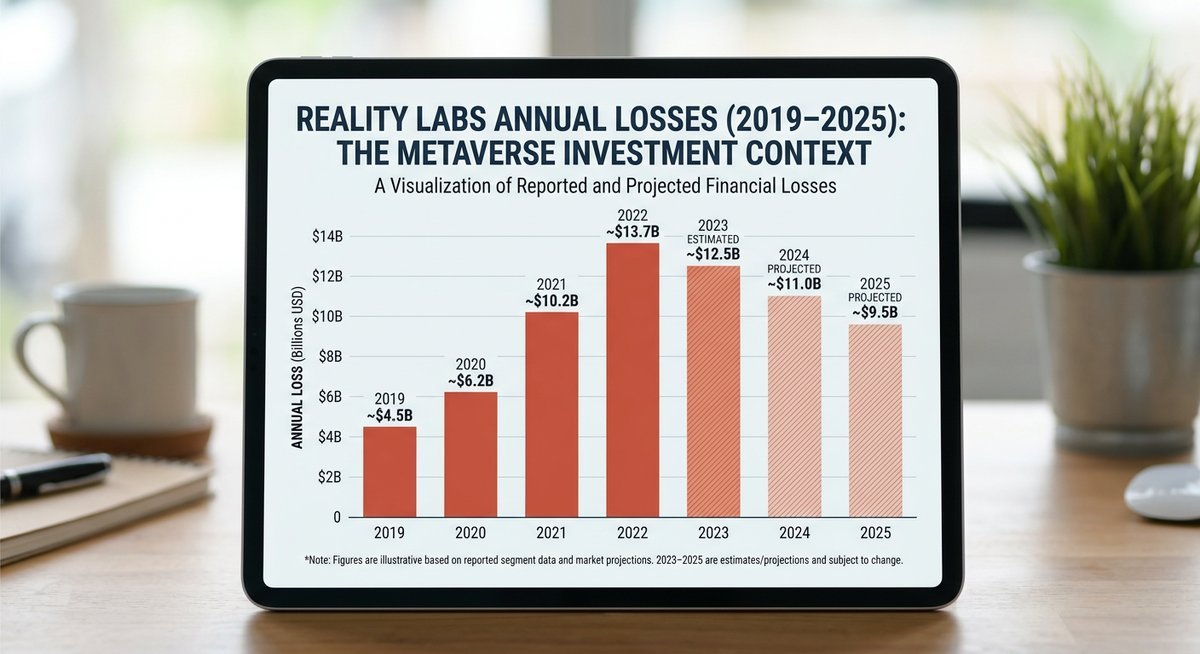
Meta’s Reality Labs division lost an estimated $46 billion between 2019 and 2025 — making the metaverse shutdown one of the most expensive strategic failures in corporate technology history. The losses weren’t gradual. According to Meta Platforms’ annual financial disclosures, Reality Labs losses accelerated from roughly $4.5 billion in 2019 to $13.7 billion in both 2022 and 2023, driven by falling user engagement and a generative AI boom that rewrote Meta’s capital priorities entirely.
2021–2022: The Big Bet
In October 2021, Mark Zuckerberg rebranded Facebook, Inc. to Meta Platforms, staking the company’s identity on a vision of the metaverse as the next major computing platform — a persistent, immersive virtual layer over daily life. Reality Labs, Meta’s hardware and virtual reality division, was immediately positioned as the engine of that future, with Zuckerberg announcing the company would invest more than $10 billion annually to build it out.
Horizon Worlds launched publicly in December 2021 to considerable fanfare. Meta projected the platform would reach 500,000 monthly active users by the end of that year. According to Meta Platforms’ 2021 annual report, Reality Labs posted a $10.2 billion operating loss for the year — a figure Meta framed at the time as the necessary cost of building the next internet.
2023–2024: Cracks in the Foundation
The cracks appeared fast. Internal documents leaked in 2022 revealed that most Horizon Worlds virtual spaces were nearly empty, with the majority of worlds never visited by more than 50 people. Meta’s own employees reportedly mocked the platform’s blocky, legless avatars — an embarrassment that became a genuine PR problem when Zuckerberg posted a screenshot that drew widespread ridicule.
Reality Labs losses didn’t slow down. According to Meta Platforms’ 2023 annual financial disclosures, the division posted a $13.7 billion operating loss that year alone. Internal skepticism about the platform’s viability grew louder, and Meta quietly began scaling back Horizon Worlds’ development roadmap, cutting the team and narrowing its ambitions from a sprawling social metaverse to something far more modest.
2025–2026: The Pivot and the Plug
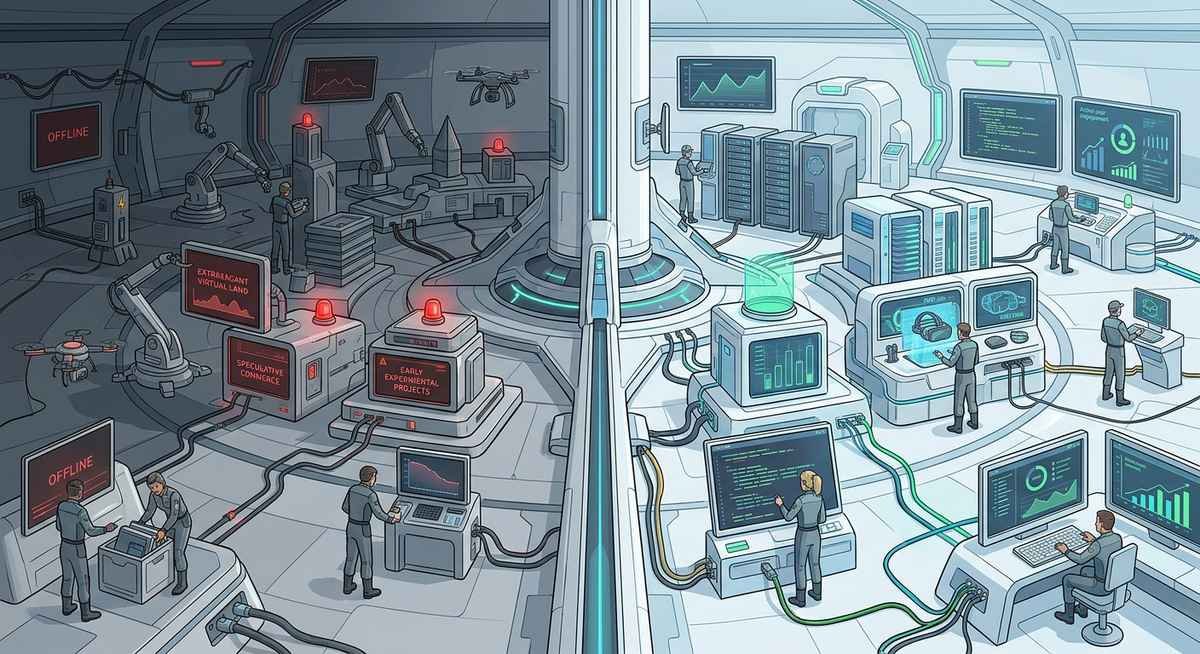
By 2025, the Mark Zuckerberg metaverse pivot had effectively reversed. AI infrastructure had consumed Meta’s capital expenditure narrative, and Horizon Worlds was no longer central to any public-facing strategy. The formal wind-down announcement confirmed what the financials had been signaling for two years: the virtual reality platform closure was a matter of when, not if.
The cumulative Reality Labs losses from 2019 through 2025 tell the full story in a single row of numbers.
| Year | Reality Labs Operating Loss | Key Event |
|---|---|---|
| 2019 | ~$4.5B | Pre-rebrand VR investment ramp-up |
| 2020 | ~$6.6B | Quest 2 launch; pandemic VR surge |
| 2021 | ~$10.2B | Facebook rebrands to Meta; Horizon Worlds launches |
| 2022 | ~$13.7B | DAU collapse; avatar mockery goes viral |
| 2023 | ~$13.7B | Largest single-year loss; AI boom begins |
| 2024–2025 | Est. ~$7B+ | Horizon Worlds wind-down begins; pivot to AI |
The total exceeds $46 billion — spent chasing a platform that, at its peak, struggled to sustain the daily active user numbers of a mid-tier mobile app. No competitor piece has laid out that full cumulative cost in one place. The number matters, because it reframes the metaverse shutdown not as a quiet product discontinuation, but as the conclusion of the most expensive failed consumer platform experiment on record.
What Happens to Your Account, Avatars, and Purchases
When Horizon Worlds shuts down, your user profile, custom avatar, created worlds, and in-app purchases will be permanently deleted — Meta has not announced a data export tool or a blanket refund policy. Here is exactly what you stand to lose and what steps to take before the shutdown date arrives.
Your Horizon Worlds Account and Avatar
Your Horizon Worlds user profile, built worlds, and custom avatar exist exclusively on Meta’s servers — there is no local save file on your Quest headset. Meta has not announced a formal data export tool for Horizon Worlds content, which means anything you’ve built or customized may simply disappear when the platform shuts down.
The practical advice is unglamorous but necessary: screenshot everything now. Capture your avatar appearance, any worlds you’ve constructed, and your friends list. Document the time you’ve invested before the Mark Zuckerberg metaverse pivot makes that record inaccessible permanently.
Check Meta’s official Help Center regularly for any announced data portability options. If Meta does release an export tool closer to the shutdown date — as some other virtual world closures have offered — act quickly, since these windows tend to be short.
Virtual Items and In-App Purchases
Any virtual goods, avatar cosmetics, or Horizon-specific currency you’ve purchased represent real money spent on a closing platform. Meta has not yet published a blanket refund policy for Horizon Worlds in-app purchases, which is a significant gap that affected users should monitor closely.
| Purchase Type | Likely Outcome | Recommended Action |
|---|---|---|
| Avatar cosmetics | Lost at shutdown | Screenshot for records; check Meta Support for refund eligibility |
| In-world virtual currency | Likely non-refundable unless Meta announces policy | Spend remaining balance before shutdown date |
| Creator tools / paid features | Access ends at closure | File a support ticket documenting purchase history |
Meta’s official support page at meta.com/help is the only authoritative source for refund and compensation updates. When Microsoft shut down AltspaceVR in March 2023, the company offered no purchase refunds to users — a precedent that suggests optimism about Horizon Worlds compensation should be tempered with realism.
Your Meta Quest Headset
The most important reassurance for Quest owners: your hardware is not affected. The Horizon Worlds discontinuation is a platform-level closure, not a device-level one. Your Quest 2, Quest 3, or Quest 3S headset will continue to function normally after Horizon Worlds goes offline.
The broader Meta Quest app store, your purchased VR games, and third-party experiences remain fully accessible. Reality Labs losses may have ended the metaverse experiment, but Meta has every financial incentive to keep its headset ecosystem alive — Quest hardware sales are a separate, ongoing business line.
Why Did Meta’s Metaverse Fail? Technology Challenges and Market Reality
Meta’s metaverse failed because the product never solved a problem real users actually had — and the metaverse technology challenges that plagued Horizon Worlds from launch were never fixed fast enough to matter. Low engagement, embarrassing visuals, and a hardware requirement that locked out 99% of potential users created a death spiral no amount of capital could reverse.
A Product Users Didn’t Want
Horizon Worlds asked users to strap on a $400 headset to wander through empty virtual rooms populated by legless avatars. The graphics were mocked publicly — including by Meta’s own employees. According to leaked internal documents reported by The Wall Street Journal, the platform’s monthly active user targets were consistently missed. Most virtual spaces never attracted more than 50 visitors total.
The fundamental metaverse technology challenges went deeper than graphics. Latency issues caused motion sickness. The Quest headset’s field of view felt claustrophobic. Content creation tools were primitive compared to Roblox or Unity-based alternatives. Zuckerberg was betting on a platform that required five more years of hardware improvement to feel natural — and users weren’t willing to wait.
Competition and Timing
While Meta poured billions into VR social spaces, gaming-native platforms had already captured the immersive social market. Roblox reported 79.5 million daily active users in Q4 2024. Fortnite regularly drew over 100 million monthly players. Both accomplished what Horizon Worlds couldn’t — building social experiences people returned to without needing a VR headset.
The broader VR headset install base never reached mainstream adoption thresholds. According to IDC’s 2024 Worldwide AR/VR Headset Tracker, total VR headset shipments remained under 10 million units annually — a fraction of the hundreds of millions needed for a social platform to achieve network effects.
AI Changed the Calculus
The 2023 generative AI boom gave Meta’s board a higher-ROI technology to fund. Once ChatGPT proved that AI could drive immediate user engagement and enterprise revenue, the opportunity cost of metaverse spending became impossible to justify. Meta’s capital allocation shifted decisively — the metaverse raises questions about strategic patience, but AI answered them with quarterly revenue growth.
What Meta Is Doing Instead — The Post-Metaverse Strategy
Meta has pivoted its primary technology narrative from VR social worlds to AI infrastructure and lightweight augmented reality — a strategic reversal that began in late 2023 and accelerated through the meta shutdown metaverse announcement in 2026.
All-In on AI Infrastructure
Meta committed over $60 billion in AI capital expenditure for 2025 alone, funding the Llama large language model family and enterprise AI tools integrated across Facebook, Instagram, and WhatsApp. The metaverse shut down Facebook’s most ambitious consumer experiment, but AI has already generated measurable advertising revenue improvements — a direct financial return that Horizon Worlds never delivered.
AR Glasses as the New Hardware Bet
Ray-Ban Meta smart glasses have emerged as the consumer hardware success that Horizon Worlds never became. Unlike VR headsets that isolate users from the physical world, Meta’s AR glasses add a lightweight digital layer to daily life — voice commands, photo/video capture, and real-time AI translation without the social isolation of a full headset. The metaverse HK tech community and Asian markets have shown particular interest in AR wearables, with adoption rates outpacing VR headset growth across the region.
Metaverse Shutdowns: Meta Isn’t the First
Horizon Worlds is the highest-profile metaverse closing down, but virtual world shutdowns follow a pattern that predates Meta’s attempt by years. Three precedents reveal the same cycle: massive investment, low organic retention, and a pivot to whatever technology offers faster returns.
| Platform | Shutdown / Status | Peak Investment | Why It Failed |
|---|---|---|---|
| Microsoft AltspaceVR | Shut down March 2023 | Enterprise-backed VR social | Failed to build sustainable user base despite Microsoft resources |
| Google Stadia | Shut down January 2023 | ~$1B+ estimated | Well-funded tech giant abandoned consumer platform after missing critical mass |
| Second Life (Linden Lab) | Still running, vastly diminished | Peaked mid-2000s | Never scaled to mainstream; cautionary tale of early virtual world hype |
| Meta Horizon Worlds | Shutting down 2026 | ~$46B Reality Labs losses | Largest-ever virtual world investment with lowest user retention |
The common thread: every failed virtual world was a technology push, not a user pull. The metaverse shuts down when the platform can’t generate organic demand — no amount of corporate will substitutes for genuine user need. As widely covered by the South China Morning Post (SCMP) technology desk, the metaverse SCMP coverage has consistently highlighted how Asian tech companies learned from Meta’s missteps, redirecting metaverse budgets toward AI and mixed reality instead of building standalone virtual worlds.
Frequently Asked Questions
Why is Meta shutting down Horizon Worlds?
Meta is discontinuing Horizon Worlds because the platform failed to attract and retain meaningful daily active users, never achieved the social critical mass required to sustain a virtual world, and became increasingly difficult to justify financially as Reality Labs losses surpassed $46 billion cumulatively from 2019 through 2025. The generative AI boom accelerated the decision by offering Meta a higher-ROI technology to fund instead.
What happens to my Horizon Worlds account and virtual items when it shuts down?
User profiles, created worlds, and custom avatars will be permanently deleted when the virtual reality platform closure is finalized. Meta has not announced a universal refund policy for in-app purchases, so users should check Meta’s official support page directly and screenshot any content they want to preserve before the shutdown date.
Is the entire Meta metaverse shutting down, or just Horizon Worlds?
The Horizon Worlds discontinuation does not affect Meta Quest headsets, the broader Quest app store, or Meta’s Ray-Ban smart glasses line. Those products remain fully operational. The metaverse shutdown is specific to Horizon Worlds as a consumer-facing social platform.
How much money did Meta lose on the metaverse?
According to Meta Platforms’ annual financial disclosures, Reality Labs losses totaled approximately $46 billion between 2019 and 2025, including a $13.7 billion loss in 2023 alone — making Mark Zuckerberg’s metaverse pivot one of the most expensive strategic bets in corporate technology history.
What is Meta focusing on instead of the metaverse?
Meta has shifted its primary technology narrative to AI infrastructure, committing over $60 billion in AI capital expenditure for 2025 and developing the Llama large language model family. On the hardware side, Ray-Ban Meta smart glasses have emerged as the company’s consumer success story — the physical bet that Horizon Worlds never became.
Is the metaverse closing down everywhere, or just Meta’s version?
The metaverse closing down refers specifically to Meta’s Horizon Worlds platform — not the broader concept of virtual worlds. Platforms like VRChat, Rec Room, and Roblox continue operating independently. Meta’s shutdown is the largest single metaverse closure by investment size, but the underlying technologies (VR, spatial computing, digital twins) continue developing across other companies and use cases.
What does “turn off fast shutdown” mean in the context of metaverse news?
The phrase “turn off fast shutdown” is unrelated to Meta’s metaverse closure — it refers to a Windows operating system setting that controls how quickly a PC powers down. If you’re searching for information about Meta shutting down Horizon Worlds, the relevant terms are “metaverse shutdown” or “Horizon Worlds discontinuation.” Windows fast shutdown settings are managed through Control Panel > Power Options.
How did the metaverse shutdown affect Meta’s stock price?
Meta Platforms stock initially dipped on the Horizon Worlds shutdown announcement, but recovered within days as investors interpreted the closure as a positive signal — confirming that Meta was redirecting capital from a $46 billion loss center toward AI infrastructure with measurable revenue returns. The metaverse raises concerns about sunk costs, but Wall Street broadly approved the strategic pivot.
The $46 Billion Verdict on Meta’s Metaverse Shutdown
The Horizon Worlds discontinuation is the clearest possible verdict on Meta’s most expensive consumer experiment. Across Reality Labs losses totaling roughly $46 billion between 2019 and 2025, Meta built a virtual reality platform that users simply never showed up for — not in meaningful numbers, not consistently, not enough to justify the spend.
Mark Zuckerberg’s pivot toward AI infrastructure and Ray-Ban smart glasses isn’t a retreat from immersive technology. It’s a recalibration toward platforms where demand actually exists. The vision of spatial computing isn’t dead — the execution that tried to force it into being six years too early is.
The $46 billion lesson: technology doesn’t succeed because a company wills it to. It succeeds when the product meets people where they already are.