
A cancer diagnosis in the United States costs the average patient between $21,000 and $36,000 in out-of-pocket expenses during the first year of treatment alone, according to the American Cancer Society. That figure exists on top of whatever your health insurance covers — and it does not include lost wages, childcare costs, or the mortgage payments that keep coming while you recover. Critical illness insurance pays a lump-sum benefit directly to you upon diagnosis of a covered condition, with zero restrictions on how the money gets spent.

is critical illness insurance worth it — financial protection gap analysis for serious illness diagnosis
Whether that policy is worth buying depends on three things: the size of your existing financial safety net, the quality of your health and disability coverage, and how much the premium actually costs relative to what you stand to receive. The answer shifts dramatically based on whether you are enrolling through an employer group plan at $15 a month or buying an individual policy at $80.
What Is Critical Illness Insurance and What Does It Cover?
Critical illness insurance is a supplemental policy that pays a one-time, fixed cash benefit — typically $5,000 to $100,000 — directly to the policyholder when a covered diagnosis is confirmed, regardless of actual medical costs incurred. The benefit goes into your bank account, not to a hospital or provider, and you decide how to use it.

How the Lump-Sum Benefit Works
Unlike health insurance, which reimburses providers for specific treatments, critical illness insurance delivers a single cash payment once the insurer verifies a qualifying diagnosis. No itemized receipts. No pre-authorization. The money covers whatever your situation demands — mortgage payments, groceries, travel to a specialist, or the income you lost during recovery.
Most policies are structured as a one-time payment per covered condition. Some insurers offer multi-event policies allowing subsequent claims for different conditions, though premiums for those plans run higher. A standard survival or waiting period of 14 to 30 days post-diagnosis typically applies before the benefit is released.
Covered Conditions and Common Exclusions
The core conditions covered by virtually every policy include invasive cancer, heart attack, stroke, major organ transplant, coronary artery bypass surgery, and end-stage kidney failure. Many plans extend coverage to multiple sclerosis, paralysis, severe burns, and blindness — but the specifics vary dramatically by insurer and plan tier.
Not all cancers qualify. Early-stage cancers and most non-melanoma skin cancers — basal cell and squamous cell carcinoma — are routinely excluded. Does critical illness insurance pay out for skin cancer? Usually not for the common types, though melanoma meeting a defined staging threshold may qualify depending on policy language. Pre-existing conditions are almost universally excluded.
One persistent source of confusion: critical illness insurance is not the same as trauma insurance. Trauma insurance, more common in Australia and New Zealand, typically covers a broader range of severity levels and medical events. Critical illness policies in North America and the UK apply stricter clinical definitions for each covered condition.
How Much Does Critical Illness Insurance Cost?
Monthly premiums generally run between $15 and $100 or more, depending on age, benefit amount, health status, and whether you are buying individually or through an employer group plan. According to the American Association for Critical Illness Insurance (2024), age is the single largest premium driver — costs can more than double between ages 40 and 55 for identical benefit amounts.
| Coverage Type | Typical Monthly Premium | Benefit Range |
|---|---|---|
| Employer group plan (voluntary) | $10–$40 | $5,000–$30,000 |
| Individual policy (age 30–45) | $25–$65 | $10,000–$100,000 |
| Individual policy (age 50+) | $60–$150+ | $10,000–$100,000 |
Group plans offered through employers are almost always cheaper per dollar of benefit than individual policies, thanks to pooled risk pricing. Some employers subsidize a base benefit, but fully employer-paid plans are uncommon — most workplace critical illness offerings are voluntary, meaning you fund the premium through payroll deduction.
Is Critical Illness Insurance Worth It? Scenarios Where It Makes Sense
Critical illness insurance is worth buying when the gap between what your health plan covers and what a serious diagnosis actually costs — in lost income, depleted savings, and non-medical expenses — is large enough to cause lasting financial damage. For people with strong emergency funds and robust disability coverage, the math often flips the other way.
Worth It If…
- You carry a high-deductible health plan with thin savings. The average individual HDHP deductible exceeds $1,600, and family deductibles routinely hit $3,000–$8,000, per Kaiser Family Foundation (2024) employer benefits data. A critical illness payout covers that exposure on day one of a diagnosis.
- You have a personal or family history of cancer, heart disease, or stroke. These three conditions account for the majority of critical illness claims. Elevated statistical risk makes the premium-to-payout ratio far more favorable.
- Your emergency fund covers less than three months of expenses. Cancer treatment can sideline someone for months. Without income replacement, savings evaporate fast. The lump-sum benefit acts as a financial bridge.
- Your employer offers group coverage at low cost. When premiums drop to $10–$20 per month for $15,000–$25,000 in coverage, the cost-benefit math rarely argues against enrolling.
- You are self-employed without employer-sponsored disability coverage. No group short-term disability plan means any income interruption comes entirely out of pocket.
Not Worth It If…
Consumer Reports has noted that some critical illness policies collect far more in premiums than they pay out in claims — largely because exclusions and narrow covered-conditions lists reduce the realistic probability of a qualifying payout.
- You have six or more months of liquid savings and a low-deductible plan. Your existing financial cushion already absorbs what the policy is designed to cover.
- You carry strong long-term disability insurance. A 60–70% income replacement policy already addresses the primary risk. A critical illness lump sum adds marginal value in that scenario.
- The covered conditions list is narrow and exclusions are extensive. A policy that excludes early-stage cancers, non-invasive tumors, and common cardiac events is unlikely to pay when you need it most.
- You are young, healthy, with no family risk factors, and the premium strains your budget. That $40–$60 per month may do more work inside an HSA or emergency fund than in a policy with low statistical payout probability at your current life stage.
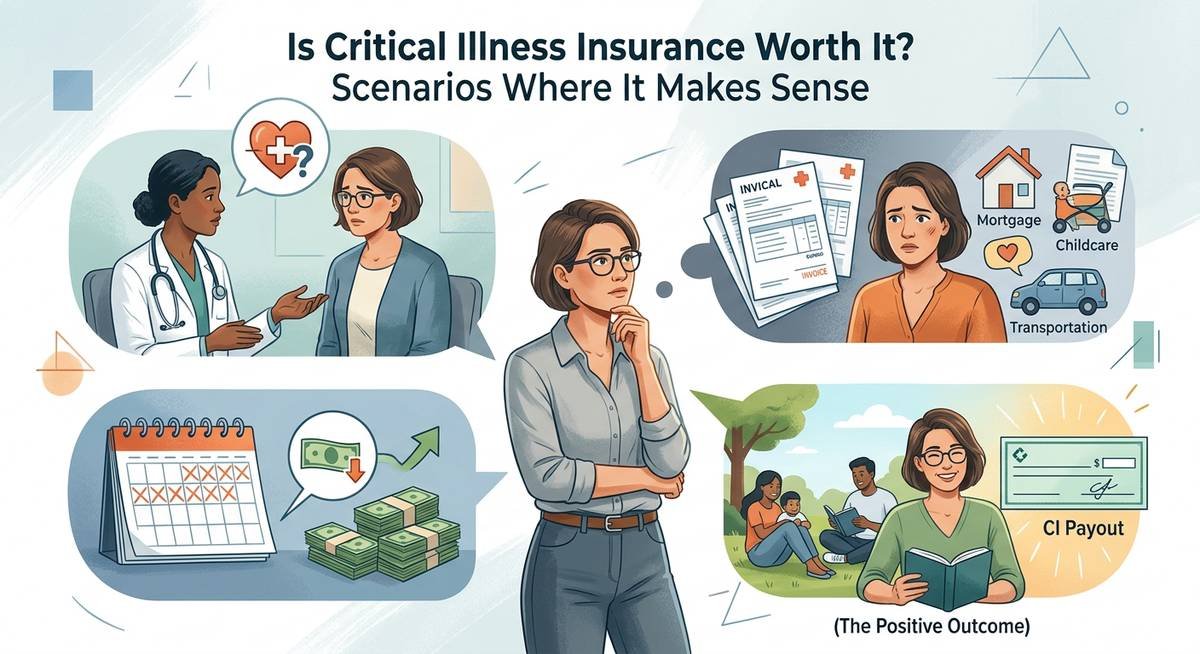
Is Critical Illness Insurance Worth It If You Already Have Health Insurance?
Health insurance pays providers for medical treatment. It does not write you a check for your mortgage, your groceries, or the three months of income you lost while recovering from a stroke. Critical illness insurance solves a different problem entirely — the lump-sum benefit goes to you, unrestricted, to cover whatever financial reality your recovery demands.
One pays your oncologist. The other keeps the lights on while you are too sick to work. They are complementary, not redundant.
| Your Situation | Verdict | Reason |
|---|---|---|
| HDHP + savings under 3 months | Worth it | High out-of-pocket exposure, no income buffer |
| Family history of cancer or heart disease | Worth it | Elevated risk justifies premium cost |
| Employer-subsidized group plan | Worth it | Low premium significantly lowers the break-even threshold |
| Self-employed, no disability coverage | Worth it | No group income protection; lump sum fills critical gap |
| 6+ months savings + low-deductible plan | Less compelling | Existing resources cover what the policy would pay |
| Strong long-term disability in place | Lower priority | Income replacement already covered |
| Narrow policy with extensive exclusions | Not worth it | Low realistic payout probability relative to premium |
Employer Plans, Voluntary Coverage, and Special Situations
Employer-offered group critical illness insurance costs 30–50% less per dollar of benefit than comparable individual policies, making the workplace enrollment window the single most cost-effective entry point for this coverage. The evaluation still depends on what the specific plan covers and how much the employer subsidizes.
Is Critical Illness Insurance Worth It Through Your Employer?
Group critical illness plans offered during open enrollment benefit from pooled risk pricing that individual applicants cannot access. A voluntary employee critical illness plan might charge $15–$25 per month for $20,000 in coverage — the same benefit purchased individually could run $40–$60 depending on age and health status.
Before enrolling, evaluate three things: the covered conditions list (not the marketing brochure — the actual schedule of conditions), the benefit amount relative to your deductible and emergency fund gap, and whether the premium is employer-subsidized or entirely employee-paid. Optional critical illness insurance through an employer is almost always worth considering when the premium is low and your existing coverage leaves gaps. Supplemental and voluntary group plans follow the same logic — cost matters more than the label.
Is Critical Illness Insurance Worth It for Kids?
Some employer and individual plans offer dependent or child riders. Childhood critical illness — particularly childhood cancers and congenital conditions — creates severe financial hardship for parents who must take unpaid leave to provide care. The National Cancer Institute reports that approximately 15,000 children under age 19 are diagnosed with cancer annually in the United States.
Child rider premiums are typically low, often $5–$10 per month, while the financial disruption of a childhood diagnosis can be catastrophic. At that price point, a child rider is one of the higher-value add-ons available on most critical illness policies.
UK, Canada, and Regional Considerations
In the United Kingdom, financial journalist Martin Lewis of MoneySavingExpert generally recommends critical illness cover for anyone with dependents or a mortgage — particularly when bundled with life insurance to reduce cost. Mortgage critical illness cover protects against the specific risk of losing your home during treatment or recovery.
In Canada, critical illness insurance is widely available as individual standalone policies. Premiums may be tax-deductible for self-employed individuals or business owners under certain Canada Revenue Agency (CRA) rules, though eligibility depends on how the policy is structured. The Canadian market tends to offer broader covered conditions lists than comparable U.S. plans.
In Singapore and Hong Kong, critical illness coverage is often bundled with life insurance products. Standalone critical illness plans exist but pricing and coverage vary significantly across insurers — comparison shopping is essential in both markets.
Tax Treatment of Critical Illness Insurance — Premiums and Payouts
Whether your critical illness insurance payout is taxable depends almost entirely on who paid the premiums and how they were paid — a distinction that can mean thousands of dollars in after-tax value on a $25,000 benefit. The rules differ between the United States, Canada, and the United Kingdom.
Are Critical Illness Insurance Premiums Pre-Tax or Post-Tax?
Employee-paid critical illness premiums are typically deducted on a post-tax basis unless your employer has established a Section 125 cafeteria plan that explicitly includes critical illness coverage. Most voluntary group plans do not qualify for pre-tax treatment automatically — confirm with your HR or benefits administrator during open enrollment.
For self-employed individuals, critical illness insurance premiums are generally not deductible as a business expense under current IRS rules, unlike health insurance premiums which qualify for the self-employed health insurance deduction. The IRS Publication 525 provides the definitive guidance on accident and health benefit taxation.
Is the Critical Illness Insurance Payout Taxable?
If you paid premiums with after-tax dollars — the default for most employee-paid voluntary plans — the lump-sum benefit is generally tax-free under IRS rules. That turns a $25,000 payout into $25,000 you actually keep, not a pre-tax figure reduced by your marginal rate.
If your employer paid the premiums without including them in your taxable wages, the payout may be taxable as income. This is the critical distinction — who paid and how it was reported determines the tax treatment of the benefit.
| Scenario | Premiums Paid By | Payout Taxable? |
|---|---|---|
| Employee pays post-tax (most common) | Employee, after-tax dollars | Generally tax-free |
| Employer pays, included in W-2 | Employer, reported as income | Generally tax-free |
| Employer pays, NOT on W-2 | Employer, not reported | Potentially taxable |
| Pre-tax via Section 125 plan | Employee, pre-tax dollars | Potentially taxable |
In Canada, critical illness insurance payouts are generally tax-free regardless of who paid the premiums, according to Canada Revenue Agency guidelines. Premiums paid by a business owner for personal coverage may be deductible as a business expense in some provinces — consult a Canadian tax professional for specific eligibility. In the United Kingdom, employer-paid critical illness premiums are typically treated as a benefit in kind, and the payout itself is usually tax-free to the policyholder.
ERISA, COBRA, and Portability
Most employer-sponsored voluntary critical illness plans are governed by the Employee Retirement Income Security Act (ERISA), which establishes minimum standards for plan administration and claims procedures. Before leaving an employer, verify three things about your group critical illness policy:
- COBRA eligibility — Some group plans qualify for COBRA continuation coverage, allowing you to maintain the policy for up to 18 months after leaving. This varies by plan design; ask HR before assuming access.
- Portability provisions — Many individual policies and some group plans let you keep coverage when changing jobs, typically at the same or slightly higher premium.
- Expiration terms — Most policies remain in force as long as premiums are paid, with no fixed expiration date. Some term policies do expire after a set period. Critical illness policies do not roll over unused benefits — if you never file a claim, the premiums are gone.
Critical Illness Insurance vs. Alternatives — What Else Should You Consider?
Critical illness insurance fills a specific niche in a financial safety net — but it is not the only tool available, and for some people, other products deliver more value per dollar spent. Understanding where critical illness coverage fits relative to disability insurance, HSAs, and life insurance riders prevents both over-insuring and leaving real gaps unprotected.
Critical Illness Insurance vs. Disability Insurance
Long-term disability insurance replaces a percentage of your income — typically 60–70% — if you cannot work due to illness or injury. Critical illness insurance pays a one-time lump sum upon diagnosis regardless of whether you can still work. They solve different problems, and understanding the distinction matters for building the right safety net.
| Feature | Critical Illness Insurance | Disability Insurance |
|---|---|---|
| Trigger | Diagnosis of covered condition | Inability to work |
| Payment structure | One-time lump sum | Monthly income replacement (60–70%) |
| Usage restrictions | None — spend however needed | Replaces income only |
| Covers non-medical expenses | Yes | Indirectly, through income replacement |
| Pays if you can still work | Yes | No |
For most people, long-term disability insurance should come first as the foundation of income protection. Financial commentator Dave Ramsey has consistently recommended prioritizing disability coverage over critical illness policies, and the math supports that position — disability insurance addresses the broadest range of income-disruption scenarios. Critical illness insurance is not the same as long-term disability or short-term disability — it is a separate, complementary product.
Critical Illness Rider vs. Standalone Policy
Critical illness coverage can sometimes be added as a rider to a life insurance policy at lower cost than a standalone plan. The trade-off: riders typically have narrower covered conditions lists and lower maximum benefit amounts. For people who already carry or are shopping for life insurance, a critical illness rider bundles both protections under a single premium.
Accident insurance and critical illness insurance are complementary, not interchangeable. Accident insurance covers injury-related events (falls, car accidents, sports injuries), while critical illness insurance covers disease diagnoses. Some employer plans bundle both under a single supplemental benefits enrollment — evaluate each component on its own merits.
Frequently Asked Questions
What do Reddit users say about critical illness insurance?
Discussions on r/personalfinance and r/insurance consistently highlight three themes: employer group plans at low premiums are generally considered worthwhile, standalone policies with narrow coverage lists draw skepticism, and most commenters recommend prioritizing disability insurance and emergency savings before adding critical illness coverage. The consensus skews toward “worth it only if the premium is low and your other coverage has gaps.”
Is critical illness insurance worth it from Aflac, MetLife, Guardian, or other specific providers?
Provider quality depends on the covered conditions list, premium cost for your age bracket, claims processing reputation, and benefit amount options — not the brand name alone. Aflac and MetLife are among the largest supplemental insurance carriers in the U.S. employer market. Guardian, Unum, Voya, and Sun Life each offer competitive group plans with varying covered conditions schedules. Compare the actual policy documents side by side rather than relying on marketing materials.
Is critical illness insurance halal or haram?
Islamic scholars hold differing opinions on conventional insurance products. Some consider standard critical illness insurance permissible because it provides financial protection against genuine hardship, while others view the premium-for-uncertain-benefit structure as containing elements of gharar (uncertainty) that conflict with Islamic finance principles. Takaful-compliant alternatives — cooperative risk-sharing arrangements that comply with Sharia law — exist in several markets including Malaysia, the UAE, and the United Kingdom.
Does critical illness insurance pay out on death?
Standard critical illness policies do not pay a death benefit — they pay upon diagnosis of a covered condition while the policyholder is alive. Some policies include a return-of-premium death benefit rider that refunds premiums paid if the policyholder dies without ever filing a claim, but this rider increases costs and is not standard. Life insurance is the appropriate product for death benefit protection.
Is critical illness insurance necessary or optional?
Critical illness insurance is not mandatory — no law or employer requires you to carry it. Whether it is necessary depends on your financial vulnerability to a serious diagnosis. Someone with robust savings, comprehensive health insurance, and strong disability coverage may not need it. Someone on a high-deductible plan with minimal savings faces a genuinely different risk equation.
How much do you get with critical illness insurance?
Benefit amounts typically range from $5,000 to $100,000, selected at enrollment. Employer group plans commonly cap at $20,000–$30,000, while individual policies may offer up to $100,000 or more. The full elected benefit amount is paid as a single lump sum upon qualifying diagnosis — there is no partial payment based on treatment cost.
Is critical illness insurance recommended by financial experts?
Recommendations vary. Consumer Reports has questioned whether many policies deliver value relative to premiums collected. Dave Ramsey recommends prioritizing disability insurance over critical illness coverage. Martin Lewis in the UK recommends it for mortgage holders and people with dependents. The National Association of Insurance Commissioners (NAIC) advises consumers to evaluate critical illness insurance as part of a broader financial protection strategy rather than in isolation.
Is $16 a month worth it for $30,000 in critical illness coverage?
At $16 per month ($192 annually), a $30,000 benefit represents a roughly 156:1 benefit-to-annual-premium ratio. If your financial situation includes a high-deductible health plan, limited emergency savings, or elevated family health risk, that premium level is generally favorable. Over five years of premiums ($960 total), the break-even point remains well below the benefit amount — making this a reasonable value proposition for people with genuine coverage gaps.
Conclusion
Critical illness insurance is worth it for people with real coverage gaps — specifically those carrying high-deductible health plans, limited emergency savings, elevated family health risk, or access to an employer-subsidized group plan where premiums are minimal. For someone with robust long-term disability coverage and six months of liquid savings already in place, a standalone policy may genuinely duplicate protection they already own.
The tax angle matters. When you pay premiums with after-tax dollars — the default for most voluntary payroll plans — the lump-sum benefit is generally tax-free under IRS rules. That distinction turns a $25,000 payout into $25,000 you actually keep.
Before deciding, answer three questions: What is your current plan deductible? How many months of expenses could you cover if you stopped working tomorrow? Does your employer subsidize the premium? Those answers will tell you more than any general recommendation ever could.
You Might Also Like...
 Mastering Your Property Tax Appeal: Essential Tips for Success
 MyGreenBucks Kenneth Jones: The Complete Guide to Smart Money, Financial Freedom, and Sustainable Wealth Building
 Is CarShield Worth It? A Brutally Honest 2026 Review
 John Radford’s Net Worth: From a £1 Football Club to a £184 Million Empire
