Best overall: Camsurf | Safest moderation: Emerald Chat | Best cross-platform: OmeTV | Best for teens: Yubo | Closest to Minichat: Holla | Best for language practice: Azar | Best new entrant: Chathub
Minichat’s coin system walls off basic features within minutes of signing up, its moderation swings between absent and arbitrary, and unexplained account bans have become a running complaint across app store reviews. The app still works for fast 1-on-1 random video matching, but the experience has pushed a growing number of users toward alternatives that handle safety, pricing, and platform access with more transparency.

minichat alternatives — top random video chat apps compared for safety and features in 2026
Ten platforms made the cut here. Each was evaluated on four criteria: content moderation strength, free-tier value versus paywall tactics, device support (Android, iOS, web), and use-case fit. Community feedback from Reddit and X factored into every assessment — real users flagging real problems carries more weight than marketing copy.
Why Users Are Switching Away From Minichat
Three issues drive most departures: a coin-based economy that monetizes basic access, inconsistent moderation that fails to catch explicit content, and regional availability gaps that lock out users in certain countries entirely.
Multiple users on X have reported difficulty even accessing the app. Posts from March 2026 include questions like “How do I use mini chat in the U.S.?” and “Como que consigo usar o Minichat?” — suggesting the platform faces distribution or geo-restriction problems that go unacknowledged in its official documentation.
“Many such apps are free, which promotes bad behavior, spam, and bot activity.”
— @Yellow (Yello founder), X, March 2026 (370 likes)
That observation captures the core problem. Minichat’s free model lacks the revenue stream needed to fund serious moderation infrastructure. The result is a platform where unexplained bans frustrate legitimate users while bad actors operate with minimal friction. Safety-conscious users — and parents checking on what their teens are downloading — have good reason to look elsewhere.
What Makes a Good Minichat Alternative
The right replacement depends on four filters: moderation quality, cost transparency, device coverage, and whether the platform requires account creation. Most comparison articles skip the first filter almost entirely — a serious oversight for any app category where strangers connect via live video.

| Filter | What to Check | Why It Matters |
|---|---|---|
| Safety | AI nudity detection, human moderators, age verification, reporting tools | Platforms with at least two safety layers show measurably fewer incidents |
| Cost | Genuinely free vs. coin/token paywall vs. subscription | Some apps advertise “free” but gate basic features behind in-app currency |
| Platform | Android, iOS, web browser support | Web-only apps lock out mobile users; app-only platforms exclude desktop |
| Anonymity | No sign-up vs. email/phone required | Lower friction means faster access but weaker identity verification |
The National Center for Missing & Exploited Children (NCMEC) publishes specific guidance on random video chat risks. Their NetSmartz program flags platforms that lack age verification and automated content scanning as higher-risk environments — a standard worth applying to every app on this list.
The 10 Best Minichat Alternatives Compared
Camsurf leads for overall safety and free access. OmeTV wins on cross-platform coverage. Emerald Chat dominates anonymous web-based chatting. The remaining seven each serve a distinct niche — from Yubo’s teen-focused social networking to Azar’s language-learning matching.
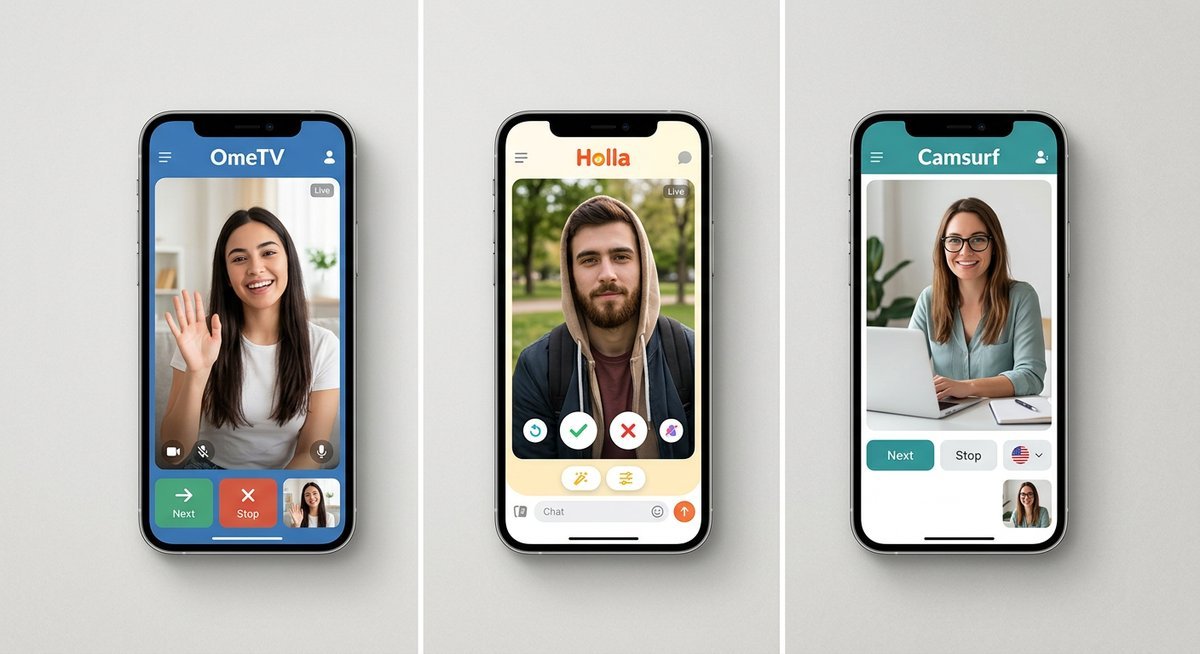
1. Camsurf — Best Free and Safe All-Around Pick
Camsurf combines AI content detection with human moderators in a dual-layer system that outperforms single-method platforms. Violations trigger immediate bans rather than warnings — a stricter enforcement posture than Minichat or most competitors.
No account is needed. Video chat is unlimited and genuinely free. A language filter narrows matches by preferred language — a feature most competitors charge for. Camsurf runs on Android, iOS, and web browser, making it one of only three apps on this list with full cross-platform coverage. For a deeper look at the platform, the Camsurf review on this site covers features, safety, and setup in detail.
Platforms: Android, iOS, Web | Cost: Free (unlimited) | Sign-up: No | Best for: Users who want zero friction and credible moderation
2. OmeTV — Best for Mobile-First Users
OmeTV is the most widely available Minichat alternative, running on Android, iOS, and web simultaneously with built-in translation covering 40+ languages. Connection times average under five seconds. The platform claims “hundreds of thousands” of concurrent users during peak hours.
A gender filter sits behind a paid subscription. The free tier is functional and unlimited but shows ads. Moderation relies primarily on user reports rather than automated AI scanning — worth factoring in if proactive safety matters to you. OmeTV also offers a “Couple” mode and country selection filter, features absent from Minichat entirely.
Platforms: Android, iOS, Web | Cost: Free (gender filter paid) | Sign-up: No | Best for: Cross-device users who want the largest active user base
3. Emerald Chat — Best Anonymous Web-Based Option
Emerald Chat markets itself explicitly as “the new Omegle alternative” and backs it up with interest-based matching, a karma reputation system, and real-time moderation bots. Users are matched by shared interest tags rather than pure random pairing, which improves conversation quality over unfiltered matching.
The platform claims 24/7 AI plus human moderation and a “Bot Free” environment. No account is required — open a browser, enable the webcam, and start. The trade-off: Emerald Chat is web-only with no mobile app, which eliminates it for phone-first users.
Platforms: Web only | Cost: Free | Sign-up: No | Best for: Anonymous, interest-matched chatting on desktop
4. Holla — Closest Feature Match to Minichat
Holla replicates Minichat’s swipe-to-match video format more closely than any other app here. The UX revolves around fast, high-volume live video matching — swipe, connect, skip — with the same kinetic energy that made Minichat popular among younger users.
Available on iOS and Android. A coin-based system gates premium features like gender and location filters. An active moderation team reviews reports, though enforcement consistency has drawn criticism from some users. For anyone who specifically misses Minichat’s fast-match feel, Holla is the most structurally similar substitute.
Platforms: iOS, Android | Cost: Freemium (coin-based) | Sign-up: Optional | Best for: Users who want Minichat’s swipe-match format
5. Chatroulette — Best for Desktop Browser Users
Chatroulette launched the random video chat category in 2009 and has since rebuilt its moderation infrastructure around a proprietary AI nudity filter that scans every video stream automatically. No user action required — the system intervenes in real time.
Web-only with no app. No account needed. Completely free. The trade-off is a smaller active user base compared to OmeTV or Holla, which means longer wait times during off-peak hours in some regions. For desktop users who want spontaneous video chat without installing anything or surrendering personal data, Chatroulette remains the default.
Platforms: Web only | Cost: Free | Sign-up: No | Best for: Desktop users who prioritize automated safety filters
6. Monkey — Safest Option for Younger Users (With Caveats)
Monkey uses a 15-second timed match format and mandatory account creation to build a minimal identity layer that most stranger chat apps lack entirely. The platform targets the 17-24 demographic and has made more visible attempts at age verification than competitors.
iOS is Monkey’s primary platform with the most consistent updates. An Android version exists but historically receives slower feature rollouts. Parents should know: no random video chat app eliminates risk completely. Monkey’s age gates are not foolproof. Among teen-oriented options, though, its moderation policies and reporting tools are more developed than most.
Platforms: iOS (primary), Android | Cost: Free (in-app purchases) | Sign-up: Required | Best for: Younger users who want some identity verification
7. Yubo — Best for Teens Who Want a Social Network, Not Just Chat
Yubo is a social discovery platform for teens and young adults that includes live video streaming alongside traditional profiles and messaging. Unlike pure random chat apps, Yubo separates users into age-verified groups (13-17 and 18+) and uses Yoti age estimation technology to enforce the split.
The platform operates more like a social network than a stranger chat service. Users build profiles, join communities, and go live to rooms rather than being matched 1-on-1 with strangers. For teens who want video interaction without the anything-goes atmosphere of Minichat, Yubo is the most structured and safety-focused environment available.
Platforms: iOS, Android | Cost: Free (premium boosts available) | Sign-up: Required (age verification) | Best for: Teens wanting social discovery with safety guardrails
8. Azar — Best for Language Learning and Cultural Exchange
Azar pairs random video chat with a real-time translation feature that covers 100+ languages — a combination no other app on this list offers. The matching algorithm accounts for language preferences, making it genuinely useful for language practice rather than just random pairing.
Available on iOS and Android with strong adoption across Asia, the Middle East, and South America. Azar uses a coin-based economy for premium filters. The app carries a 4.0+ rating on both app stores with millions of reviews. Photo verification is available, adding an identity layer absent from most competitors.
Platforms: iOS, Android | Cost: Freemium (coin-based) | Sign-up: Required | Best for: Language learners and cross-cultural connection
9. Chathub — Best Emerging Alternative
Chathub positions itself as a direct Omegle and Minichat replacement with gender and location filters, webcam-based matching, and both video and text chat modes. The platform supports four connection types: 1-on-1 video, 1-on-1 text, group video, and group text.
Web-based with no app required. A free tier covers basic matching, while premium unlocks gender filters and ad removal. Chathub is newer to the space and has a smaller user base than OmeTV or Chatroulette, but its feature set is more comprehensive than most web-only platforms.
Platforms: Web only | Cost: Freemium | Sign-up: No | Best for: Users who want multiple chat modes (video, text, group) in one platform
10. Badoo — Best for Users Who Want More Than Random Chat
Badoo is a full dating and social discovery platform with 100M+ downloads on Google Play alone. It includes video chat functionality alongside traditional matching, profiles, and messaging. Photo verification technology and an anti-fraud system add identity layers that pure random chat apps simply do not have.
Operating since 2006 across 40+ languages, Badoo is the most established platform on this list by a wide margin. The trade-off: it is not a random stranger chat app in the Minichat mold. Users looking for quick anonymous video matching will find Badoo’s profile-based approach slower. But for anyone who wants video chat within a moderated social platform with real identity verification, Badoo is the most mature option available.
Platforms: iOS, Android, Web | Cost: Freemium | Sign-up: Required (photo verification available) | Best for: Users who want video chat within a full social/dating platform
Side-by-Side Comparison Table
Ten platforms, six decision filters. Use this table to shortlist the right random video chat app based on your device, budget, and safety priorities.
| Platform | Available On | Cost | Sign-Up | Key Safety Feature | Best For |
|---|---|---|---|---|---|
| Camsurf | Android, iOS, Web | Free (unlimited) | No | AI + human moderation | Free, safe all-around use |
| OmeTV | Android, iOS, Web | Free (filters paid) | No | Report system, translation | Mobile-first, largest user base |
| Emerald Chat | Web only | Free | No | Interest matching + karma system | Anonymous web-based chatting |
| Holla | iOS, Android | Freemium (coins) | Optional | Active moderation team | Minichat-style fast matching |
| Chatroulette | Web only | Free | No | AI nudity filter (proprietary) | Desktop browser users |
| Monkey | iOS, Android | Free (IAP) | Yes | Age verification + reporting | Younger users (17-24) |
| Yubo | iOS, Android | Free (boosts paid) | Yes (age-verified) | Yoti age estimation, age-split groups | Teens wanting social discovery |
| Azar | iOS, Android | Freemium (coins) | Yes | Photo verification available | Language learning, cultural exchange |
| Chathub | Web only | Freemium | No | Gender/location filters | Multi-mode chat (video+text+group) |
| Badoo | iOS, Android, Web | Freemium | Yes (photo-verified) | Anti-fraud system, photo verification | Video chat within full social platform |
Safety Reality Check: What No Random Video Chat App Tells You
Every platform on this list markets itself as safe. The reality is more nuanced. Random video chat apps carry inherent risks that no amount of AI filtering completely eliminates — and one risk in particular deserves direct attention.
Sextortion — where a stranger records a video call and uses the footage as blackmail leverage — has been reported across multiple random chat platforms. NCMEC’s CyberTipline received a record number of sextortion reports in recent years, and community discussions on Reddit’s r/Sextortion reference Minichat by name as one of the platforms involved.
“How do you handle underage safety on the platform?”
— First question asked on r/startup_resources, March 2026 (187 upvotes) — a subreddit for startup founders sharing early-stage product feedback
That question is the first thing the community asks about any new video chat platform. And the fact that it needs asking tells you something about the state of the category.
Practical safety steps that apply regardless of which app you choose: never share personal information on camera, avoid showing identifiable backgrounds (school logos, street signs, workplace badges), and report suspicious behavior immediately. For parents, the Minichat complete guide covers the platform’s specific safety features and limitations in detail. The same age-policy pressure is now reshaping AI chat as well: see how Character.AI ended up banning under-18 users outright in our guide to apps like Character AI.
The Omegle Shutdown and Why It Matters
Omegle — the platform that invented random video chat in 2009 — shut down permanently in November 2023. Founder Leif K-Brooks cited financial unsustainability and psychological toll, driven largely by persistent child safety litigation. The closure displaced millions of users and created the demand wave that every app on this list is riding.
The lesson from Omegle’s collapse: platforms that treat moderation as an afterthought eventually face existential consequences. When evaluating any Minichat alternative, the strength of its safety infrastructure is not just a feature — it is a signal of long-term viability.
Frequently Asked Questions About Minichat Alternatives
What is the best free alternative to Minichat?
Camsurf is the strongest fully free option — no subscription, no account required, unlimited 1-on-1 video chat across Android, iOS, and web. Emerald Chat and Chatroulette are also completely free but limited to web browsers.
Is there a Minichat alternative that is actually safer?
Camsurf and Chatroulette both use automated AI content filters that run on every session by default, compared to Minichat’s reactive moderation model. Yubo goes further with Yoti age estimation technology and separated age groups. No stranger chat platform eliminates risk entirely.
Minichat vs OmeTV: which is better?
OmeTV offers broader platform coverage (Android, iOS, and web versus Minichat’s mobile-only focus), built-in translation for 40+ languages, and a larger concurrent user base. Minichat’s coin system gates features that OmeTV keeps free. For most users, OmeTV is the more capable platform.
Are there Minichat-like apps that work on both iOS and Android?
Camsurf, OmeTV, Holla, Monkey, Yubo, Azar, and Badoo all support both iOS and Android. Camsurf and OmeTV also add web browser access. Emerald Chat, Chatroulette, and Chathub are web-only.
What is the best Minichat replacement for language learning?
Azar is the clear choice, with real-time translation covering 100+ languages and a matching algorithm that accounts for language preferences. OmeTV also offers built-in translation. Dedicated language exchange apps like Tandem and HelloTalk pair learners more precisely but do not offer random video matching.
Is Minichat the same as Omegle?
No. Minichat is a separate app developed independently from Omegle. Both offered random video chat with strangers, but Omegle was web-based and shut down in November 2023. Minichat remains operational as a mobile-focused app with its own coin-based economy and feature set.
What are the most common Minichat complaints?
Three complaints dominate app store reviews and community discussions: the coin system that paywalls basic features, unexplained account bans with no appeal process, and moderation that fails to prevent explicit content. Regional availability issues have also surfaced, with users in several countries reporting that Minichat is not available on their app stores.
Which Minichat alternatives work without creating an account?
Camsurf, Emerald Chat, Chatroulette, OmeTV, and Chathub all allow instant video chat with no sign-up. Holla makes registration optional. Monkey, Yubo, Azar, and Badoo require account creation — the trade-off being stronger identity verification.
Is there a safe random video chat app for teenagers?
Yubo is the only platform on this list specifically designed for teens, with age-verified groups separating 13-17 and 18+ users via Yoti age estimation. Monkey targets the 17-24 range with mandatory accounts. Parents should review the NCMEC NetSmartz resources on video chat safety regardless of which platform a teen uses.
Choosing the Right Minichat Alternative
The right pick depends on what drove you away from Minichat in the first place. Frustrated by the coin paywall? Camsurf and Emerald Chat cost nothing. Concerned about safety? Yubo’s age verification and Chatroulette’s AI nudity filter set the standard. Need an app that works across phone, tablet, and laptop? Camsurf, OmeTV, and Badoo cover all three.
Holla is the most direct Minichat substitute — same swipe format, same mobile-first feel. Azar carves out a unique niche with real-time translation for language learners. Badoo suits users who want video chat embedded in a broader social platform with real identity verification.
Most of these platforms are free to start. Test two or three against your specific priorities — safety, cost, device, anonymity — and the right fit will surface faster than reading another comparison article.
For more on Minichat itself — including how to log in and download options across devices — the dedicated guides on this site cover each topic in full. A broader list of Omegle alternatives is available for users exploring beyond the Minichat-specific replacements covered here.