Few words carry as much weight in as many different rooms. Drop “gyre” in a literature seminar and someone will immediately quote Yeats. Mention it to an oceanographer and they’ll start talking about wind patterns and the Coriolis effect. The gyre meaning shifts depending on context — but at its core, the word always circles back to the same idea: something spinning, spiraling, turning on itself.
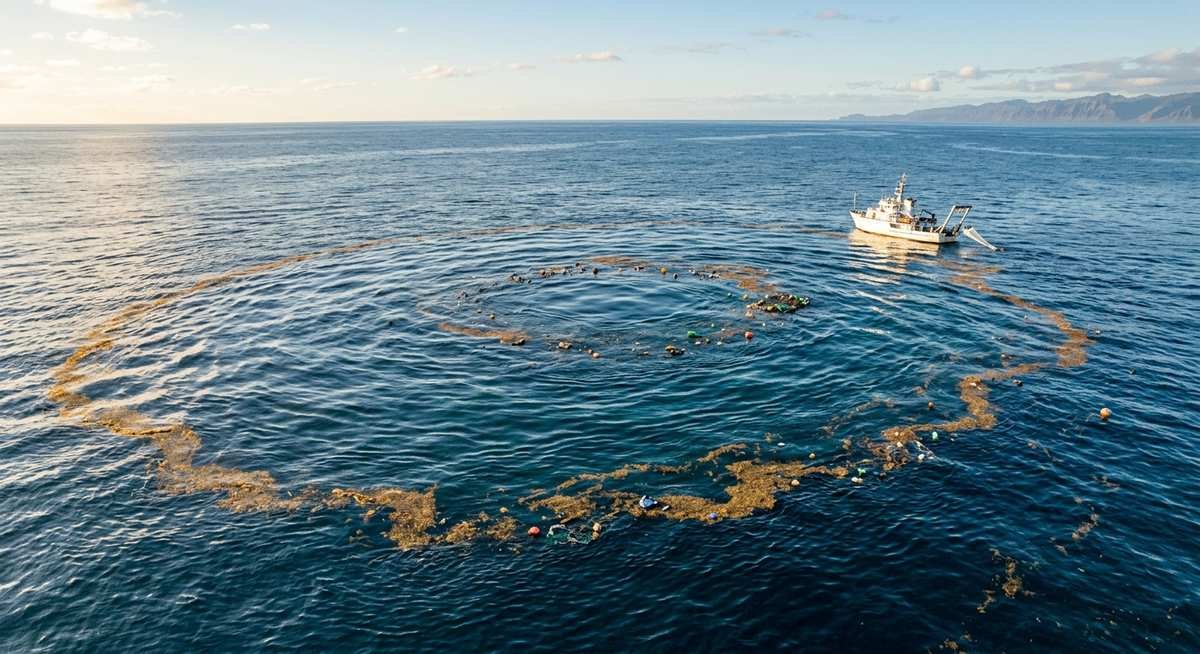
gyre meaning — Gyre Meaning: Definition, Poetry, and Ocean Science
Pronounced like “fire” with a hard J sound (/ˈjaɪər/), “gyre” is one of those rare words that feels ancient and urgent at the same time. It shows up in one of the most quoted poems of the twentieth century. It also names the slow, massive ocean current systems that are quietly accumulating the world’s plastic waste.
Both dimensions — the literary and the scientific — deserve a serious look. The word is older than Yeats, stranger than most dictionaries let on, and more relevant to the state of the planet than most people realize. Here’s what it actually means, where it came from, and why it keeps appearing in places that matter.
What Does “Gyre” Mean? Definition and Pronunciation
A gyre is a circular or spiral motion — or, in its scientific sense, a massive system of rotating ocean currents. The word functions as both a noun and a verb, carries roots stretching back to ancient Greek, and has been immortalized by everyone from W.B. Yeats to Lewis Carroll. Pronouncing it correctly is the first hurdle, and most people stumble.
Clean typographic card showing the word
Core Definition
As a noun, gyre refers to a circular or spiral form — a ring, a vortex, a whirling motion. As a verb, it means to whirl or revolve in a circle, essentially a poetic synonym for “gyrate.” The noun form dominates modern usage, particularly in oceanography.
A few natural examples: “The hawk traced a slow gyre above the valley.” “Debris collected at the center of the gyre, far from any shore.” And in its verb form: “The leaves gyred upward in the sudden draft.”
| Part of Speech | Meaning | Example Sentence |
|---|---|---|
| Noun | A circular or spiral motion; a ring or vortex | “The falcon rode the gyre higher and higher.” |
| Verb | To whirl or revolve in a circular path | “The dancers gyred around the central flame.” |
How to Pronounce “Gyre”
The correct pronunciation is /ˈjaɪər/ — it rhymes with fire, hire, and wire. The G is soft, producing a “j” sound, not a hard “g.” Say “jire” and you’ve got it.
The most common mispronunciation renders it as “geer” (hard G, long E) or “guy-ree” — both wrong. The soft G comes directly from the word’s Greek ancestor, gyros (γῦρος), meaning circle or ring, which passed into Latin as gyrus before entering English. That same root gives us “gyroscope” and “gyrate,” though those words kept a harder initial sound in common use — a small irony of English phonetics.
“Gyre” in Literature — Yeats and the Poetic Tradition
The single most common reason people search “gyre meaning” has nothing to do with oceanography. It’s a poem — specifically the opening two lines of W.B. Yeats’ “The Second Coming” (1919), one of the most quoted poems in the English language. Yeats used “gyre” not as decoration but as the structural and philosophical heart of his entire worldview.
Yeats and “The Second Coming”
The poem opens with two lines that have lodged themselves permanently in the cultural imagination: “Turning and turning in the widening gyre / The falcon cannot hear the falconer.” The image is precise and devastating. A falcon spiraling outward, climbing higher and higher in ever-wider circles, until it has traveled so far from its handler that communication breaks down entirely.
Yeats wrote “The Second Coming” in January 1919, in the immediate aftermath of World War I and during the Irish War of Independence. The widening gyre isn’t abstract — it’s civilization losing its center, order unraveling as the spiral expands beyond control. The falconer represents authority, tradition, God; the falcon is humanity, or history itself, spinning away.
“The Second Coming” appears on high school and university syllabi across the English-speaking world, and its lines surface constantly in journalism, political commentary, and fiction. Joan Didion borrowed from it; Chinua Achebe took his novel title Things Fall Apart from the poem’s third line. That cultural saturation explains why “gyre” generates significant search volume from readers encountering the word for the first time mid-stanza.
Gyres in Yeats’ Mystical System
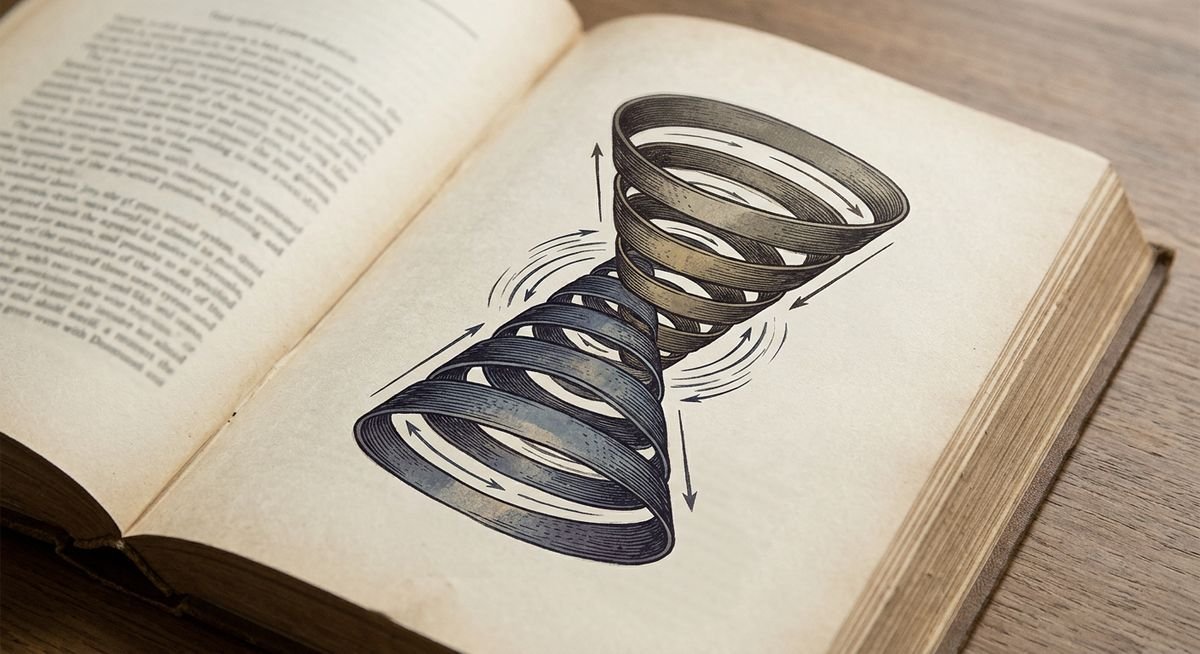
Most readers stop at the poem. Yeats didn’t. In A Vision (first published 1925, revised 1937), William Butler Yeats laid out an elaborate symbolic and esoteric framework in which interlocking gyres — imagined as two cones placed tip-to-tip and spinning in opposite directions — served as the master metaphor for everything: history, human personality, lunar cycles, and cosmic time.
The mechanics matter here. Picture one cone expanding (its base growing wider) while a second cone, inserted point-first into the first, simultaneously contracts. As one gyre reaches its maximum expansion, the other reaches its minimum — and then the process reverses. Yeats called these opposing movements the “primary” and “antithetical” tinctures, and he believed all historical epochs followed this pattern of approximately 2,000-year cycles.
According to this system, each civilization rises to dominance, expands to its fullest expression, then collapses inward as the opposing gyre begins its ascent. The birth of Christ marked one such turning point; Yeats believed another was imminent when he wrote “The Second Coming.” The “rough beast” slouching toward Bethlehem in the poem’s final lines is the new gyre’s terrible first form.
This is the dimension no casual reader of the poem encounters — and no competitor currently explains it. A Vision is dense, idiosyncratic, and draws on Neoplatonism, astrology, and automatic writing that Yeats’ wife Georgie Hyde-Lees reportedly produced in trance states. Whatever one makes of its metaphysics, the gyre framework gave Yeats a coherent symbolic language he used across decades of poetry.
| Yeats’ Gyre Concept | What It Represents | Key Detail |
|---|---|---|
| Widening gyre | Civilization losing coherence | Used in “The Second Coming” (1919) to depict historical collapse |
| Double-gyre (interlocking cones) | Opposing forces in history and personality | Central symbol in A Vision (1925/1937) |
| Primary tincture | Objectivity, order, convention | Expands as the antithetical contracts |
| Antithetical tincture | Subjectivity, individuality, creative will | Dominant during artistic high periods |
Other Literary Uses
Yeats owns the word in modern literature, but he wasn’t the first to use it. Lewis Carroll’s “Jabberwocky” (1871) opens with the line: “‘Twas brillig, and the slithy toves / Did gyre and gimble in the wabe.” Carroll used “gyre” as a verb meaning to scratch like a gyroscope — spinning and scraping simultaneously. The poem is deliberate nonsense, but Carroll chose real roots for his invented vocabulary, and “gyre” was already in English dictionaries when he picked it up.
The word also appears in older English poetry as a general term for circular flight or motion. Hawks gyre. Vultures gyre. Dante’s sinners spiral in gyres through the levels of Hell (though translators vary on whether to use the English word). The consistent thread across centuries of usage is rotation with purpose — not random spinning, but motion that traces a pattern.
Ocean Gyres — The Scientific Meaning Explained
Ocean gyres are massive, slow-moving systems of rotating ocean currents that circulate across entire ocean basins. They form through the combined force of global wind patterns, Earth’s rotation, and the physical boundaries of continental coastlines. There are five major gyres on Earth, and together they govern heat distribution, marine ecosystems, and — increasingly — the accumulation of plastic waste.
How Ocean Gyres Form
The engine behind every ocean gyre is wind. Persistent global wind systems — trade winds near the equator, westerlies in the mid-latitudes — push surface water in consistent directions across vast stretches of open ocean. That water doesn’t travel in a straight line, though.
Earth’s rotation introduces what oceanographers call the Coriolis effect: a deflection force that bends moving water to the right in the Northern Hemisphere and to the left in the Southern Hemisphere. The result is a clockwise rotation in northern ocean basins and counterclockwise rotation in southern ones. Coastlines act as walls, redirecting these currents back into a closed loop.
According to the National Oceanic and Atmospheric Administration (NOAA), ocean surface currents driven by these gyres redistribute roughly 90% of the ocean’s heat energy, making gyres a fundamental mechanism of global climate regulation — not merely a curiosity of fluid dynamics.
The Five Major Ocean Gyres
Each gyre has a distinct character shaped by its geography, the currents that define it, and its ecological role. The North Atlantic Gyre, for example, is bounded by the Gulf Stream — one of the most powerful ocean currents on Earth — while the North Pacific Gyre is now infamous for a different reason entirely: it is home to the Great Pacific Garbage Patch, a vast accumulation of marine plastic debris estimated by The Ocean Cleanup project to span an area roughly three times the size of France.
| Gyre | Hemisphere | Rotation | Notable Feature |
|---|---|---|---|
| North Atlantic Gyre | Northern | Clockwise | Bounded by the Gulf Stream; contains the Sargasso Sea |
| South Atlantic Gyre | Southern | Counterclockwise | Relatively nutrient-poor center; strong Brazil Current on western edge |
| North Pacific Gyre | Northern | Clockwise | Contains the Great Pacific Garbage Patch |
| South Pacific Gyre | Southern | Counterclockwise | Largest gyre by area; among the most biologically sparse ocean zones on Earth |
| Indian Ocean Gyre | Southern | Counterclockwise | Seasonally influenced by monsoon winds; unique among the five |
The Indian Ocean Gyre stands apart from the other four because monsoon winds partially reverse its surface currents on a seasonal basis — a behavior no other major gyre exhibits. That seasonal reversal makes the Indian Ocean basin a particularly complex system for climate scientists to model.
Gyres concentrate more than heat. Their calm, high-pressure centers trap floating debris, creating enormous accumulation zones. The Great Pacific Garbage Patch, located within the North Pacific Gyre, is the most notorious example — an area of concentrated microplastics and marine debris estimated by The Ocean Cleanup project to contain over 80,000 tonnes of plastic. Contrary to popular imagery, the patch is not a visible island of trash. Most of it consists of tiny plastic fragments suspended just below the surface, making cleanup extraordinarily difficult.
All five gyres now contain measurable concentrations of plastic pollution, though the North Pacific remains the most studied. The environmental stakes are significant: marine organisms ingest microplastics, toxins accumulate up the food chain, and gyre-trapped debris can persist for decades before degrading. Understanding how gyres function is no longer just an oceanography exercise — it’s central to addressing one of the most visible consequences of global plastic production.
Frequently Asked Questions
What does “gyre” mean in simple terms?
A gyre is a circular or spiral motion. As a noun, it refers to any ring-like or vortex-shaped movement — from a hawk circling overhead to a massive rotating ocean current system. As a verb, “to gyre” means to whirl or spin in a circle. The word comes from the Greek gyros, meaning circle.
How do you pronounce “gyre”?
It rhymes with “fire.” The phonetic spelling is /ˈjaɪər/. The G is soft, producing a “j” sound — say “jire” and you have it right. Common mistakes include pronouncing it with a hard G (“geer”) or splitting it into two syllables (“guy-ree”).
What does “gyre” mean in Yeats’ “The Second Coming”?
In the poem’s opening line — “Turning and turning in the widening gyre” — Yeats uses a falcon spiraling outward in ever-wider circles as a metaphor for civilization losing its center. The gyre represents historical cycles of expansion and collapse, drawn from Yeats’ elaborate mystical system described in his book A Vision (1925).
What is an ocean gyre?
An ocean gyre is a large system of rotating ocean currents that forms a roughly circular loop across an entire ocean basin. Five major gyres exist on Earth: North Atlantic, South Atlantic, North Pacific, South Pacific, and Indian Ocean. They are driven by wind patterns, Earth’s rotation (the Coriolis effect), and continental coastlines acting as boundaries.
What is the Great Pacific Garbage Patch?
The Great Pacific Garbage Patch is a massive concentration of marine plastic debris trapped within the North Pacific Gyre. Estimated to span roughly three times the area of France, it consists mostly of microplastics suspended below the surface rather than a solid floating island. The Ocean Cleanup project has been working on removal technology since 2013.
Is “gyre” the same as a whirlpool or vortex?
Not exactly. A whirlpool is a localized, rapidly spinning body of water that pulls objects downward. A vortex is any spinning flow of fluid or air. A gyre operates on a much larger scale — spanning entire ocean basins and moving slowly over thousands of miles. Ocean gyres rotate over months and years, not seconds.
What is the difference between the five ocean gyres?
Each gyre differs in size, rotation direction, and ecological character. Northern Hemisphere gyres (North Atlantic, North Pacific) rotate clockwise; Southern Hemisphere gyres (South Atlantic, South Pacific, Indian Ocean) rotate counterclockwise. The North Pacific Gyre contains the Great Pacific Garbage Patch. The Indian Ocean Gyre is unique because monsoon winds partially reverse its currents seasonally. The South Pacific Gyre is the largest by area and one of the most biologically sparse ocean regions on Earth.
The Word That Keeps Turning
A single word, two syllables, and centuries of accumulated meaning. “Gyre” started as a Greek term for a circle, passed through Latin into English, and picked up literary and scientific weight along the way. Yeats turned it into a symbol for the rise and fall of civilizations. Oceanographers use it to describe the planet’s largest current systems. Environmentalists now associate it with one of the defining pollution crises of the modern era.
The word endures because what it describes endures — circular motion, cyclical patterns, things that spiral outward or inward depending on the forces acting on them. Whether you arrived here from a poetry class, a marine biology textbook, or a news article about ocean plastic, the core meaning holds. A gyre is something that turns. And the things it names — from Yeats’ collapsing civilizations to the slow rotation of ocean basins — haven’t stopped turning yet.