Sustained greatness in the NFL is a rare and expensive commodity. The Kansas City Chiefs have spent the last half-decade building a modern dynasty, complete with multiple Super Bowl victories and a collection of the league’s brightest stars. But that level of success isn’t free. Now, the bill is coming due, and it takes the form of a complex and challenging salary cap situation. Welcome to the “dynasty tax.”
This article provides a comprehensive breakdown of everything you need to know about the Chiefs’ intricate 2026 salary cap. We will explore the key moves they’ve already made, the fundamental cap concepts every fan should understand, and the significant challenges that still lie ahead for General Manager Brett Veach and the front office.
What is the NFL Salary Cap? A Quick Primer for Fans
At its core, the NFL salary cap is a straightforward concept: it is a hard limit on the total amount of money a team can spend on player salaries for a given season. This system, governed by the NFL’s Collective Bargaining Agreement (CBA), is designed to maintain competitive balance across the league, preventing the wealthiest teams from simply buying championships.
For the 2026 season, the NFL has set the official salary cap at $301.2 million per team. During the offseason, a specific rule known as the “Top 51 Rule” is in effect. This means that only the 51 most expensive player contracts on the roster, plus all prorated bonus money for every player, count against the cap. This gives teams flexibility while they carry up to 90 players on their offseason rosters.
The Current State of the Kingdom: Chiefs’ 2026 Cap at a Glance
After a flurry of offseason activity, the Kansas City Chiefs currently have approximately $21.7 million in available cap space, according to data from Over the Cap. While this figure places them in a much healthier position than where they started the offseason—more than $57 million over the limit—it still requires careful management to address roster needs.
The team’s spending is concentrated on its core, homegrown superstars. The five largest cap hits for 2026 represent a significant portion of their total budget, underscoring the financial weight of their top-tier talent.
| Player | Position | 2026 Cap Hit |
|---|---|---|
| Chris Jones | DT | $44,850,000 |
| Patrick Mahomes | QB | $34,653,888 |
| Trey Smith | G | $24,495,277 |
| Nick Bolton | LB | $19,250,000 |
| Creed Humphrey | C | $18,100,000 |
Data courtesy of Over the Cap as of March 10, 2026.
The Veach Maneuvers: How the Chiefs Created Breathing Room
Facing a significant cap deficit entering the 2026 league year, GM Brett Veach executed a series of aggressive financial moves to become cap-compliant and create operating room. These maneuvers involved contract restructures and difficult decisions to part ways with key players.
The Mahomes Restructure: Kicking the Can Down the Road
The most significant move was the fourth consecutive restructuring of quarterback Patrick Mahomes’ contract. The Chiefs converted $54.45 million of Mahomes’ 2026 salary into a signing bonus, a move that immediately created $43.65 million in cap space for the 2026 season. This accounting trick provides short-term relief by spreading the cap hit of the bonus over the remaining years of the contract.
Key Departures: The Tough Decisions
Creating space also required making some tough personnel choices. The team released starting right tackle Jawaan Taylor, a move that saved $20 million against the 2026 cap, though it came with a dead money charge of $7.39 million.
In a more shocking move, the Chiefs traded All-Pro cornerback Trent McDuffie to the Los Angeles Rams. This deal not only brought back a haul of valuable draft picks but also cleared McDuffie’s $13.6 million salary from the books with zero dead money. Finally, the release of defensive end Mike Danna created nearly $9 million in additional space, albeit with a $2.17 million dead cap hit.
Understanding Key Cap Concepts: Restructures, Cuts, and Dead Money
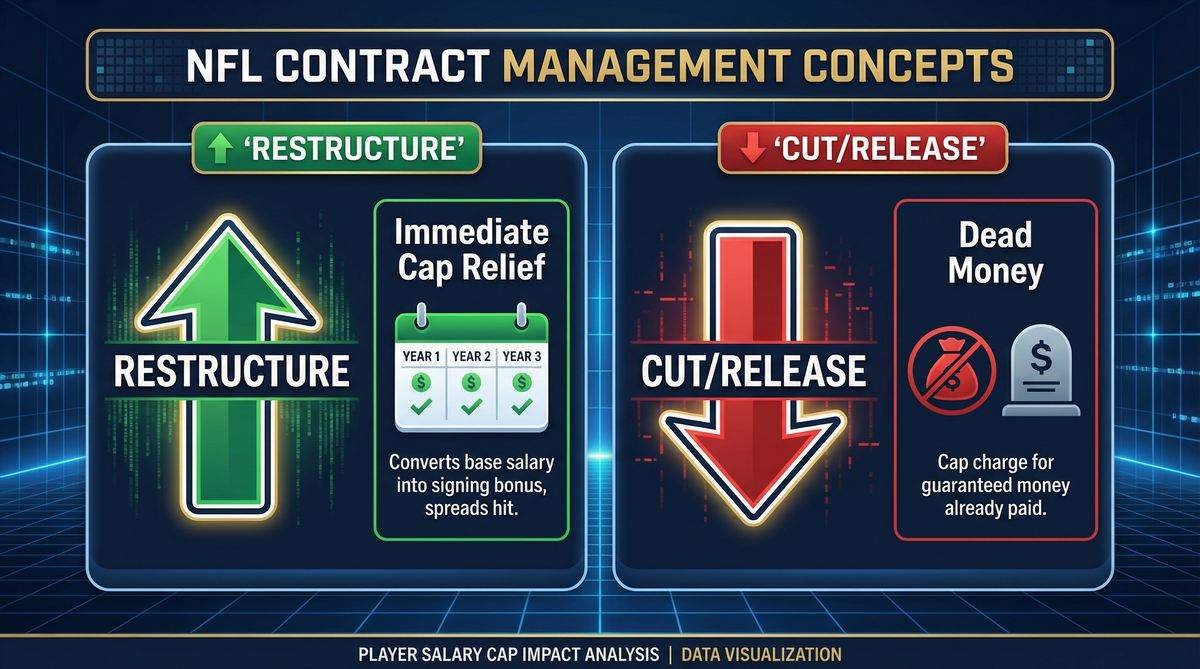
To fully grasp the Chiefs’ situation, it’s essential to understand the tools GMs use to manage the salary cap. These mechanisms are the foundation of modern roster construction.
A contract restructure is the most common method for creating immediate cap space. It involves converting a player’s base salary, which counts fully against the current year’s cap, into a signing bonus. This bonus is then prorated, or spread evenly, over the remaining years of the contract (up to a maximum of five years). While it lowers the current year’s cap hit, it increases the cap hits in all future years.
Cutting a player removes their base salary from the books for that year. However, any previously paid signing bonus money that has not yet been accounted for on the cap accelerates into the current year. This acceleration is known as dead money—a cap charge for a player who is no longer on the team. Jawaan Taylor’s $7.39 million dead money hit is the result of the prorated portions of his original signing bonus accelerating onto the 2026 cap after his release.
The Price of a Dynasty: How Super Bowl Runs Shaped the 2026 Cap
The Chiefs’ current financial landscape was not created overnight. It is the direct and predictable result of a multi-year effort to build and maintain a championship-caliber roster. Winning multiple Super Bowls requires paying top-of-market, often record-setting, contracts to generational talents like Patrick Mahomes and Chris Jones.
These massive contracts, while essential for securing victory, inevitably lead to tight salary cap situations. The front office has consistently prioritized winning now, using restructures to push cap charges into the future to keep the championship window open. The 2026 cap situation is not a sign of mismanagement but rather the accumulated “dynasty tax”—the financial cost of sustained excellence.
Looking Ahead: The Looming 2027 Cap Challenge
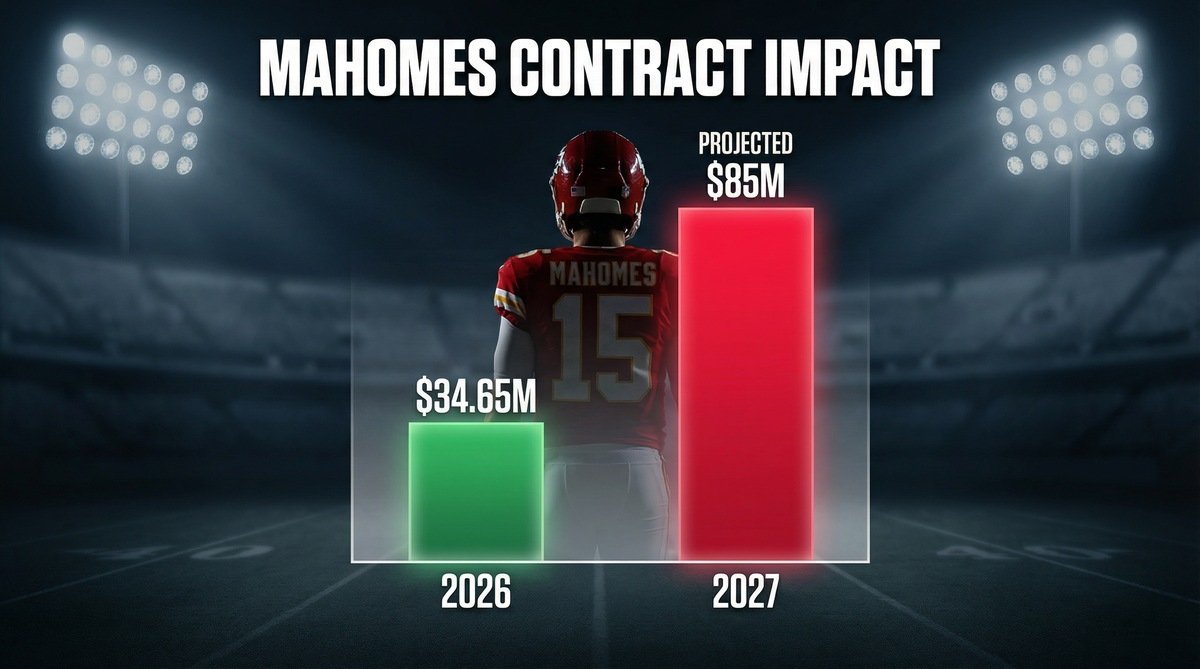
While Veach’s maneuvers have made the 2026 season manageable, they have created a formidable challenge for 2027. As a result of the most recent restructure, Patrick Mahomes’ cap hit is projected to skyrocket to an unprecedented $85 million in 2027.
This colossal figure is not a realistic number for any team to carry for a single player. It is almost certain that the Chiefs will need to address Mahomes’ contract again before the 2027 season, either through another restructure or, more likely, a full contract extension that creates a new, more manageable cap structure. This future challenge highlights the cyclical nature of cap management, where solving today’s problem often creates tomorrow’s.
Frequently Asked Questions (FAQ) about the Chiefs Salary Cap
How much cap space do the Chiefs have right now?
As of early March 2026, the Kansas City Chiefs have approximately $21.7 million in available salary cap space.
What is “dead money”?
Dead money is a salary cap charge for a player who is no longer on the team’s roster. It typically comes from the accelerated proration of a signing bonus after a player is cut or traded.
Why did the Chiefs restructure Patrick Mahomes’ contract again?
The Chiefs restructured his contract to lower his massive 2026 cap hit, creating over $43 million in immediate cap space needed to get under the league limit and sign other players.
Will the Chiefs have to cut more players?
While they are currently under the cap, further cuts or restructures are possible if they wish to make significant signings in free agency. Players on large, non-guaranteed contracts are always potential candidates.
Can the Chiefs still sign free agents?
Yes. With over $21 million in space, the Chiefs have the flexibility to sign mid-tier free agents and fill roster holes. They could create more room for a major signing if they choose to.
What is the biggest cap hit on the team?
For the 2026 season, defensive tackle Chris Jones holds the largest cap hit at $44.85 million, followed closely by Patrick Mahomes’ post-restructure number of $34.65 million.
How will the salary cap affect the Chiefs’ chances in 2026?
The tight cap limits their ability to pursue top-tier free agents but does not prevent them from being competitive. Their success will depend on the performance of their core players and contributions from younger, cheaper talent acquired through the draft.
Is a salary cap crisis looming for the Chiefs?
“Crisis” is a strong word. The Chiefs face significant challenges, particularly with the 2027 cap, but these are predictable consequences of their success. The front office has a proven track record of navigating these issues effectively.
Conclusion
The Kansas City Chiefs’ 2026 salary cap is a complex puzzle, shaped by years of championship pursuits. While the “dynasty tax” has put them in a tight financial position, it is a situation born from unparalleled success, not from poor planning. General Manager Brett Veach has skillfully used every available tool—from massive restructures to difficult but necessary cuts—to ensure the team remains competitive.
The road ahead, especially in 2027, is challenging. However, with a franchise quarterback in his prime and a front office that has consistently proven its adeptness at financial management, the Kingdom has every reason to believe it can navigate the pressures of the salary cap and continue its reign as one of the NFL’s elite franchises.