Here’s a startling fact. Over 70% of digital transformation projects fail to achieve their goals. [1] The reason is often surprisingly simple. We’re trying to solve tomorrow’s problems with yesterday’s mindset, forcing dynamic teams into rigid, inflexible software that dictates how they should work. This friction between human creativity and digital constraint is the single biggest barrier to true innovation.

But what if there was a different way? What if, instead of forcing people to adapt to tools, our tools could adapt to us? This is the core promise of Awius. It’s not another app, platform, or piece of software. Awius is a revolutionary concept, a fundamental shift in how we approach digital solutions, prioritizing flexibility, user-centric design, and adaptive intelligence above all else.
This guide will take you beyond the buzzword. We will explore the Awius mindset and its psychological underpinnings, provide a real-world implementation roadmap, and analyze how it aligns with the defining tech trends of 2026. You will discover a new framework for thinking about digital identity and innovation—one that finally closes the gap between what your tools can do and what your people can achieve.
What is Awius? Beyond the Buzzword
No, this is not another article defining a hot new app you have to download.
Awius is something more fundamental. It represents a break from the rigid, one-size-fits-all software that has dominated the digital landscape for decades. Think of it less as a product and more as an operating system for innovation—a philosophy and architectural approach that allows digital experiences to be fluid, contextual, and deeply human-centric. While competitors struggle to pin it down, they miss the point: its undefined nature is its greatest feature.
At its core, Awius is built on three pillars. First, Radical Adaptability ensures that Awius-inspired systems are designed to be endlessly configurable. They don’t come with a fixed set of features; they provide a flexible framework that can be molded to specific user needs, team workflows, or business challenges. Second, Contextual Intelligence means it’s not just about being flexible; it’s about being smart. Awius leverages data and AI to understand the context of a user’s work, anticipating needs and surfacing the right functionality at the right moment. Third, Human-Centric Design flips the traditional model. Instead of forcing users to learn the logic of the software, the software is built to understand the logic of the user. It prioritizes intuitive interfaces and seamless experiences.
This table clarifies how this new approach fundamentally differs from the software we’ve grown accustomed to.
| Feature | Traditional Software | Awius Approach |
|---|---|---|
| Core Design | Rigid, feature-based | Flexible, framework-based |
| User Experience | One-size-fits-all | Personalized & contextual |
| Scalability | Often monolithic & difficult | Modular & inherently scalable |
| Purpose | To perform a fixed set of tasks | To adapt to evolving challenges |
| Innovation Cycle | Slow, with periodic updates | Fast, with continuous iteration |
The Awius Mindset: The Psychology of Digital Adaptability

For decades, we’ve been trained to adapt to our software. We learn its quirks, memorize its shortcuts, and contort our workflows to fit its rigid logic. This process creates a significant cognitive load—the mental effort required to use a tool—that drains our energy and stifles creativity. [2] It’s the digital equivalent of trying to write a novel with a chisel and stone. You can do it, but the tool is constantly working against you.
Awius proposes a radical inversion of this relationship. It’s built on a simple, yet profound, psychological insight: technology should adapt to us, not the other way around. This isn’t just about user-friendliness; it’s about creating an environment where people can achieve a state of flow, a concept pioneered by psychologist Mihaly Csikszentmihalyi. [3] Flow is the experience of being so deeply immersed in an activity that you lose track of time, your focus sharpens, and your productivity soars. It’s the state where our best work happens.
Rigid software is the enemy of flow. Every time you’re forced to stop and figure out a confusing interface or fight against a pre-determined workflow, the spell is broken. The Awius mindset, therefore, is a cultural and organizational commitment to minimizing this friction. It’s about building and adopting digital systems that are so intuitive and responsive they feel like an extension of your own mind. This requires a shift from a culture of process-adherence to one of empowered experimentation, where teams are given the flexible tools they need to solve problems in the most natural way possible.
Here’s how to start cultivating the Awius mindset in your organization. When evaluating new tools, ask not “What can it do?” but “How can it adapt?” Prioritize flexibility over features. Give your people the autonomy to customize their own digital workspaces and empower your teams. Identify and eliminate the small, frustrating roadblocks in your team’s daily workflows by measuring friction, not just output. Finally, treat your internal systems like a product that is never truly “finished,” always evolving based on user feedback by embracing continuous iteration.
Awius in Action: Real-World Applications & Case Studies
Abstract concepts are one thing; real-world results are another. While Awius is a philosophy, its principles are already being applied by forward-thinking organizations to build a tangible competitive edge. Let’s explore three scenarios where the Awius approach transforms how work gets done.
The SaaS Startup: Innovate.AI
The Challenge: A small but ambitious AI startup, “Innovate.AI,” was struggling to keep up with a rapidly changing market. Their monolithic platform made it slow and costly to test new features or respond to user feedback. Development cycles were long, and they were losing ground to more agile competitors.
The Awius Solution: Instead of continuing to build on their rigid codebase, they re-architected their platform around Awius principles. They broke down their application into a collection of independent, micro-services that could be rapidly developed, tested, and deployed. They built a core framework that allowed their internal teams to create new user-facing modules without extensive engineering support.
The Result: The transformation was dramatic. Innovate.AI was able to pivot its product roadmap 50% faster than before. They could now launch and test a new feature in two weeks, down from three months. This agility allowed them to quickly find product-market fit and secure their next round of funding, all because they chose a system built for change.
The Enterprise: A Global Retail Giant
The Challenge: A Fortune 500 retailer with over 100,000 employees was hampered by a sprawling, outdated intranet and a suite of legacy software. Employee onboarding was a nightmare, taking weeks for new hires to get access to the right systems. Workflows were inconsistent across departments, leading to massive inefficiencies.
The Awius Solution: The company invested in building a new internal platform, codenamed “Project Agora,” based on Awius principles. Agora was a composable, user-centric workspace. Each employee received a personalized dashboard based on their role, department, and current projects. Instead of a dozen different logins, everything was accessible through a single, intelligent portal that surfaced the most relevant tools and information for the task at hand.
The Result: The new platform streamlined operations across the board. Employee onboarding time was reduced by an average of 30%. More importantly, the company fostered a culture of self-service and innovation. Departments could now build their own simple applications on the Agora framework, solving local problems without waiting for corporate IT.
The Digital Creator: “Solo-preneur” Powerhouse
The Challenge: A successful content creator managing a YouTube channel, a podcast, a newsletter, and multiple social media accounts was drowning in administrative work. Her time was spent juggling a dozen disconnected apps for content scheduling, community management, and monetization. She was working 70-hour weeks, with most of that time spent on operations, not creation.
The Awius Solution: She adopted a new, integrated suite of creator tools built with an Awius-inspired architecture. The platform connected all her channels into a single, unified dashboard. An AI assistant, understanding the context of her brand, could suggest content ideas, automate social media posting, and even draft email campaigns based on her latest video.
The Result: By automating the friction-filled parts of her workflow, she reclaimed over 20 hours per week. This allowed her to focus on what she does best: creating high-quality content. Her business continued to grow, but her workload became manageable. She was able to run a multi-faceted media brand with the efficiency of a much larger team, all thanks to a system that adapted to her needs.
The Awius Implementation Roadmap: A 4-Phase Guide
Adopting an Awius philosophy is not a simple software update; it’s a strategic business transformation. It requires careful planning, a phased approach, and a commitment to cultural change. While every organization’s journey is unique, this four-phase roadmap provides a proven framework for moving from the rigid systems of the past to the adaptive digital future.
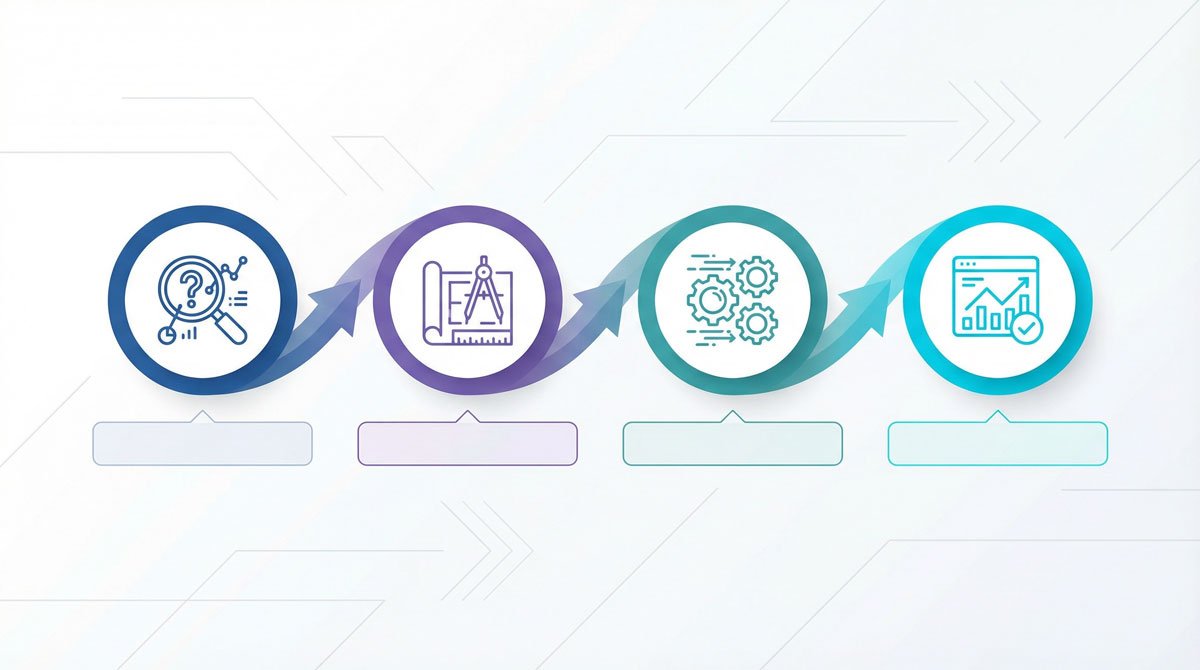
Phase 1: Assess & Identify
Before you can build the future, you must understand the present. This initial phase is about conducting a brutally honest audit of your current digital ecosystem and organizational culture. The goal is to identify the biggest points of friction—the places where your tools are holding your people back.
Start by asking critical questions. Where do workflows break down? Which tasks consume a disproportionate amount of manual effort? What are the most common complaints your teams have about their software? Use surveys, interviews, and workflow analysis to gather both qualitative and quantitative data. Map out your key business processes and pinpoint the exact moments where rigid systems create bottlenecks. This initial diagnosis is the most critical step; a flawed assessment will lead to a flawed strategy.
Phase 2: Strategize & Design
With a clear understanding of your pain points, you can begin to design your solution. This phase is not about choosing vendors; it’s about defining your strategy and architecting your ideal future state. Start by building a compelling business case. How will an Awius-inspired transformation impact key metrics like revenue, operational efficiency, and employee retention? Secure buy-in from leadership by tying the initiative directly to strategic business goals.
Next, focus on the architectural design. This is where the principles of composability and flexibility become concrete. Instead of designing a single, monolithic platform, think in terms of a modular ecosystem. Identify the core capabilities your business needs (e.g., customer data management, project tracking, content creation) and design them as independent, interconnected services. This architectural blueprint is your guide for the entire transformation.
Phase 3: Integrate & Deploy
This is where the strategy becomes reality. The key to a successful deployment is to avoid a “big bang” approach. A sudden, company-wide switch is disruptive and risky. Instead, adopt a phased rollout, starting with a single department or a specific, high-impact workflow. This allows you to test your new architecture in a controlled environment, gather feedback, and demonstrate value quickly.
Focus on integration, not just replacement. Your new Awius-style systems should seamlessly connect with your existing infrastructure where necessary. Use APIs and middleware to ensure data flows smoothly between the old and the new. This hybrid approach minimizes disruption and allows you to gradually decommission legacy systems over time, rather than all at once. Celebrate small wins and use them to build momentum for the broader, organization-wide transformation.
Phase 4: Measure & Optimize
An Awius transformation is not a one-time project; it’s a continuous process of improvement. The final phase is about establishing a system for measuring success and optimizing your digital ecosystem based on real-world data. Define a clear set of Key Performance Indicators (KPIs) before you even begin deployment. These should go beyond simple technical metrics and focus on business outcomes.
Track metrics like user adoption rates, task completion times, employee satisfaction scores, and the number of new innovations originating from your teams. Create a dedicated feedback loop where users can easily report issues and suggest improvements. Use this data to drive an ongoing cycle of iteration. The goal is to create a digital environment that is not just adaptive by design, but one that actively evolves and improves every single day.
| Common Pitfall | Solution |
|---|---|
| Lack of Executive Buy-In | Tie the transformation directly to strategic business goals and demonstrate early ROI with a pilot project. |
| Trying to Boil the Ocean | Start with a single, high-impact workflow. A phased rollout builds momentum and reduces risk. |
| Focusing on Technology, Not Culture | The transformation must be paired with a cultural shift toward empowerment and experimentation. |
| Poor Integration Strategy | Design a robust API and middleware strategy from the start to ensure new and old systems communicate effectively. |
| Failing to Measure What Matters | Define business-centric KPIs before you begin. Track user satisfaction and adoption, not just system uptime. |
Awius in 2026: How It Aligns with the Next Wave of Tech
The digital landscape of 2026 will be defined by intelligence, personalization, and unprecedented speed. Legacy systems, with their rigid architectures and slow development cycles, are fundamentally ill-equipped for this new reality. Awius, however, is not just prepared for these trends; it is the philosophical and architectural foundation upon which they will be built. Let’s explore how Awius directly enables the three defining tech movements of the coming years.
The Rise of the Composable Enterprise
The era of the monolithic, all-in-one software suite is over. Leading industry analysts like Gartner predict that the future belongs to the composable enterprise, an organization built from interchangeable, modular components. [4] This is the very essence of Awius. Instead of relying on a single, inflexible platform, a composable enterprise assembles a custom stack of best-in-class tools, all seamlessly connected. The Awius framework provides the necessary architectural glue, allowing businesses to add, remove, or swap out components on the fly without breaking the entire system. This modularity is the key to achieving the agility needed to thrive in a constantly changing market.
The Era of Hyper-Personalization
Customers and employees alike now expect digital experiences that are tailored to their specific needs and context. Hyper-personalization is no longer a luxury; it’s a core requirement for engagement and retention. Achieving this level of personalization with traditional, one-size-fits-all software is nearly impossible. It requires a system that can understand user behavior, process contextual data in real-time, and dynamically adjust the interface and functionality. This is precisely what the contextual intelligence pillar of Awius is designed to do. By building on an adaptive framework, organizations can finally move beyond generic user segments and deliver truly one-to-one digital experiences.
The Integration of Generative AI
Generative AI is the most disruptive technology of our time, but its true potential will not be unlocked by simply bolting it onto existing, outdated systems. To fully leverage generative AI, organizations need a platform that can seamlessly integrate new AI capabilities as they emerge. An Awius-based architecture, with its modular design and API-first approach, is perfectly suited for this task. It allows businesses to treat AI models as just another interchangeable component in their composable ecosystem. This means they can easily plug in new, more powerful models as they become available, ensuring their technology stack never becomes obsolete. In the age of AI, the ability to adapt and integrate is the ultimate competitive advantage.
The Awius Advantage: How It Outpaces Traditional Solutions
Choosing a technology strategy is one of the most critical decisions a modern business can make. While traditional, monolithic platforms offer a sense of security through their all-in-one approach, they often become a hidden tax on innovation and agility. The Awius philosophy, in contrast, is an investment in future-readiness. It’s not just a different type of software; it’s a fundamentally different way of thinking about the relationship between technology and business.
The most significant advantage lies in speed and adaptability. A business running on a rigid, monolithic platform might take six months to launch a new feature. An organization built on Awius principles can often achieve the same result in a matter of weeks. This is because a composable architecture allows for parallel development and independent deployment of modules, eliminating the bottlenecks inherent in legacy systems.
This table breaks down the practical differences between the two approaches:
| Aspect | Monolithic Platforms | The Awius Advantage |
|---|---|---|
| Time-to-Market | Slow; changes require extensive testing across the entire system. | Fast; modular changes can be deployed independently and rapidly. |
| Total Cost of Ownership | High; includes licensing, maintenance, and the hidden cost of missed opportunities. | Lower; pay only for the components you need and reduce technical debt. |
| Scalability | Limited; scaling often requires a complete and costly re-platforming. | Infinite; scale individual components as needed without disrupting the whole. |
| User Autonomy | Low; users are forced to follow pre-defined, rigid workflows. | High; empowers users to customize tools and create their own solutions. |
| Innovation | Stifled; the platform is a barrier to experimentation. | Accelerated; the framework encourages rapid testing and iteration. |
However, it’s important to maintain a balanced perspective. For highly regulated industries with static, unchanging workflows, a traditional, locked-down system might still be a valid choice for compliance reasons. But for the vast majority of businesses operating in today’s dynamic market, the strategic moat provided by the adaptability of Awius is no longer a luxury—it is essential for survival and growth.
Is Awius Right for You? A Practical Checklist
Embarking on an Awius transformation is a major strategic decision. It’s not the right path for every organization. This simple checklist is designed to help you determine if your company is ready to move beyond rigid software and embrace a more adaptive digital future. If you find yourself nodding in agreement with most of these points, it’s time to start a serious conversation about Awius.
You should consider an Awius approach if:
- Your teams frequently complain that their tools are a barrier to getting work done.
- Your time-to-market for new digital features is measured in months, not weeks.
- You have a collection of disconnected, single-purpose apps that don’t talk to each other.
- Your employees rely on a patchwork of spreadsheets and manual workarounds to bridge gaps in your official systems.
- You struggle to integrate new technologies, like AI, into your existing, outdated infrastructure.
- Your business strategy is evolving faster than your IT department can keep up.
A traditional approach might be sufficient if:
- Your workflows are highly standardized, regulated, and rarely change.
- Your primary need is for a simple, stable system of record with minimal customization.
- Your competitive advantage does not depend on digital agility or speed of innovation.
If you’ve identified that Awius is the right path, here are three concrete first steps to begin your journey. First, launch a pilot project. Don’t try to transform the entire organization at once. Select one specific, high-friction workflow and build a small, Awius-inspired solution to address it. Use this pilot to demonstrate value and learn key lessons. Second, assemble a cross-functional team. An Awius transformation is not just an IT project. Your team should include representatives from IT, product, operations, and key business units to ensure the solution is both technically sound and aligned with real-world needs. Third, seek expertise in composable architecture. This is a specialized field. Look for consultants or new hires with proven experience in designing and building modular, API-first systems. Their expertise will be invaluable in avoiding common pitfalls.
Your Next Digital Evolution Starts with Awius
For too long, we have accepted a fundamental imbalance in our relationship with technology. We have allowed our tools to dictate our workflows, forcing our most creative and dynamic people into rigid digital boxes. The 70% failure rate of digital transformations is not a technical problem; it’s a philosophical one. It is the inevitable result of trying to build the future on a foundation of inflexibility.
Awius offers a way out. It is more than just a new trend; it is a necessary evolution. It is the recognition that true digital maturity comes not from having the most features, but from having the most flexibility. By embracing a mindset of adaptability, contextual intelligence, and human-centric design, organizations can finally close the gap between their potential and their performance.
Don’t just upgrade your tools. Upgrade your thinking. Use the checklist in this guide to start a conversation in your organization. The journey to a fully adaptive digital ecosystem is a marathon, not a sprint, but it is a race that the most successful organizations of 2026 and beyond are already running. Your Awius journey starts today.
Frequently Asked Questions About Awius
- 1. What exactly is Awius, and is it a real product?
- Awius is best understood as a concept or a philosophy, not a single, off-the-shelf product. It represents a modern approach to building digital solutions that are flexible, intelligent, and centered around the user. While you can’t “buy Awius,” you can adopt its principles to build or choose software that is highly adaptive. Some forward-thinking companies are now building platforms based on this philosophy, offering them as real products that deliver on the promise of adaptability. So, while Awius itself is an idea, its implementation is very real and tangible.
- 2. How does Awius differ from other digital platforms and concepts?
- The key difference lies in its core design. Traditional platforms are often monolithic and rigid, forcing users into predefined workflows. Awius, by contrast, is modular and composable. This means it’s built from independent, interchangeable components, allowing for much greater flexibility. Unlike broad concepts like “digital transformation,” Awius provides a specific architectural and philosophical framework for how to achieve it. It prioritizes adapting to the user over forcing the user to adapt to the software, a fundamental reversal of the traditional model.
- 3. Can individuals use Awius for personal branding and creative projects?
- Absolutely. Awius is an incredibly powerful concept for individuals, especially in the creator economy. For a freelancer or artist, an Awius-inspired personal brand means having an identity that can evolve with their career. A creator might use a suite of integrated, flexible tools (an Awius-style platform) to manage their content, community, and business operations seamlessly. This allows them to run a complex, multi-faceted brand with the efficiency of a much larger team, freeing them to focus on creativity rather than administration.
- 4. What are the main business benefits of implementing Awius?
- The primary benefits are increased agility, faster innovation, and a superior user experience. Businesses that adopt Awius principles can bring new ideas to market significantly faster because their technology stack is built for change. This leads to a strong competitive advantage. Furthermore, by reducing the daily friction employees experience with rigid software, companies see higher productivity and improved morale. Ultimately, it leads to a more resilient and future-ready organization that can pivot quickly as market conditions change.
- 5. How much does an Awius-style implementation cost, and what’s the ROI?
- The cost of an Awius-style implementation varies greatly and depends on whether you are building a custom solution or adopting a commercial platform built on Awius principles. While the initial investment in re-architecting systems can be significant, the long-term Return on Investment (ROI) is compelling. The ROI comes from several areas: reduced development costs over time due to modularity, lower operational costs from increased efficiency, and increased revenue from the ability to innovate and respond to market needs faster. The biggest return, however, is often the strategic value of organizational agility.
- 6. Is Awius compatible with our existing systems and infrastructure?
- Yes. A core tenet of the Awius approach is seamless integration. It is not a “rip and replace” strategy. A well-designed Awius architecture is built around APIs and middleware, allowing new, flexible modules to communicate effectively with existing legacy systems. This enables a phased transition, where you can gradually modernize your technology stack without causing major disruptions to your daily operations. You can start by applying Awius principles to a single, high-friction area of your business and expand from there.
- 7. What is the future of Awius in the age of AI?
- Awius and AI are deeply interconnected. The flexible, modular architecture of Awius is perfectly suited for the age of AI. It allows organizations to treat powerful new AI models as “pluggable” components, easily integrating them into their workflows without having to rebuild their entire system. As AI technology continues to evolve at a rapid pace, a rigid technology stack will become an insurmountable barrier to staying competitive. An Awius framework provides the necessary future-proofing, ensuring that a business can always incorporate the latest AI capabilities as they emerge.
References
[1] Why Technology Transformations Keep Failing – Forbes
[2] Minimize Cognitive Load to Maximize Usability – Nielsen Norman Group
You Might Also Like...
 Rosboxar: Modular Innovation Platform for Digital Future
 Ecards + Blockchain Gift Cards: Secure Digital Philanthropy Solutions
 Ashenaletuve: The Emerging Framework Reshaping Creative Innovation, Digital Identity, and Sustainable Growth in 2025 and Beyond
 Classroom 60x: The Ultimate Guide to the Future of Learning