What if you could amplify the learning experience in your classroom by 60 times? This isn’t a far-fetched dream from a sci-fi novel. It’s a question that gets to the heart of a growing movement in education. Traditional chalk-and-talk methods are fading. They struggle to keep a generation of digital natives engaged and fail to provide the personalized learning that modern students need to thrive.
In the search for a better way, the term “Classroom 60x” has exploded in popularity. But its rapid rise has created confusion. A quick search reveals two very different things: a website for unblocked browser games and a revolutionary educational philosophy. This article is about the latter. We will cut through the noise to deliver a clear, honest look at Classroom 60x as a powerful framework for educational transformation. It’s not just another piece of software; it’s a new way of thinking.

This guide will provide a comprehensive roadmap for educators, administrators, and parents. We will explore its core philosophy and unpack the tangible benefits for everyone involved. More importantly, we will tackle the tough questions that other articles ignore: What is the real cost? How does it stack up against giants like Google Classroom? And what does a practical implementation plan actually look like? Prepare for a deep dive into the future of learning.
What is Classroom 60x, Really? Beyond the Buzzword
The term Classroom 60x is intentionally bold. It’s designed to make you stop and think. But it’s not about a specific product with a flashy logo. It represents a fundamental shift in educational strategy, an ambitious framework aimed at making learning exponentially more effective, engaging, and accessible.
Deconstructing the “60x” Concept
The “60x” isn’t a literal multiplier promising that students will learn 60 times faster. Instead, it’s a powerful metaphor for exponential improvement across the entire educational ecosystem. Think of it as a guiding principle. It challenges educators to break free from incremental changes and pursue transformative results. This means rethinking everything from lesson design to student assessment, leveraging technology not just as a digital worksheet, but as a tool to unlock entirely new ways of learning.
The Two Faces of Classroom 60x
A quick Google search for “Classroom 60x” can be confusing, and it’s crucial to address this head-on. You will find a popular website offering unblocked games for students to play during breaks. While that site serves a purpose, it is not the subject of our discussion.
This article focuses on the far more significant concept: Classroom 60x as an educational philosophy. This framework is about integrating technology, pedagogy, and collaborative learning to create a richer, more personalized educational experience. It’s a strategic approach, not a simple gaming portal.
Core Philosophy: A Shift from Teaching to Facilitating
At its heart, Classroom 60x champions a profound change in the role of the teacher. The traditional model of the instructor as a “sage on the stage,” delivering information to passive students, is obsolete. In the Classroom 60x model, the teacher becomes a “guide on the side.”
This means educators shift their focus from lecturing to facilitating. They design learning experiences that encourage exploration, critical thinking, and problem-solving. They curate resources, pose challenging questions, and provide personalized support, empowering students to take ownership of their learning journey. It’s a move from rote memorization to meaningful discovery.
The Tangible Benefits: How Classroom 60x Transforms Learning
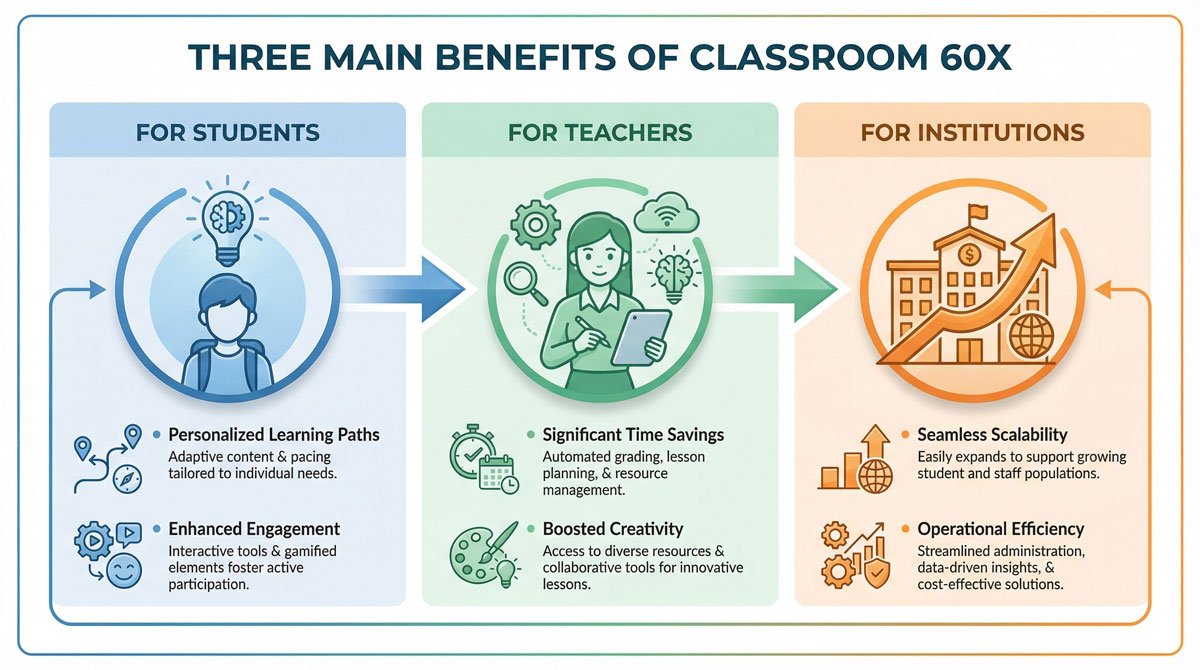
Adopting the Classroom 60x framework is not just about embracing new technology; it’s about unlocking measurable improvements for everyone involved. The philosophy translates into practical advantages that address the most pressing challenges in modern education, creating a win-win-win scenario for students, teachers, and institutions.
For Students: Personalized Journeys and Deeper Engagement
For too long, education has followed a one-size-fits-all model. Classroom 60x shatters that paradigm. By leveraging AI-driven analytics and adaptive technologies, it tailors the learning experience to each student’s unique pace and style. Struggling students receive targeted support to master foundational concepts, while advanced learners are given challenging extensions to deepen their knowledge. This personalization makes learning feel relevant and empowering.
The result is a dramatic increase in student engagement. When learning is no longer a passive activity but an interactive quest, students become active participants. Gamification elements like badges and leaderboards turn progress into a motivating challenge. Immersive tools like virtual reality can transport students to ancient Rome or the surface of Mars, making abstract concepts tangible and unforgettable. This approach doesn’t just teach subjects; it cultivates critical skills like collaboration, creativity, and complex problem-solving—competencies essential for the 21st-century workforce.
For Teachers: From Administrator to Innovator
Many teachers feel buried under a mountain of administrative tasks. Grading papers, tracking attendance, and preparing reports consume valuable time that could be spent on what truly matters: teaching. Classroom 60x acts as a powerful assistant, automating many of these repetitive duties. Integrated dashboards provide real-time insights into student performance, allowing educators to identify learning gaps instantly and intervene effectively.
This newfound freedom empowers teachers to evolve from administrators into educational innovators. They have the time and tools to design creative, interdisciplinary projects, provide one-on-one mentoring, and experiment with new pedagogical approaches. The framework doesn’t seek to replace teachers with technology; it seeks to augment their capabilities, allowing their professional expertise and human connection to shine.
For Institutions: Scalability, Efficiency, and Future-Readiness
From a leadership perspective, Classroom 60x offers a strategic advantage. It provides a model for delivering high-quality education at scale. Digital resources and flexible learning environments allow schools to serve more students without a proportional increase in physical infrastructure costs. This efficiency is critical in an era of tight budgets and growing demand.
Furthermore, adopting this framework is a mark of a forward-thinking institution. It signals a commitment to providing a modern, effective education that prepares students for a rapidly changing world. By building a flexible and resilient educational model, schools can better adapt to future challenges, whether it’s a sudden shift to remote learning or the integration of new, unforeseen technologies. It’s an investment in long-term relevance and success.
The Financial Equation: Is Classroom 60x Worth the Investment?
Innovation is exciting, but for school leaders and administrators, it must also be financially viable. The most common question that follows any discussion of educational transformation is a simple one: What will it cost? While competitors shy away from this topic, a transparent financial analysis is essential for making an informed decision. Classroom 60x is not a single product with a fixed price tag, but a strategic framework. Its cost and return on investment (ROI) depend entirely on the scale and depth of implementation.
Understanding the Total Cost of Ownership
The initial investment is only one part of the financial picture. The Total Cost of Ownership (TCO) provides a more realistic view by encompassing all direct and indirect costs over the long term. For a Classroom 60x implementation, this typically includes technology infrastructure, software licensing, professional development, and ongoing support. While a full-scale, district-wide implementation could run into the hundreds of thousands of dollars, a single-school or even single-department pilot program can be launched for a fraction of that cost, often by leveraging existing technology more effectively.
Calculating the Return on Investment (ROI)
The true value of Classroom 60x becomes clear when you analyze its ROI. The return is not just financial; it’s educational and operational. A solid ROI calculation should include quantifiable gains like higher test scores and improved teacher retention, efficiency savings from digitized workflows, and powerful intangible benefits like enhanced school reputation and improved student morale. By weighing the comprehensive costs against these multifaceted returns, institutions can see that Classroom 60x is not an expense, but an investment in a more effective and sustainable educational future.
The Ultimate Showdown: Classroom 60x vs. The Competition
To truly understand the value of the Classroom 60x framework, it’s helpful to see how it stacks up against the tools teachers use every day. Platforms like Google Classroom, Schoology, and Canvas are powerful Learning Management Systems (LMS), but they are fundamentally different from the Classroom 60x philosophy. An LMS is a tool; Classroom 60x is the strategy that guides how you use the tools.
Think of it this way: Google Classroom is the vehicle, but Classroom 60x is the GPS, the driver’s education, and the roadmap for the entire journey. The following table breaks down the key differences in philosophy and function.
| Feature | Classroom 60x Framework | Google Classroom | Schoology / Canvas |
|---|---|---|---|
| Core Philosophy | A strategic approach to transform pedagogy and culture. Focuses on how to teach. | A tool for managing classroom logistics and digital assignments. | Comprehensive Learning Management Systems for institutional control. |
| Personalization | Central to the philosophy. Uses AI and adaptive paths to tailor learning to each student. | Limited. Offers basic differentiation by assigning work to specific students. | Moderate. Allows for creation of groups and some rule-based content release. |
| Collaboration | Emphasizes deep, project-based collaboration and peer-to-peer learning. | Good. Integrates well with Google Workspace for simultaneous document editing. | Strong. Includes built-in discussion boards, group features, and messaging. |
| Cost Model | Varies based on implementation. It’s an investment in strategy, not just software. | Free for schools with Google Workspace for Education. | Typically a paid, per-student subscription model for institutions. |
| Ease of Use | The learning curve is for pedagogy, not just a tool. Requires significant teacher training. | Very easy to use. Clean, simple interface that teachers and students grasp quickly. | Steeper learning curve. More complex, feature-rich interfaces. |
| Best For | Schools and districts committed to a deep, systemic change in their educational model. | Individual teachers or schools looking for a simple, effective way to manage digital workflow. | Large institutions needing a robust, centralized platform for course management and administration. |
Ultimately, the choice is not about which one is “better,” but which one fits your goals. If you simply need to digitize your existing classroom, an LMS like Google Classroom is a fantastic tool. But if your goal is to fundamentally reinvent the learning experience, the Classroom 60x framework provides the vision and strategy to make that happen.
Your Step-by-Step Implementation Roadmap
Transforming your educational environment with the Classroom 60x framework is a journey, not a destination. It requires careful planning, stakeholder buy-in, and a commitment to continuous improvement. A phased approach is the most effective way to manage this change, ensuring a smooth transition and maximizing the chances of success. Here is a practical, four-phase roadmap for implementation.
Phase 1: Assessment and Strategic Planning
Before you purchase a single piece of software or hardware, you must first look inward. This initial phase is about understanding your starting point and defining your destination. Start by conducting a thorough audit of your current state. What is your existing technology infrastructure? What are your teachers’ current digital skills? Most importantly, what are your biggest pedagogical pain points? Survey students, teachers, and parents to gather diverse perspectives.
Once you have a clear picture of your needs, you can develop a strategic plan. This plan should articulate a clear vision for what you want to achieve with the Classroom 60x framework. Define measurable goals, such as “increase student engagement in STEM subjects by 25%” or “reduce teacher administrative workload by 5 hours per week.” Secure buy-in from key stakeholders, including school leadership, the IT department, and influential teacher leaders. This is the foundation upon which your entire transformation will be built.
Phase 2: The Pilot Program – Test, Learn, and Refine
Instead of attempting a risky, large-scale rollout, start small with a pilot program. Select a small, enthusiastic group of teachers and students to test the new framework in a controlled environment. This group could be a single department, a specific grade level, or a cross-curricular team. Provide them with the necessary technology and, crucially, intensive training and support.
The goal of the pilot is to learn. What works? What doesn’t? Are there unexpected technical glitches? Is the pedagogical shift resonating with students? Collect constant feedback through surveys, focus groups, and classroom observations. Use this data to refine your strategy, adjust your technology choices, and improve your training program. A successful pilot not only provides a proof of concept but also creates a group of internal champions who can advocate for the broader rollout.
Phase 3: Full-Scale Rollout and Integration
Armed with the insights from your successful pilot, you are now ready for a full-scale implementation. This phase is a major project management undertaking. Your plan should include a clear timeline for technology deployment, data migration from old systems, and a schedule for school-wide training. Communication is key. Keep the entire school community informed about the changes, the timeline, and the “why” behind the transition.
Technical integration is a critical component. Ensure that your new tools work seamlessly with existing systems, such as your Student Information System (SIS). A fragmented, disjointed user experience will kill adoption rates. The goal is to create a cohesive digital ecosystem where technology feels invisible and empowers learning rather than hindering it.
Phase 4: Ongoing Training, Support, and Optimization
Implementation does not end when the technology is deployed. In many ways, this is just the beginning. The Classroom 60x framework requires a culture of continuous learning and improvement. You must establish a robust system for ongoing professional development. This could include regular workshops, peer mentoring programs, and access to a rich library of online resources.
Create a dedicated support system so that teachers have a place to turn when they encounter challenges. This could be a help desk, a team of instructional technology coaches, or both. Finally, continue to collect and analyze data on student and teacher performance. Use these insights to identify areas for improvement and continually optimize your implementation. The educational landscape is always changing, and your Classroom 60x environment must evolve with it.
Frequently Asked Questions (FAQ)
We’ve covered a lot of ground, but you probably still have questions. Here are answers to some of the most common inquiries about the Classroom 60x framework, designed to give you the clear, straightforward information you need.
- 1. What is the biggest misconception about Classroom 60x?
- The biggest misconception is that Classroom 60x is a single, off-the-shelf product or, as some search results suggest, a gaming website. It is neither. Classroom 60x is a strategic framework and educational philosophy. It’s a way of thinking about how to integrate technology and pedagogy to create a more effective learning environment. It’s about the *how*, not the *what*.
- 2. How does Classroom 60x handle student data privacy and security?
- This is a top priority. Since Classroom 60x is a framework, it doesn’t store data itself. Instead, it mandates that any selected tools (like an LMS or educational apps) must comply with the highest standards of data protection, such as FERPA in the United States and GDPR in Europe. A core part of the implementation process involves a thorough security audit of all software to ensure student data is encrypted, protected, and used only for educational purposes.
- 3. Can Classroom 60x be adapted for schools with limited budgets or technology?
- Absolutely. The “60x” mindset is about exponential improvement, not expensive hardware. A school can begin its journey by using its existing technology more effectively. For example, instead of simply using tablets for digital worksheets, teachers can be trained to use them for collaborative projects and creative expression. The framework is scalable and can be adapted to any budget, focusing first on pedagogical shifts and low-cost tools.
- 4. What kind of training is required for teachers to use Classroom 60x effectively?
- The training is more about pedagogy than technology. While teachers need to be comfortable with the chosen tools, the primary focus of professional development is on shifting their instructional methods. This includes learning how to design project-based lessons, facilitate student-led discussions, and use data to personalize learning. Effective training is ongoing, collaborative, and embedded in the teachers’ daily work, not a one-time event.
- 5. How does Classroom 60x support students with special needs?
- This is one of the most powerful applications of the framework. The emphasis on personalization is a game-changer for students with diverse learning needs. Adaptive technologies can provide text-to-speech, customized font sizes, and alternative ways to demonstrate understanding (e.g., creating a video instead of writing an essay). The data-driven approach allows teachers to identify challenges earlier and provide targeted, individualized support, creating a more inclusive and equitable classroom for every learner.
Conclusion: Your Classroom, Multiplied
Classroom 60x is more than just a buzzword. It’s a challenge, an invitation, and a roadmap to a more dynamic and effective future for education. We have journeyed beyond the surface-level confusion, revealing it not as a simple product, but as a powerful philosophy. It’s a framework built on the belief that when we shift the teacher’s role from lecturer to facilitator, personalize the learning journey for every student, and strategically leverage technology, we can unlock exponential growth.
We’ve tackled the tough questions, moving from the tangible benefits for students and teachers to the practical realities of cost, ROI, and implementation. We’ve seen how this framework compares to the tools you use every day, highlighting that it’s not about replacing them, but about elevating the strategy behind them. This is not a call to discard everything you know. It is a call to build upon it, to think bigger, and to aspire to a classroom that is more adaptive, engaging, and equitable, in line with global educational goals set by organizations like UNESCO [1].
The journey to a full Classroom 60x environment is an incremental one, built on thoughtful planning, continuous learning, and a relentless focus on student success, guided by standards from bodies like ISTE [2]. It begins not with a massive budget, but with a single, powerful question. What is the first step you can take this week to make your classroom 1% more ‘60x’?
References
[1] UNESCO. (n.d.). Education transforms lives.
[2] ISTE. (n.d.). ISTE Standards.