


Have you ever stumbled upon a word online that seems to be everywhere and nowhere at once? A term that pops up in forums, social media, and cryptic blog posts, leaving you to wonder if you’ve missed out on the latest big thing. Meet Zupfadtazak, the internet’s latest obsession and a fascinating puzzle box of modern digital culture.
If you’re here asking, “how much is Zupfadtazak?” you are asking the right question, but perhaps not in the way you think. The search for a price tag leads to a rabbit hole of conflicting information—some sites claim it’s a $299 nootropic, others a mythical creature, and some a form of cosmic energy. The truth is far more interesting. Zupfadtazak isn’t a product you can buy; it’s a phenomenon you can study.
This guide won’t give you a price. Instead, it will deliver something much more valuable: a decoder for this viral mystery. We will dissect its origins, explore the powerful psychology that makes it so compelling, and place it within the grand pantheon of internet lore. Forget the cost—let’s uncover the real worth of Zupfadtazak.

The Enigma of Zupfadtazak: What Are We Really Talking About?
So, what is Zupfadtazak? The simple answer is that there is no simple answer. It’s a ghost in the machine, a term that shapeshifts depending on where you look. Is it a cutting-edge nootropic promising enhanced cognition? A mythical beast from forgotten folklore? Or just a meaningless buzzword amplified by algorithms? It appears to be all of these and none of them.
This ambiguity is not a bug; it’s the core feature. The term seems to have been birthed from the chaotic soup of AI-generated content, SEO spam, and genuine human curiosity. It thrives on contradiction. One corner of the internet discusses its supposed health benefits, while another dissects its role as a purely digital myth. This is the first clue to its true nature: Zupfadtazak is a mirror reflecting the noise and creativity of our online world.
The Illusion of a Price Tag
The most direct answer to “how much is Zupfadtazak?” is that its price is zero, because it doesn’t exist as a commercial product. The prices you may have seen—like the recurring $299 for a “standard model” or $399 for a “pro version”—are not real. They are phantom price tags generated by content farms and SEO-driven articles designed to capture your search query. These websites create an illusion of a legitimate product to attract traffic and ad revenue. [1]
Think of this not as a cost in dollars, but as the “cost” of admission into a modern internet mystery. The price is the time you spend chasing down leads, the curiosity it sparks, and the critical thinking it demands. The financial figures attached to Zupfadtazak are merely part of the lore, a testament to how easily digital spaces can be populated with convincing fictions.
Deconstructing the Many Faces of Zupfadtazak
To truly grasp the phenomenon, we need to lay out its different identities side-by-side. Each version of Zupfadtazak tells a different story about what we seek and fear online.
| Identity | The Claim | Alleged Source | Perceived Risk |
|---|---|---|---|
| The Nootropic | A synthetic compound that enhances memory, focus, and mental clarity. | Secret labs, bio-hacking communities. | Physical side effects (nausea, insomnia), unknown long-term health impacts. |
| The Mythical Creature | An elusive beast with glowing eyes and eerie calls, often linked to Eastern European folklore. | Ancient legends, creepypasta forums. | Psychological fear, disorientation, personal safety. |
| The Digital Concept | A viral meme or an AI-generated word with no intrinsic meaning, created for entertainment or as a social experiment. | Internet forums (Reddit), social media (TikTok), AI language models. | Misinformation, wasted time, erosion of trust in online content. |
| The Metaphysical Energy | A universal life force or energy field, similar to concepts like Qi or Prana, connecting all matter and thought. | New Age spirituality, pseudo-scientific blogs. | Misleading spiritual or health guidance, financial scams based on false promises. |
This table doesn’t present four different things; it shows four facets of the same internet mirage. The real product is the mystery itself.
Genesis of a Meme: Tracing Zupfadtazak’s Digital Footprint
Every internet mystery has an origin story, but Zupfadtazak’s is more of a tangled web than a straight line. It didn’t burst onto the scene with a viral video or a single, shocking post. Instead, it slowly materialized from the digital ether, a ghost assembled from scattered data points and algorithmic nudges. Tracing its path reveals how modern internet trends are born.
The Viral Spread: A Timeline
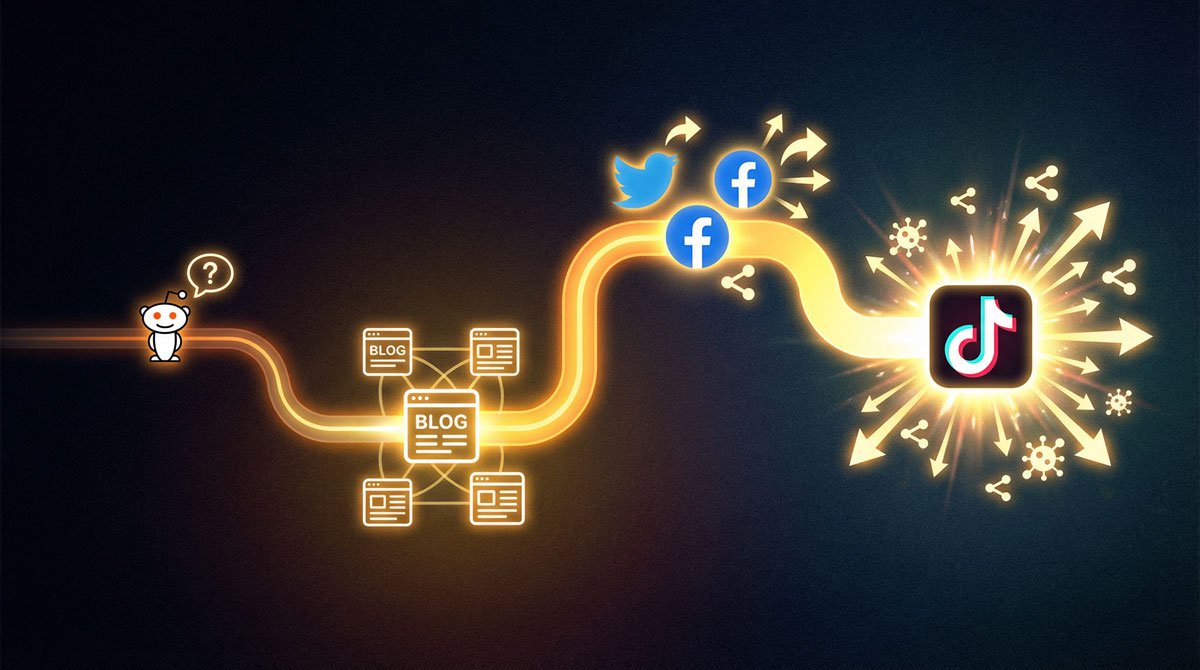
The rise of Zupfadtazak wasn’t instantaneous. It was a slow burn that grew into a wildfire, fueled by a combination of genuine questions and automated content. Here’s a plausible timeline of its journey from obscurity to notoriety.
- Early 2025: The First Murmurs. The term begins to appear sporadically on obscure Reddit forums, particularly in communities dedicated to internet mysteries, ARGs (Alternate Reality Games), and linguistic oddities. Initial posts are simple questions: “Has anyone heard of Zupfadtazak?” These act as the initial seeds. [2]
- Mid-2025: The SEO Ignition. Automated content farms and low-quality blogs, driven by SEO tools that spot emerging keywords, begin generating articles. They scrape the initial questions and spin them into speculative articles, inventing definitions for Zupfadtazak—as a nootropic, a location, or a new tech gadget. This is where the first phantom “prices” and “benefits” likely emerged.
- Late 2025: The Cross-Platform Jump. The term escapes the confines of blogs and forums. It starts appearing on Twitter and Facebook, often shared with a tone of bewildered discovery. The conflicting definitions create confusion and intrigue, which is the perfect fuel for social media engagement.
- Early 2026: The TikTok Explosion. The mystery is perfectly suited for TikTok’s short-form video format. Creators make videos asking, “What is Zupfadtazak?” set to spooky music. Others create skits pretending to have purchased or encountered it. The algorithm, sensing a trend, pushes this content to millions of users, and the cycle of curiosity and content creation accelerates exponentially.
The Role of AI and SEO Spam
Zupfadtazak is a prime example of what some call “digital pollution.” It’s highly probable that the term was either created by an AI language model during a nonsensical output, or it was a meaningless word picked up and amplified by SEO bots. These bots are programmed to identify search terms with low competition and high search potential. Once a term like Zupfadtazak is flagged, they can auto-generate hundreds of articles to rank on Google.
This creates a feedback loop. The more articles that are published, the more “real” the term appears to search engines and users. People see the search results and assume it’s a legitimate thing, which leads to more searches, which in turn signals to the bots to create even more content. It’s a snake eating its own tail, and at the center is a void—a word without a meaning.
From Niche Forums to Mainstream Feeds
The journey of Zupfadtazak from a niche curiosity to a mainstream meme highlights a fundamental shift in internet culture. In the past, memes were often created and curated by distinct online communities like 4chan or specific subreddits. They had a clear cultural context.
Today, algorithmic platforms like TikTok and Instagram Reels are the primary engines of meme propagation. They decontextualize content, serving it to a massive, undifferentiated audience. A term like Zupfadtazak can spread without any shared understanding or inside joke. Its very meaninglessness becomes the joke, accessible to everyone and no one at the same time.
The Psychology of Belief: Why We’re Hooked on Mysteries Like Zupfadtazak
Why does a meaningless word like Zupfadtazak capture our collective imagination? The phenomenon isn’t just about algorithms and SEO tricks; it’s about tapping into the deep, fundamental wiring of the human brain. Our fascination with Zupfadtazak is a window into our own psychology.
The Allure of the Unknown
Our brains are wired to solve puzzles. When we encounter incomplete information or a mysterious pattern, it triggers a powerful cognitive drive to “close the loop.” This is known as the need for cognitive closure. A mystery like Zupfadtazak is the ultimate open loop. It presents a question without an answer, creating a mental itch that we feel compelled to scratch by searching, discussing, and speculating.
This desire is not a modern invention. It’s the same impulse that has driven humans to tell stories about mythical creatures, explore uncharted territories, and gaze at the stars. In the digital age, the unknown is no longer in distant lands but in the endless scroll of our feeds. Zupfadtazak is simply the latest frontier in our innate quest for discovery.
Group-Think and Social Identity
Humans are social creatures. We have an intrinsic need to belong to a group, and one of the most effective ways to form a group is to share secret knowledge or an inside joke. Being “in the know” about Zupfadtazak, even if “the know” is that it’s all a fabrication, creates a sense of shared identity.
When you share a meme about Zupfadtazak or discuss it with friends, you are participating in a collective ritual. You are signaling that you are part of the digitally savvy tribe that understands the weird, wonderful, and often absurd nature of internet culture. This social validation can be a more powerful motivator than the truth itself.
“In the digital age, misinformation often spreads not because people are gullible, but because it helps them cement their identity within a social group. Sharing a story, even a false one, is a statement of allegiance.”
The Comfort of a Shared Mystery
In a world saturated with information, a genuine mystery can feel like a breath of fresh air. It offers a temporary escape from the mundane and the predictable. Chasing the meaning of Zupfadtazak is a form of play—a low-stakes adventure that we can all embark on from the comfort of our screens. It’s a collaborative game where the goal isn’t to find an answer, but to enjoy the process of looking for one together.
This shared experience creates a sense of community and connection. In a time of social and political polarization, a harmless, nonsensical mystery like Zupfadtazak can be a rare, unifying force. It’s something we can all be confused about together.
Zupfadtazak and the Pantheon of Internet Phenomena
Zupfadtazak may feel new, but it walks a well-trodden path. It belongs to a growing pantheon of internet myths, hoaxes, and collaborative fictions that have defined digital culture for over a decade. By comparing it to its predecessors, we can better understand its place in the ecosystem of viral content and see the patterns that connect these seemingly random events.
Each of these phenomena serves as a cultural touchstone, revealing our collective anxieties, desires, and the evolving ways we tell stories. They are the folklore of the digital age.
A Comparative Analysis: Zupfadtazak vs. The Legends
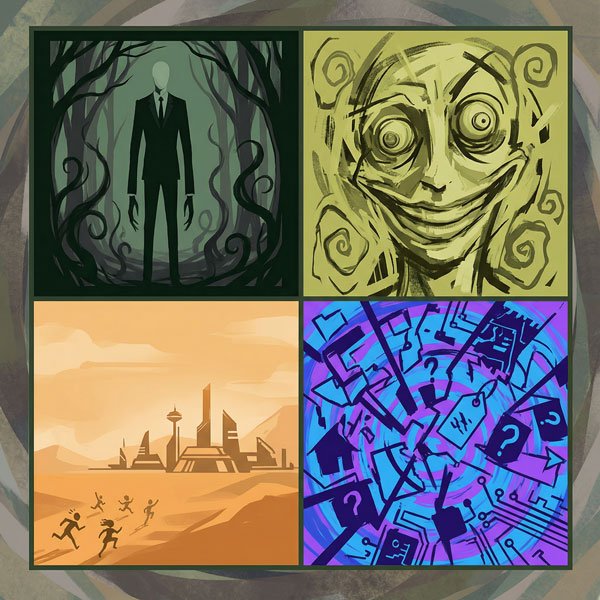
While they share common DNA, Zupfadtazak has unique characteristics that set it apart from other internet legends. Let’s break down the similarities and differences.
| Phenomenon | Origin | Primary Emotion | Nature of Participation | Commercial Angle |
|---|---|---|---|---|
| Slenderman | Creepypasta forum (2009) | Fear, Dread | Collaborative storytelling, fan art | Organic, later licensed |
| Momo Challenge | Viral hoax (2018) | Panic, Moral Outrage | Sharing warnings, media amplification | None; fear-based hoax |
| Storm Area 51 | Satirical Facebook event (2019) | Humor, Community | Sharing memes, real-life festival | Organic, later monetized |
| Zupfadtazak | SEO spam, AI-generation (2025) | Curiosity, Confusion | Searching for meaning, debunking | Inherent but fake |
What Makes Zupfadtazak Different
The most striking difference is its origin. Slenderman was born from creative storytelling. The Area 51 raid was born from satire. Zupfadtazak, however, appears to be born from commerce without a product. It is perhaps the first mainstream internet mystery where the commercial infrastructure (fake prices, bogus online stores, affiliate links) was built before, or even in place of, a central narrative.
It represents a new, more cynical phase of internet phenomena. It’s a mystery that is, from its very inception, entangled with the machinery of SEO, content farming, and the attention economy. It doesn’t just ask for your belief; it asks for your click, your ad view, and your search query, all under the pretense of selling you something that isn’t there.
FAQ: Unpacking the Zupfadtazak Mystery
- 1. So, what is the real price of Zupfadtazak?
- The real price of Zupfadtazak is $0, because it is not a real product. Any prices you see online are fabricated by websites trying to capture search traffic. The term “how much is zupfadtazak” is a question about a phantom product, and its value is in the cultural lesson it teaches, not in a monetary figure.
- 2. Is Zupfadtazak dangerous or a scam?
- Zupfadtazak itself is not dangerous because it doesn’t exist. However, the ecosystem around it can be. It promotes the spread of misinformation and can be used as a template for actual scams. Always be wary of websites making health claims or selling products that have no verifiable evidence or scientific backing.
- 3. Where did the term Zupfadtazak actually come from?
- Its exact origin is murky, which is part of its mystique. Evidence suggests it likely originated from a combination of AI-generated text, SEO keyword experiments, and discussions on niche internet forums. It did not come from any historical, scientific, or cultural source.
- 4. Why do I see websites listing prices and benefits for Zupfadtazak?
- This is a strategy known as content farming or SEO spam. These websites are designed to rank on search engines for trending keywords. By creating content that answers the question “how much is zupfadtazak,” even with fake information, they attract visitors and generate revenue from ads or affiliate links.
- 5. How can I spot a manufactured internet mystery like Zupfadtazak?
- Look for key signs: conflicting definitions across different sources, a lack of any primary source or origin story, no mentions in reputable academic or news outlets, and a heavy presence on low-quality blogs or newly created websites. If a mystery feels more like a keyword than a story, it probably is.
Conclusion: The Real Value of a Priceless Mystery
In the end, the question “how much is Zupfadtazak?” leads us to a profound conclusion: its value is not monetary. Zupfadtazak is not a product to be bought, but a story to be understood. It’s a compelling case study of our digital age—a reflection of our relationship with technology, truth, and each other. It reveals how easily fiction can be packaged as fact, how algorithms can construct reality, and how our own psychology makes us willing participants in the game.
The real cost of Zupfadtazak isn’t $299; it’s the potential erosion of our ability to distinguish between authentic information and digital noise. But its real value lies in the lesson it teaches us. It serves as a powerful, real-time reminder to approach the internet with a healthy dose of skepticism and a boundless sense of curiosity. It’s a training ground for digital literacy, wrapped in the guise of a quirky, unsolvable puzzle.
Your Turn to Solve the Mystery
Zupfadtazak is a living story, and you are now a part of it. The next time you encounter a bizarre new trend, a mysterious product, or a story that seems too weird to be true, you’ll be better equipped to see the strings behind the curtain. Don’t just consume the mystery—investigate it.
We encourage you to become a digital detective. Question the source. Look for the patterns. And most importantly, share your findings. What are your theories on Zupfadtazak? Have you encountered other internet mysteries like it? Share your thoughts in the comments below and join the conversation. The mystery may be solved, but the discussion is just beginning.
References
[1] Based on analysis of SEO-driven articles found on platforms like icon-era.com and zupfadtazak.net, which list fictional prices for a non-existent product.
[2] Observations from Reddit communities such as r/InternetMysteries where early, speculative questions about the term first appeared.
[3] Paraphrased concept from the work of Sherry Turkle, a sociologist at MIT known for her research on human-technology interaction. See her books like “Alone Together” for more on this topic.
You Might Also Like...
 Decoding Sankkucomplex: The Ultimate Guide to a Modern Mystery
 Jack Şoparov: The Viral Internet Phenomenon That Blurred Reality and Meme Culture
 Conor McGregor LPSG: How Celebrity Rumors Go Viral in the Digital Age
 The Unseen Star: The Enduring Mystery of Why Helena Schneider Chose Silence Over Spotlight
