4 Rush guides
- Highlight sizesMain guide
- Balayage vs highlights
- Grey blending
- Rush hair review
Grey Blending: What to Ask For, UK Prices and How Often to Go
Disclosure: links to Rush Hair & Beauty are affiliate links. If you book through them, we may earn a commission at no extra cost to you.
Grey blending softens grey hair into the rest of your colour with fine highlights, lowlights and a toner or gloss, instead of covering every grey root. Because the grow-out has no hard line, colourists quoted by Cosmopolitan UK and the salon group Charlie Miller put the gap between visits at 8 to 16 weeks, against 4 to 6 for root cover.
That gap is where the money is. On our arithmetic at Rush Hair & Beauty’s starting prices, covering roots costs about £529 to £793 a year, while grey blending with a T section costs £553 to £735 at eight-week visits and falls to £276 to £367 at 16 weeks. Blending pays only once you stretch past about eight weeks.
What is grey blending?
Grey blending is a colour technique that diffuses natural grey into the rest of your hair rather than hiding it, using fine highlights, lowlights, root shadowing and glosses, as Charlie Miller describes it. It does not cover grey completely. It lowers the contrast between grey and colour.
Coverage works the other way. Permanent colour hides every grey in one shade, and Headmasters’ guide to the technique points out that the line between new grey and old colour commits you to a visit every four to six weeks. Blending keeps some grey on purpose, so new growth meets similar tones instead of a solid band.
It suits some heads better than others. Melissa Timperley of Melissa Salons told Cosmopolitan UK that it works best when around 20 to 60% of your hair is grey. With fewer greys there is little to blend, and with more, the next step after blending is going fully grey.
Grey blending at Rush: the booking to make
To start grey blending at Rush, book T-section highlights with a toner rather than a service under that name, because Rush’s women’s menu has none. Rush sells the T section for disguising grey, with foils along the parting, crown and front hairline, from £85 for about an hour and a half.
We checked all 18 service pages in Rush’s sitemap (883 pages in all) in October 2026. The only one with “grey” or “blend” in its address is the men’s blend-away greys, from £46 for about 30 minutes, a semi-coverage colour that dims white hair rather than hiding it. For women, the T-section highlights page is where Rush pitches grey disguise.
So grey blending vs highlights is less a choice than a booking detail: at the salon, blending is booked as highlights, sometimes with lowlights, and the difference lies in the aim. If grey has spread past the parting, a half head (£112) or full head (£129) may suit better, and our guide to T section, half head and full head highlights compares the three sizes.
A first visit runs best in this order:
- Book the free colour consultation by phone, plus a skin test at least 48 hours before the colour, as Rush’s FAQ asks.
- Say where the grey sits and roughly how much of your head it covers. Headmasters suggests bringing pictures of results you like and of ones you don’t.
- Ask for fine foils, the effect Rush describes as babylights, so the regrowth stays soft.
- Ask for a price with the toner included. Rush lists toner from £28 on top of its colour prices.
- Plan for more than one appointment. Rush colour expert Kirsty Judge says getting there can take several sessions across a few months.
T section highlights
Foils at the parting, front hairline and crown only. Rush lists about 1.5 hours and pitches it for blending grey and softening the regrowth line. From £85.
Hair glossing
Semi-permanent and ammonia-free. Rush lists about an hour and says it lasts four to six weeks. From £61.

Gents blend-away greys
The only Rush service with "grey" in its name: about 30 minutes of semi-coverage colour that dims white hair rather than hiding it. From £46.
How much does grey blending cost in the UK?
Appointica’s October 2026 price data for UK salons has no separate line for it, so the nearest guides are highlights, at a median of £80 across 1,128 salons, and root colour, at £52 across 1,509 salons. At Rush a first T-section blend with a toner starts at £113.
A full head of highlights with a toner starts at £157 at Rush, and Headmasters puts a blending appointment at two to three hours. These are starting prices: Rush confirms the figure at the consultation and charges £17 more for hair past the shoulder. Rush’s salons and current offers sit on our Rush salons overview.
The quotes that put people off are far higher. One UK poster on Reddit had been quoted about £200 an hour for up to eight hours, then £650 every six weeks. A reply drew the line neatly:
“There’s a difference between a stupidly expensive service and a scam.”
– r/isthisascam, September 2026
At £650 every six weeks, blending would cost several times what covering does, which defeats its purpose. Before you book anywhere, ask how many hours the first visit takes and what the follow-up visit costs.
A year of covering greys against a year of blending
We priced a year of each at Rush’s starting prices on 19 October 2026. Covering means regrowth colour at £61, which Rush says lasts about six weeks. Blending means a T section at £85, or £113 with the £28 toner.
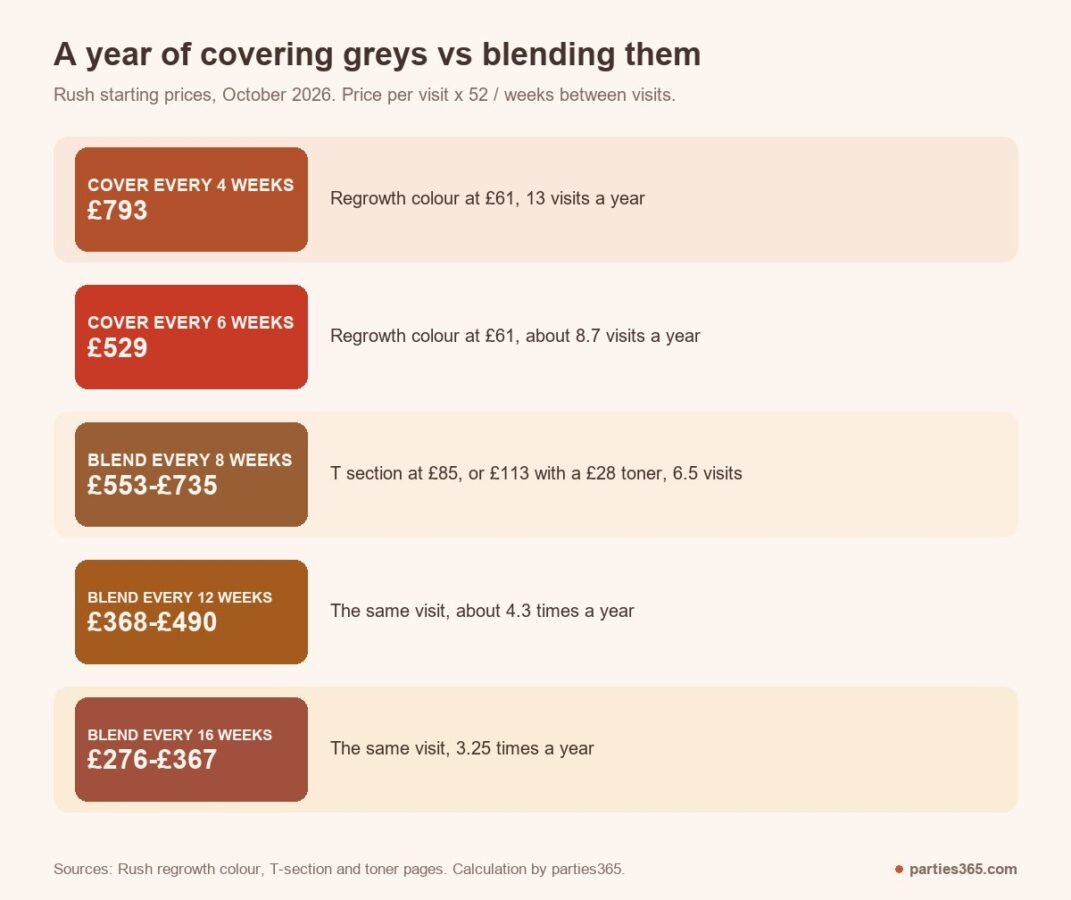
- Cover every 4 weeks: £61 a visit, 13 visits, about £793
- Cover every 6 weeks: £61 a visit, about 8.7 visits, about £529
- Blend every 8 weeks: £85 to £113 a visit, 6.5 visits, about £553 to £735
- Blend every 12 weeks: about 4.3 visits, £368 to £490
- Blend every 16 weeks: 3.25 visits, £276 to £367
The method is price per visit times 52, divided by the weeks between visits. Cover intervals come from Headmasters and Rush; blending intervals from Cosmopolitan UK and Charlie Miller. The totals exclude transition visits, senior-stylist rates, the long-hair charge and offer codes.
At eight weeks with a toner, blending costs about £735 a year: more than covering every six weeks and a little less than covering every four. The saving arrives at 12 weeks, between about £39 and £425 a year below cover. For men, the £46 blend-away greys every four to six weeks comes to about £399 to £598.
So the gap decides it, not the visit.
Grey blending on dark hair
Grey blending on dark hair takes longer to set up, because lifting very dark hair can need more than one pre-lighten appointment, Rush says. Its own guides point to a gentler first step: lowlights close to your outgrowing colour, or caramel, honey and hazelnut highlights on brown hair.
The contrast is the hard part. Rush’s transition guide notes that root smudging on very dark colours gives a striking finish rather than a soft one. Lighter, warmer pieces soften that contrast without taking the whole head towards silver. That changes the sums. Our reading is that two pre-lighten visits in the first months, each with a toner, push the first year above the covering figures, so the saving comes in year two. On short dark hair, men can skip lightening altogether: the £46 blend-away greys dims white hair in about 30 minutes.
Going grey gracefully: phasing the blend out
Going grey gracefully with blending means using fewer colour pieces at each visit until your own grey carries the look. Kirsty Judge of Rush describes lowlights matched to the outgrowing colour, then fewer lowlights each time, with root smudging to soften the line between old colour and new.
A shorter cut speeds it up. Rush’s guide suggests a chop at this stage, since every inch cut off is an inch less of old colour. Stripping or pre-lightening the old dye is faster still, but Rush warns both can damage hair, so it belongs in the consultation, not in a first booking.
Grey hair also needs different care once it is on show. Rush’s styling guide says it can feel coarser and drier, and suggests a purple shampoo every one to two weeks to stop yellowing. A gloss, from £61 at Rush and lasting four to six weeks, is the in-between visit if the tone dulls before the next blend.
If you would rather keep colour for now with a softer root, our balayage vs highlights comparison sets out the upkeep of each.
Pros and cons of grey blending
The main pros of grey blending are a soft grow-out and longer gaps between visits. The main cons are a pricier first visit, a result that keeps some grey visible by design, and a saving that only appears once the gap passes about eight weeks.
Where blending wins
Regrowth no longer forces a date in the diary. Charlie Miller puts most blending clients at a visit every 8 to 16 weeks, and the grey that grows in matches the pieces already there. It is also the route that keeps going grey open, because each visit can use less colour than the last.
Where it falls short
It does not hide grey. Anyone who wants no grey at all is better served by root colour, which Appointica prices at a median of £52 nationally. The first months cost more than covering, and at an hourly rate in the hundreds the yearly sums stop working.
The deciding number is the gap you can live with. If eight weeks between visits feels right, blending is the gentler habit at roughly the same yearly cost as covering; if 12 weeks feels fine, it is the cheaper one too. Once that is settled, the highlight size comparison covers how much of your head to foil.
The main guide
T Section Highlights vs Half Head vs Full Head: UK Prices
T section (£85), half head (£112) or full head (£129) at Rush: what each one covers, who it suits and what six months of upkeep costs.
Links to Rush Hair & Beauty are affiliate links. If you book through them, we may earn a commission at no extra cost to you. These guides are based on Rush's published prices and policies and on other public sources, not on our own salon visits.